Environmental Science Final Exam 2021 February
SECTION – A
1. What is the meaning of 3 R’s in waste management? [1]
Ans: The three Rs strategy of waste management involves reduce, reuse and recycle.
2. What are slums? [1]
Ans: Slums are clusters of huts or homes in parts of cities.
3. Name the earliest human ancestor. [1]
Ans: Australopithecines
4. Define Eutrophication. [1]
Ans: The discharge of domestic wastewater, agricultural return water, or run-off water and many industrial effluents contribute nutrients like phosphates and nitrates. These nutrients promote excess growth of algae in water bodies (algal blooms). This is called eutrophication.
5. Expand E.I.A. and state its main objective. [2]
Ans: Environmental Impact Assessment (EIA). It is a tool for preventing the adverse environmental impact of developmental activities,
6. Name and define any two modes of transmission of diseases by pathogens, giving suitable examples. [2]
Ans: Contact transmission and vector transmission.
7. What is Commensalism? Briefly explain it with a suitable example. [2]
Ans: Commensalism is the relationship in which one of the species benefits while the other is
neither harmed nor benefited. Some species obtain the benefit of shelter or transport from another species. For example, a sucker fish, remora, often attaches to a shark by means of its sucker, which is present on the top side of its head.
8. Name any two National Parks/Sanctuaries of India and also mention the name of the important animal species found there. [2]
Ans:
- Jim Corbett Tiger Reserve- Uttaranchal: –Tigers, barking deer, wild bear, rhesus monkey.
- Kanha National Park, Madhya Pradesh: Tiger, leopards, wild dogs
9. a) List any two consequences of Deforestation.
b) Name a medicinal plant from which quinine is extracted to treat malaria? [2]
Ans:
(a) Soil erosion, landslides, silting, loss of habitat.
(b) Cinchona tree
10. Mention the main objectives of the following : [2]
a) Ramsar Convention.
b) Montreal Protocol.
Ans:
- a) Ramsar Convention: The convention provides the framework for international cooperation for the conservation and wise use of wetland habitats.
- b) Montreal Protocol: Through this convention, nations committed themselves to protecting the ozone layer and to cooperate in scientific research to improve understanding of the atmospheric processes and the serious consequences of ozone depletion.
11. List any four immediate strategies to cope with green house effect? [2]
Ans: The following steps would be useful in reducing the emission/release of greenhouse gases into the atmosphere:
- Increased fuel efficiency of power plants and vehicles;
- Development/implementation of solar energy/non-fossil fuel alternatives;
- Halting deforestation;
- Supporting and undertaking tree-planting (afforestation);
- Reduce air-pollution.(see
12. What is the difference between ‘one-star’ and ‘five-star’ refrigerators? [2]
Ans: The 5-star refrigerator is significantly more energy efficient and consumes much less electricity than the 1-star refrigerator, which leads to lower electricity bills over time.
13. What may happen to [4]
a) The cells of the body are exposed to radiation dose of around 10 rem.
b) Lungs of coal miners working in coal mines for several years.
c) Drinking arsenic contaminated water for several years.
d) Marine life in case of an oil-spill in the sea.
Ans:
- a) The cells might not be able to repair the damage, and the cells may either be changed permanently or die. Cells changed permanently may go on to produce abnormal cells when they divide and may become cancerous.
- b) They develop Black lung disease, a common name for pneumoconiosis (CWP) or anthracosis, a lung disease of older workers in the coal industry, caused by inhalation over many years of small amounts of coal dust.
- c) If a person drinks water contaminated with arsenic for about 10 years, dark spots develop on the upper chest, back, and arms, known as melanosis. The next stage is keratosis, in which palms become hard, and the patient may suffer from diarrhoea, stomach pain, breathing problems, etc.
- d) Within hours of an oil spill, the fish, shellfish, and plankton die due to suffocation and metabolic disorders. Within a day of an oil spill, birds and sea mammals die. The death of these organisms severely damages marine ecosystems. Oil spills also either poison or suffocate algal blooms. This, in turn, makes the water body deficient in oxygen. Water deficient in oxygen, in turn, is responsible for the deaths of an enormous number of fish/marine life.
14. a) Expand the following : [4]
- i) MNRE
- ii) IREDA
b) Briefly explain biological control of Pests with a suitable example.
Ans:
(a)
- Ministry of New and Renewable Energy (MNRE)
- Indian Renewable Energy Development Agency (IREDA)
(b) Biological control of pests is an ecologically sound alternative to chemical pest control. The biological control agents of pests do not enter the food chain or poison animals and so are not likely to harm mankind.
The cottony cushion scale pest (Icerya purcahsi) is controlled biologically on a large scale by its predator, the ladybird beetle. At present, some 15,000 naturally occurring micro-organisms or microbial byproducts have been identified as potentially useful biological pesticides.
15. List any two factors which contributed to the enormous rise in human population and also mention any four ways by which this population growth has had an impact on the environment? [4]
Ans:
- Improved agricultural practices have helped in increasing food production, hence food become available.
- Progress in medicine prevented deaths due to injury and epidemic diseases.
Impact of population growth on the environment
- Clearing land for cultivation to grow more food depleted natural resources
- Water scarcity due to increased withdrawal of water more than beyond the rate of replenishment of groundwater.
- The need for human settlements increased the quarrying of stones and other building materials, with increased water usage.
- Slum development causes a lack of basic amenities like drinking water, drainage, waste disposal, a lack of hygienic conditions and a filthy environment.
16. a) Environmentalists are worried about climate change. Which international body is entrusted with the task of suggesting and ensuring means and ways of tackling this problem? State the objectives of this organisation.
b) What is the role of Sulabh International in promoting environmental sanitation and removing social stigma in India? [4]
Ans:
- (a) UN Framework Convention on Climate Change (UNFCCC). The main aim of the convention is to consider what can be done to reduce ‘global warming’ and to cope with whatever temperature increases are inevitable.
- (b) Sulabh International is a social service organization which works to promote human rights, environmental sanitation, non-conventional sources of energy, waste management and social reforms through education. It has played a defining role in changing the mindset of the people of India towards sanitation. It has played an important role in preventing the practice of defecation in the open and has motivated people to use toilets and follow sanitation practices.
17. a) What is an Ecotone, and give two examples?
b) Give two examples of human-modified ecosystems. [4]
Ans:
(a) Ecotone is a zone of junction between two or more diverse ecosystems, e.g. the mangrove forests. They represent an ecotone between marine and terrestrial ecosystems. Some more examples of ecotone are – grassland, estuary and river bank.
(b) Some examples of human-modified ecosystems are:
- (1) Agro-ecosystems
- (2) Plantation forests
- (3) Urban ecosystems
- (4) Rural ecosystems
18. a) Name any two common diseases that may reach epidemic proportions.
b) How are the above-mentioned diseases transmitted and give the main characteristic symptom of each of the diseases? [4]
Ans: (a) Dengue, HIV and AIDS, Mad Cow disease.
(b)
- Dengue is caused by a virus transmitted through a mosquito called Aedes aegypti or Asian tiger mosquito.
- This disease is caused by a virus, called HIV (Human Immunodeficiency Virus), which is mostly transmitted through sexual contact and blood transmission.
- Bovine spongiform encephalopathy (BSE or mad cow disease) in cattle is caused by an infectious agent that has a long incubation period, between two and five years.
19. a) Depending on the nature of water in which fish is reared, name the type of fisheries and name any two fish reared in each type?
b) Give an example :
i) Indian poultry bird.
ii) Exotic poultry bird.
c) What is Apiculture and list any two of its benefits? [6]
Ans: (a)
- Marine fisheries: Sea bass, Cobia
- Freshwater fisheries: ROhua and Catla.
(b)
- i) Indian poultry bird: Aseel, Chittagong, Busra.
- ii) Exotic poultry birds: Leghorn, Rhode Island Red, Cornish.
(c) bee. Apiculture or bee-keeping is the art of caring for and controlling colonies of honey bees in large quantities for the commercial production of honey. There are three major advantages of beekeeping:
- (i) provides honey, a valuable food
- (ii) provides beeswax, which has many uses in industry
- (iii) Honey bees are excellent pollinating agents, which increase agricultural yields.
20. a) List any four parameters that characterize the standard of living of a population.
b) How does the improper sewage system in the cities affect the quality of water?
c) What are Phytosanitary products? How are they harmful? [6]
Ans:
(a) A population is also characterised by certain parameters, such as:
- life expectancy (should be high)
- infant mortality rate (should be low)
- income per head (should be high)
- literacy (the maximum number of literate individuals)
(b) Improper sewage disposal, dumping of farm yard manures and agricultural chemicals, and industrial effluents are causing pollution of groundwater.
(c) Phyto-sanitary products are insecticides, pesticides, fungicides, herbicides, etc. They enter the soil as run off and pollute the water table, affecting aquatic life. They are carcinogenic and cause renal failure.
21. a) Draw and label a terrestrial food chain showing four trophic levels.
b) Explain Lindman’s 10% law: If the 1st trophic level in the above food chain you have drawn receives 10,000 k. cal. of energy how much energy will the members of the 4th trophic level receive?
c) Define a food-web? [6]
Ans:
(a) Terrestrial food chain
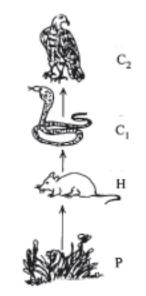
(b) According to the 10% rule related to ecological efficiency, and states that the amount of energy
transferred at each tropic level is only 10% of the energy of the previous tropic level. Therefore,
- If the first trophic level receives 10,000 k. Cal. of energy, the second trophic level requires only 1000 kcal.
- The third trophic level receives just 100 kcal.
- Thus, the fourth trophic level will receive only 10 kcal.
(c) A food web is a network of interconnected food chains existing in an ecosystem. One animal may be a member of several different food chains.
22. a) Give two reasons as to why are agrochemicals applied to the soil?
b) State any four adverse effects of continuous application of biocides. [6]
Ans:
(a) Agrochemicals are applied to the soil for two main reasons, namely to:
- (i) replenish or replace soil nutrients by using chemical fertilisers.
- (ii) destroy plant pests by using toxic chemicals called pesticides.
(b) Continued application of biocides causes various problems, which are as follows:
- 1. They contaminate food materials and drinking water.
- 2. They disrupt the balance of the natural ecosystem by killing non-target, often useful organisms.
- 3. The continuous use of biocides results in a gradual increase in the immunity of the pest to these chemicals. The biocides, after a period of time, become ineffective against the pest, leading to excessive multiplication of the pests.
- 4. Most of these chemicals are persistent and not biodegradable, and so they persist in the plant or animal body once they enter the food chain. Their concentration in the organisms multiplies progressively through the food chain due to biological magnification.
SECTION – B
OPTION – I (Water Resource Management)
23. Name any two sources of fresh water. [1]
Ans: Fresh water is found in lakes, rivers, streams, ponds and in the ground.
24. Define Grey water giving suitable examples. [1]
Ans: Grey water is defined as untreated household wastewater, which has not come into contact with toilet waste. It can originate from the shower, bath, bathroom, washing basin, clothes washing machine and laundry trough.
25. Name any two contaminants of groundwater. [2]
Ans: Nitrates and phosphates.
26. List any four ways for improving the efficiency of water use at the household level. [2]
Ans:
- Reduce wastage-leaking pipes mean that a lot of water never reaches the people.
- Closing of taps while not in use.
- Better irrigation techniques – irrigation systems waste up to 70% water used. In drip irrigation, water loss is significantly less.
- Use low-flush toilets, reducing the amount of water used each time the lavatory is flushed.
27. a) Name the two main techniques of rainwater harvesting. Which one of these techniques is the new concept of rainwater harvesting, and name the four structures generally used in the process?
b) List any four benefits of rainwater harvesting.
c) Mention any one ancient method of water harvesting in India. [6]
Ans:
- (a) There are two main techniques of rainwater harvesting:
- 1. Storage of rainwater on the surface for future use
- 2. Recharge to groundwater
- The storage of rainwater on the surface is a traditional technique, and structures used were tanks, ponds, check dams, weirs, etc. Recharge to groundwater is a new concept of rainwater harvesting, and the structures generally used are: pits, aquifers, trenches, dug wells, etc.
- (b) Some of the benefits of rainwater harvesting are as follows:
- Increases water availability;
- Check the declining water table.
- It is environmentally friendly;
- Improves the quality of groundwater through the dilution of fluoride, nitrate, and salinity;
- Prevents soil erosion and flooding, especially in urban areas.
- (c) Ancient method of rainwater harvesting
- One of the oldest water harvesting systems is found about 130 km from Pune along Naneghat in the Western Ghats. A large number of tanks were cut in the rocks to provide drinking water to tradesmen who used to travel along this ancient trade route. Each fort in the area had its own water harvesting and storage system in the form of rock cut cisterns, ponds, tanks and wells that are still in use today.
OPTION-II (Energy and Environment)
23. Name any two renewable sources of energy. [1]
Ans: Solar energy, biomass, hydropower, wind energy, wave energy, geothermal energy, etc.
24. What is the significance of dams in the production of hydroelectricity? [1]
Ans: Water released from the dam reservoir flows through a turbine, spinning it, which in turn activates a generator to produce electricity. The water stored at a higher elevation is a source of potential energy. It is converted to kinetic energy in the turbines and then to electrical energy.
25. What are petro crops? Name any two such plants? [2]
Ans: Plants that produce hydrocarbons, which are used as alternative energy sources, are called petro crops. Eg., Jatropa curcas and Calotropis gigantea.
26. a) List the main advantages of natural gas as a domestic fuel.
b) Expand CNG. Give its one significance. [2]
Ans:
- (a) Natural gas is a relatively clean fuel that burns readily to produce a large amount of heat, which is why natural gas is used as the main fuel for domestic purposes.
- (b) Compressed Natural Gas (CNG). CNG is a good alternative to petrol and diesel because it causes less pollution.
27. a) What is an Ecohouse? Name the technologies used during its construction.
b) Expand CFL and give its significance.
Ans:
(a) Ecohouse is a residential building and was constructed in the mid-seventies. It was equipped with a solar cooker and a multifeed biogas plant. The following technologies were used in this house-
- Rainwater harvesting with an underground cistern.
- Roof-integrated solar water heater.
- Window-mounted retractable solar cooker.
- Multifeed biogas plant, usable as a septic tank, if required.
- Three different types of experimental roofs (hollow concrete tiles, Prefab brick jack arches, Madras terrace roof).
- Design for Ventura (ventilation via inner courtyard).
(b) Compact Fluorescent Lamps (CFL). CFL lamps are used because they are comparatively less electricity-intensive and last longer.
– o O o –
Additional Study Materials
- NIOS Environmental Science Question Paper April 2025
- NIOS Class 12 Environmental Science Question Paper 2024 Oct
- Environmental Science NIOS Question Paper April 2024
- NIOS Class 12 Environmental Science Question Paper 2023 ASS
- NIOS Class 12 Environmental Science PYQ With Answers 2023
- NIOS Class 12 Environmental Science Question Paper 2022 Oct
- NIOS Class 12 Environmental Science Paper 2022 April