NIOS Class 12 Environmental Science Question Paper 2022 Oct
SECTION – A
1. What is the role of blue-green algae in agriculture? 1
Ans: Blue green algae (BGA or cyanobacteria) like Nostoc and Anabaena are free-living phototrophic organisms also capable of fixing atmospheric nitrogen. In the flooded rice fields, blue-green algae serve as a nitrogen biofertilizer.
2. Name the drug extracted from the Cinchona tree, and also mention the disease it treats. 1
Ans: Quinine is used to treat malaria.
3. Write the full form of DDT. 1
Ans: Dichloro-Diphenyl-Trichloroethane
4. Name any two draught animals. 1
Ans: Horses, bullocks, elephants, oxen, camels, donkeys, or yaks.
5. Define the following terms: 2
(i) Adaptation
(ii) Species
Ans:
- (i) An adaptation is “the appearance or behaviour or structure or mode of life of an organism that allows it to survive in a particular environment”.
- (ii) A species is defined as “a group of similar populations of organisms whose members are capable of interbreeding and producing fertile offspring (children)”.
6. Why are plastic bags a big environmental nuisance? Explain. 2
Ans: Plastic bags made from low-density polyethene (LDPE) are virtually indestructible and create colossal environmental hazards. The discarded bags block drains and sewage systems. bags. Plastic is non-biodegradable, and burning of plastic in garbage dumps releases highly toxic and poisonous gases like carbon monoxide, carbon dioxide, phosgene, dioxin, and other poisonous chlorinated compounds.
7. What is the impact of rapid industrialization on nature and our environment? 2
Ans: Rapid industrialisation has also led to pollution from the dumping of industrial effluents into rivers and other water bodies. Rapid industrialisation has caused much damage to the environment. Mining activities have depleted the stock of mineral resources, particularly fossil fuels.
8. What is the full form of WHO, and what is its main objective? 2
Ans: WHO – World Health Organization. WHO aims to eradicate polio within the next few years. In addition to its work in eradicating disease. WHO is devoting increasing attention to various health-environment-related issues. For example, campaigns to boost the consumption of fruits and vegetables worldwide and to discourage tobacco use.
9. Differentiate between Endangered species and Extinct species, giving one example of each.
Ans:
- Endangered species: A species is considered endangered when its numbers are few and its homeland is very small, or both, and if special protection is not given, it may become extinct. For example, the lion –tailed monkey from rainforests and Sholas of South India.
- The extinct species only exist in museums and photographs. The most noted example of an extinct species is the passenger pigeon.
10. (a) Name the substance which causes Minamata disease. 2
(b) Define Eutrophication.
Ans:
- (a) Mercury
- (b) The discharge of domestic wastewater, agricultural return water or run-off water and many industrial effluents contribute nutrients like phosphates and nitrates. These nutrients promote excess growth of algae in water bodies (algal blooms). This is called eutrophication.
11. Write the causative organism and mode of spread for the following diseases: 2
(a) a Protozoal disease
(b) a Viral disease
Ans:
- (a) A protozoal disease: Entamoeba histolytica – Ingestion of cysts in food and water
- (b) a Viral disease: Hepatitis virus – Food and water contaminated with virus in stools
12. (a) What is the main objective of the following legislations? 2
(i) UNFCCC
(ii) Ramsar Convention
(b) What type of work does Sulabh International undertake?
Ans:
- (a)
- (i) UNFCCC: The UNFCCC commits signatory countries to limit anthropogenic (i.e., human-induced) greenhouse gas emissions to levels that would prevent dangerous anthropogenic interference with the climate system.
- (ii) Ramsar Convention: The convention provides the framework for international cooperation for the conservation and wise use of wetland habitats.
- (b) Sulabh International is a social service organization which works to promote human rights, environmental sanitation, non-conventional sources of energy, waste management and social reforms through education.
13. (a) What are Exotic species? What effect do they have on the local species? Give a suitable example.
(b) Which two criteria are used for determining a hot spot? Name the two hot spots in India. 4
Ans:
- (a) The non-native species introduced into an area is called an exotic species. New species entering a geographical region or exotic species may cause the disappearance of native species through changed biotic interactions.
- (b) Hot spots are the regions which show maximum biodiversity, richness of species and endemic forms. These ecosystems are threatened due to human interference. Western Ghats and Eastern Himalayas are two hotspots of India.
14. (a) Draw a neat and labelled diagram of an aquatic food chain comprising of four trophic levels.
(b) Why is the number of steps in a food chain limited to 4 or 5? 4
Ans:
(a) Aquatic food chain
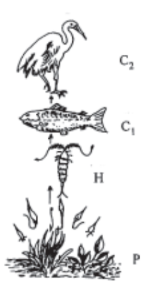
(b) During this process of transfer of energy, some energy is lost into the system as heat energy and is not available to the next trophic level. Therefore, the number of steps is limited in a chain to 4 or 5.
15. Write any four difficult situations encountered by the rural population due to their migration towards the cities. 4
Ans:
- (i) Lack of greenery and of open spaces.
- (ii) Poor air quality. Villages are largely pollution-free, while in urban areas, air is polluted due to industries, automobiles, thermal power plants, etc.
- (iii) Scarcity of water and acute shortage lead to the growth of cheap lead to slums.
- (iv) Lack of sanitation and hygiene.
- (v) Overcrowding also causes several social problems.
16. (a) You want to set up a Crude Oil company. You are supposed to get EIA approval. What is EIA approval, and why is it necessary?
(b) Write any four activities which could be included in the school curriculum to inculcate Environmental ethics in children. 4
Ans:
- (a) EIA is a tool which helps to evaluate the environmental impact of proposed developmental projects or programs, are visualized as clearance accorded after mitigation strategies are included in the plan. Environmental clearance of developmental projects is mandatory for the new project.
- (b) In the school curriculum, activities such as (i) growing plants and taking care of them, (ii) visits to national parks and sanctuaries, (iii) creating stories/ poems/ plays on nature conservation, should be included. Tree plantations for ‘greening schools’ and their neighbourhood, weeding lawns, making attractive posters and messages related to the environment should become competitive events every year for various classes.
17. (a) List any four remedial strategies for prevention of Soil erosion.
(b) What is meant by Monoculture? Write any two ways by which monoculture can lead to Soil erosion. 4
Ans:
(a)
- 1. It is essential to retain vegetation cover so that the soil is not exposed to rain. Vegetation cover is important because the roots of plants hold soil particles together. Plants intercept rainfall and protect the soil from the direct impact of raindrops.
- 2. Cattle grazing should be controlled.
- 3. Crop rotation and keeping the land fallow (not planting anything in the soil for some time) should be adopted.
- 4. Vegetation and soil management should be improved to increase soil organic matter.
(b) Monoculture refers to the practice of planting the same variety of crop in the field. Monoculture practices can lead to soil erosion in three ways.
- (i) A monoculture crop is harvested all at one time, which leaves the entire field bare, exposing it to both water and wind.
- (ii) Without vegetation, natural rainfall is not retained by the soil and flows rapidly over the surface rather than into the ground. It also carries away the topsoil, which results in soil erosion and degradation.
- (iii) In the event any disease or pest invades the field, the entire crop is usually wiped out, leaving the bare soil susceptible to water and wind.
18. (a) A group of students is travelling to Jaipur from Delhi by train. Suggest any four precautionary measures to ensure a safe journey.
(b) List any four parameters that characterize the standard of living in a population. 4
Ans:
- (a) Some of the common safety measures are:-
- Do not stop the train on a bridge or tunnel where evacuation is not possible.
- Do not carry inflammable material in a train.
- Do not lean out of a moving train.
- Do not smoke on the train.
- Do not pull the emergency cord unnecessarily.
- (b) A population is also characterised by certain parameters, such as:
- Life expectancy (should be high)
- Infant mortality rate (should be low)
- Income per head (should be high)
- Literacy (the maximum number of literate individuals)
19. (a) Name the biological techniques involved in the following :
- (i) The red spider mite on the cucumber plant can be controlled by using a predatory mite, which specifically feeds on the red spider mite.
- (ii) Microbial method of conversion of organic waste into manure.
(b) How was “Sharbati sonora” produced by Dr. M.S. Swaminathan on the onset of Green Revolution?
(c) Durga went to her village in Karnataka and found that the Indian Poultry birds were better than the common Exotic birds. Give any two characteristic features of the Indian Poultry bird to support your answer. Also, name a common Indian poultry bird. 6
Ans:
- (a)
- Pest on the cucumber plant, called red spider mite, is controlled by using a predatory mite that feeds on red spider mite.
- Organic fertilizer is produced from plants and animal waste matter through biological degradation by microorganisms. This is known as manure or compost and is produced from cattle dung and other animal wastes or from fallen leaves, twigs and other vegetable wastes by biodegradation by microorganisms.
- (b) Dr. M.S. Swaminathan produced ‘Sharbati Sonara’ in a mutation breeding programme by subjecting Sonara 64 to gamma and ultraviolet radiations. ‘Sharbati Sonara’ had bold, amber, and lustrous grains and was found to contain 15-25% more protein than the parent Sonara 64.
- (c) Indian poultry birds provide good quality meat but produce small-sized eggs. They have natural immunity against common diseases as compared to exotic varieties bred abroad. Common Indian breeds are Aseel, Chittagong, and Busra.
20. (a) List four principal causes which promote desertification. 6
(b) State one anthropogenic cause of Ozone layer depletion. Also, give its effect on human beings. State the measures taken to prevent the Ozone layer depletion.
(c) What is Acid rain? State the effect of acid rain on the following :
- (i) aquatic life
- (ii) buildings and monuments
Ans:
- (a) Causes of desertification
- (i) Uncontrolled and overexploitation of grazing land, indiscriminate cutting of trees and forest resources leading to drought, soil erosion, and deterioration of soil fertility, which results in stunted plant growth.
- (ii) Excessive mining in arid and semi-arid regions for the extraction of minerals, coal or limestone, resulting in the loss of trees and green cover, and leading to the destruction of conditions conducive to vegetation growing.
- (iii) Uneconomic land use for agriculture by cultivation on marginal lands affecting adjacent fertile lands and causing soil erosion.
- (iv) Intensive and uneconomic exploitation of water resources leading to a fall in the water table, seepage and problems of excessive salinisation of soil.
- (b) Any event which releases chlorine atoms into the atmosphere can cause severe ozone destruction, because chlorine atoms in the stratosphere can destroy ozone very efficiently.
- Harmful effects on human beings
- Increase susceptibility to skin cancer
- Increase cataract
- Damage DNA
- Damage cornea
- Preventive measures
- Preventive measures
- A complete ban on the use of CFCs and other ozone-destroying chemicals
- Use of HCFCs (Hydrochloric fluorocarbons) as a substitute for CFCs is being recommended temporarily because HCFCs are relatively less damaging to the ozone layer as compared to CFCs, but they are not completely ozone safe.
- Harmful effects on human beings
- (c) Acid rain refers to any precipitation (rain, fog, mist, snow) that is more acidic than normal.
- Acid rain kills their gametes, affecting the life cycles and productivity.
- Limestone and marble are destroyed by acid rain. Smoke and soot cover such objects. They slowly dissolve/flake away the surfaces because of acid fumes in the air.
21. (a) Mention the major steps in the nitrogen cycle. Explain briefly each of its role. 6
(b) Why is nitrogen essential for all living organisms?
Ans:
(a) There are five main processes which essential for the nitrogen cycle are elaborated below.
- (i) Nitrogen fixation: This process involves the conversion of gaseous nitrogen into Ammonia, a form in which it can be used by plants. Atmospheric nitrogen can be fixed by the following three methods:-
- (i) Atmospheric fixation through lightning, combustion and volcanic activity
- (ii) Industrial fixation: At high temperature (400 °C) and high pressure (200 atm.), molecular nitrogen is broken into atomic nitrogen, which then combines with hydrogen to form ammonia.
- (iii) Bacterial fixation with the help of symbiotic bacteria (Rhizobium) in the root nodules of leguminous plants or freeliving or symbiotic bacteria
- (ii) Nitrification: It is a process by which ammonia is converted into nitrates or nitrites by Nitrosomonas and Nitrococcus bacteria, respectively. Another soil bacterium, Nitrobacter, can convert nitrate into nitrite.
- (iii) Assimilation: In this process, nitrogen fixed by plants is converted into organic molecules such as proteins, DNA, RNA, etc. These molecules make up the plant and animal tissue.
- (iv) Ammonification: Living organisms produce nitrogenous waste products such as urea and uric acid. These waste products, as well as dead remains of organisms, are converted back into inorganic ammonia by the bacteria. This process is called ammonification. Ammonifying bacteria help in this process.
- (v) Denitrification: Conversion of nitrates back into gaseous nitrogen is called denitrification. Denitrifying bacteria live deep in soil near the water table, as they like to live in an oxygen-free medium. Denitrification is the reverse of nitrogen fixation.
(b) Nitrogen is an essential component of protein and is required by all living organisms, including human beings.
22. Suggest any four steps you will take as a responsible citizen to improve energy efficiency in
each of the following places: 6
(a) at home
(b) at work place
(c) in the transport sector
Ans:
- (a) At home
- Use fuel-efficient hearths (chulhas) for cooking. Do not use smoking stoves.
- Cut only dry branches of trees for burning.
- Use the gas at a simmer level. It saves cooking gas and makes the cooked item healthier and tastier.
- Use solar cookers for heating and cooking.
- (b) At the workplace
- Use a carpool to reach the office – share the transport vehicles.
- Switch off the lights and the fan when not used. Does not matter if somebody else is paying bills. It is not about saving money so much as it is about saving power.
- Computer to be switched off when not in use.
- (c) In the transport sector
- To use the public transport system as much as possible instead of using personally owned vehicles.
- Car speed should be maintained as far as possible, 50 to 60km/hr. Moderate driving; driving at lower speeds.
- Take care to check and mend leak if fuel tanks and exhausts of vehicles.
- Turning off a vehicle’s engine at stops rather than idling.
SECTION – B
OPTION – I (Water Resource Management)
23. Most of the fresh water is locked up in solid forms. Which are these two forms? 1
Ans: In ice caps of Antarctica and glaciers that occupy high alpine locations.
24. How does groundwater get contaminated? 1
Ans: Groundwater contamination may happen from injected surface water runoff, especially from agricultural fields and road surfaces, unless the surface water runoff is pre-treated before injection.
25. Why are Chlorine compounds preferred over ozone gas for disinfecting drinking water? 2
Ans: The direct application of gaseous chlorine from pressurised steel containers is usually the most economical method for disinfecting large volumes of water. On the other hand, since ozone is unstable, it cannot be stored and must be produced on-site, making the process more expensive than chlorination.
26. Write any four benefits of Rainwater harvesting. 2
Ans: Some of the benefits of rainwater harvesting are as follows:
- Increases water availability;
- Check the declining water table.
- It is environmentally friendly;
- Improves the quality of groundwater through the dilution of fluoride, nitrate, and salinity;
- Prevents soil erosion and flooding, especially in urban areas.
27. (a) How do forests help in recharging groundwater? 6
(b) Write any five ways by which you can conserve water at it personal level.
Ans:
(a) In forests, water seeps gently into the ground as vegetation breaks the rainfall. This groundwater in turn feeds wells, lakes, and rivers. Protecting forests means protecting water catchments.
(b)
- Take short showers or a bucket for bathing.
- Turn off the taps while brushing and shaving.
- Use basins to clean vegetables and fruits.
- Promptly repair any plumbing issues at home.
- Invest in rainwater harvesting at home.
OPTION – II (Energy and Environment)
23. Which process converts the biocrude into gasoline, oil and kerosene? 1
Ans: Hydro cracking of biocrude can convert it into several useful products, like gasoline
24. What are Photovoltaic cells? 1
Ans: A Photovoltaic cell is a solar cell that produces electricity from solar energy. It is a thin, wafer-like semiconductor.
25. Expand CFL. What is the advantage of CFL bulbs over incandescent bulbs? 2
Ans: CFL stands for Compact Fluorescent Lamps. CFLs should be used instead of incandescent bulbs as they use comparatively less electricity and last longer.
26. What are Petro crops? Give two examples. 2
Ans: Plants that produce hydrocarbons, which can be used as alternative energy sources, are called petro crops. Jatropa curcas and Calotropis procera are examples of petro plants.
27. (a) What is an Ecohouse? What are the energy conservation technologies used in its construction?
(b) Name any energy-efficient public building and mention any four technologies used to conserve energy in this building. 6
Ans: (a) Eco house is a residential building and was constructed in the mid-seventies. It was equipped with a solar cooker and a multifeed biogas plant. The following technologies were used in this house-
- Rainwater harvesting with an underground cistern.
- Roof-integrated solar water heater.
- Window-mounted retractable solar cooker.
- Multifeed biogas plant, usable as a septic tank, if required.
- Three different types of experimental roofs (hollow concrete tiles, Prefab brick jack arches, Madras terrace roof).
- Design for Ventura (ventilation via inner courtyard).
(b) The Auroville visitors centre. The following technologies and equipment were used during its construction.
- Compressed earth blocks
- Ferro-cement roof channels and building elements
- Solar chimneys
- Wind pump
- Water solar PV pump
- Wind generators
- Decentralized waste water system.
– o O o –
Additional Study Materials
- NIOS Class 12 Environmental Science Question Paper 2024 Oct
- NIOS Class 12 Environmental Science Sample Paper
- NIOS Environmental Science Question Paper April 2025
- Environmental Science NIOS Question Paper April 2024
- NIOS Class 12 Environmental Science Question Paper 2023 ASS
- NIOS Class 12 Environmental Science PYQ With Answers 2023