NIOS Class 12 Environmental Science Question Paper 2023
SECTION A
1. Why was invention of wheel important towards industrialization? 1
Ans: The invention of the wheel led to faster transportation and marked the beginning of the transportation industry.
2. Define desertification. 1
Ans: Desertification can be defined as ‘the diminution or destruction of the biological potential of the land which can ultimately lead to desert-like conditions’.
3. What is a Seismograph? 1
Ans: The instrument used to measure the intensity of an earthquake is called a seismograph.
4. What is the most dangerous result of population explosion?
Ans: Poverty is the most dangerous result of population explosion.
5. How is natural gas formed? How is liquefied petroleum gas different from liquefied natural gas?
Ans: Oil and natural gas are fossils of phytoplankton (floating algae) that lived millions of years ago and sank to the ocean bottom when they died. Over the years, under pressure and heat, they became petroleum and filled reservoirs beneath the seabed.
6. What is a food chain? Draw a simple food chain.
Ans: Transfer of food energy from green plants (producers) through a series of organisms with repeated eating and being eaten is called a food chain.
Grass → rat → snake → eagle → forest → deer → tiger
7. Write any two factors that lead to rise in population?
Ans: Many factors have contributed to the enormous rise in the human population. These are listed
below:
- Improved agricultural practices have helped increase food production, making food more available.
- Progress in medicine prevented deaths due to injury and epidemic diseases.
- The average longevity of humans has increased since heart, lung, and kidney disorders, as well as other diseases, can now be diagnosed and treated through modern medical technology.
8. What is deforestation? Why do wild animals become endangered due to deforestation?
Ans: The removal or damage of vegetation in a forest to the extent that it no longer supports its natural flora and fauna is called deforestation. The extinction of wildlife species is on the rise because their natural habitats are being destroyed due to deforestation.
9. What is species diversity? How can it be measured?
Ans: Species diversity refers to the variety of species within a geographical area. It can be measured in terms of:
- (a) Species richness – refers to the number of various species in a defined area.
- (b) Species abundance – refers to the relative numbers among species. For example, the number of species of plants, animals, and microorganisms may be more in an area than that recorded in another area.
- (c) Taxonomic or phylogenetic diversity – refers to the genetic relationships between different groups of species.
10. Name any two important newer agricultural practices of great value and mention their advantages.
Ans:
- Poultry farming is a term used for the rearing and keeping of birds such as fowl, ducks, and hens for egg and meat. Its advantages are,
- Poultry farming has become popular because it is comparatively easy to start and maintain.
- It gives a quick return within one to six months of investments, is easily manageable and requires less space and labour.
- Poultry birds and their eggs are a rich source of nutrients.
- Apiculture is also known as beekeeping. It is the art of caring for and controlling colonies of honey bees in large quantities for the commercial production of honey. There are three major advantages of beekeeping:
- (i) provides honey, a valuable food
- (ii) provides beeswax, which has many uses in industry
- (iii) Honey bees are excellent pollinating agents, which increase agricultural yields.
11 Match Column I with Column II:
| Column I | Column II |
| (a) Kalpavriksh | (i) an island |
| (b) Greenpeace | (ii) Indian NGO concerned with environment |
| (c) Amchitka | (iii) International NGO concerned with environment |
| (d) Down to earth | (iv) Environment Magazine |
Ans:
| Column I | Column II |
| (a) Kalpavriksh | (ii) Indian NGO concerned with environment |
| (b) Greenpeace | (iii) International NGO concerned with environment |
| (c) Amchitka | (i) an island |
| (d) Down to earth | (iv) Environment Magazine |
12. What is EIA? What are its important aspects?
Ans: Environmental Impact Assessment. It is a tool to anticipate the likely environmental problems and threats due to a particular developmental activity. The important aspects of EIA are:
- Risk assessment,
- Environmental management and
- Post product monitoring.
13. Differentiate between the following: (2 points each)
(a) Fish farming and Fish ranching
(b) Urban ecosystem and Rural ecosystem
Ans:
(a) Fish farming and Fish ranching
- Fish farming is the cultivation of fish in a controlled environment, often a coastal or inland pond, lake, reservoir or rice field (paddy). They are harvested when they reach the desired size.
- Fish ranching is a practice of keeping which fishes in captivity for the first few years in floating cages in coastal lagoons and releasing them from captivity into water bodies. Adults are harvested when they return for spawning to the lagoons.
(b) Urban ecosystem and Rural ecosystem
- Urban ecosystems
- More employment opportunities as well as tough competition.
- Better education facilities.
- Rural ecosystem
- Education, healthcare, drainage, sanitation, hygiene, and transport, etc., are inadequate
- or lacking.
- Rural areas are mostly free from air and noise pollution.
14. What is meant by indoor air pollution? How can it be prevented and controlled?
Ans: Indoor pollution refers to air pollution in closed spaces due to poor ventilation, emission of volatile organic compounds (VOCs), hazardous gases, smoke from firewood, spores, etc.
Prevention and control of indoor air pollution
- Use of biogas and CNG (Compressed Natural Gas) for cooking
- Use cleaner fuel such as charcoal
- Cover the waste in the kitchen properly
- Segregate waste and pretreat it at source
- Sterilize rooms
- Use smokeless chullas for cooking
- Ensure proper ventilation in homes
15. What is Ozone hole? How does it occur? What is the effect of Ozone layer depletion on humans and plants?
Ans: The reduction of the ozone umbrella or shield over the Arctic and Antarctic regions is known as the ozone hole.
Chlorine from chemicals such as chlorofluorocarbons (CFCs) used for refrigeration, air conditioning, fire extinguishers, cleaning solvents, aerosols (spray cans of perfumes, medicine, insecticides) causes damage to the ozone layer. Chlorine contained in the CFCs, on reaching the ozone (O3) layer, splits the ozone molecules to form oxygen (O2). The amount of ozone thus gets reduced and cannot prevent the entry of UV radiation.
The ozone hole permits passage of UV radiation through Earth’s atmosphere, which causes sunburn, cataracts in the eyes leading to blindness, skin cancer, reduced productivity of forests, etc.
16 Explain various factors responsible for increasing demand of water.
Ans: The following factors are responsible for increasing water demand are as follows:
- a. Expansion of irrigation
- b. Increasing demand by the industry
- c. Rising demand due to growing population
- d. Increasing water use due to a changing lifestyle
17. What is environmental ethics? List its different approaches.
Ans: Environmental ethics is that part of philosophy which considers the ethical relationship between human beings and the natural environment.
There are basically three approaches to environmental ethics.
- One view is that humans are the dominant and important species on planet Earth. That gives them the power to manipulate and use nature for their own benefit. This view is “human-centred”, and thus it is called anthropocentric.
- A second human-centred view is that humans have the ethical responsibility towards future generations of human beings, so humans are the ‘stewards or caring managers’ who must leave Earth in a good condition for future generations.
- Environmental wisdom talks of total dependence of humans on nature, and nature is for all species. This is a life-centric or biocentric approach.
18 Explain various components for proper management of livestock.
Ans: Management of livestock includes proper care of animals, providing them with feed and water, shelter and protection against diseases.
- (a) Feed for livestock: The food consumed by animals is called feed. The feed of the cattle must be rich in food nutrients like carbohydrates, proteins, fats, minerals and vitamins.
- (b) A large amount of water, roughage and concentrate should be included in an ideal cattle feed.
- (c) Breeding and lactation: A female calf after a certain age is allowed to mate naturally or is inseminated artificially, and she gives birth to a calf in ten months.
- (d) Domestic animals must be provided with proper shelter to protect them from rain, heat, cold disease-causing organisms and predators.
19. Write various processes of a Nitrogen cycle.
Ans: Five main processes are essential for the nitrogen cycle, which are elaborated below.
- (a) Nitrogen fixation: This process involves the conversion of gaseous nitrogen into Ammonia, a form in which it can be used by plants. Atmospheric nitrogen can be fixed by the following three methods:-
- (i) Atmospheric fixation through lightning, combustion and volcanic activity
- (ii) Industrial fixation: At high temperature (400 °C) and high pressure (200 atm.), molecular nitrogen is broken into atomic nitrogen, which then combines with hydrogen to form ammonia.
- (iii) Bacterial fixation with the help of symbiotic bacteria (Rhizobium) in the root nodules of leguminous plants or freeliving or symbiotic bacteria
- (b) Nitrification: It is a process by which ammonia is converted into nitrates or nitrites by Nitrosomonas and Nitrococcus bacteria, respectively. Another soil bacterium, Nitrobacter, can convert nitrate into nitrite.
- (c) Assimilation: In this process, nitrogen fixed by plants is converted into organic molecules such as proteins, DNA, RNA, etc. These molecules make up the plant and animal tissue.
- (d) Ammonification: Living organisms produce nitrogenous waste products such as urea and uric acid. These waste products, as well as dead remains of organisms, are converted back into inorganic ammonia by the bacteria. This process is called ammonification. Ammonifying bacteria help in this process.
- (e) Denitrification: Conversion of nitrates back into gaseous nitrogen is called denitrification. Denitrifying bacteria live deep in soil near the water table as they like to live in an oxygen-free medium. Denitrification is the reverse of nitrogen fixation.
20. What are rural settlements? Write the characteristics of rural settlements.
Ans: The settlements of primitive humans in village habitations comprised of an enlarged primary group. Such village habitations are persistent aggregates of human society. Simple living and compact organisation characterise rural societies.
Rural communities possess special features:
- 1. Agriculture forms the dominant occupation. Their occupations are directly or indirectly connected to agriculture. The village economy is based on an agricultural economy.
- 2. Joint family system: The joint family is a social and cultural institution more commonly found in village communities than in cities.
- 3. Caste system: Social stratification based on castes is more pronounced in villages.
- 4. Jajmani system: Each village is grouped into (i) jajmans and (ii) service provider castes who are paid in cash or kind. Jajmans are landowners who come from upper castes, while service provider castes are at a middle or lower level.
- 5. Rural calendar: In Indian villages, people understand the Indian samvat and the Hijri calendars.
- 6. Simple living: God-fearing and tradition-bound villagers lead simple lives untouched by the glamour of city life.
- 7. Poverty and illiteracy are because of uneconomic land holdings and poor productivity due to fragmented and barren lands. Colleges, medical facilities, transport and civic amenities are not available in spite of several rural development schemes of the government.
- 8. Averse to mobility and social change: Orthodoxy, illiteracy, superstitions and fear keep back youth from moving out or changing profession, caste and religion. The punishing authority of panchayats also contributes towards keeping back rural youth from taking new initiatives or adopting any change.
21 Differentiate between the following giving two points of difference for each :
(a) Ionizing and non-ionizing radiation
(b) Point source and non-point source water pollution
(c) Electrostatic precipitator and inertial collectors
Ans:
(a) Ionizing and non-ionizing radiation
- Ionising radiations cause ionisation of atoms and molecules of the medium through which they pass. Electromagnetic radiations such as short wavelength ultraviolet radiations (UV), X-rays and gamma rays and energetic particles produced in nuclear processes, electrically charged particles like alpha and beta particles produced in radioactive decay and neutrons produced in nuclear fission, are highly damaging to living organisms.
- Non-ionising radiations are constituted by the electromagnetic waves at the longer wavelength of the spectrum, ranging from near infra-red rays to radio waves. These waves have energies enough to excite the atoms and molecules of the medium through which they pass, causing them to vibrate faster, but not strong enough to ionize them.
(b) Point source and non-point source water pollution
- When pollutants are discharged from a specific location, such as a drain pipe carrying industrial effluents discharged directly into a water body, it represents point source pollution.
- Non-point sources include discharge of pollutants from diffused sources or from a larger area, such as run off from agricultural fields, grazing lands, construction sites, abandoned mines and pits, roads and streets.
(c) Electrostatic precipitator and inertial collectors
- Electrostatic precipitators (ESP)- The emanating dust is charged with ions, and the ionized particulate matter is collected on an oppositely charged surface. The particle’s surface. ESPs are used in boilers, furnaces, and many other units of thermal power plants, cement factories, steel plants, etc.
- Inertial collectors – It works on the principle that the inertia of SPM in a gas is higher than its solvent, and as inertia is a function of the mass of the particulate matter, this device collects heavier particles more efficiently. ‘Cyclone’ is a common inertial collector used in gas cleaning plants.
22 (a) What is meant by land degradation? How is it classified? Explain various causes for land degradation.
(b) How do microbes resist soil erosion?
Ans:
(a) Land degradation is the deterioration in the quality of land. Degradation of land results in the loss of crop production capacity of the land. Degraded land is classified based on the productive capacity of the land.
- Slight degradation refers to the condition where crop yield potential is reduced by 10%.
- Moderate degradation refers to 10-50% reduction in yield potential.
- Severe degradation means that the land has yield potential is lost more than 50% of its yield potential (or its productive capacity).
Some causes of land degradation are:
- Use of agrochemicals (chemical fertilizers and pesticides)
- Excessive irrigation
- Cultivation of high-yielding plant varieties.
(b) Microbes in the soil decompose the organic matter and produce polysaccharides, which are sticky and help glue the soil particles together and thus help the soil to resist erosion.
SECTION B
OPTION – I (Water Resource Management)
23. Give two methods of artificial recharge of groundwater? 1
Ans:
- The spreading basins method involves the surface spreading of water in basins which are excavated in the existing terrain.
- Recharge or injection wells are used to directly recharge water into deep water-bearing zones. Recharge wells are suitable only in areas where a thick impervious layer exists between the surface of the soil and the aquifer to be replenished.
24. What is CAP? How is it useful? 1
Ans: CAP is Catchment Area Protection. Catchment protection plans are usually called watershed protection or management plans. These forms are an important measure to conserve and protect the quality of water in a watershed. It helps in withholding runoff water, albeit temporarily, by a check bund constructed across the streams in hilly terrains to delay the runoff so that greater time is available for water to seep underground.
25. Water harvesting is a wise step towards water conservation. Justify. 2
Ans: There is a scarcity of fresh water and an increasing population, unequal distribution of rain in certain parts of our country, increasing industrialisation and urbanisation, but excessive demand on this scarce resource. Therefore, harvesting rainwater and storing it for dry spells of times is a very important step.
26. Explain the following terms: 2
(i) Pathogenic pollution
(ii) Eutrophication
Ans:
- (i) Pathogenic pollution: It refers to the contamination of water due to pathogens.
- (ii) Eutrophication: The excess growth of algae in water bodies (algal blooms) due to the presence of nutrients like phosphates and nitrates by discharge of domestic wastewater, agricultural return water or run-off water and many industrial effluents.
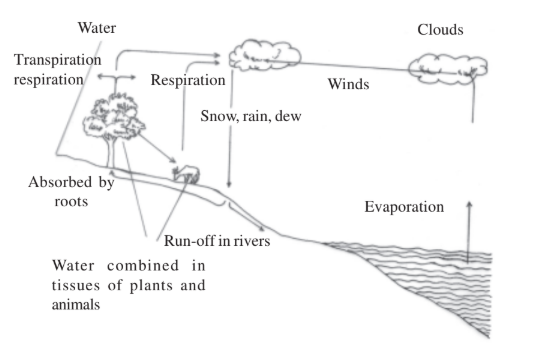
27. What is Global Hydrological Cycle? Illustrate diagramatically various steps involved in it. 6
Ans: Fresh water for human needs and the maintenance of the natural environment and ecosystems is supplied through a continuous movement of water in all its forms (ice, liquid and vapour), by a system known as the hydrological cycle.
- This cycle is driven by solar energy.
- It involves a continuous recycling of water between the atmosphere, land and oceans by several processes.
- Within the atmosphere, vertical and horizontal air movements, including winds, transfer moisture from place to place.
- The streams, rivers, and glaciers transfer water from land to the oceans, where large-scale currents transfer water within the oceans.
OPTION – II (Energy and Environment)
23. State Second law of thermodynamics. 1
Ans: The Second law of thermodynamics states that in every energy transformation, some energy is always lost in the form of heat, which is unavailable to do further useful work. In other words, no energy transformation is one hundred per cent efficient, i.e., at each energy transformation some energy is lost as waste heat and dissipated into the environment.
24. Define Energy. What is its SI unit? 1
Ans: Energy is the capacity to do work. Its SI unit is Joule (J).
25 Distinguish between nuclear fusion and fission reactions. What is the main problem related to nuclear energy generation? 2
Ans:
- Nuclear fission – In this process, the nucleus of a heavy atom, namely of uranium (U235) or plutonium (P239), breaks apart into smaller fragments, releasing an enormous amount of energy.
- Nuclear fusion – In this process, small nuclei like those of isotopes of hydrogen, namely deuterium and tritium, etc., fuse or join together to form heavier nuclei, releasing vast amounts of energy.
The major problems associated with the generation of nuclear power are disposal of nuclear waste, contamination of environment with long lasting radioactive materials (radioactive pollution) thermal pollution, health effects from exposure to low levels of radiation, limited supplies of uranium ore, high construction and maintenance costs, questionable reactor safety, human or technical error that could result in a major accidents and vulnerability to sabotage, developing nuclear weapons by processing reactor waste.
26. What is Geothermal Energy? Give its two environmental impacts? 2
Ans: Geothermal energy refers to energy contained in underground rock and fluids. Geothermal energy is natural heat from the interior of the Earth that can be used to generate electricity as well as to heat up buildings.
- Geothermal energy can pose several environmental problems, including on-site noise, emissions of gas, disturbance at drilling sites, disposal sites, roads, pipelines and power plants during its development.
- The steam contains hydrogen sulphide gas, which has the odour of rotten eggs, and causes air pollution.
- The minerals in the steam are also toxic to fish, and they are corrosive to pipes and equipment, requiring constant maintenance.
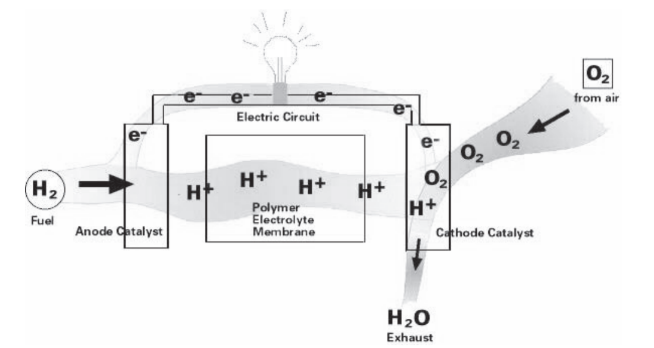
27. What is a fuel cell? Diagramatically illustrate the working of a hydrogen fuel cell. How is fuel cell technology beneficial for the environment? 6
Ans: Fuel cells are devices that directly convert hydrogen into electricity. A fuel cell converts hydrogen (produced and stored) and oxygen from the air into electricity.
Fuel cell technology and environment
- Fuel cells are efficient and clean energy producers.
- Fuel cells have been used in space flights and are being introduced in electric vehicles to reduce urban air pollution.
- Compared to vehicles powered by the internal combustion engine, fuel cell-powered vehicles have very high-energy conversion efficiency (almost double that of currently used engines) and near-zero pollution.
- Fuel-cell-powered EVs (electric vehicles) score over battery operated EV’s in terms of increased efficiency and easier and faster refuelling.
– o O o –
Additional Study Materials
- NIOS Class 12 Environmental Science Question Paper 2024 Oct
- NIOS Class 12 Environmental Science Sample Paper
- NIOS Environmental Science Question Paper April 2025
- Environmental Science NIOS Question Paper April 2024