NIOS Class 12 Environmental Science Question Paper With Answers 2023
SECTION – A
1. Name the occupational disease common in coal miners, due to their profession. 1
Ans: Black lung disease
2. What is meant by Oil spills?
Ans: Oil spills are accidental spills of crude oil and petroleum products into the sea by oil tankers and ships.
3. What is the role of nectar and pollen in Apiculture?
Ans: Nectar and pollen from flowers form the raw material for honey. Nectar is the sweet secretion of the flowers. It is the raw material for honey. Pollen provides the raw material necessary for the major food of the brood (fertilized egg).
4. Where is Tehri Power Project situated?
Ans: Tehri power project is located at a 260.5m high earth and rock fill dam near the Tehri town in the Garhwal Himalayas.
5 (i) Write the scientific name for human beings.
(ii) Name the earliest bipedal humans.
Ans:
- (i) Homo sapiens sapiens
- (ii) Australopithecus
6. Mention four human activities that promote desertification. 2
Ans:
- (i) Uncontrolled and overexploitation of grazing land, indiscriminate cutting of trees and forest resources leading to drought, soil erosion, and deterioration of soil fertility, which results in stunted plant growth.
- (ii) Excessive mining in arid and semi-arid regions for the extraction of minerals, coal or limestone, resulting in loss of trees and green cover, and leading to destruction of conditions conducive to vegetation growing.
- (iii) Uneconomic land use for agriculture by cultivation on marginal lands affecting adjacent fertile lands and causing soil erosion.
- (iv) Intensive and uneconomic exploitation of water resources leading to a fall in the water table, seepage and problems of excessive salinisation of soil.
7. Name any two medicinal plants, and also name the diseases for which they are used. 2
Ans:
- Digitalis is used to treat chronic heart trouble
- Vinca rosea drug for leukaemia from
8. What are Biofertilizers? How are they different from green manures? Write one example of each. 2
Ans: Biofertilizers are plant nutrients of biological origin, like algae, bacteria, fungi, which have no harmful effect on soil and environment.
- Green manure is an organic fertilizer such as cow dung and agricultural waste.
- Biofertilizers are sources from biological beings such as algae, fungi, etc.
9. Write any two economic importance of (i) Agro-ecosystem and (ii) Plantation forests. 2
Ans:
- (i) Agro-ecosystem Economic importance
- (i) Agroecosystems fulfil the basic requirements of food, fruits, edible oil, etc.
- (ii) Good quality grains can be produced with high yield.
- (iii) Provides livelihood to a large number of people. More than 70 % of the Indian population depends on agriculture.
- (ii) Plantation Forests: Economic importance
- (1) Tree plantations are raised for fruits, oil, rubber, coffee, timber, firewood, pulp wood for making the rayon and paper industries.
- (2) Trees are also planted to serve as wind breaks or shelter belts.
- (3) Tree plantations are also raised for controlling soil erosion and for increasing soil fertility.
- (4) Tree plantation provides job opportunities and generates income.
10. Write two examples each of the following:
(a) Biofuels
(b) Fossil fuels 2
Ans:
- (a) Ethanol, Methane.
- (b) Natural gas and petroleum
11. What is meant by “Buffering Capacity of Earth”? Write its importance. 2
Ans: Buffering Capacity of Earth is its ability to maintain a neutral pH or 7 in the soil and water bodies thrugh buffering action. The neutral pH is congenial for the survival and sustenance of living organisms.
12. List the four parameters that characterize the standard of living of a population. 2
Ans: A population is also characterized by certain parameters, such as:
- Life expectancy (should be high)
- Infant mortality rate (should be low)
- Income per head (should be high)
- Literacy (the maximum number of individuals who are literate)
- Consumption of food, natural resources (should be balanced)
- Kind of energy used (eco-friendly)
- Eco-friendly activity.
13. Give appropriate example for each of the following: 4
(a) Intraspecific competition
(b) Symbiosis
(c) Parasitism in plants
(d) Commensalism
Ans:
- (a) Intraspecific competition: Intraspecific competition occurs between members of the same species, and so it is very intense.
- (b) Symbiosis: Pollination of flowers where flowering plants are cross-pollinated by the bees, which benefit by getting nectar from the plants, and neither can survive without the other.
- (c) Parasitism in plants: Plants like the dodder plant (Cuscuta) and the mistletoe (Loranthus ) are parasites that live on flowering plants.
- (d) Commensalism: Epiphytes live on the surface of other plants like ferns, mosses and orchids and use the surface of trees for support and for obtaining sunlight and moisture.
14 (a) What are the precautionary measures you would follow to reduce the risk of flood during the monsoon? Give any four. 4
(b) How can you, as a responsible citizen, prevent road accidents? Write any four ways.
Ans:
(a) Some precautionary measures are as follows –
- Build houses away from flood-prone areas.
- Keep yourself alert and updated to weather and flood forecasting information.
- In case evacuation warnings are issued, immediately go to the shelters provided.
- Store extra food, such as rice, pulses, etc., for emergencies.
(b) To avoid accidents, the following safety measures can be adopted:
- Look on either side of the road before crossing.
- Use a zebra crossing when crossing the road on foot.
- Wear a helmet while riding a two-wheeler.
- Use the seat belt provided in your car.
15 (a) What are the main objectives of the following: 4
(i) Montreal Protocol
(ii) Ramsar Convention
(b) Expand the following abbreviations and give its main objective:
(i) WHO
(ii) CPCB
Ans:
(a)
- (i) Montreal Protocol: Protection of the ozone layer
- (ii) Ramsar Convention: Conservation and wise use of wetland habitats.
(b)
- (i) WHO: World Health Organisation
- (ii) CPCB: Central Pollution Control Board
16. (a) What is the full form of IUCN?
(b ) “Western Ghats and Eastern Himalayas are termed as Hot-Spots”. Explain briefly.
(c) What is IUCN Red List?
Ans:
- (a) International Union for Conservation of Nature
- (b) These are the regions which show maximum biodiversity, richness of species and endemic forms.
- (c) The IUCN Red List is an authentic source of information that uses a set of criteria, relevant to all species and all regions of the world, to evaluate the extinction risk of species and list endangered species.
17. Write any four Pull and Push factors, each responsible for migration of villagers towards cities.
Ans:
| Pull factors | Push factors |
| 1. Employment. | 1. Overpopulation (often one or more members move out of large families and then invite others to come to cities) |
| 2. Better and more opportunities | 4. Better lifestyle |
| 3. Better social amenities | 3. Slavery/bonded labour |
| 7. Fragmentation of family-owned land | 4. Lack of food |
| 5. Continuous trade and economic expansion | 5. Racial discrimination |
| 6. Territorial expansion. | 6. Natural hazards and climate change |
| 7. Fragmentation of family owned land |
18. (a) Who is the founder of Chipko movement?
(b) Who founded the Sulabh International? What sort of work does this organisation undertake?
Ans:
- (a) Chandi Prasad Bhatt and Sunder Lal Bahuguna
- (b) Dr Bindeshwar Pathak. Sulabh International is a social service organisation that works to promote human rights, environmental sanitation, non-conventional sources of energy, waste management and social reforms through education.
19. (a) With the help of suitable examples differentiate between In-Situ and Ex-Situ Conservation Strategies.
(b) With the help of a flow chart explain the various stages in the process of coal formation.
Ans:
(a)
- In-situ (on-site) conservation includes the protection of plants and animals within their natural habitats or in protected areas. Protected areas are land or sea dedicated to protecting and maintaining biodiversity.
- Ex-situ (off-site) conservation of plants and animals outside their natural habitats. These include botanical gardens, zoo, gene banks, seed bank, tissue culture and cryopreservation.
(b)
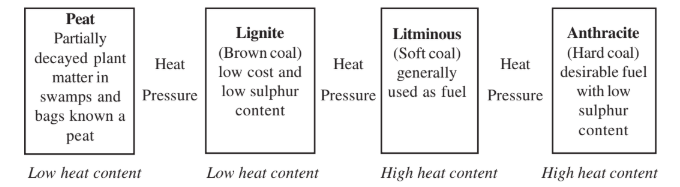
20. “The sewage water can be treated to make it safe for disposal into waterbodies like rivers and lakes.” List the three stages involved in the water treatment, mentioning the various steps and activities involved at each stage.
Ans: The treatment involves three stages: primary, secondary and tertiary. This includes
- 1. Sedimentation
- 2. coagulation/flocculation
- 3. filtration
- 4. disinfection
- 5. softening
- 6. aeration.
The first four steps are of primary treatment, and then comes secondary treatment.
- The first three steps are involved in primary treatment remove suspended particulate matter.
- Secondary treatment removes organic solids, left out after primary treatment, through their microbial decomposition. Effluents after secondary treatment may be clean but contain large amounts of nitrogen, in the form of ammonia, nitrates and phosphorus, which can cause the problem of eutrophication upon their discharge into a receiving water body such as a river, lake or pond.
- The tertiary treatment is meant to remove nutrients, disinfect to remove pathogenic bacteria, and aeration removes hydrogen sulphide and reduces the amount of carbon dioxide, making the water healthy and fit for aquatic organisms.
21. (a) Draw and label a terrestrial food chain showing four trophic levels.
(b) Explain the 10% rule of energy transfer in the above food chain. If the first trophic level receives 10,000 k. Cal. of energy, how much energy would the organisms in the fourth trophic level receive?
Ans: (a) Terrestrial food chain
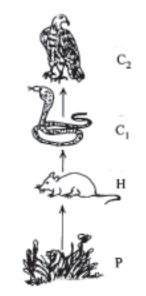
(b) According to the 10% rule related to ecological efficiency and states that the amount of energy
transferred at each tropic level is only 10% of the energy of the previous tropic level. Therefore,
- If the first trophic level receives 10,000 k. Cal of energy, the second trophic level recipes only 1000 kcal.
- The third trophic level receives just 100 kcal.
- Thus, the fourth trophic level will receive only 10 kcal.
22. (a ) What are the three Rs in Waste Management? Briefly explain.
(b) What is the Indian Ecolabel known as, and what is its symbol?
(c) Write any two proposed methods of disposing of nuclear waste?
Ans:
(a) The three Rs are reduce, reuse and recycle.
(b) It is known as “Eco-mark,” and the symbol is an “Earthen Pot”. The earthen pot symbolises a biodegradable, fully harmless material.
(c) Safe disposal of nuclear waste
- Bury it deep underground in insulated containers. This is a strategy being pursued in the United States.
- Shoot it into space or into the sun. The cost would be very high, and a launch accident should be disastrous.
SECTION – B
OPTION – I (Water Resource Management)
23. Give one word for: Growth of algal blooms due to enrichment of nutrients like phosphates and nitrates in water bodies. 1
Ans: Eutrophication
24. How does water table get reduced? 1
Ans: The water table is reduced as the level of groundwater decreases.
25. What is meant by Artificial recharge? List any two advantages of artificial recharge. 2
Ans: Artificial recharge is a process by which excess surface water is directed into the ground, either by spreading on the surface by using recharge wells, or by altering natural conditions to increase infiltration.
- Recharge can significantly increase the sustainable yield of an aquifer.
- Recharge methods are attractive, particularly in arid regions.
- Most aquifer recharge systems are easy to operate.
26. How does Rainwater harvesting help in overcoming water scarcity? Name a traditional structure used in Rajasthan for rainwater harvesting. 2
Ans: Not only does this recharge arrest groundwater depletion, but it also raises the declining water table and can help augment the water supply. The traditional structure used in Rajasthan for rainwater harvesting is a rooftop water harvesting system.
27. As a responsible individual, write six ways by which you can help in conserving water at the personal level. 6
Ans:
- Take short showers or a bucket for bathing.
- Turn off the taps while brushing and shaving.
- Use basins to clean vegetables and fruits.
- Promptly repair any plumbing issues at home.
- Invest in rainwater harvesting at home.
OPTION – II (Energy and Environment)
23. Why is Hydrogen considered as a clean energy source? 1
Ans: Hydrogen produces clean energy and pure water without causing any pollution.
24. What are Petrochemicals used for? 1
Ans: Petrochemicals are used as raw materials for the manufacture of pesticides, plastics, synthetic fibres, paints, and medicines, etc.
25. What is Photovoltaic cell, and how does it work? 2
Ans: A Photovoltaic cell is a solar cell that produces electricity from solar energy. It is a thin, wafer-like semiconductor. Sunlight energises electrons in the semiconductor, causing them to flow and produce an electrical current.
26. How is bio-crude obtained from the plants, and how is it converted into useful products? 2
Ans:
- Biocrude is a complex mixture of liquids, terpenoids, triglycerides, phytosterols, waxes, and other modified isoprenoid compounds. This biocrude can be obtained by tapping the latex, followed by coagulation, or by extraction of the dry biomass using a suitable solvent in cases where latex tapping is not possible.
- It can be catalytically upgraded for use as a liquid fuel. Hydro cracking of biocrude can convert it into several useful products like gasoline (automobile fuel), gas oil and kerosene.
27. (a) What is an Ecohouse? Name the technologies used during its construction. 6
(b) Name any two energy-efficient devices commonly used in our homes and give their significance.
Ans: (a) Eco house is a residential building and was constructed in the mid-seventies. It was equipped with a solar cooker and a multifeed biogas plant. The following technologies were used in this house-
- Rainwater harvesting with an underground cistern.
- Roof-integrated solar water heater.
- Window-mounted retractable solar cooker.
- Multifeed biogas plant, usable as a septic tank, if required.
- Three different types of experimental roofs (hollow concrete tiles, Prefab brick jack arches, Madras terrace roof).
- Design for Ventura (ventilation via inner courtyard).
(b) Compact Fluorescent Lamps (CFL) replaced incandescent bulbs.
Tubelight has an electronic ballast device, which helps in reducing energy consumption by limiting the amount of electric current in an electric circuit.
– o O o –
Additional Study Materials
- NIOS Class 12 Environmental Science Question Paper 2024 Oct
- NIOS Class 12 Environmental Science Sample Paper
- NIOS Environmental Science Question Paper April 2025
- Environmental Science NIOS Question Paper April 2024
- NIOS Class 12 Environmental Science Question Paper 2023 ASS