NIOS Home Science Class 10 Chapter 11
INTEXT QUESTIONS 11.1
1. Fill in the blanks after unscrambling the clues in the brackets:
i. The treatment given to fabrics to enhance their appearance, performance or handling is known as __________ (N I F S I H E).
Ans: Finishes
ii. When no finish is applied on a fabric’s surface, it is known as ____________ fabric (R A Y G).
Ans: Gray
iii. ______________ and ________________ produce variety in fabric (Y E D I N G, N I N G P R I T).
Ans: Dyeing and printing
iv. A chemical finish is also known as ______________ (E T W – I S H F I N).
Ans: Wet finish
v. Waterproof finish is a__________________ finish. (N C F U T I O N A L).
Ans: Functional
INTEXT QUESTIONS 11.2
1. State True or False and explain if the answer is false.
i. (True / False) (i) Scouring is a finish used to clean the fabric.
Ans: True, scouring is washing fabric with soap and chemicals to remove all impurities
ii. (True / False) (ii) Bleaching has no damaging effect on fabric.
Ans: False, Bleaching has to be done very carefully. It destroys the colour. Strong bleach can damage the fabric to some extent.
iii. (True / False) (iii) Shrinkage control can be done at home also.
Ans: True, soaking the fabric overnight and drying it causes shrinkage.
iv. (True / False) (iv) Organdy is a permanently stiff fabric.
Ans: True, this is due to a permanent finish called Parchmentisation.
v. (True / False) (v) Mercerized thread should be used for stitching.
Ans: True, mercerization makes cotton smooth, shiny and strong.
2. Fill the blanks with the suitable word given at the end of each sentence
(i) Mercerisation is a ________ finish. (renewable/durable).
Ans: Durable
(ii) Shrinkage control is indicated as __________ on the label. (sanforised /parchmentisation)
Ans: Sanforised
(iii) Wash n wear is a ________ finish. (routine/special)
Ans: Special
(iv) If the colour does not bleed on washing, it means fabric is __________. (waterproof / colour fast)
Ans: Colourfast
INTEXT QUESTIONS 11.3
1. Fill in the blanks :
(i) Vegetables and animal dyes are known as ______________.(natural/artificial)
Ans: Natural dyes
(ii) Tyrian purple dye is obtained from _____________ source. (natural/animal)
Ans: Animal
(iii) Fibre dyeing is more popular in _____________ fibres. (man-made/synthetic)
Ans: Man-made
(iv) Tie and dye is _________________ dyeing. (resist/discharge)
Ans: Resist
(v) At home fabric can be decorated easily by ____________ printing. (block/roller)
Ans: Block.
2. Look at the grid given below, followed by statements. The answer to each statement is in a single word. Fill in the word in the grid at its respective number. The first one is done for you.
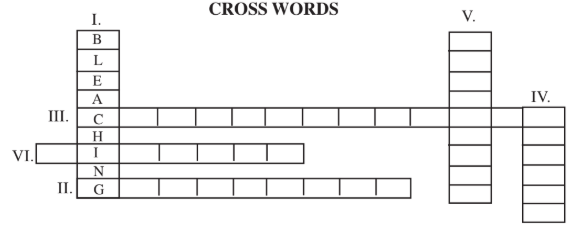
I. It is a chemical treatment given to a fibre, yarn or fabric to remove yellowing.
II. The term used for fabrics that come directly from loom.
III. Also known as wet finishes.
IV. It makes fabric heavier, stiff and crisp.
V. It makes cotton fabrics easy to maintain.
VI. It is one of the tie and dye technique.
Ans:
- I. It is a chemical treatment given to a fibre, yarn or fabric to remove yellowing. – Bleaching
- II. The term used for fabrics that come directly from the loom. – Gray goods
- III. Also known as wet finishes. – Chemical finish
- IV. It makes fabric heavier, stiff and crisp. – Starch
- V. It makes cotton fabrics easy to maintain. – Wash ‘N’Wear
- VI. It is one of the tie and dye technique. – Binding
TERMINAL EXERCISE
1. What is a textile finish? Why is it necessary to apply on fabric?
Ans: A finish is a treatment given to a fabric to change its appearance, handling /touch or performance. Its purpose is to make the fabric more suitable for its end use. Finish includes any general treatment given to clean and iron fabrics and creates exclusive variations of them by using chemical treatments, dyeing, printing, etc., to make the fabric attractive and appealing.
2. How does a gray fabric differ from a finished fabric?
Ans: Gray goods are the term used for fabrics that come directly from the loom and are used as such. These are not actually gray in colour but are ‘unfinished’.
| Gray fabric | Finished Fabric |
| Dull looking, available only in natural colours- off-white, brown, black, etc. | Smooth and wrinkle-free, with no defects on the surface, even width, free from stains, etc. |
| Wrinkled, stained, with broken threads, uneven in width, etc. | Lacks customer appeal, and are purchased only for rough work, backing, packaging, etc. |
| Relatively less expensive. | The cost of fabric depends upon the type of fibre, along with the number and type of finishes applied. |
| Lacks customer appeal, are purchased only for rough work, backing, packaging, etc. | Customers get attracted and buy. |
3. Describe any two basic finishes and their application.
Ans:
- Scouring is the process of industrial cleaning of fabrics with the help of warm water and a soap solution. It cleans the fabric and makes it more absorbent.
- Bleaching is a chemical treatment given to fibres, yarns or fabric to remove paleness or colour and make them white.
4. The sewing thread Ritu brought had the label mercerized? Give the advantages of ‘mercerization’ and explain the process of mercerization to Ritu.
Ans: Mercerization makes the fabric stronger, lustrous, and absorbent and improves the uptake of dyes.
5. “Dyeing is finishing with colour”. Explain.
Ans: Dyeing gives a solid colour to the fabric. It improves the appearance of fabric and adds diversity to our dresses through colours and designs.
6. Differentiate between natural and synthetic dyes.
Ans:
- Natural Dyes – These were the first dyes known to mankind. These are obtained from natural sources – vegetables, animals or minerals. These are eco-friendly and do not pollute water or land. The residue of these dyes can be safely used as fertilizer in the fields. But the process of dyeing with natural dyes is slow, difficult and expensive. Major natural dyes obtained from plants are turmeric (haldi), henna (mehndi), madder (manjishta) and indigo (neel). While Tyrian purple and lac dyes are obtained from animal sources. Khakhi dye comes from a mineral source.
- Synthetic Dyes – These dyes are prepared synthetically with the help of different chemicals. These differ in their chemical composition and behaviour. Popular classes of synthetic dyes are direct, basic, acid, disperse, azo, vat and reactive dyes. These dyes cause a lot of pollution and skin allergies, etc. Some of these dyes, such as azo, are very harmful to human health, and their use has been banned. Synthetic dyes are very easy to use and have better fastness than natural dyes. These also give a brighter and larger colour range.
7. You have just bought a shirt that has a label “Piece dyed”. What do you understand from it? What are the other methods of dyeing textiles?
Ans: When dyeing is done after the garment is stitched, it’s called piece dyed. It avoids fabric wastage, but the colour may not be uniform.
The other methods of dyeing textiles are tie and dye, batik, etc. Dyeing can be done at the fibre stage before making them into fabric, the yarn stage, where it is used for knitting, or in the fabric stage for uniform dyeing.
8. Describe batik and block printing.
Ans:
- Batik is also a method of resist dyeing. Here, wax is used as a resist material to prevent the dye from colouring certain areas. In selected areas of the fabric, a mixture of Bees’ wax and paraffin wax is filled with a brush or a block, according to the design. These areas do not get coloured when dyed, giving a patterned effect. The wax is later removed.
- In block printing, a wooden block, which has a design engraved on it, is pressed into a thick dye paste and then stamped onto the fabric.
Additional Study Materials
- Chapter 6 Environment Textbook Solutions
- Chapter 7 Health Textbook Solutions
- Chapter 8 Communicable and Lifestyle Diseases Textbook Solutions
- Chapter 9 Care and Maintenance of Fabric Textbook Solutions
- Chapter 10 Fiber to Fabric Textbook Solutions