NIOS Home Science Class 10 Chapter 10
INTEXT QUESTIONS 10.1
1. Match column A with column B and fill in the given blanks-
| A | B |
| i) Jute | a) Plant fibres |
| ii) Cotton | b) Man-made fibres |
| iii) Wool | c) Bast fibre |
| iv) Rayon | d) Regenerated fibre |
| v) Silk | e) Natural fibre |
| vi) Nylon | f) Animal fibre |
| vii) Cellulosic fibres | g) Silkworm |
| h) Flax |
10.1 1. i) c ii) a iii) f iv) d
v) g vi) b vii) e.
INTEXT QUESTION 10.2
1. One evening, Geet was busy cooking dinner, and her father was in the garden. Suddenly, Geet saw her dupatta had caught fire. She shouted loudly and ran out of the kitchen. Her father saw flames and rushed towards her with a cotton sheet. He quickly wrapped it around Geet to put off the flames.
He immediately took her to hospital. Doctor said Geet had received burns because the dupatta, made from polyester, had melted and stuck to her skin. Her father had received only a few scalds while wrapping Geet with cotton sheet and putting off the flames. Since he was wearing cotton kurta, pyajama he was saved.
The doctor appreciated her father’s presence of mind in wrapping a sheet that helped in extinguishing the fire immediately. Fortunately, the burns were not very severe, and Geet recovered soon.
Answer the following questions:
i) Why did the dupatta catch fire?
Ans: The dupatta was made of synthetic fibre.
ii) Why did the dupatta get stuck to the body after catching fire?
Ans: Synthetic fibre can stick to the body after watching fire.
iii) Why was Geet’s father relatively safe from burns?
Ans: Geet’s father was relatively safe because he was wearing cotton clothes (kurta and pyjama). Cotton is a natural fibre that does not melt on heating. It may burn slowly, but it does not stick to the skin like synthetic fabrics. Therefore, he suffered only minor scalds.
iv) What type of fabric should you prefer to wear while working in the kitchen?
Ans: While working in the kitchen, we should prefer to wear cotton fabrics because cotton does not melt or stick to the skin when exposed to fire. It is also comfortable and safe to use near heat.
v) List three other fabrics which can be worn while working near fire.
Ans: Cotton, linen and wool.
vi) People know that synthetic fabrics catch fire easily, yet most of them wear these clothes while working in the kitchen. Convince them in about 30 words about merits of changing into cotton clothes before working in the kitchen.
Ans: Cotton clothes are safer to wear in the kitchen because they do not melt or stick to the skin if they catch fire. Synthetic fabrics melt quickly and cause severe burns.
2. Fill in the blanks –
i) If wool: winter, then ___________ : summer
Ans: Cotton
ii) If bark: flax, then ___________: wool
Ans: Fleece
iii) If cotton: king of fibres, then silk: ____________
Ans: Queen of fibres
iv) If regenerated fibres: wood pulp, then synthetic fibres: _______________
Ans: Petroleum products
v) If linen: cotton, then acrylic: __________
Ans: Wool.
3. Put a tick mark on the right option. Justify the chosen option.
True/False a) Cotton is a filament fibre.
Ans: False – Cotton is a staple fibre
True/False b) Length of staple fibres is measured in inches.
Ans: True
True/False c) Acetate is a man-made fibre.
Ans: False – Acetate is a Regenerated fibre
True/False d) Natural fibres can be made from chemicals.
Ans: False – wool is a protein fibre.
True/False e) Wool is a plant fibre.
Ans: True
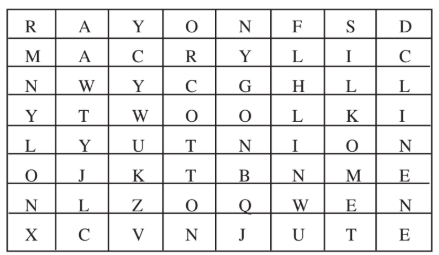
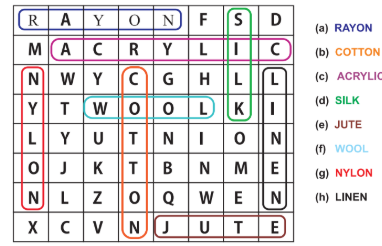
4. Search names of fibres in Wonder box. Hints are given below.
a. I am soft and look like silk.
b. I become lustrous by starching.
c. I look like wool.
d. I am smooth and lustrous.
e. I am rough to touch.
f. I give warmth in winters.
g. I am easily washable.
h. I wrinkle easily.
WONDER BOX
Ans:
INTEXT QUESTION 10.3
1. State whether the following statements are true or false. Encircle the right answer.
True / False i) Silk yarn breaks easily.
Ans: False – Silk yarn breaks with a jerk.
True / False ii) Bulky yarns need less number of twists in one inch length.
Ans: True
True / False iii) Slub yarns have thick and thin places.
Ans: True
True / False iv) Cord yarn is made from single yarn.
Ans: False – Cord yarn is made from 3/4/5 ply yarns. It is multiple strand yarn.
2. Fill in the blanks with appropriate words. Choose the words from the box given along.
Cotton, multiple-strand yarn, fibres, do not break easily, thickness, synthetic.
i) A simple yarn has uniform __________in per inch length.
Ans: Thickness
ii) Cord yarn is a __________.
Ans: Multiple-strand yarn
iii) Flex is stronger than _______________ .
Ans: Cotton
iv) Synthetic yarns stretch and ________________.
Ans: Do not break easily.
INTEXT QUESTIONS 10.4
1. Fill in the blanks with appropriate words.
1. Hand knitting is known as ——————— ———- (warp knitting / weft knitting)
Ans: Weft knitting
2. Khadi Movement in India was started by ———————- (Mahatma Gandhi / Jawaharlal Nehru)
Ans: Mahatma Gandhi
3. Selvedge refers to ————————— (width/length of fabric)
Ans: length of fabric
4. Woven fabrics ————————— (stretch / do not stretch)
Ans: do not stretch
2. Unscramble the following jumbled words to identify the names of some fabrics–
i) niemd
ii) bargadine
iii) ydnaorg
iv) twelo
Ans:
- i) Denim
- ii) Gabardine
- iii) Organdy
- iv) Towel
INTEXT QUESTIONS 10.5
Choose the correct answer of the four given at the end of each statement
1. Muslin is a fabric which is _______________.
(a) lightweight and loosely woven
(b) transparent and crisp
(c) heavyweight and thick
(d) medium weight and plain
Ans: (a) lightweight and loosely woven
2. Denim is a fabric which is _______________.
(a) lightweight and loosely woven
(b) transparent and crisp
(c) heavyweight and thick
(d) medium weight and plain
Ans: (c) heavyweight and thick
3. Organdy is a fabric which is _______________.
(a) lightweight and loosely woven
(b) transparent and crisp
(c) heavyweight and thick
(d) medium weight and plain
Ans: (b) transparent and crisp
4. Poplin is a fabric which is _______________.
(a) lightweight and loosely woven
(b) transparent and crisp
(c) heavyweight and thick
(d) medium weight and plain
Ans: (d) medium weight and plain
TERMINAL EXERCISE
1. Give one difference between the following-
i) Coarse and fine yarn
ii) S and Z twist
iii) Four ply and cord yarn
iv) Spun and filament yarns
Ans:
- i) Coarse and fine yarn: Coarse yarn is made of two or more simple yarns, and a fine yarn is made of a lightweight single strand
- ii) S and Z twist: S-twist is clockwise, and Z-twist is anticlockwise.
- iii) Four ply and cord yarn: Four ply or cable yarns are usually made by plying two strands of two-ply yarns together. Cord yarn is a multiple-strand yarn.
- iv) Spun and filament yarns: Filament yarns are long natural fibres. Spun yarns are made of filament yarn.
2. Why do Nylon, Polyester and Acrylic catch fire easily?
Ans: Nylon, Polyester and Acrylic are all synthetic fibres that are thermoplastic fibres. Thus, these fibres catch fire easily.
3. Read the case study given below and answer the questions given at the end:
Ginni was extremely unhappy because a red rash was spreading all over her body and was very painful. She had tried many local applications to get rid of them, but nothing helped. The rash was causing irritation and made her feel uncomfortable.
She discussed her problem with her friend Shyama,, who suggested her to consult a doctor in the village dispensary. In the dispensary, the doctor looked at her skin problem and noticed the fabric of her dress. She asked Ginny if she wore the same dress often. Ginni said yes because she liked the dress very much. It was a fashionable dress, easy to wear, carry and maintain.
The doctor advised Ginni not to wear the dress again for some time. In warm climate, it did not allow the skin to breathe fresh air, caused sweating, which led the skin to become irritable and cause the red rash.
But Ginny was not convinced. She thought that everybody wore dresses made from similar material and had no complaints. If nobody else had any problem in wearing such clothes, why she should have any? Surely she thought that her problem could not be due to the clothes she wore. So she did not stop wearing her favourite dress. Some questions to ponder (if possible, discuss with peer group or with people at home)
If you were Ginni’s friend, what would you advise her to do? How would you convince her?
Ans: Individual answer
Additional Study Materials
- Chapter 5 Preservation of Food Textbook Solutions
- Chapter 6 Environment Textbook Solutions
- Chapter 7 Health Textbook Solutions
- Chapter 8 Communicable and Lifestyle Diseases Textbook Solutions
- Chapter 9 Care and Maintenance of Fabric Textbook Solutions