The amino acid pathway in pharmacognosy refers to biochemical reactions that lead to the biosynthesis of various amino acids. These amino acids are necessary for various biological processes such as energy production, cellular signaling, etc.
Amino acid pathway involves substrates that come from intermediates from other metabolic pathways and reactions. As you know, amino acids are of two types- essential and non-essential amino acids.
| Essential amino acids | Non-essential amino acids |
| Arginine | Alanine |
| HIstidine | Asparagine |
| Isoleucine | Aspartate |
| Lysine | Cysteine |
| Methionine | Glutamate |
| Phenylalanine | Glutamine |
| Threonine | Glycine |
| Tryptophan | Proline |
| Valine | Serine |
| Leucine | Tyrosine |
All of them are formed in one of the two types of amino acid pathways. Moreover, each of them are formed from different biomolecules or compounds or intermediates from other metabolic pathways.
Types of Amino Acid Pathway in Pharmacognosy
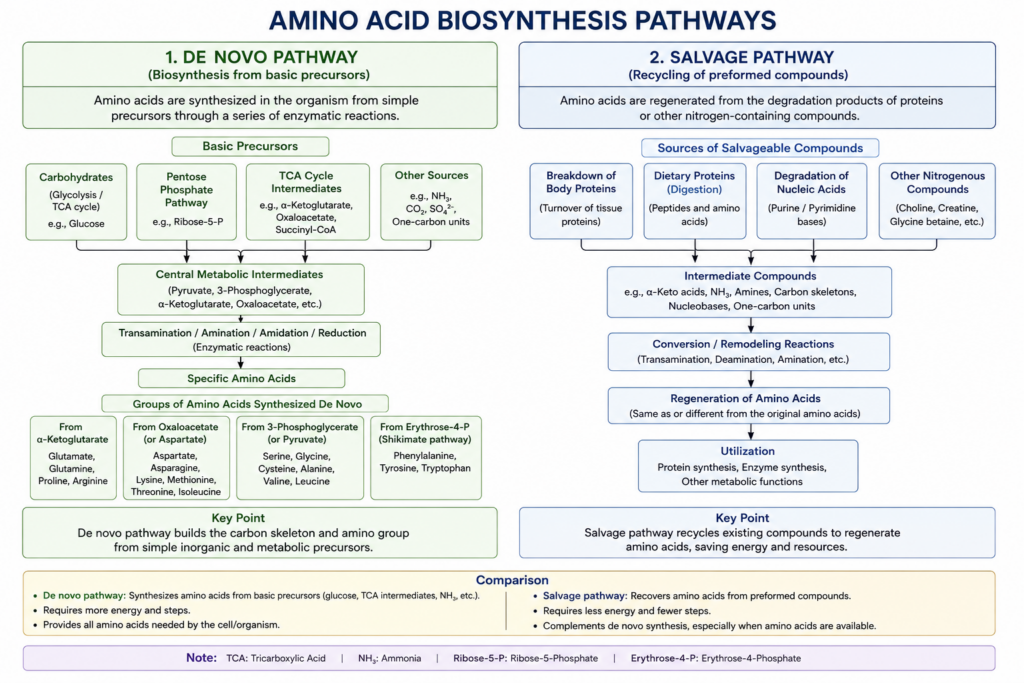
As mentioned, the amino acid pathway in pharmacognosy is of two types: the de novo pathway and the salvage pathway. The former refers to the formation of amino acids from scratch and the latter is the formation of amino acids from the degradation of other biomolecules such as proteins and nucleotides.
De novo Pathway
The de novo pathway involves the biosynthesis of amino acids from intermediary precursor molecules. The exact pathway is different for each amino acid. The intermediates for such amino acid pathways include α-ketoglutarate, oxaloacetate, phosphoenolpyruvate, erythrose 4-phosphate, 3-phosphoglycerate, and ribose 5-phosphate.
Each of these intermediates undergoes a different series of reactions with the help of enzymes. Such reactions include transamination, decarboxylation, and amination, to produce each amino acid. Some intermediates end up forming multiple amino acids, while ribose 5-phosphate produces only one amino acid – histidine.
- Oxaloacetate from the TCA Cycle forms aspartate, which in turn forms four amino acids- asparagine, methionine, lysine, and threonine. Threonine will then form isoleucine.
- Pyruvate from glycolysis produces alanine, leucine, and valine.
- Ribose 5-phosphate produces histidine.
- Phosphoenolpyruvate and erythrose 4-phosphate together form tyrosine, tryptophan, and phenylalanine. Phenylalanine will also form tyrosine
- Alpha-ketoglutarate produces glutamate through a reductive amination reaction with the help of glutamate dehydrogenase. Glutamate will later form glutamine, arginine, and proline.
- 3-Phosphoglycerate produces serine. Serine will later form cysteine and glycine.
| Biosynthetic Family | Amino acids |
| α-Ketoglutarate | Glutamate |
| Glutamine | |
| Proline | |
| Arginine | |
| Pyruvate | Alanine |
| Valine | |
| Leucine | |
| Isoleusine | |
| 3-Phosphoglycerate | Serine |
| Glycine | |
| Cysteine | |
| Oxaloacetate | Aspartate |
| Asparagine | |
| Methionine | |
| Threonine | |
| Lysine | |
| Ribose 5-phosphate | Histidine |
| PEP+Erythrose 4-phosphate | Tryptophan |
| Phenylalanine | |
| Tyrosine |
| Amino acids | Reactions |
| Glutamate | Transamination from 𝜶-Ketoglutarate |
| Glutamine | Glutamate → Acyl-phosphate intermediate → Glutamine |
| Proline | Glutamate → Acyl phosphate →Glutamate 𝛾-semialdehyde→Proline |
| Arginine | Glutamate →N-Acetylglutamate→N-acetyl-𝛾-glutamyl phosphate →N-acetylglutamate 𝛾-semialdehyde→N-Acetylornithine → L-citruline → Arginosuccinate → Arginine |
| Alanine | Transamination from pyruvate |
| Valine | Pyruvate → 2-Acetolactate → 2,3-Dihydroxyisovalerate →2-Ketoisovalerate → Valine |
| Leucine | Pyruvate → 2-Acetolactate → 2,3-Dihydroxyisovalerate →2-Ketoisovalerate → Leusine |
| Isoleusine | Pyruvate+2-Ketobutyrate → 2-Aceto-2-Hydroxybutyrate → 2,3-Dihydroxy-3-Methylvalerate → 2-Keto-3-Methylvalerate → Isoleusine |
| Serine | 3-Phosphoglycerate → 3-Phosphohydroxypyruvate → 3-phosphoserine → Serine |
| Glycine | 3-Phosphoglycerate → 3-Phosphohydroxypyruvate → 3-phosphoserine → Serine→ Glycine |
| Cysteine | Serine→ O-Acetylserine→Cysteine |
| Aspartate | Transamination of Oxaloacetate |
| Asparagine | Aspartate → Acyl-adenylate intermediate → Asparagine |
| Methionine | Homocysteine → N5-Methyl-tetrahydrofolate → Methionine |
| Threonine | Aspartate → Aspartyl phosphate → Aspartate semialdehyde → Homoserine → Homoserine phosphate → Threonine |
| Lysine | Aspartate → Aspartyl phosphate → Aspartate 4-semialdehyde → Dihydrodipiocolinate → Lysine |
| Histidine | Ribose 5-phosphate → Phosphoribosylpyrophosphate → Phosphoribosyl-ATP → Phosphoribosyl-AMP → Phosphoribosylformimino-AIC-RP → Phosphoribulosylformimino-AIC-RP → Imidazole glycerol-phosphate → Imidazole acetol-phosphate → Histidinol-phosphate → Histidinol → Histidine |
| Tryptophan | Chorismate → Anthranilate → N-(5’-Phosphoribosyl)-anthranilate → Indole-3-glycerol phosphate → Indole → Tryptophan |
| Phenylalanine | Chorismate → Prephenate → Phenylpyruvate → Phenylalanine |
| Tyrosine | Chorismate → Prephenate → p-Hydroxyphenylpyruvate→ Tyrosine |
Salvage Pathway
The salvage pathway recovers amino acids from the degradation of proteins, protein turnover, or nucleotides. These salvaged amino acids are used for protein synthesis and in other metabolic reactions.
References
- Metabolic pathways in higher plants and their determination. (n.d.). In UNIT-I. https://www.ramauniversity.ac.in/online-study-material/pharmacy/bpharma/vsemester/pharmacognosyandphytochemistry-ii/lecture-1.pdf
- Lehninger (n.d.). AMINO ACID BIOSYNTHESIS. In Principles of Biochemistry (6th ed.). https://www.shivajicollege.ac.in/sPanel/uploads/econtent/031f78747fa81e295d4f96150c21493b.pdf
- https://www.chem.uwec.edu/chem454_s09/chapter24.pdf
- Desai, S. D. & Department of Biochemistry & Molecular Biology. (n.d.). Amino acids degradation and synthesis. https://www.medschool.lsuhsc.edu/biochemistry/Courses/Biochemistry201/Desai/Amino%20Acid%20Metabolism%20I%2010-14-08.pdf