Acetate Pathway in Pharmacognosy
The Acetate Malonate pathway and the Acetate Mevalonate pathway are two biochemical pathways involved in the synthesis of important molecules in living organisms.
Acetate Malonate Pathway
The Acetate Malonate pathway is a metabolic pathway that has acetate as a precursor for malonate. Acetate is a two-carbon molecule derived from various sources, including the breakdown of glucose or fatty acids.
In this pathway, acetate is first converted into acetyl-CoA through a series of enzymatic reactions. Acetyl-CoA then undergoes carboxylation to form malonyl-CoA, which is an important intermediate in fatty acid synthesis. Malonyl-CoA can be further utilized in fatty acid elongation or for the synthesis of other metabolites.
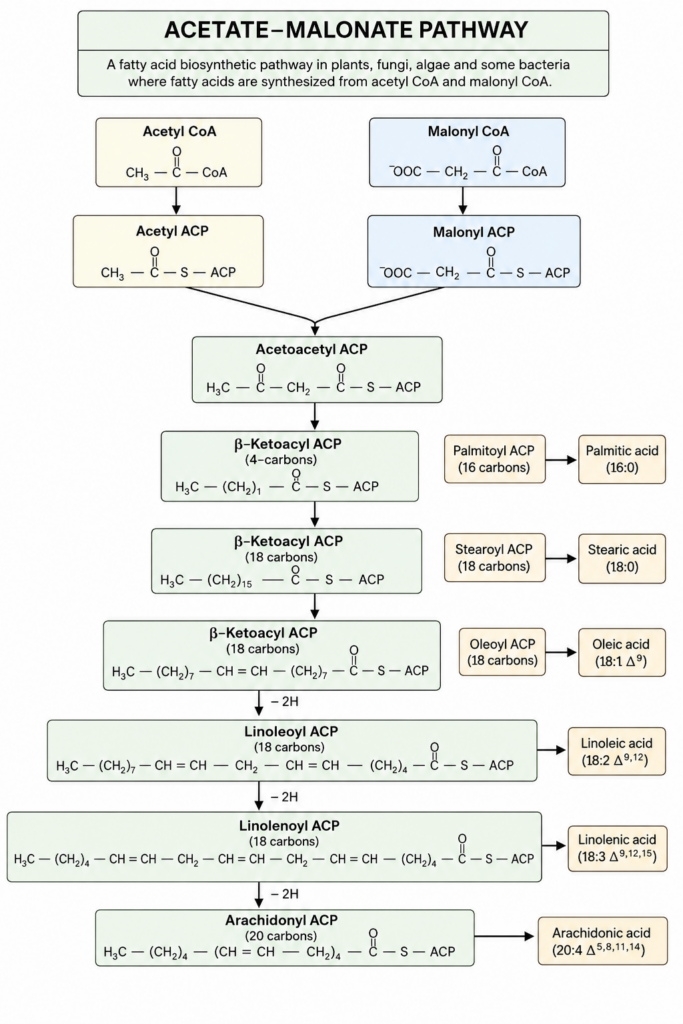
The Acetate Malonate pathway is particularly significant for organisms that rely on fatty acid synthesis for energy storage or membrane formation. It plays a crucial role in the synthesis of complex lipids, including triglycerides, phospholipids, and cholesterol.
Acetate Mevalonate Pathway
The Acetate Mevalonate pathway, also known as the HMG-CoA reductase pathway, is an essential pathway involved in the synthesis of isoprenoids, which are important molecules with diverse functions. Isoprenoids include compounds such as cholesterol, steroid hormones, carotenoids, and various essential molecules in cellular processes.
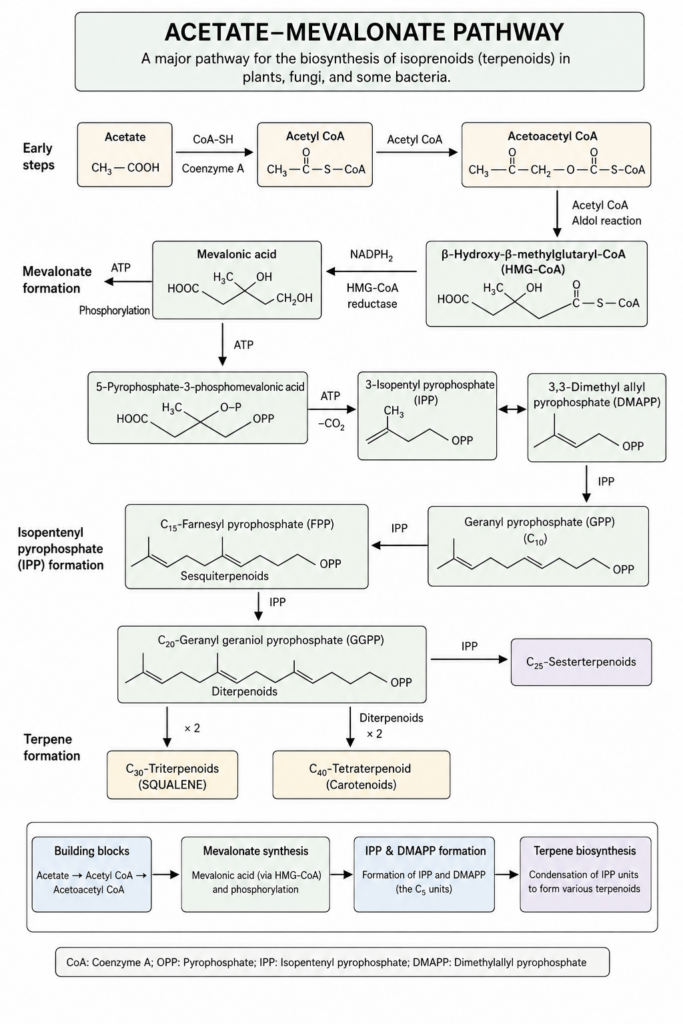
In this pathway, acetate is converted into acetyl-CoA, similar to the Acetate Malonate pathway. Acetyl-CoA then undergoes a series of enzymatic reactions to produce mevalonate. Mevalonate is a key intermediate that serves as the precursor for the synthesis of isoprenoids.
- The pathway begins with an acetyl-CoA molecule produced from pyruvic acid, which is the end product of glycolysis.
- First 2 molecules of acetyl-CoA form acetoacetyl-CoA through Claisen condensation.
- 3rd molecule of acetyl-CoA forms β-hydroxy β-methylglutaryl-CoA by aldol addition.
- Next on the reduction gives rise to mevalonic acid, which is the main precursor for the biosynthesis of terpenoids.
- Mevalonic acid on ATP-mediated phosphorylation gives mevalonic acid diphosphate, which on decarboxylation gives the 1st isoprene unit, isopentyl pyrophosphate (IPP).
- By the isomerase enzyme, the IPP gives 2nd isoprene unit dimethylallyl pyrophosphate (DMAPP)
- Electrophilic addition of IPP with DMAPP via enzyme prenyl transferase yields the C10 unit, geranyl pyrophosphate (GPP), which is the precursor for the synthesis of monoterpenes.
- Combinations of another IPP unit with GPP give rise to form farnesyl pyrophosphate (FPP), a C15 unit which acts as a precursor for the synthesis of sesquiterpene.
- Further addition of the IPP unit gives C20 geranyl geraniol pyrophosphate (GGPP) to produce a range of Diterpenes.
- Further addition of the IPP unit gives C25 geranyl farnesyl pyrophosphate, called Sesterterpenes.
- The tail-to-tail addition of two FPP units yields a C30 unit, a triterpene. Similarly, 2 units of GGPP yield a C40 unit, tetraterpene.
- The mevalonate pathway thus works through IPP and DMAPP via squalene to produce two different skeleton-containing compounds, that is, steroids and triterpenoids. It also produces a vast range of monoterpenoids, sesquiterpenoids, diterpenoids, carotenoids, polyprenols, and also the compounds like glycosides and alkaloids in association with other pathways.
The Acetate Mevalonate pathway is found in most organisms, from bacteria to humans. It is particularly important in eukaryotes, as it is responsible for the synthesis of cholesterol, a crucial component of cell membranes and a precursor for steroid hormones.
In summary, both the Acetate Malonate pathway and the Acetate Mevalonate pathway are essential biochemical pathways that utilize acetate as a starting point for the synthesis of important molecules. The Acetate Malonate pathway is involved in fatty acid synthesis, while the Acetate Mevalonate pathway is involved in the synthesis of isoprenoids, including cholesterol.
References
- https://www.ramauniversity.ac.in/online-study-material/pharmacy/bpharma/vsemester/pharmacognosyandphytochemistry-ii/lecture-1.pdf
- Acetate Pathway- An Overview. (n.d.). International Journal of Research Publication and Reviews, Pp 2174-2177, October 2023, Vol 4(No. 10). https://ijrpr.com/uploads/V4ISSUE10/IJRPR18371.pdf
- Patel, T., Patel, Y., Patel, M., Patel, D., Patel, D., & Vaghela, K. (2025). Biosynthetic pathways in plants: A gateway to natural products and drug discovery. Journal of Pharmacognosy and Phytochemistry, 14(5), 328–335. https://doi.org/10.22271/phyto.2025.v14.i5e.15589
Related Topics
- Enfleurage Method of Extraction of Volatile Oils
- Borntrager’s Test and Modified Borntrager’s Test
- Shuttle Systems in Metabolism
- Write a Short Note on Vitali Test