NIOS Class 12 Environmental Science Paper 2022 April
SECTION – A
1 As a responsible member of the society, suggest two methods to save trees. 1
Ans: Save the trees
- Reduce the use of paper and paper products.
- Recycle used papers.
- Make full use of writing papers.
- Plant trees and care for trees.
2 How did the reducing atmosphere on primitive earth gradually transform into an oxidizing atmosphere? 1
Ans: Continued photosynthesis by chlorophyll-containing bacteria progressively accumulated oxygen in the atmosphere. Thus, the atmosphere gradually transformed from reducing to oxidising.
3 Name a disease caused by drinking excessive lead in contaminated water. 1
Ans: Neurological damage, lung cancer.
4 Name an endangered species of animal in India. 1
Ans: The lion –tailed monkey
5 Why is plastic bags considered as an environmental hazard? Explain briefly. 2
Ans: Plastic bags made from low-density polyethene (LDPE) are virtually indestructible and create colossal environmental hazards. The discarded bags block drains and sewage systems. bags. Plastic is non-biodegradable, and burning of plastic in garbage dumps releases highly toxic and poisonous gases like carbon monoxide, carbon dioxide, phosgene, dioxin, and other poisonous chlorinated compounds.
6 What is ‘Sharbati Sonora’? How was it produced by Dr. M.S. Swaminathan during Green Revolution? 2
Ans: ‘Sharbati Sonora’ is a variety of wheat. Dr. M.S. Swaminathan produced ‘Sharbati Sonara’ in a mutation breeding programme by subjecting Sonara 64 to gamma and ultraviolet radiations. ‘Sharbati Sonara’ had bold, amber, and lustrous grains and was found to contain 15-25% more protein than the parent Sonara 64.
7 State any two types of environmental degradation caused by humans. 2
Ans:
- Forests are being cut down for use by humans for converting them into cultivable fields, for building houses and for taking away logs for making shelters and furniture or fuel.
- Non-renewable energy resources such as coal, natural gas and petroleum are being used up speedily, leading to their depletion.
8 Name any two water-borne diseases transmitted through vectors? Also name their vectors.
Ans:
- Malaria: Female anopheles mosquito
- Dengue: Aedes aegypti
9 (a) Name the fuel that has been made mandatory for public vehicles in Delhi for reducing air pollution.
(b) What is the main objective of Climate Convention? 2
Ans:
- (a) CNG (Compressed Natural Gas)
- (b) The Climate Convention aims to control and reduce global warming and strengthen international action and broader participation.
10 Name the four main evolutionary stages of human species in the correct sequence, beginning with the earliest human ancestor. 2
Ans: Australopithecines, Homo habilis, Homo erectus, Homo sapiens sapiens.
11 Expand IUCN and state the main mission of this non-governmental organization. 2
Ans: International Union for the Conservation of Nature and Natural Resources, IUCN. They categorize the threatened species into endangered, rare, depleted and indeterminate.
12 Give any four aerial adaptations in birds. 2
Ans:
- Presence of feathers
- Light weighted
- Presence of wings
13 (a) What is Biodiesel? Give the common name and scientific name of anyone plant from which biodiesel is obtained. 4
Ans: Biodiesel is a fuel alternative obtained from oilseed plants or vegetable oils. Biodiesel does not contain any petroleum, but it substitutes for petroleum in the same conventional engines. Some oil-yielding trees that can give biodiesel are
- (1) Ratanjot or Jatropha curcas
- (2) Nagchampa or Callophyllum ionophyllum
- (3) Rubber seeds or Hevea braziliensis.
14 What do you mean by the following terms?
(a) Environmental ethics
(b) EIA
(c) Environmental legislations
(d) Protocol 4
Ans:
- (a) Environmental ethics: Environmental ethics is that part of philosophy which considers the ethical relationship between human beings and the natural environment.
- (b) EIA: Environmental Impact Assessment
- (c) Environmental legislation: Legislation that is effective or made to protect the environment.
- (d) Protocol: A protocol is an international agreement that stands on its own but is linked to an existing convention.
15 Name the type of relationship which exists between the following :
(i) Suckerfish-Remora and shark.
(ii) Members of the deer herd in the same area.
(iii) a flower being pollinated by a bee.
(iv) a garden spider feeding on a grasshopper. 4
Ans:
- (i) Suckerfish-Remora and shark: Commensalism
- (ii) Members of the deer herd in the same area: Intraspecific competition
- (iii) a flower being pollinated by a bee: Symbiosis
- (iv) a garden spider feeding on a grasshopper: Predation
16 (a) Indian Poultry birds are better than the common exotic varieties. Give any two characteristic features of the Indian birds to support your answer. 4
(b) Give one example of each :
(i) Common Indian bird
(ii) an exotic bird.
(c) Distinguish between Crop rotation and multiple cropping.
Ans:
(a)
- Indian poultry birds provide good-quality meat but produce small eggs.
- They have natural immunity against common diseases as compared to exotic varieties bred abroad.
(b)
- (i) Common Indian bird: Aseel, Chittagong, Busra.
- (ii) an exotic bird: Leg horn, Rhode Island Red, Cornish.
(c) Crop rotation and multiple cropping
- Crop rotation is the practice of growing different crops in regular succession in the same field. This practice controls insects and diseases, increases soil fertility and decreases soil erosion.
- The practice of growing two or sometimes three different crops in succession on the same land within a year is known as multiple cropping. This practice can go on for sometime but the land cannot maintain high yield in the long run.
17 You are provided with data on :
(a) the total number of individuals in a population.
(b) total number of deaths per unit time.
(c) total number of births per unit time by providing N for (a), D for (b), and B for (c), obtain the formula for calculating :
(i) Growth rate (g)
(ii) Death rate (d).
Draw the J-shaped curve for population growth and explain how does it become S-shaped.
Ans:
(i) Growth rate: The growth rate (g) is the result of the number of births minus the number of deaths per unit time divided by the total number of individuals in the population.
B = total number of births per unit time.
D = total number of deaths per unit time
G = the difference between the total births and the deaths of the individuals per unit time.
N = The total number of individuals in the population.
g = growth rate for that per unit time
g = (B-D)/N
g = G/N
(ii) Death rate: The Rate at which deaths occur in the population
N = Total number of individuals in the population
D = Total number of deaths per unit time in the population ‘N’
Death rate d = D/N
When the population approaches the full carrying capacity (the capacity to sustain itself at equilibrium), the growth rate decreases, and the growth changes from a J-shaped curve to an S-shaped curve. (Sigmoid curve).
18 (a) Distinguish between In-situ conservation and Ex-situ conservation and give appropriate examples.
(b) Name the two hot spots of biodiversity found in India. 4
Ans:
(a)
- In-situ (on-site) conservation includes the protection of plants and animals within their natural habitats or in protected areas. Protected areas are land or sea dedicated to protecting and maintaining biodiversity.
- Ex-situ (off-site) conservation of plants and animals outside their natural habitats. These include botanical gardens, zoo, gene banks, seed bank, tissue culture and cryopreservation.
(b) Western Ghats and Eastern Himalayas are two hotspots of India.
19 (a) Areas in Mumbai are prone to floods during monsoon. State any four 6 precautionary measures to reduce the risk of floods.
(b) A group of students are travelling to Jaipur by train. Suggest four precautionary measures to ensure a safe journey. 4
(c) State any two sources from where slow nuclear radiations are possible and also mention any two harmful effects of this exposure on humans.
Ans:
(a) Some precautionary measures are as follows –
- Build houses away from flood-prone areas.
- Keep yourself alert and updated to weather and flood forecasting information.
- In case evacuation warnings are issued, immediately go to the shelters provided.
- Store extra food, such as rice, pulses, etc., for emergencies.
- Do not touch any loose electric wires to avoid electrocution.
- Do not spread rumours or listen to them.
- Make provision for adults and children who need a special diet.
(b) Some of the common safety measures are:-
- Do not stop the train on a bridge or tunnel where evacuation is not possible.
- Do not carry inflammable material in a train.
- Do not lean out of a moving train.
- Do not smoke on the train.
- Do not pull the emergency cord unnecessarily.
(c) Sources of nuclear radiation: Nuclear reactors, laboratories, hospitals, and direct exposures to radiation for diagnostic purposes (e.g., X-rays). Harmful effects of its exposure on humans include childhood leukaemia, miscarriage, underweight babies, infant deaths, increased susceptibility to AIDS and other immune disorders and increased criminality.
20 (a) Draw a labelled diagrammatic representation of the water cycle in nature. 6
(b) Why should we conserve water? Suggest two methods for conservation of water.
Ans:
(a) Water cycle
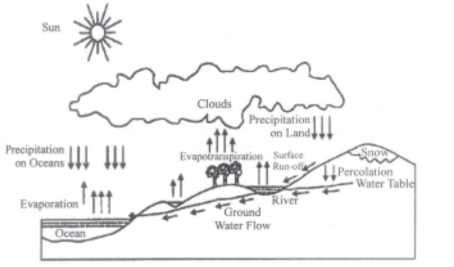
(b) Water is an indispensable natural resource, as no life can exist without water. It is also renewable and reusable. Two methods for conservation of water are,
- Recycling of water: Wastewater from industrial or domestic sources can be used after proper treatment for irrigation, recharging groundwater, and even industrial and municipal use.
- Water harvesting is collecting rainwater that falls on a house or on and around any building, then using it later, or simply replenishing groundwater by allowing the water to recharge it.
21 (a) “The migration of rural population towards neighbouring towns and cities is leading to conspicuous chaos” – briefly explain.
(b) List any two causes of desertification.’ 6
Ans:
(a) The migration of the rural population towards towns and cities in a country is leading to conspicuous chaos. As the villagers mingle with the already swollen urban population, they start facing scarcity of water, sanitation, easily affordable housing, public transport, roads, safe waste supply and clear air. Despite such difficulties, the influx of rural population into cities is continuing and growing.
(b) Causes of desertification
- Deforestation
- Overgrazing
22 (a) What is a Food Chain? Draw a neat and labelled diagram of an aquatic food chain with four trophic levels.
(b) Explain the 10% rule of energy transfer in the above food chain you have drawn. If the 1st trophic level has 5,000 K. cal. of energy, what will the organisms in the 4th trophic level receive?
(c) Why is the number of steps in a food chain limited to 4 or 5? 6
Ans:
(a) Transfer of food energy from green plants (producers) through a series of organisms with repeated eating and being eaten is called a food chain.
Aquatic food chain
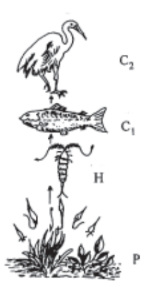
(b) According to the 10% rule related to ecological efficiency, it states that the amount of energy
transferred at each tropic level is only 10% of the energy of the previous tropic level. Therefore,
- If the first trophic level receives 5000 k. Calorie. of energy, the second trophic level recipes only 500 kcal.
- The third trophic level receives just 50 kcal.
- Thus, the fourth trophic level will receive only 5 kcal.
(c) During this process of transfer of energy, some energy is lost into the system as heat energy and is not available to the next trophic level. Therefore, the number of steps is limited in a chain to 4 or 5.
SECTION – B
OPTION – I (Water Resource Management)
23 What do you mean by recharge of water? 1
Ans: The process of precipitation replenishing the groundwater supply is known as recharge.
24 State two reasons for the decline of quality of groundwater. 1
Ans: Contamination, over-exploitation, or a combination of the two. All kinds of activities, urban, industrial, or agricultural, carried out on land have the potential to contaminate groundwater. Industrial discharges, landfills, and subsurface injection of chemicals and hazardous wastes are obvious sources of groundwater pollution.
25 What do you mean by water harvesting at the household level? List any 2 three benefits of it.
Ans: Water harvesting at the household level is simply collecting rainwater that falls over one’s property and then putting it to use around one’s home or yard. This collected water is
- Used to irrigate trees, lawns and landscaping
- Help lower the water bill
- Reduce local flooding
- Reduce landscaping and property maintenance needs
26 How does Precipitation occur? 2
Ans: After water enters the lower atmosphere, it is carried upwards by the rising air currents. High up in the atmosphere, the air cools and loses its capacity to hold water vapour. As a result, the excess water condenses, i.e., changes from vapour to liquid and forms cloud droplets. The droplets ultimately grow in size and cause precipitation. These are four major types of precipitation, namely drizzle, rain, snow and hail. Thus, most of the water is returned to the oceans and on land in the form of rain, snow, hail, etc.
27 (a) List any six attributes of groundwater. 6
(b) Mention in sequence the steps undertaken during water treatment to purify water for drinking.
Ans:
(a) Attributes of groundwater
- There is more groundwater than surface water.
- Groundwater is a less expensive and more economical resource and is available almost everywhere.
- Groundwater is a sustainable and reliable source of water supply.
- Groundwater is relatively less vulnerable to pollution.
- Groundwater is free of pathogenic organisms.
- Groundwater needs little treatment before use.
(b) Conventional treatment of water primarily involves clarification and disinfection.
- Clarification removes most of the turbidity, making the water crystal clear.
- Disinfection, usually the final step in the treatment of drinking water, destroys pathogenic microbes.
- In addition to clarification and disinfection, the processes of softening, aeration, carbon adsorption, and defluoridation may be used for certain public water sources.
- Desalination processes, i.e. removal of excess salt from water, are used in areas where fresh water supplies are not readily available, or the groundwater is saline.
OPTION – II (Energy and Environment)
23 Why nuclear energy remains the world’s slowest-growing energy source? 1
Ans: Management of the nuclear waste disposal, its vulnerability to terrorist attacks and misuse of the technology for making nuclear weapons make it a difficult choice, and it remains the world’s slowest-growing energy source.
24 Give an example each of conventional and non-conventional sources of energy. 1
Ans:
- Conventional: Coal, oil, natural gas, etc., are examples.
- Non-conventional: Biogas, tidal energy, solar energy.
25 What is Natural gas? List the advantages of using natural gas for domestic 2 purposes.
Ans: Natural gas is also a fossil fuel that is a mixture of gases found underground.
- Natural gas is a relatively clean fuel that burns readily to produce a large amount of heat.
- homes. It can be supplied directly to the homes and factories through a network of underground pipelines, thus eliminating the need for additional storage and transport.
26 What are Petro crops? Where are they grown? List any two such plants. 2
Ans: Plants that produce hydrocarbons, which can be used as alternative energy sources, are called petro crops. They are grown on land that is unfit for agriculture and not covered with forests. Jatropa curcas and Calotropis procera are examples of petro plants.
27 Why is it important to construct energy-efficient buildings? Give an example of such a building and mention the technologies used to make it energy efficient? 6
Ans: Energy-efficient buildings are made to save energy and conserve resources. An Ecohouse, a residential building built in the 70s, equipped with a solar cooker, a multifeed biogas plant, rainwater harvesting, etc., is an example. A roof-mounted wind generator was also contemplated but not installed.
The following technologies were used in this house-
- Rainwater harvesting with an underground cistern.
- Roof-integrated solar water heater.
- Window-mounted retractable solar cooker.
- Multifeed biogas plant, usable as a septic tank, if required.
- Three different types of experimental roofs (hollow concrete tiles, Prefab brick jack arches, Madras terrace roof).
- Design for Ventura (ventilation via inner courtyard).
– o O o –
Additional Study Materials
- NIOS Class 12 Environmental Science Question Paper 2024 Oct
- NIOS Class 12 Environmental Science Sample Paper
- NIOS Environmental Science Question Paper April 2025
- Environmental Science NIOS Question Paper April 2024
- NIOS Class 12 Environmental Science Question Paper 2023 ASS
- NIOS Class 12 Environmental Science PYQ With Answers 2023
- NIOS Class 12 Environmental Science Question Paper 2022 Oct