NIOS Social Science Class 10 Chapter 16 Solutions
INTEXT QUESTIONS 16.1
1. What do you mean by rights and duties? How are they interrelated?
Ans: Rights are defined as claims of an individual that are essential for the development of his or her own self and that are recognized by society or the State. A duty is something that someone is expected or required to do. Rights and duties are interdependent. Life can be smoother when rights and duties go hand in hand and complement each other. Rights are what we want others to do for us whereas duties are those acts which we should perform for others. Thus, a right entails an obligation to respect the rights of others. The obligations that accompany rights are in the form of duties.
2. Which of the following statements do not conform to the Right to Equality and why?
(i) Reservation for the Scheduled Castes and Scheduled Tribes provided only in a case of discrimination.
(ii) A former Union Minister facing charges of corruption is exempted from attending the Court.
(iii) Access to public places is open to all.
(iv) Eligibility for employment is based on religion.
(v) Rai Bahadur Sohan Singh is a candidate in Lok Sabha elections.
Ans:
- (i) Because the provision for reservation is not a case of discrimination.
- (ii) Because everyone is equal before the law and discrimination cannot be made on any basis, including the status of a person.
- (iv) Because religion cannot be made the sole basis of employment in any situation.
- (v) Because the Constitution of India has abolished all titles. Mr. Sohan Singh can not use the title of Rai Bahadur.
3. Which one of the following is not a form of untouchability?
(i) There are separate doors for entry in a sacred place, one for Dalits and one for others.
(ii) A Gym refused to admit Dalit clients.
(iii) Dalits share the village hand pumps for water with others.
(iv) A Dalit bride was not allowed to wear a bridal dress on her marriage day.
Ans: (iii) Dalits share the village hand pumps for water with others.
INTEXT QUESTIONS 16.2
1. What are the freedoms provided in the Indian Constitution?
Ans:
- (a) Freedom of speech and expression
- (b) Freedom to assemble peacefully and without arms
- (c) Freedom to form Associations and Unions
- (d) Freedom to move freely throughout the territory of India
- (e) Freedom to reside and settle in any part of India
- (f) Freedom to practise any profession or to carry on any occupation, trade or business
2. Which freedom has been violated in the following cases?
(i) The state policy did not allow the leader of a particular political party to cross its border and enter the state without any reason.
Ans: Freedom to move freely throughout the territory of India
(ii) Workers were not allowed to unite and highlight their demands.
Ans: Freedom to form Associations and Unions
(iii) People forced to leave their own state and go elsewhere.
Ans: Freedom to reside and settle in any part of India
(iv) The son of a shoemaker was not allowed to open a sweet shop in the village.
Ans: Freedom to practise any profession or to carry on any occupation, trade or business
(v) A political party was not accorded permission to hold a public meeting.
Ans: Freedom to assemble peacefully and without arms
3. What are the provisions in the Constitution for the protection of citizens in respect of conviction for offenders, the protection of life and personal liberty and the protection against arrest and detention?
Ans: Article 20, Article 21 and Article 22 respectively
INTEXT QUESTIONS 16.3
1. What is the main objective of making ‘right against exploitation,’ a fundamental right?
Ans: Traditionally, Indian society has been hierarchical, which has encouraged exploitation in many forms. Which is why the Constitution makes provisions against exploitation.
2. Write one term for the following statements:
(a) A practice where a person is compelled to serve without any payment …………………..
(b) Selling and buying of a human beings …………………..
Ans:
- (a) begar
- (b) human trafficking
3. Mention any four real life-situations of exploitation being openly practiced in your neighbourhood.
Ans: Mention the life situations based on your own experiences, like a 10-year-old boy working in a tea shop.
INTEXT QUESTIONS 16.4
1. What are the major cultural and educational rights guaranteed by the Constitution?
Ans: In Articles 29-30 two major provisions have been made: Protection of the interests of minorities, and the right of minorities to establish and administer educational institutions.
2. Tamil, Kannada and Telugu speaking people living in Delhi are amongst the many minority communities. What can they do to conserve their distinct language and culture?
Ans: Any minority having a distinct language, script or culture of its own shall have the right to conserve the same.
3. Which one of the following situations is not covered under the Cultural and Educational Rights:
(a) To conserve one’s distinct language.
(b) No discrimination in granting funds to the minorities.
(c) Right to establish institutions of their own choice.
(d) The Minority school must admit children belonging to the majority community.
Ans: (d) Minority school must admit children belonging to majority community
4. “The right to constitutional remedies is the most important fundamental right.”Do you agree with this statement? Give justification to your answer.
Ans: Encroachment or violation of Fundamental Rights in our day-to-day life is a matter of great concern. Which is why our Constitution does not permit the legislature and the executive to curb these rights. It provides legal remedies for the protection of our Fundamental Rights. This is called the Right to Constitutional Remedies.
INTEXT QUESTIONS 16.5
1. Which international document on Human Rights was prepared and passed by the United Nations General Assembly?
Ans: The General Assembly of the United Nations adopted Human Rights in 1948 and preserved it in the Universal Declaration of Human Rights.
2. List any four Fundamental Rights which are Human Rights also.
Ans: Right to Equality, Right to Freedom, Right to Freedom of Religion and Cultural and Educational Rights.
3. Carefully study the following illustrations and identify and list one Fundamental Duty for each illustration which can be associated with or are related to it.
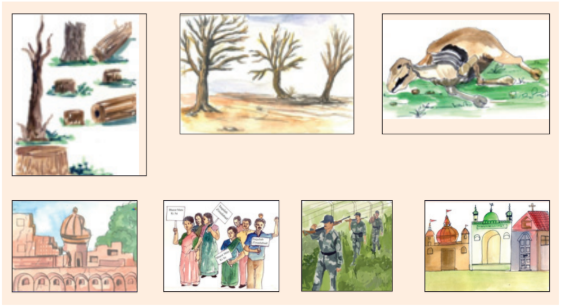
Illustrations to be included:(a) Leafless trees, fallen trees, dead animals etc. (b)Some ruined monuments (c) Marchers in a procession with placards like Inqulab zinadabad, Bharat Mata Ki Jai, Hindustan Amar Rahey (d) Soldier guarding the border or patrolling on the border (e) a few places of worship representing different religions
Ans:
- (a) to protect and improve the natural environment, including forests, lakes, rivers and wildlife, and to have compassion for living creatures;
- (b) to value and preserve the rich heritage of our composite culture
- (c) to abide by the Constitution and respect its ideals and institutions, the National Flag and the National Anthem;
- (d) to defend the country and render national service when called upon to do so
- (e) to promote harmony and the spirit of common brotherhood amongst all the people of India, transcending religious, linguistic and regional or sectional diversities; to renounce practices derogatory to the dignity of women;
4. If you are to take a pledge to abide by four Fundamental Duties on Independence Day, which four duties, according to you, are the most important ones and why?
Ans:
- (a) to abide by the Constitution and respect its ideals and institutions, the National Flag and the National Anthem;
- (b) to uphold and protect the sovereignty, unity and integrity of India;
- (c) to promote harmony and the spirit of common brotherhood amongst all the people of India, transcending religious, linguistic and regional or sectional diversities; to renounce practices derogatory to the dignity of women;
- (d) to protect and improve the natural environment, including forests, lakes, rivers and wildlife, and to have compassion for living creatures;
These duties are focused on the central spirit of the Constitution and the goals that the Indian political system tries to achieve.
TERMINAL EXERCISES
1. Explain the significance of Fundamental Rights in our day to day life. Which fundamental right do you consider the most important in your life and why?
Ans: Fundamental rights are significant for two reasons. First, these are mentioned in the Constitution, which guarantees them and second, these are justiciable, i.e. enforceable through courts. Being justiciable means that in case of their violation, the individual can approach courts for their protection. If a government enacts a law that restricts any of these rights, it will be declared invalid by the courts. Such rights are provided in Part III of the Indian Constitution.
2. Enumerate the six Fundamental Rights granted to us by the Constitution.
Ans: The Constitution guarantees six fundamental rights to Indian citizens as follows:
- (i) right to equality
- (ii) right to freedom
- (iii) right against exploitation
- (iv) right to freedom of religion
- (v) cultural and educational rights
- (vi) right to constitutional remedies
3. How far will the Right to Education eradicate illiteracy from India? Explain.
Ans: Right to Education Act aims at ensuring that every child who is between 6-14 years of age and is out of the school in India, goes to school and receives quality education, which is his/her right. It helps every child to get the basic education and cannot be denied to them by anyone.
4. Describe the main provisions of the Right to freedom of religion.
Ans: In respect of the Right to freedom, the Constitution makes the following four provisions under Articles 25-28:
- 1. Freedom of conscience and free profession, practice and propagation of religion: All persons are equally entitled to freedom of conscience and the right to profess, practise and propagate religion freely. However, it does not mean that one can force another person to convert his/her religion by force or allurement.
- 2. Freedom to manage religious affairs: Subject to public order, morality and health, every religious group or any section thereof shall have the right
- (a) to establish and maintain institutions for religious and charitable purposes
- (b) to manage its own affairs in matters of religion
- (c) to own and acquire movable and immovable property
- (d) to administer such property in accordance with law.
- 3. Freedom as to the payment of taxes for promotion of any particular religion: No person shall be compelled to pay any tax, the proceeds of which are specifically used in payment of expenses incurred on the promotion or maintenance of any particular religion or religious sect.
- 4. Freedom as to attendance at religious instruction or religious worship in certain educational institutions:(1) No religious instruction shall be provided in any educational institution wholly maintained out of State funds.
5. Highlight only three restrictions imposed on the Right to Freedom. In your opinion, are these restrictions justified? Give arguments to support your answer.
Ans: Any three
- 1. Restrictions may be put on the Right to Freedom of speech and expression in the interests of the sovereignty, integrity and security of India, friendly relations with foreign States, public order, decency or morality, or in relation to contempt of court, defamation or incitement to an offence.
- 2. Right to assemble peacefully and without arms may be restricted in the interests of the sovereignty and integrity of India or public order.
- 3. Right to form associations or unions may have restrictions in the interests of the sovereignty and integrity of India, public order or morality.
- 4. Right to move freely throughout the territory of India and to reside and settle in any part of India may also be restricted in the interest of the general public or for the protection of the interests of any Scheduled Tribe.
- 5. Right to practise any profession or to carry on any occupation, trade, or business may have restrictions in the interests of the general public. The State is also permitted to lay down the professional or technical qualifications necessary for practising any profession or carrying on any occupation, trade or business.
6. Do you agree that Human Rights are reflected in the Fundamental Rights of the Indian Constitution?
Ans: Yes, the Indian Constitution covers all the important human rights under the Fundamental Rights. Some of the Human Rights are: Equality before Law, Freedom from Discrimination, Right to Life, Liberty and Personal Security, Right to Free Movement, Right to Education, Right to Marriage and Family, Freedom of Thought, Conscience and Religion, Right to Peaceful Assembly and Association and Right to Participate in the Cultural Life of the Community.
The Fundamental Rights in the Indian Constitution include (i) right to equality, (ii) right to freedom, (iii) right against exploitation, (iv) right to freedom of religion, (v) cultural and educational rights, and (vi) right to constitutional remedies.
7. What are the fundamental duties enumerated in the Constitution? Which of these do you consider as your most important duties and why?
Ans: The following ten duties have been listed in the Constitution of India:
- 1. to abide by the Constitution and respect its ideals and institutions, the National Flag, National Anthem;
- 2. to cherish and follow the noble ideals which inspired our national struggle for freedom;
- 3. to uphold and protect the sovereignty, unity and integrity of India;
- 4. to defend the country and render national service when called upon to do;
- 5. to promote harmony and the spirit of common brotherhood amongst all the people of India and to renounce practices derogatory to the dignity of women;
- 6. to value and preserve the rich heritage of our composite culture;
- 7. to protect and improve the natural environments, including forests, lakes, rivers and wildlife;
- 8. to develop the scientific temper, humanism and the spirit of inquiry and reform;
- 9. to safeguard public property and not to use violence; and
- 10. to serve towards excellence in all spheres of individual and collective activity.
8. Read the following statements; identify the correct ones and rewrite the incorrect ones after necessary corrections:
(i) A person is not free to change his/her religion without permission from the government.
(ii) Every government or government-aided school can impart religious instructions.
(iii) Students of institutions managed by private bodies cannot be compelled to take part in religious worship.
(iv) As a multi-religious state, India can confer any privilege or favor on any religion.
(v) The government can impose taxes for the maintenance of important religious places.
(vi) Places of worship can be constructed anywhere even if they obstruct the national development projects.
Ans:
- (i) Incorrect: A person is
notfree to change his/her religion without permission from the government. - (ii) Incorrect: Every government or government-aided school cannot impart religious instructions.
- (iii) Correct
- (iv) Incorrect: As a multi-religious state, India cannot confer any privilege or favor on any religion.
- (v) Incorrect: The government cannot impose taxes for the maintenance of important religious places.
- (vi) Incorrect: Places of worship cannot be constructed anywhere if they obstruct the national development projects.
9. Match the rights in column ‘A’ with their corresponding duties in column ‘B’.
| A | B |
| (a) The constitution gives us the freedom of expression | (a) It is our duty not to deny the use of them to others. |
| (b) If we have the right to practise the religion of our own choice | (b) It is our duty to obey the rules and maintain discipline. |
| (c) If we have a right to use a public park, a well or a tank | (c) It is the duty of others not to kill us or injure us. |
| (d) If we have the right to live. | (d) It is our duty to allow others to practise their religion. |
| (e) If we have the right to be taught. | (e) It also reminds us and tells us not to hurt the feelings of others. |
Ans:
| A | B |
| (a) The constitution gives us the freedom of expression | (e) It also reminds us and tells us not to hurt the feelings of others. |
| (b) If we have the right to practise the religion of our own choice | (d) It is our duty to allow others to practise their religion. |
| (c) If we have a right to use a public park, a well or a tank | (a) It is our duty not to deny the use of them to others. |
| (d) If we have the right to live. | (c) It is the duty of others not to kill us or injure us. |
| (e) If we have the right to be taught. | (b) It is our duty to obey the rules and maintain discipline. |
Additional Study Materials
- Chapter 11. Bio-diversity Textbook Solutions
- Chapter 12. Agriculture in India Textbook Solutions
- Chapter 13. Transport and Communication Textbook Solutions
- Chapter 14. Population: Our Greatest Resource Textbook Solutions
- Chapter 15. Constitutional Values and Political System in India Textbook Solutions