NIOS Class 12 Psychology Chapter 10 Answers
INTEXT QUESTIONS 10.1
Fill in the blanks
1. _________________ is a part of the brain involved in controlling of physiological expressions of emotions such as fear, anger and pleasure.
Ans: Hypothalamus
2. The involuntary body functions such as heartbeat, breathing, blood flow and digestion are regulated by _________________
Ans: Autonomic Nervous System
3. The Schachter-Singer theory of emotion suggests that emotions compose of _________ and cognitive factors.
Ans: Physiological factor
4. _____________________ is one of the most important non verbal body cues.
Ans: Facial expression
5. The component of emotion is expressed in the form of facial expression & gestures.
Ans: Behavioural
INTEXT QUESTIONS 10.2
State which of the following statements are ‘true’ or ‘false’.
1. The parasympathetic nervous system regulates our body for emergency actions.
Ans: False
2. Verbal and non verbal communications are interdependent on each other.
Ans: True
3. The James-Lange theory of emotion suggests that emotional experience arise from physiological changes.
Ans: True
4. “I” message technique is for expressing intensely positive emotions.
Ans: False
5. Anxiety can sometimes help us to take certain action to avoid dangerous situation.
Ans: True
INTEXT QUESTIONS 10.3
Multiple Choice Questions
i. Which of the following is not Eckman’s basic emotion
(a) Happiness
(b) Love
(c) Surprise
(d) Sadness
Ans: b)
ii. What are the main component (s) of emotion:
(a) physiological
(b) cognitive
(c) behavioral
(d) all of the above
Ans: d)
iii. Happiness is a psychological state characterized by,
(a) an increased positive affect
(b) a decrease in negative affect
(c) life satisfaction
(d) All of the above
Ans: d)
iv. Jealousy is an emotion, predominated by:
(a) love
(b) happiness
(c) fear of loss
(d) disgust
Ans: c)
v. The statement “Emotion we feel is due to the cognitive interpretation of aroused bodily state” was given by
(a) James-Lange
(b) Cannon-Bard
(c) Schachter and Singer
(d) Eckman
Ans: b)
TERMINAL QUESTIONS
1. Why do we have emotions? What role do they serve?
Ans: Humans are emotional beings. We experience a plethora of emotions, including happiness, love, sadness, sorrow, pride, excitement, and many more in our daily lives. It is a medium through which we express and interact with others.
2. What are your primary emotions? What emotions do you think you express most freely and frequently?
Ans: The primary emotions are happiness, love, sadness, sorrow, pride, excitement, etc. Happiness and sadness are the most frequently experienced emotions.
3. Explore the effects of anxiety on your life.
Ans: Anxiety is a feeling characterized by tension, constant recurrence of intrusive thoughts or concerns, and physical changes like an increase in blood pressure.
- It serves as an emotional alarm signal, warning us of a threat or danger.
- When the threats are real, moderate levels of anxiety can encourage us to take certain actions to avoid trouble.
- High levels of anxiety can distort our perception and thinking, thus impairing our performance.
4. When you feel jealous, how do you usually express and behave?
Ans: Jealousy involves fear of losing something (relationship, promotion, friend, etc.) to someone else. It generally happens when a person perceives a threat to a valued relationship from someone else. It may lead to emotional disturbances such as disappointment, anger, depression, etc. It serves as a signal, or wake-up call, that a valued relationship is in threat and that certain steps need to be taken to maintain an important relationship and regain the affection and preserve social bonds.
5. Explain the different theories of emotions with diagram.
Ans:
The James-Lange theory of emotion suggests that emotional experience arises from our perception of physiological changes. For example, when one sees a snake, his/her heart races and muscles get tense, and thus he/she feels scared.

The Cannon-Bard theory of emotion says that the physiological arousal and emotional experience occur simultaneously, yet they are independent of each other. For instance, on seeing a snake, one feels scared (an emotional response). At the same time, his/her heart beat increases (a physiological reaction). Cannon-Bard suggests that both these emotional and physiological reactions will co-occur, even though they would be separate and independent.
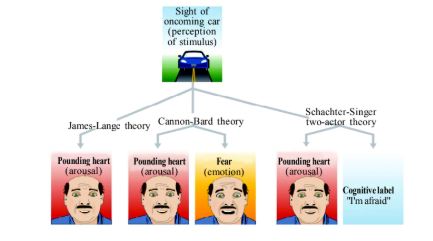
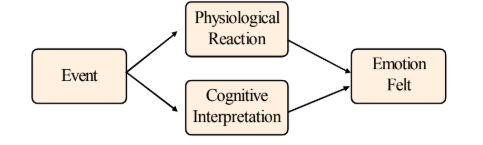
The Schachter-Singer theory of emotion maintains that emotions are composed of two factors: physiological and cognitive. In other words, it suggests that the emotion we feel is due to the cognitive interpretation of an aroused bodily state. Using the same example, on seeing a snake, one’s heart races (a physiological reaction). There is also an apprehension that the snake might bite (cognitive interpretation). Both these reactions contribute to the emotion of fear.
6. Analyze the Autonomic Nervous System and what role does it play?
Ans: The Autonomic Nervous System is the part of the peripheral nervous system that is in charge of regulating a variety of involuntary body functions such as heartbeat, breathing, blood flow, and digestion. It consists of many nerves leading from the brain and spinal cord to the muscles of various organs. The autonomic nervous system can be divided into two parts.
- The Sympathetic Nervous System: The sympathetic nervous system regulates the fight-or-flight response and prepares our body for emergency actions. It is active during an aroused state and prepares the body for extensive action by speeding up the heart rate, raising blood pressure, dilating eye pupils, and raising blood sugar levels.
- The Parasympathetic Nervous System: It tends to be active when our body is in a calm and relaxed state and helps the body to store energy for future use. It helps in maintaining normal body functions, builds up and conserves our physical resources by slowing down heart rate, decreasing blood pressure, constricting eye pupils, and maintaining blood sugar levels.
7. What are the different ways by which we can manage our emotions?
Ans: Emotional management techniques generally focus on lessening unpleasant emotions and enhancing positive emotions. It consists of four components.
- The First component involves telling the objectionable behavior that hurt you in a specific way, but in a nonjudgmental manner.
- Second, politely point out to the person in what ways his/her behavior has affected you.
- Third, indicate to the person how you feel about his or her behavior in terms of the emotions you felt. Express your feelings, but don’t project your feelings onto others. For example, you should say “I feel hurt” instead of “you hurt me”.
- Fourth, tell the person what you want him or her to do to correct the situation.
- Expressing our feelings openly and constructively will help us to clear the misunderstanding and facilitate communication.
- Enhancing self-awareness, appraising the situation objectively, and using self-monitoring techniques can also be used to regulate our emotions.
8. How does culture influence our expressions and emotions?
Ans: Culture has a major influence on how we express and interpret our emotions. Some cultures promote free expression of emotions, whereas others emphasize revealing fewer emotions in public. Silence has been found to convey different meanings. In India, deep emotions are sometimes expressed by staying silent. However, in Western countries, it may mean embarrassment. For instance, the thumbs-up sign is represented as ‘A-Okay’ or nice job in the United States, but assumes a derogatory and offensive interpretation in some Latin American cultures.
9. Explain Yerkes-Dodson’s Law and analyze the relationship between anxiety and performance.
Ans: Yerkes-Dodson’s law suggests a relationship between arousal and performance and states that in a moderately difficult task, performance increases with physiological arousal, but only up to a certain point. When the arousal becomes too high, performance decreases. The phenomenon is often demonstrated graphically as a bell-shaped curve.
10. Why expressing our emotions and feelings are important?
Ans: Some emotions are associated with positive feelings, while others are associated with negative feelings. However, both are equally important and play a significant role in the understanding of our and others’ experiences. It has a great impact on others if expressed in a way that can be perceived well by others. We also perceive the emotional responses of other people and respond appropriately. We communicate our feelings and decipher the feelings of others constantly.
Additional Study Materials
- NIOS Class 12 Psychology Syllabus Bifurcation
- NIOS Class 12 Sample Question Paper
- Attention and Perceptual Processes
- Learning
- Human Memory
- Motivation