NIOS Class 12 Environmental Science Chapter 27A
INTEXT QUESTIONS 27.1
1. Which part of earth is covered with water?
Ans: More than 3⁄4
2. To be considered as fresh water, how much solids can be there?
Ans: Less than 1000 ppm
3. In arid and semi-arid areas, what is true regarding the amount of water present?
Ans: Limited water availability.
INTEXT QUESTION 27.2
1. State any two important uses of water for maintaining life on Earth.
Ans:
- The cycling of all other elements depends on water, as it serves as a medium for their transportation during the various steps and is the solvent medium for the nutrient uptake by the plants and other organisms.
- Water is also the only source of hydrogen and one of the many sources of oxygen available to the body through metabolic processes.
2. Why did early civilizations settle near river banks?
Ans: Human survival since the ages has depended on the relationship between human settlements and the availability of fresh water resources. Many early civilisations have grown and flourished on riverbanks. Availability of fresh water at appropriate times and in suitable quantity and quality is vital to the ecological health of a country, as well as vital to the towns and cities.
3. Why there is an increasing shortage of fresh water? Give two reasons.
Ans: Much water is being wasted, used inefficiently and polluted through human activities. As
a result of developments and mismanagement of fresh water resources have resulted in huge water shortages.
INTEXT QUESTIONS 27.3
1. What is surface run-off?
Ans: Groundwater is discharged either directly or indirectly into the rivers and seas by way of springs. The rest of the water moves as surface runoff into streams and rivers and ultimately flows into the ocean or other water bodies from where it enters the cycle again.
2. Name three long-term stores of water.
Ans: Oceans, ice caps and glaciers are long-term stores of water.
3. How long can water be stored in the body of a living organism?
Ans: One week or 7 days.
INTEXT QUESTIONS 27.4
1. How does global warming change movement of water vapour across oceans and continents?
Ans: Global warming significantly changes the precipitation patterns, as precipitation is dependent on ambient temperature.
2. How can river run-off be altered?
Ans: Increasing or decreasing the length or density of the river channels can directly change river runoff.
3. State one way of reducing water table.
Ans: Groundwater can be affected by pumping out excessive water that lowers the water table or through increased percolation due to waterlogging from the development of reservoirs and dams.
TERMINAL EXERCISES
1. How does hydrological cycle is driven?
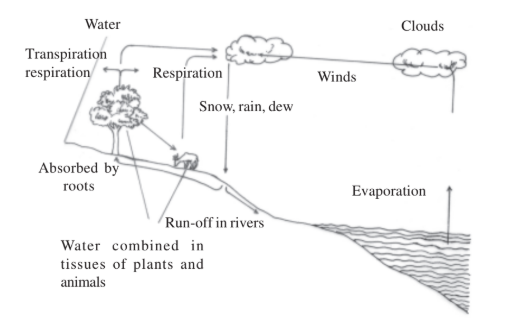
Ans: The system of continuous movement of water in all its forms (ice, liquid and vapour), is called the hydrological cycle. This cycle is driven by solar energy. It involves a continuous recycling of water between the atmosphere, land and oceans by several processes. Within the atmosphere, vertical and horizontal air movements, including winds, transfer moisture from place to place. The streams, rivers, and glaciers transfer water from land to the oceans, where large-scale currents transfer water within the oceans.
2. In which form water locks in ice caps?
Ans: About 2% of the earth’s fresh water (i.e. about 66% of all fresh water) is in solid form, locked in ice caps of Antarctica and glaciers that occupy high alpine locations. Because it is frozen and far away, fresh water in ice caps is not available for use.
3. Where did primitive human settlements find?
Ans: Human survival since the ages has depended on the relationship between human settlements and the availability of fresh water resources. Many early civilisations have grown and flourished on riverbanks.
4. ‘Living beings cannot survive without water’. Explain this statement in your own words.
Ans: Water is an inescapable necessity for all life on earth. It is the most important component of protoplasm in the cells of living organisms. On average, 70% of our bodies are made up of water. Water is also the only source of hydrogen and one of the many sources of oxygen available to the body through metabolic processes.
5. Draw a neat diagram to depict the movement of water in the hydrological cycle.
Ans:
6. What is the role of oceans in the water cycle?
Ans: Oceans are the major storage of water on the Earth. They are conduits rather than stores. 97.41% of the water on Earth is saltwater found in the oceans. The streams, rivers, and glaciers transfer water from land to the oceans, where large-scale currents transfer water within the oceans. Moreover, water ultimately
flows into the ocean or other water bodies from where it enters the cycle again.
7. What is precipitation? When does it occur?
Ans: After water enters the lower atmosphere, it is carried upwards by the rising air currents. High up in the atmosphere, the air cools and loses its capacity to hold water vapour. As a result, the excess water condenses, i.e., changes from vapour to liquid and forms cloud droplets. The droplets ultimately grow in size and cause precipitation.
8. State three ways in which usable water is becoming scarce.
Ans: Much water is being wasted, used inefficiently and polluted through human activities. As a result of developments and mismanagement of fresh water resources have resulted in huge water shortages.
9. What is meant by global circulation of water?
Ans: The global circulation of water refers to the hydrological cycle of water, which is prevalent across the globe. It is the system of a continuous movement of water in all its forms, such as ice, liquid
and vapour. This cycle is powered by solar energy.
Water is evaporated from oceans, rivers, lakes and vegetation, and becomes part of the atmospheric moisture. Global winds distribute this across the Earth’s surface. Condensation creates clouds, and precipitation brings it back to the surface from where it evaporates to re-enter the global water cycle.
10. Explain in brief about the various steps involved in hydrological cycle.
Ans: The three main processes involved in the hydrological cycles are –
Evaporation and evapotranspiration
Heat from the sun changes liquid water into water vapour. Transpiration from plants is another source of water vapour. Since it is difficult to separate the processes of transpiration and evaporation, evapotranspiration is generally used to describe the combined process of evaporation and transpiration. These three processes together provide all the water to the atmosphere. Some of these vapours enter the atmosphere through sublimation, a process by which water changes from solid state, that is ice, directly into vapour without changing into liquid form.
Precipitation
- After water enters the lower atmosphere, it is carried upwards by the rising air currents.
- High up in the atmosphere, the air cools and loses its capacity to hold water vapour, and excess water condenses i.e., changes from vapour to liquid and forms cloud droplets.
- The droplets ultimately grow in size and cause precipitation in the form of drizzle, rain, snow and hail and is returned to the oceans and land.
Surface runoff
- When precipitation falls over land, it travels through various routes.
- One part of it evaporates back into the atmosphere, and the other part is stored as groundwater.
- This water is discharged either directly or indirectly into the rivers and seas by way of springs.
- The rest of the water moves as surface runoff into streams and rivers and ultimately flows into the ocean or other water bodies, from where it enters the cycle again.
- At different stages of the water cycle, human beings and other organisms intercept it and withdraw water for their use.
Additional Study Materials
- Chapter 23 Environmental Legislation
- Chapter 24 Environmental Impact Assessment
- Chapter 25 Environmental Related Institutions and Organisations
- Chapter 26 Environmental Ethics and Gandhian Approach