NIOS Class 12 Environmental Science Chapter 30B
INTEXT QUESTIONS 30.1
1. Define biomass and list various sources of biomass.
Ans: Biomass is an accumulation of organic matter such as plant and animal materials (living or dead). It is a renewable energy source. Eg, agricultural wastes and residues.
2. What is biomass conversion?
Ans: Biomass conservation is the process of obtaining energy or fuel from the chemical energy stored in biomass.
3. Why is biomass considered an indirect form of solar energy?
Ans: Biomass consists of green plants, which convert solar energy to chemical energy by photosynthesis, and animals which feed upon plants and store chemical energy. Biomass can be burned directly as solid fuel or converted into alcohol or into biogas. So the fuel energy of biomass is actually locked up in solar energy.
4. Give two advantages of using biomass fuel.
Ans: Uses of biomass energy
- Does not add CO2 to the atmosphere.
- It can be used to generate electricity easily.
- It constitutes a major form of renewable resource of energy.
5. What are petro crops? List any two such plants.
Ans: Plants that produce hydrocarbons in substantial amounts and can act as alternative energy sources are called petrocrops. Examples: Jatropa curcas, Calotropis procure (or any other).
INTEXT QUESTIONS 30.2
1. Define geothermal energy and list its uses. Give some examples of where this form of energy can be trapped.
Ans: It is the natural heat from the interior of the earth that is converted to heat building and generates electricity. Examples of such sites are volcanoes, hot springs, geysers and methane under the water in the process.
2. Describe the disadvantages and advantages of the use of geothermal energy.
Ans: Advantages of geothermal energy- Most energy efficient, cost-effective and environmentally clean.
Disadvantages –
- Steam contains H2O, which has the odour of rotten eggs.
- The minerals in the steam are also toxic to fish and corrosive to the pipes and equipment.
3. “Hydrogen energy is called fuel for the next generation” Comment on the statement.
Ans: Hydrogen is available in plenty, and when it burns in the presence of oxygen, it produces non-polluting water vapour. It is a clean source of energy. Technology is needed to get free hydrogen as fuel, and cost-effective fuel cells need to be developed.
4. Where in India is the most promising geothermal field located?
Ans: Puga Valley in the Ladakh region.
TERMINAL EXERCISE
1. List the renewable sources of energy which are ideal for the coming times.
Ans: Petro crops, geothermal energy, hydrogen gas, fuel cells, etc, are some of the renewable sources of energy ideal for the coming times.
2. Describe the advantages of hydrogen as a fuel. Do you think hydrogen will become a major source of energy? Give reasons for your answer.
Ans: When hydrogen gas burns in the air or in fuel cells, it combines with oxygen gas to produce non-polluting water vapour, and fuel cells directly convert hydrogen into electricity. Widespread use of hydrogen as fuel would greatly reduce the problem of air pollution and the danger of global warming
because there would be no CO2 emissions. It is clean, alternative energy for diverse uses, including lighting, power, heating, cooling, transportation and many more.
The disadvantage of hydrogen as fuel is its high production cost, as it is not freely available and has to be made from combination compounds with oxygen, carbon and nitrogen.
3. Describe fuel cell technology and its advantages.
Ans: Fuel cells are highly efficient power-generating systems that produce electricity by combining fuel (hydrogen) and oxygen in an electrochemical reaction. Fuel cells are electrochemical devices that convert the chemical energy of a fuel directly and very efficiently into electricity (DC) and heat, thus doing away with combustion.
Both oxygen and hydrogen are added to the fuel cell in an electrolyte solution. The reactants remain separated from one another and, upon ionisation, migrate through the electrolyte solution from one electrode to another. The flow of electrons from the negative to the positive electrode is diverted along its path into an electrical motor, supplying current to keep the motor running. In order to maintain this reaction, hydrogen and oxygen are added as needed.
Advantages
- Fuel cells are well-suited for automobiles, homes, and large-scale power plants and can store energy to be used as needed.
- Fuel cell systems are excellent options for small-scale decentralised power generation.
- Fuel cells can supply combined heat and power to buildings, hospitals, airports and military installations at remote locations.
- Fuel cells have efficiency levels up to 55% as compared to 35% of conventional power plants.
- The emission of greenhouse gases is significantly low CO2 as water vapor is being the only emission.
- Fuel cells have been used in space flights and are being introduced in electric vehicles to reduce urban air pollution.
- Fuel-cell-powered EVs (electric vehicles) are better than battery-operated EVs in terms of increased efficiency and easier and faster refuelling.
4. Why are fuel cells more efficient in generating electricity in comparison to traditional systems?
Ans: A fuel cell consists of an electrolyte sandwiched between two electrodes. Oxygen passes over one electrode and hydrogen over the other, and they react electrochemically to generate electricity, water,
and heat. Traditional methods of generating electricity require combustion of fuel, and the resultant heat is used to produce steam to run turbines, which generate electricity. This method involves loss of heat and thus is not very efficient. In chemical fuel cells, on the other hand, chemical energy is converted directly into electricity, thus is more efficient and does not produce harmful gases.
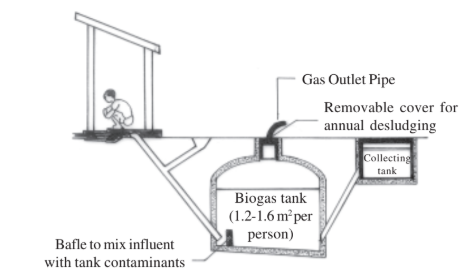
5. Draw a schematic representation of a biogas plant and label its parts.
Ans:
6. What are the limitations of (i) fuel cells, (ii) geothermal energy? (any two)
Ans:
- (i) Fuel Cells: High initial cost is still the biggest hurdle in the widespread commercialisation of fuel cells.
- (ii) Geothermal Energy
- Geothermal energy can pose several environmental problems, which include on-site noise, emissions of gas and disturbance at drilling sites, disposal sites, roads and pipelines and power plants during its development.
- The steam contains hydrogen sulphide gas, which has the odour of rotten eggs, and causes air pollution.
- The minerals in the steam are also toxic to fish, and they are corrosive to pipes and equipment, requiring constant maintenance.
7. How is the fuel obtained from petrocrops?
Ans: The most critical step in bioenergy production is the selection of plant species that produce substances from which useful products can be extracted in an economically viable way. Jatropa curcas is an important petro plant.
- This biocrude can be obtained by tapping the latex, followed by coagulation, or by extraction of the dry biomass using a suitable solvent in cases where latex tapping is not possible.
- Biocrude is a complex mixture of liquids, terpenoids, triglycerides, phytosterols, waxes, and other modified isoprenoid compounds.
- It can be catalytically upgraded for use as a liquid fuel. Hydro cracking of biocrude can convert it into several useful products like gasoline (automobile fuel), gas oil and kerosene.
8. Discuss the advantages and disadvantages of geothermal energy.
Ans:
Advantages
- Geothermal energy is natural heat from the interior of the Earth that can be used to generate electricity as well as to heat up buildings.
- In some countries, such as the USA, water is pumped from underground hot water deposits and used for heating houses.
- It is being used mainly for poultry farming, mushroom cultivation, and pashmina-wool processing, all of which need higher temperatures.
Disadvantages
- Geothermal energy can pose several environmental problems, which include on-site noise, emissions of gas and disturbance at drilling sites, disposal sites, roads and pipelines and power plants during its development.
- The steam contains hydrogen sulphide gas, which has the odour of rotten eggs, and causes air pollution.
- The minerals in the steam are also toxic to fish, and they are corrosive to pipes and equipment, requiring constant maintenance.