NIOS Class 12 English Chapter 14 Question Answer
INTEXT QUESTIONS 14.1
1. Where are the merchants? What are they doing?
Ans: The merchants are in the bazaar in Hyderabad. They are selling their goods that they have displayed in a very attractive manner.
2. Who addresses the merchants?
Ans: The poet, who finds the display very attractive, addresses the merchants.
3. What do the merchants display? Why does the poet use the words ‘richly displayed’?
Ans: The merchants display turbans that are crimson and silver, loose-fitting shirts made of purple brocade, mirrors framed in yellow amber and daggers that have handles made of jade, a green coloured stone. The poet uses the words ‘richly displayed’ as all these items are brightly coloured, expensive and lavishly exhibited.
4. What kind of cloth is brocade?
Ans: Brocade is a patterned fabric specifically made for ornamental outfits. It is a rich silk fabric with raised patterns in gold and silver. These rich designs are not embroidered on the fabric but woven into it.
5. Explain Mirrors with panels of amber.
Ans: The mirrors sold in the market are framed with a yellow coloured stone called amber.
6. What kind of people are likely to buy Tunics of purple brocade, Mirrors with panels of amber, Daggers with handles of jade?
Ans: The rich people and nobles from the court of the Nizam of Hyderabad will buy these costly items.
INTEXT QUESTIONS 14.2
1. How many people does the speaker address in this stanza?
Ans: The poet addresses vendors, young maidens and peddlers.
2. Where are the maidens? What do they grind?
Ans: The maidens are in the bazaar. They are grinding sandalwood, henna and spices for sale.
3. Who are referred to as vendors in the poem?
Ans: The vendors weigh saffron, lentil and rice.
4. Why do the maidens grind sandalwood, henna and spice?
Ans: The maidens grind sandalwood, henna and spice to make their fine powder. They may be grinding henna and sandalwood, probably because there is some auspicious ceremony or festival.
5. Who are peddlers? How are they different from vendors?
Ans: A peddler is a person who sells from door to door or in the street, calling out to draw attention to his goods. to sell their goods. Peddlers usually do not have a stall, so they will go from place to place selling their goods. On the other hand, a vendor is someone who sells goods from their own stall.
6. What do the wares sold by the peddlers – ‘chessmen and ivory dice’ – suggest about Indian society?
Ans: Individual answer (society that had money; able to afford luxuries; enjoy beautiful products; had leisure time for pursuits like chess).
INTEXT QUESTIONS 14.3
1. What do the goldsmith make for women?
Ans: Wristlets, anklets and rings.
2. What is a wristlet?
Ans: A wristlet is a bracelet encircling the wrist.
3. What do goldsmiths make for pigeons?
Ans: Delicate bells for the feet of blue pigeons.
4. What do you think of people who buy gold ornaments for their pets?
Ans: Individual answer
5. What do goldsmiths make for the dancers?
Ans: Gold Girdles or belts
6. What do the goldsmiths make for the king?
Ans: Gold scabbards or sheaths to cover the sword.
INTEXT QUESTIONS 14.4
1. The poet says, “What do you cry, O ye Fruit merchants.” Why does the Poet say cry when she refers to the fruit men?
Ans: The poet used the term cry because the fruit men were calling in a loud voice.
2. What are the fruit merchants selling?
Ans: The musical instruments being played by the musicians in the bazaars of Hyderabad are the sitar, sarangi and drum.
3. What are the instruments played by the musicians in the bazaars of Hyderabad?
Ans: “Spells for aeons to come” means that the magicians are chanting magical spells that will last for a long period of time.
4. What does Spells for aeons to come mean?
Ans: Aeons means an immeasurably long period of time.
5. Which of the following musical instruments is a sarangi?
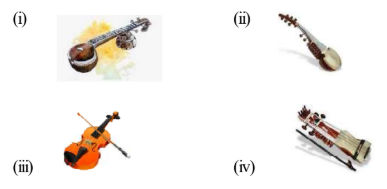
a) Option (i)
b) Option (ii)
c) Option (iii)
d) Option (iv)
Ans: (d) Option (iv)
6. Name the instrument.
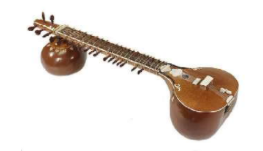
Ans: Sitar
INTEXT QUESTIONS 14.5
1. What colour tassels are the flower girls weaving?
Ans: Azure and red.
2. What do the flower girls weave for the bridegroom?
Ans: Crowns for the brow and chaplets to garland his bed.
3. What is meant by tassels of azure and red?
Ans: It refers to the tassels that are blue and red in colour
4. What is the wedding hair thing called?
Ans: Referred to is a “crown” for the bridegroom.
5. What is the meaning of tassels?
i) Fight
ii) Coloured
iii) a tuft of loosely hanging threads or cords knotted at one end
iv) conflicting situation
Ans: (iii) a tuft of loosely hanging threads or cords knotted at one end.
6. What two contrasting (happy and sad) occasions are referred to in stanza 5?
Ans: The flower girls were making crowns and garlands for the marriage ceremony. Chaplets were made to decorate the bed of the bridegroom. The flower girls were also making a sheet of white flowers to cover the dead bodies. These are some of the happy and sad occasions for which the flower girls are weaving flowers.
INTEXT QUESTIONS 14.6
1. Change the following active voice interrogative sentences into passive voice:
i. Who completed the project?
Ans: By whom was the project completed?
ii. When will they announce the winners?
Ans: When will the winners be announced by them?
iii. How did she solve the problem?
Ans: How was the problem solved by her?
iv. Why did you break the vase?
Ans: Why was the vase broken by you?
v. Where can we find the keys?
Ans: Where can keys be found?
2. Rewrite the following passive voice interrogative sentences into active voice:
i. Was the cake baked by Sarah?
Ans: Did Sarah bake the cake?
ii. Is the book being read by anyone?
Ans: Is anyone reading the book?
iii. Has the car been repaired by the mechanic?
Ans: Did the mechanic repair the car?
iv. Were the tickets purchased by the group?
Ans: Did the group purchase the tickets?
v. Will the letter be delivered by the postman?
Ans: Will the postman deliver the letter?
3. Change the voice of the following interrogative sentences:
i. Were the cookies eaten by the children?
Ans: The children ate the cookies.
ii. Who painted this beautiful portrait?
Ans: Who painted this beautiful portrait?
iii. Is the report being reviewed by the supervisor?
Ans: The supervisor is reviewing the report.
iv. Why was the concert canceled by the organizers?
Ans: The organizers canceled the concert.
v. Has the homework been completed by the students?
Ans: The students have completed the homework.
INTEXT QUESTIONS 14.7
1. Is there any simile used in the poem?
Ans: “Bells for the feet of blue pigeons, Frail as a dragon-fly’s wing.”
2. Find out the symbolism used in this poem.
Ans: “Crowns for the brow of a bridegroom” symbolise celebration and festivity.
“Scabbards of gold for the kings” symbolise power and authority.
“Sheets of white blossoms” symbolise purity and mourning.
3. Complete the table given below listing the imagery used in the poem.
| Sight | Sound | Smell | Taste | Touch |
| turbans of crimson and silver | fragrance of sandalwood, henna and spice |
Ans:
| Sight | Sound | Smell | Taste | Touch |
| turbans of crimson and silver | Sitar, Sarangi, and drum Spells for the eons to come | fragrance of sandalwood, henna and spice | Citron,pomegranateand plum | Wristlet and anklet and ringGirdles of gold for the dancers,Scabbards of gold for the kings |
TERMINAL QUESTIONS
1. How does the poet highlight the occupation of the simple people in India?
Ans: The poet highlights the occupations of simple Indian people by presenting the bazaar as a lively and colourful place filled with workers from different trades. She shows sellers, merchants, craftsmen, musicians, magicians, goldsmiths, fruit sellers, flower girls and poets, each busy with their work.
Through questions and answers, the poet allows every worker to describe what they sell or make, such as turbans, mirrors, garlands, anklets, saffron, rice, ivory dyes, and lamps. This style makes their work feel natural and meaningful. The poem celebrates Indian traditional crafts and self-reliance, showing that ordinary people earn their living honestly through skill, creativity, and hard work.
2. When you happen to visit the bazaars of Hyderabad what things from the poem come to your mind?
Ans: Individual answer.
Additional Study Materials
- NIOS Class 12 English Sample Paper
- Chapter 9: Three Questions
- Chapter 10: Of Studies
- Chapter 11: Night of the Scorpion
- Chapter 12: Where the Mind is without Fear
- Chapter 13: If