NIOS Class 10 English Chapter 20 Question Answer
INTEXT QUESTIONS 20.1
I. State which of the following statements are false and why.
a. Recycling is the need of the hour.
b. We should burn our rubbish.
c. Recycling means reusing waste material.
d. Thousands of trees are felled to print the Sunday edition of the New York Times.
Ans: b. We should burn our rubbish.- False. Burning actually increases pollution.
II. How is the reusing of waste beneficial? Explain.
Ans: Reusing waste is beneficial as it will help to save our natural resources which are limited in quantity. The reuse of waste will reduce the pollution caused by burning it.
III. Summarise the passage by completing the following web:
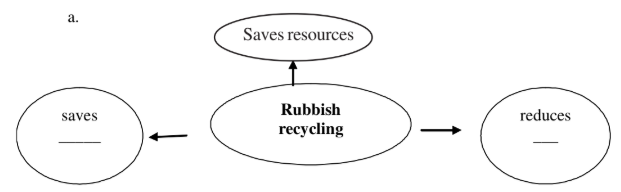
Ans: Rubbish recycling saves resources, reduces pollution and saves our environment.
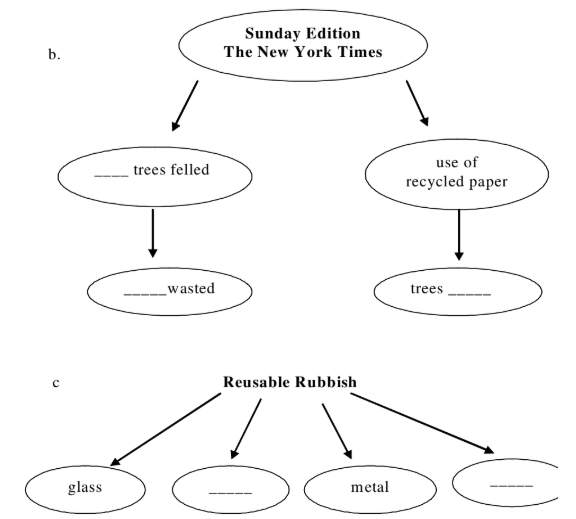
Ans:
b. Thousands of trees felled and earth’s resources wasted. Use of recycled paper , trees saved.
Reusable rubbish- glass, paper, metal, plastics.
LET US DO 20.2
Try to find out about the Chipko Movement.
Who started it?
Where was the movement started?
Why was it started?
How did people participate in the movement?
What was the outcome of the movement?
Ans:
- Sunderlal Bahuguna and Chandi Prasad Bhatt
- It began in the Chamoli district in Uttar Pradesh (now Uttarakhand).
- The movement was a response to massive, government-backed commercial deforestation that destroyed the local ecology and deprived villagers of fuel, fodder, and water.
- Villagers, mainly women, engaged in non-violent satyagraha by physically hugging or clinging to trees to prevent loggers from cutting them down.
- Because of this movement, a 15-year ban on the commercial felling in the Himalayan region above 1,000 meters was enacted by Prime Minister Indira Gandhi in 1980.
INTEXT QUESTIONS 20.2
I. State which of the following statements are false and why.
a. It is simple to recycle plastic.
b. We should avoid recycling aluminum.
c. A new shining car has components of old cars.
d. It is always beneficial to recycle valuable metals.
Ans:
- a. False
- b. False
- c. True
- d. True
II. How is metal recycling different from plastic recycling? Explain.
Ans:
III. In the first line of the last para, the word more is used twice.
Make a sentence using more in a similar way.
Eg. The more respect you give the more you get.
Ans: Metal recycling not only saves natural resources, but also a lot of electricity and energy. It is not easy to recycle plastic. It is also not possible to make good quality plastic products out of recycled plastic.
INTEXT QUESTIONS 20.3
I. State which of the following statements are false and why.
a. Glass bottles can be used over and over again.
b. Copying western habits may lead Indians towards wasting resources.
c. The British are more successful in recovering glass than the Dutch
d. Glass once broken is a waste material.
Ans:
- a. True
- b. True
- c. False
- d. False
II. Suggest two ways in which a student can avoid wastage of paper.
Ans:
- By recycling unused pages into a new book
- Use both the sides of a paper.
- Use whiteboard for studying rather than papers.
III. In the sentence ‘Half the world’s waste consists of paper’, waste is used as a noun.
Make a sentence using waste as a verb.
e.g. If we waste time we can not get it back.
Ans: We can’t afford to waste so much food.
LET US LEARN NEW WORDS 20.1
1. Underline the words which do not constitute our natural resources:
air, water, earth, plastic, trees, paper, gold, glass
Ans:
2. Match the describing words with the nouns they describe:
| Describing word | Noun |
| valuable coloured western plastic precious | bottles metals glass countries resources |
Eg: plastic bottles
- Western countries
- Coloured glass
- Valuable resources
- Precious metals
1. Fill in the blanks with appropriate conjunctions from the brackets.
a. Make hay _____ the sun shines. (when, while)
Ans: while
b. She must sleep _______ she will fall sick. (or, and)
Ans: or
c. You reap ______ you sow. (as, so)
Ans: as
d. The sky is neither cloudy _______ bright. (or, nor)
Ans: nor
e. She is poor ______ happy (but, though)
Ans: but
2. Find out one example each of coordinating and subordinating conjunctions in UNIT III of the lesson.
Ans:
- Conjunction: “and”: Broken glass can be remelted in furnaces and then it can easily be shaped into new bottles.
- Subordinating Conjunction “since”: Glass is best separated by colour, since cullet of mixed colours can be used only to make green glass.
3. The following passage has not been edited. The conjunction in each line is incorrect. Underline the error and write the correct conjunction in the blank space alongside.
Turmeric has sacred so well as medicinal value (a) ________ It is native to India yet it is now grown (b) ________ in many countries in Asia or Africa. (c) ________ Researches establish while it can be used (d) ________ for colouring paints but varnishes . (e) ________ It is used that as a medicine (f) ________ Yet also as an inexpensive beauty aid. (g) ________.
Ans:
- (a) as (replaces “so”) – Turmeric has sacred as well as medicinal value.
- (b) and (replaces “yet”) – It is native to India, and it is now grown…
- (c) and (replaces “or”) – …in many countries in Asia and Africa.
- (d) that (replaces “while”) – Researches establish that it can be used…
- (e) and (replaces “but”) – …for colouring paints and varnishes.
- (f) is (replaces “that”) – It is used as a medicine…
- (g) But (replaces “Yet”) – But also as an inexpensive beauty aid.
Corrected Paragraph:
Turmeric has sacred as well as medicinal value. It is native to India and it is now grown and in many countries in Asia and Africa. Researches establish that it can be used and for colouring paints and varnishes. It is used as a medicine and also as an inexpensive beauty aid.
Dive deeper in AI Mode
4. Given below are a few instructions to prepare a cup of hot tea.
- 1. Put one cup of water into a pan.
- 2. Put the pan on the stove.
- 3. Let the water boil.
- 4. Add 1⁄2 teaspoon tea leaves and some milk.
- 5. Add sugar according to taste.
- 6. Boil for some time.
- 7. Strain into a cup.
- 8. Serve hot
Read the above instructions carefully and fill in the blanks to complete the paragraph below. Remember to use the passive voice when describing the process of making hot tea.
A cup of hot tea
First of all _____ is _____ into a pan. The pan is _______. The water is ______ to boil. Then 1⁄2 a teaspoon of _____ and some ______are added. Thereafter, sugar _____ according to taste. The decoction is _____ to boil. It is then ______ into cups and _______ hot.
Ans: water, poured, placed, tea leaves, milk, is added, left, poured, served.
TERMINAL QUESTIONS
I. Complete the following using the correct alternatives:
1. Recycling refers to
a. the conversion of waste materials into new and useful things.
b. the conversion of new and useful things into some other form.
c. the conversion of old useful things into a different form.
Ans: a. the conversion of waste materials into new and useful things.
2. Rubbish burning should be avoided to
a. create pollution.
b. increase pollution.
c. reduce pollution.
Ans: c. reduce pollution.
3. Plastic recycling is the most difficult because of
a. its various colours.
b. its various varieties.
c. its various sizes.
Ans: b. its various varieties.
II. Answer the following in no more than 50 words.
1. Why is it important to recycle waste?
Ans: Recycling rubbish not only helps save money, it also helps the environment. We lessen the pollution that is created by burning rubbish and we save valuable resources.
2. How can recycling help in checking global warming?
Ans: manufacturing of plastics and metals often leads to greenhouse gas emissions, By recycling them, these gas emissions are reduced thereby reducing global warming.
3. Reduce, Reuse, Recycle shall be our motto.
a. Explain why this should be our motto.
b. Give one example of each action in daily life.
Ans:
a.
- If we reduce our needs, we can preserve our natural resources.
- If we reuse the most commonly used paper, metal, glass and plastic objects, it will help us save natural resources and our environment.
- Recycling things as much as possible reduces landfills and can protect the environment.
b.
- Instead of paper bags, we should use cloth bags, which will reduce the need for paper.
- Most of the world’s rubbish can be reused: paper, metals, glass, and even some plastics.
- Waste like empty cans, old books, notebooks, broken buckets, and utensils should be recycled so as to save energy, electricity, money, manpower and resources.
4. Think of an alternative title for the passage and justify it.
Ans: The Art of Recycling
5. Imagine that no waste material is recycled. What would be the outcome? Write any three outcomes.
Ans:
- There will be massive environmental pollution due to the accumulation of waste.
- Most waste generates toxic gases that not only pollute the air but also cause health issues for living beings.
- It will also lead to faster depletion of natural resources.
6. Complete the following slogans:
- Recycle paper Save ___________
- Recycle metals Save ____________
- Recycle today Save ___________
Ans:
- Recycle paper, Save forests
- Recycle metals Save resources
- Recycle today Save tomorrow
Additional Study Materials
- Chapter 14: Stealing And Atonement Textbook Solutions
- Chapter 15: My Vision For India Textbook Solutions
- Chapter 16: My Only Cry Textbook Solutions
- Chapter 17: Caring For Other Textbook Solutions
- Chapter 18: The Little Girl Textbook Solutions
- Chapter 19: A Prayer For Healing Textbook Solutions






Great article with real substance. This website continues to deliver.