NIOS Class 12 Psychology Sample Paper
Time: 3 Hrs Marks: 100
Section A
1. Rita, a chess enthusiast, is being observed by her coach to monitor her moves for improvement. To do so the coach is studying her ________ behaviour.
a. Normal
b. Observable
c. Covert
d. Quiet
Ans: c. Covert
2. Which of the following statements is true for correlational research?
a. Identifies relationship with many variables
b. It can predict cause and effect
c. Identifies relationship between two variables
d. Controls the impact of extraneous variables
Ans: c. Identifies relationship between two variables.
3. When do researchers use the experiment method?
a. When the researcher needs to identify relationship with many variables
b. When the researcher has to predict cause and effect
c. When the researcher has to identify relationship between two variables
d. When the researcher has to study about opinions, beliefs and values of the participants.
Ans: b. When the researcher has to predict cause and effect
4. If you look at a railway track from a distance. The tracks appear to be converging at a point though, we know, this does not actually happen. What is this monocular cue called?
a. Linear perspective
b. Aerial Perspective
c. Relative height
d. Interposition
Ans: a. Linear perspective.
5. Meena travelled by train for the first time and noticed that the hills, at a distance, slowly moved along with her but the trees next to the train moved rapidly against the direction of the train. This an example of:
a. Texture gradient
b. Light and Shade
c. Motion Parallax
d. Relative Size
Ans: c. Motion Parallax
6. You must have noticed that police vehicles and ambulances have flickering and flashing lights along with a loud siren for people to notice them. Which are the two external factors here that help people to attend to them?
a. Novelty and size
b. Movement and intensity
c. Change and repetition
d. Clarity and colour
Ans: b. Movement and intensity
7. Why is it that when we are hungry, we pay attention to all the food stalls around the area which we never did earlier? This is because of:
a. Need
b. Contrast
c. Interest
d. Emotional state
Ans: a. Need
8. Why do we perceive objects e.g an open window, to be relatively stable in shape even though the retinal image keeps changing as we move in different directions? Identify the reason.
a. Brightness constancy
b. Colour constancy
c. Shape constancy
d. Size constancy
Ans: c. Shape Constancy
9. Baba Vanga, a mystic who was famous for predicting the future events. According to parapsychology, she has the power of
a. Pre-cognition
b. Misperception
c. Hallucination
d. Clairvoyance
Ans: a. Pre-cognition
10. A phenomenon by which the visual field having more density of elements is seen farther away. This is known as ___________
a. Relative Height
b. Texture Gradient
c. Aerial Perspective
d. Linear Perspective
Ans: b. Texture gradient
11. A problem-solving technique where the problem or goal is broken into subgoals and path is laid to solve the problem in a stepwise manner.
a. Heuristics
b. Algorithm
c. Trial and Error
d. Means –End Analysis
Ans: d. Means-end Analysis
12. Match the views on language development with the names of psychologists:
| Psychologists | Views on Language development |
| i.Lev Vygotsky | a. Language determines content of thought |
| ii. Noam Chomsky | b. Language and thought develop separately |
| iii. Jean Piaget | c. Critical period in development of language |
| iv. Benjamin Whorf | d. Thoughts precede language |
a. a-iv; b-iii; c-i; d-ii
b. b-iv; c-iii; a-ii; d-i
c. c-iii; d-ii; a-iv; b-i
d. a-ii; b-iii; c-iv; d-i
Ans: d. a-ii; b-iii; c-iv; d-i.
13. Which of the following is not a part of physical development of an individual?
a. Height
b. Aptitude
c. Weight
d. Motor skills
Ans: b. Aptitude.
14. What is this process of cognitive development called where the child incorporates new information about the world into their existing schemas?
a. Assimilation
b. Accommodation
c. Organisation
d. Equilibration
Ans: a. Assimilation.
15. It’s interesting to see Salim, a 5-month-old baby, producing infant copies of the noise that his mother makes while playing with him. This is because of:
a. Reflex
b. Imitation
c. Echoing
d. Gargling
Ans: b Imitation.
16. Which one action, given below, shows conservation?
a. The child can put vegetables and fruits into categories
b. The child can arrange different-sized objects into descending order
c. The child can differentiate between familiar and unfamiliar people
d. The child can identify in which beaker the water is more even though the sizes of the beakers are different.
Ans: d. The child can identify in which beaker the water is more even though the sizes of the beakers are different.
17. Differentiate between gross and fine motor skills.
a. Gross motor skills involve small muscle movement; Fine motor skills involve large muscle movements
b. Gross motor skills involve large muscle movement; Fine motor skills involve small muscle movements
c. Gross motor skills involve reflexes; Fine motor skills involve involuntary movement.
d. Gross motor skills involve no muscle movement; Fine motor skills involve all muscle movement
Ans: b. Gross motor skills involve large muscle movement; Fine motor skills involve small muscle movements.
18. Why do infants try to hold anything that touches their palms? This is due to
a. Rooting reflex
b. Grasping reflex
c. Voluntary reflex
d. Babinski reflex
Ans: b Grasping reflex.
19. Which of the following cognitive characteristics does not happen in the preoperational stage of development?
a. Represent world with images and words
b. Uses logical thoughts to construct something
c. Play make believe games with other children
d. Understands from others viewpoint
Ans: a. Represent world with images and words.
20. Little Samaira fell on the road and began to cry. Her mother pretended to hit the road and this made Samaira cheer up. In the preoperational stage, this happens due to:
a. Centration
b. Conservation
c. Egocentrism
d. Animism
Ans: d. Animism.
21. The following data shows the marks obtained by students out of 60 on social science test:
41, 29, 28, 42, 60, 40, 20, 30, 29, 41
i. Calculate the mean for the above given data
ii. Calculate the median for the above given data
Ans:
- i. 36
- ii. 35
22. With respect to assessment of personality, state whether the following statements are true or false:
i. Word association Tests are example of objective techniques of personality assessment
ii. Cattell’s 16 PF questionnaire measures personality qualities like Reasoning ability, Dominance, Rule aware, Sensitivity, Abstractness, Uncertainty, Independence etc.
Ans:
- i. False
- ii. True
23. Identify the following phenomenon with respect to social processes:
i. Sheriff created a task wherein groups A and B in a camp were forced to cooperate with each other in order to ensure water supply in their respective camps. Sheriff thus tried to reduce conflict between competing groups by ______________
ii. The negative affect like hatred and dislike towards members of specific groups is called ____________
Ans:
- i. Creating superordinate goals.
- ii. Prejudice
24. A researcher wishes to study the effect of different teaching methods on the learning behaviour (score on test) of small children. With respect to the experiment, match the following :
| a. Independent variable | i. Intelligence of child |
| b. Dependent variable | ii. Teaching methods |
| c. Confounding variable | iii. Noise in the environment |
| d. Control variable | iv. Score on test |
Ans:
| a. Independent variable | ii. Teaching methods |
| b. Dependent variable | iv. Score on test |
| c. Confounding variable | i. Intelligence of child |
| d. Control variable | iii. Noise in the environment |
25. i. This is the type of reasoning which starts with a general assumption to a specific one like-
All dolphins are mammals
All mammals have kidneys
All dolphins have kidneys
This is an example ______________
Ans: Deductive Reasoning
ii. In a particular study, Kahneman, a psychologist, asked the participants if more words in the English language start with K or have the third letter as K. To this most participants responded that there were more words which start with the letter K. In reality, it is the other way around.
This is an example of _______ heuristics.
Ans: Availability Heuristics
iii. Farheen is thinking of a creative solution to a problem. She keeps on thinking and after some time there is a sudden appearance of a new idea which can be used to solve the problem. This phenomenon is known as _________.
Ans: Insight
iv. Tanu sits in his room and watches the sky through his window while daydreaming about his future. This private thinking which may use symbols and has a personal meaning is known as ______________.
Ans: Autistic thinking
26. With respect to group processes, identify the following phenomenon described below:
i. Hari is a cyclist. His performance is improved when the crowd is watching him cycle in comparison to when he cycles alone during his practice. This is known as __________
Ans: Social Facilitation
ii. Riya does not give her best effort when she is doing a group project. This social behaviour of reduction in individual efforts when performing in the group is known as__________
Ans: Social Loafing
iii. ____________is the tendency of groups to take extreme actions or decisions rather than the initial actions or decisions of the individual members.
Ans: Risky shift/group polarization
iv. Highly cohesive group tend to get involved in _________ as the group members avoid sharing
opinions which may be different from others.
Ans: Groupthink
27. With respect to attitude formation and change, answer the following:
i. Swati is against the use of plastics. She expresses her views very strongly in group discussions. This is also seen in her not using plastic at all and joining an awareness campaign. The given example highlights which three components of attitude?
Ans: Affective, behavioral and cognitive.
ii. Research shows that when people are in a good mood, they are more likely to change their attitudes compared to others. Mood highlights an important characteristic of the _____.
Ans: Target
iii. Saima and her group are very selective in talking to other students, and they particularly do not like the students of 9C as they are very hardworking. They are often overheard calling them names and making fun of them. Saima and her group are exhibiting ___________.
Ans: In-group bias
iv. Puneeta noticed that her son is suddenly very particular about segregating waste and creating
different garbage bins for the house and their society. On asking him, Puneeta realized that he has been reading a lot of articles on the internet and has developed a strong attitude towards waste management. The son’s attitude is a result of _________________
Ans: Exposure to information
28. Rahul is a 12-year-old boy. He loves to paint, sing, and play with his friends. His mental age is 8 years.
i. Calculate Rahul’s IQ.
Ans: MA/CA x100 = 66.667 or 66.67
ii. In which category does Rahul fall according to his IQ score?
Ans: Mild intellectual deficiency
iii. What interventions can help Rahul in order to function and meet the demands of life in a better way?
Ans: Educable, can function independently, and hold jobs and family
iv. State any two conditions required to be judged as ‘Intellectually Disabled’.
Ans: Any 2:
- Significantly sub-average intellectual functioning,
- Deficit should occur between 0- 18 years of age
- Deficits in adaptive behaviour
29. Identify the defense mechanisms described below:
i. Shyam was denied a loan for his dream house, then he said it’s a good thing because the house was too big anyway. This is ____________
Ans: Rationalization
ii. Ravi gets scolded by his boss. He comes back home and starts shouting at his wife. This is an example of ________.
Ans: Displacement
iii. You are very angry with your friend. Rather than shouting at your friend you go for a run. You are using __________ as a defense mechanism.
Ans: Sublimation
iv. Jacob’s father passed away due to a sudden heart attack. He refuses to believe that he is no more. This is an example of _______.
Ans: Denial
Section B
30A. How can information in the short-term memory be stored in the long-term memory?
Ans: It can be done through-
- Maintenance rehearsal- constant repetition of information
- Elaborative rehearsal- information is retained through forming connections of new information with old ones.
OR
30B. List four techniques to enhance memory.
Ans: Techniques to enhance memory:
- The Keyword Method
- The Method of Loci
- Mnemonics using organization Chunking,
- Give Yourself Enough Retrieval Cues
(Any four points)
31. Differentiate between imaginary audience and personal fable that takes place during cognitive development in adolescents.
Ans:
- Imaginary audience – An aspect of adolescent egocentrism that involves seeking attention.
- Personal fable- An aspect of behaviour that shows in their feeling of being unique and indestructible.
32A. Sooraj has reached his adolescence. He is able to move beyond concrete experiences and can think in abstract and more logical ways. They become more systematic in solving problems. Explain any two cognitive attainments of adolescents.
Ans:
- Hypothetical deductive reasoning
- Propositional thought
- Idealistic thinking
- Adolescent egocentrism
OR
32B. What is hypothetical deductive reasoning?
Ans: It is one of the cognitive attainments of adolescents. Adolescents think more like scientists. They think of all possible solutions to a problem and systematically test those solutions. In other words, they develop hypotheses and systematically try out those options, choosing the best possible one.
33. What is the concept of self-efficacy? Give any two points.
Ans:
- It is the expectation of a person about his/her capability to perform different types of tasks successfully.
- High self-efficacy people can predict their success or failure at a task.
- They can take up challenges and spend time and effort on selected tasks.
34. How can physiological changes lead to mental disorders in certain cases?
Ans:
- Puberty, menstruation, pregnancy etc are not only marked by hormonal changes but also by psychological changes.
- This reduces the adjustment capacity of the individual, and hence, the person becomes vulnerable to mental illnesses.
35A. Aliya is unable to carry her normal routine as she is afraid of leaving her house or of entering any unfamiliar situation. Explain her disorder.
Ans: Aliya has Agoraphobia. Agoraphobia is the term used when people develop a fear of entering unfamiliar situations. Many agoraphobics are afraid of leaving their home. Their ability to carry out normal life activities is severely limited.
OR
35B. What is the primary characteristic of Generalized Anxiety Disorder (GAD)?
Ans: Excessive and uncontrollable worry about various aspects of life.
36. Differentiate between mean, median, and mode with the help of examples.
Ans:
- Mean- It is the average of all items in a series.
- Median- It reflects the midpoint of an array of scores in a distribution.
- Mode- It is the highest frequency in a distribution
37A. A researcher wishes to study the number of customers who visit XYZ restaurant and the time when there are maximum customers. He makes a table like the one given below:
| Class interval | Frequency |
| Time | Number of customers |
| 10 -12noon | 4 |
| 12-2 pm | 8 |
| 2-4 pm | 24 |
| 4-6 pm | 4 |
| 6-8 pm | 4 |
| 8-10 pm | 32 |
| 10 pm – 12 am | 20 |
Using the data given, make a histogram with the time of the day on the X axis and the number of customers on the Y axis.
Ans:
1mk for plotting X and Y axis
1 mk for plotting the histogram
1 mk for labelling
(1+1+1=3 mks). Pg 16.
OR
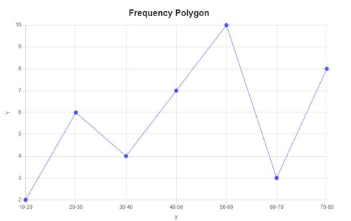
37B. The following data represents distribution of marks for a class.
| Marks obtained | No. of students |
| 10-20 | 2 |
| 20-30 | 6 |
| 30-40 | 4 |
| 40-50 | 7 |
| 50-60 | 10 |
| 60-70 | 3 |
| 70-80 | 8 |
Using the data given, draw and label a frequency polygon on a graph.
Ans:
38A. During adolescence, why does the relationship with significant members like parents, peers, and teachers change? Give any three reasons.
Ans:
- 1. Adolescents like to confide in their peers on matters that are important to them
- 2. Believe that their parents do not understand them and are inflexible
- 3. Parents feel that their children are not sharing their hearts and hence monitor them.
- 4. Empathetic teachers become their anchors, and adolescents seek their advice and care.
- 5. Understanding parents make their children aware of adolescence and how to deal with issues.
OR
38B. Adolescents are prone to getting involved in substance abuse and addiction. State some symptoms of drug addiction commonly seen among adolescents.
Ans: Some of the Symptoms of Drug Addiction :
- Feeling that one has to take the drug regularly
- Having an intense urge for the drug
- Over time, needing more and more of the drug
- Keeping a constant supply of the drug so that one is not short of it
- Arranging for money by unfair means to buy drugs
- Continuing to take drugs even after knowing its harmful effects
39A. According to Freud, the continuous struggles between the three parts of the personality determine the development of personality. Discuss the characteristics of these three parts.
Ans: According to the Psychodynamic theory, personality is made of three parts-
- a. Id- includes all desires or bodily needs, sexual desires and aggressive impulses. It operated on the pleasure principle.
- b. Ego- operates on the reality principle. It keeps the id in control and allows satisfaction of needs only under appropriate circumstances.
- c. Superego- concerned with the moral aspect of our actions.
OR
39B. Differentiate between type and trait theories of personality.
Ans:
| Trait theories | Type Theories |
| The personality is constituted by several traits. These are the building blocks of personality | Type approach is historical |
| Traits are the observable behavioural tendencies of people that are consistent across situations | Categorizes people into different types according to some specific characteristics |
| Example : Catell’s Trait theory | Example: Hippocrates’ theory – people-based on the dominance of fluid in the body |
| According to Allport, the traits are important, but the situations are also serious and influence the expression of traits. | According to Tridosha theory, those with excessive vata are generally energetic, muscular, open-minded, alert and learn easily. Those with excessive Pitta are generally intelligent, fastidious, strong-built, and competitive. Those with excessive kapha are generally steady, patient, thoughtful and supportive. |
40A.What are the characteristics of a mentally healthy person? Mention any three.
Ans:
- Strong sense of personal worth
- Ability to make adjustments
- Sense of responsibility
- Sense of personal security
- Emotional maturity
- Give and accept love
- Lives in a world of reality
OR
40B. What are biological factors contributing to mental illness?
Ans:
- Heredity- What one inherits is not the illness or its symptoms, but a predisposition to the illness, which is determined by genes that we inherit directly. Studies have shown that three-fourths of mental defectives and one-third of psychotic individuals have unfavourable heredity.
- Biochemical Factors- Biochemical abnormalities in the brain are considered to be the cause of some psychological disorders. Disturbance in neurotransmitters in the brain is found to play an important role in the development of certain mental disorders.
- Brain Damage- Any damage to the structure and functioning of the brain can give rise to mental illness. Damage to the structure of the brain may be due to one of the following causes: E.g. Infection of the brain, injury to brain tissue, disturbance in blood glucose levels, lack of oxygen, fluid and electrolyte imbalance, and brain tumor.
41 According to the psychologists treating Naina, her mental health has been affected by psychological factors. Give examples of three such factors that are psychological in nature.
Ans: Psychological factors like:
- a) strained interpersonal relationships
- b) Childhood insecurities
- c) Social and recreational deprivations
- d) Marriage problems
42A. What was the observation made by Ebbinghaus in his experiment on forgetting? Explain the causes of forgetting.
Ans: He found that maximum forgetting happens in the first nine hours, particularly in the first hour. After that, the rate slows down, and so does forgetting.
Causes:
- 1. Decay of memory traces- if memory traces are not used, then they decay or fade
- 2. Interference Theory – Interference leads to forgetting as learning takes place due tothe association of old and new
- 3. Retroactive Interference- new information interferes with the recollection of old information.
- 4. Proactive Interference-old information interferes with the recollection of new information.
A detailed description of all four- 4mks
OR
42B. Differentiate between the types of memory as given by Atkinson and Shiffrin.
Ans:
| Sensory Memory | Short Term Memory | Long Term Memory |
| Information from the environment first enters the sensory memory through the senses | Information that is attended by the sensory system enters the short-term memory (STM) | Information enters LTM through elaborative rehearsal. |
| Duration: less than a second | Less than 30 seconds | Unlimited time period |
| Capacity: large | Small (7+-2) | Large |
| Semantically encoded information enters LTM |
43. Gurjeet was walking home from work late at night when he heard heavy footsteps. His heart started pounding, and breathing became rapid. He felt extremely nervous till the man with the heavy footsteps crossed him and disappeared. He felt extremely relieved and relaxed, and soon his breathing and heartbeat became normal. Explain the physiological basis of Gurjeet’s emotions.
Ans:
- Our physiological activity is regulated by the Autonomic Nervous System- part of the peripheral nervous system-regulates involuntary functions
- Sympathetic NS-fight/flight/freeze reaction; body in a state of arousal
- Parasympathetic NS- brings the body back to normal after arousal; calm and relaxed state
- Adrenal Glands- top of kidneys; secrete epinephrine; get activated by nerve impulse; increase blood sugar, heart beat, etc., for emergency
- Hypothalamus-core part of the brain; involved in the expression of emotion
44. During India’s Independence Movement, various leaders championed the nation’s cause. Identify the leadership theory which enables such people to lead while shaping the very pages of history. Discuss the characteristics of an effective leader.
Ans: Great Man theory- assumes that great leaders are born and have a unique background, which makes them different from their followers.
Characteristics of effective Leaders- 4m
- a. Work towards the achievement of goals
- b. Are driven by a desire to excel
- c. Good communication skills
- d. Are self-confident and are assertive
- e. Are open to new ideas, and experiences and can be flexible
- f. Have high personal integrity and maturity
- g. Good interpersonal skills
- h. Considerate and can listen.
45A. Discuss the steps taken by therapist to help the client deal with the disorder that is leading to distress in her/him.
Ans:
- Preparation of case history: The history of the particular disorder is prepared targeting the adjustment pattern of the client with family, friends, social and occupational setup.
- Determination of the problem: After preparing the case history, the psychotherapist identifies certain key problems which require urgent attention. This is achieved through athe dministration of clinical tests and interviews.
- Therapeutic Session: Depending on the nature and severity of the problem, the psychotherapist conducts a session with the client with a focused treatment plan. Progress after each session is monitored and assessed, and further interventions are modified if necessary.
- Termination of Therapeutic Intervention: Once it is confirmed that the sessions have yielded the desired outcome set by the psychotherapist then it is terminated. The client and the family members are asked to follow the suggestions at home, and if required, the client is asked to visit the psychotherapist again.
OR
45B. Discuss some specific strategies given by WHO to promote mental health and well-being.
Ans: Strategies (By WHO) to promote Wellbeing :
- Early childhood interventions (e.g. Providing a stable environment to the child),
- Support to children (e.g. Life skills programmes, child and youth development programmes).
- Socio-economic empowerment of women (e.g. improving access to education and microcredit schemes).
- Social support for elderly populations
- Programmes targeted at vulnerable people, including minorities, indigenous
- People, migrants and people affected by conflicts and disasters (e.g. Psychosocial interventions after disasters).
- Mental health promotional activities in schools
- Mental health interventions at work (e.g. Stress prevention programmes).
- Housing policies (e.g. Housing improvement).
- Violence prevention programmes (e.g. Reducing availability of alcohol and access to arms).
- Community development programmes (e.g. integrated rural development).
- Poverty reduction and social protection for the poor.
- Anti-discrimination laws and campaigns
Additional Study Materials
NIOS Class 12 Psychology Syllabus Bifurcation