Class 12 Biology Chapter 15 Exemplar Solutions
Multiple Choice Questions (MCQs)
1. Non-biodegradable pollutants are created by
(a) nature
(b) excessive use of resources
(c) humans
(d) natural disasters
2. According to the Central Pollution Control Board, particles that are responsible for causing great harm to human health are of diameter
(a) 2.50 micrometers
(b) 5.00 micrometers
(c) 10.00 micrometers
(d) 7.5 micrometers
3. The material generally used for soundproofing of rooms like a recording studio and auditorium, etc., is
(a) cotton
(b) coir
(c) wood
(d) styrofoam
4. Compressed Natural Gas (CNG) is
(a) propane
(b) methane
(c) ethane
(d) butane
5. World’s most problematic aquatic weed is
(a) Azolla
(b) Wolffia
(c) Eichhornia
(d) Trapa
6. Which of the following causes biomagnification?
(a) SO2
(b) Mercury
(c) DDT
(d) Both (b) and (c)
7. The expanded form of DDT is
(a) dichloro diphenyl trichloroethane
(b) dichloro diethyl trichloroethane
(c) dichloro dipyrydyl trichloroethane
(d) dichloro diphenyl tetrachloroacetate
8. Which of the following materials takes the longest time for biodegradation?
(a) Cotton
(b) Paper
(c) Bone
(d) Jute
9. Choose the incorrect statement.
(a) The Montreal Protocol is associated with the control of emissions of ozone-depleting substances
(b) Methane and carbon dioxide are greenhouse gases
(c) Dobson units are used to measure oxygen content
(d) Use of incinerators is crucial to disposal of hospital wastes
10. Among the following, which one causes more indoor chemical pollution?
(a) Burning coal
(b) Burning cooking gas
(c) Burning mosquito coil
(d) Room spray
11. The green scum seen in the freshwater bodies is
(a) blue green algae
(b) red algae
(c) green algae
(d) Both (a) and (c)
12. The loudness of a sound that a person can withstand without discomfort is about
(a) 150 dB
(b) 215 dB
(c) 30 dB
(d) 80 dB
13. The major source of noise pollution worldwide is due to
(a) office equipment
(b) transport system
(c) sugar, textile, and paper industries
(d) oil refineries and thermal power plants
14. Match correctly the following and choose the correct option
| A. Environment Protection Act | 1. 1974 |
| B. Air Prevention and Control of Pollution Act | 2. 1987 |
| C. Water Act | 3. 1986 |
| D. Amendment of Air Act to include noise | 4. 1981 |
The correct matches are
(a) A-3, B-4, C-1, D-2
(b) A-1, B-3, C-2, D-4
(c) A-4, B-1, C-2, D-3
(d) A-3, B-4, C-2, D-1
15. Catalytic converters are fitted into automobiles to reduce emission of harmful gases. Catalytic converters change unburnt hydrocarbons into
(a) carbon dioxide and water
(b) carbon monoxide
(c) methane
(d) carbon dioxide and methane
16. Why is it necessary to remove sulphur from petroleum products?
(a) To reduce the emission of sulphur dioxide in exhaust fumes
(b) To increase efficiency of automobile engines
(c) To use sulphur removed from petroleum for commercial purposes
(d) To increase the life span of engine silencers
17. Which one of the following impurities is easiest to remove from wastewater?
(a) Bacteria
(b) Colloids
(c) Dissolved solids
(d) Suspended solids
18. Which one of the following diseases is not due to contamination of water?
(a) Hepatitis B
(b) Jaundice
(c) Cholera
(d) Typhoid
19. Nuisance growth of aquatic plants and bloom-forming algae in natural water is generally due to high concentrations of
(a) carbon
(b) sulphur
(c) calcium
(d) phosphorus
20. Algal blooms impart a distinct colour to water due to
(a) their pigments
(b) excretion of coloured substances
(c) formation of coloured chemicals in water facilitated by physiological degradation of algae
(d) absorption of light by algal cell wall
21. Match the items in column I and column II and choose the correct option.
| Column I | Column II |
| A. UV | 1. Biomagnificatron |
| B. Biodegradable organic matter | 2. Eutrophication |
| C. DDT | 3. Snow blindness |
| D. Phosphates | 4. BOD |
The correct match is
(a) A-2, B-1, C-4, D-3
(b) A-3, B-2, C-4, D-1
(c) A-3, B-4, C-1, D-2
(d) A-3, B-1, C-4, D-2
22. In the textbook, you came across Three Mile Island and Chernobyl disasters associated with the accidental leakage of radioactive wastes. In India, we had Bhopal gas tragedy. It is associated with which of the following?
(a) CO2
(b) Methyl isocyanate
(c) CFCs
(d) Methyl cyanate
Very Short Answer Type Questions
1. Use of lead-free petrol or diesel is recommended to reduce the pollutants emitted by automobiles. What role does lead play?
2. In which year was the Air (Prevention and Control of Pollution) Act amended to include noise as air pollution?
3. Name the city in our country where the entire public road transport runs on CNG.
4. It is a common practice to undertake desilting of the overhead water tanks. What is the possible source of silt that gets deposited in the water tanks?
5. What is cultural eutrophication?
6. List any two adverse effects of particulate matter on human health.
7. What is the raw material for polyblend?
8. Blends of polyblend and bitumen, when used, help to increase road life by a factor of three. What is the reason?
9. Mention any two examples of plants used as windbreakers in the agricultural fields.
10. Name an industry which can cause both air and thermal pollution and as well as eutrophication.
11. What is an algal bloom?
12. What do you understand by biomagnification?
13. What are the three major kinds of impurities in domestic wastewater?
14. What is reforestation?
15. What is the best solution for the treatment of electronic waste?
Short Answer Type Questions
1. Is it true that carpets and curtains/drapes placed on the floor or wall surfaces can reduce noise levels? Explain briefly?
2. What is hybrid vehicle technology? Explain its advantages with a suitable example?
3. Is it true that if the dissolved oxygen level drops to zero, the water will become septic? Give an example that could lower the dissolved oxygen content of an aquatic body.
4. Name any one greenhouse gas and its possible source of production on a large scale. What are the harmful effects of it?
5. It is a common practice to plant trees and shrubs near the boundary walls of buildings. What purpose do they serve?
6. Why has the National Forest Commission of India recommended a relatively larger forest cover for hills than for plains?
7. How can slash-and-burn agriculture become environment friendly?
8. What is the main idea behind the “Joint Forest Management Concept” introduced by the Government of India?
9. What do you understand by Snow-blindness?
10. How has DDT caused a decline in bird population?
11. Observe the figures A and B given below and answer the following questions
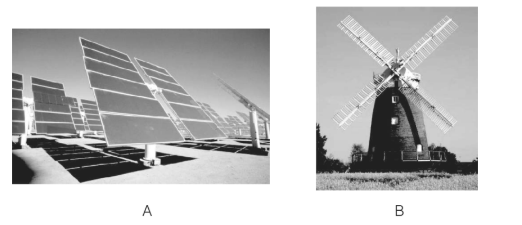
(i) The power generation by the above two methods is non-polluting, True/False.
(ii) List any two applications of solar energy
(iii) What is a photovoltaic cell?
Long Answer Type Questions
1. Write a short note on electronic waste. List the various sources of e-waste and the problems associated with its disposal.
2. What is organic farming? Discuss the benefits of organic farming as a viable practice in the context of developing nations like India.
3. Waterlogging and soil salinity are some of the problems that have come in the wake of the Green Revolution. Discuss their causes and adverse effects on the environment.
4. What are multipurpose trees? Give the botanical and local names of any two multipurpose trees known to you and list their uses.
5. What are the basic characteristics of a modern landfill site? List any three and also mention the reasons for their use.
6. How does an electrostatic precipitator work?
7. Observe the figure and answer the following questions.
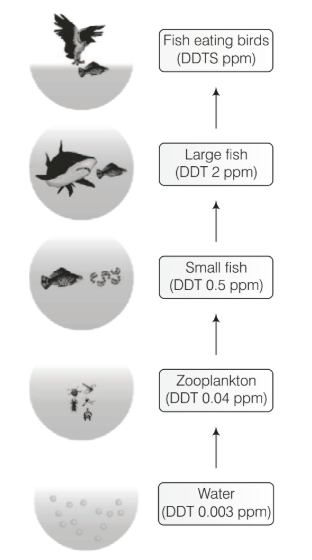
(i) What ecological term is used to describe the DDT accumulation at different trophic levels?
(ii) List any one effect of DDT accumulation on birds.
(iii) Will DDT accumulation lead to eutrophication?
(iv) Does it affect the BOD?
(v) Name a disease caused by the accumulation of any heavy metal.
Class 12 Biology Chapter 15 Exemplar Solutions PDF
Download the Class 12 Biology Chapter 15 Exemplar Solutions PDF so you can master the CBSE NCERT chapter Environmental Issues, and prepare well for your board exam.
Additional Study Materials
- Environmental Issues – Competency-Based Questions
- Ecosystem- Exemplar Solutions
- Biodiversity and Conservation- Exemplar Solutions