Class 12 Biology Chapter 10 Exemplar Solutions
Multiple Choice Questions
1. Rising of dough is due to
(a) multiplication of yeast
(b) production of CO2
(c) emulsification
(d) hydrolysis of wheat flour starch into sugars
2. An enzyme catalysing the removal of nucleotides from the ends of DNA is
(a) endonuclease
(b) exonuclease
(c) DNA ligase
(d) Hind II
3. The transfer of genetic material from one bacterium to another through the mediation of a vector-like virus is termed as
(a) transduction
(b) conjugation
(c) transformation
(d) translation
4. Which of the given statement is correct in the context of observing DNA separated by agarose gel electrophoresis?
(a) DNA can be seen in visible light.
(b) DNA can be seen without staining in visible light.
(c) Ethidium bromide-stained DNA can be seen in visible light.
(d) Ethidium bromide-stained DNA can be seen under exposure to UV light.
5. ‘Restriction’ in restriction enzyme refers to
(a) cleaving of phosphodiester bond in DNA by the enzyme
(b) cutting of DNA at specific position only
(c) prevention of the multiplication of bacteriophage in bacteria
(d) All of the above
6. Which of the following is not required in the preparation of a recombinant DNA molecule?
(a) Restriction endonucleases
(b) DNA ligase
(c) DNA fragments
(d) E. coli
7. In agarose gel electrophoresis, DNA molecules are separated on the basis of their
(a) charge only
(b) size only
(c) charge to size ratio
(d) All of these
Ans: (b) size only
8. The most important feature in a plasmid to be used as a vector is
(a) Origin of replication (Ori)
(b) presence of a selectable marker
(c) presence of sites for restriction endonuclease
(d) its size
9. While isolating DNA from bacteria, which of the following enzymes is not used?
(a) Lysozyme
(b) Ribonuclease
(c) Deoxyribonuclease
(d) Protease
10. Which of the following has popularised the PCR (Polymerase Chain Reaction)?
(a) Easy availability of DNA template
(b) Availability of synthetic primers
(c) Availability of cheap deoxyribonucleotides
(d) Availability of ‘Thermostable’ DNA polymerase
11. An antibiotic resistance gene in a vector usually helps in the selection of
(a) competent cells
(b) transformed cells
(c) recombinant cells
(d) None of these
12. Significance of heat shock method in bacterial transformation is to facilitate.
(a) Binding of DNA to the cell wall
(b) Uptake of DNA through membrane transport proteins
(c) Uptake of DNA through transient pores in the bacterial cell wall
(d) Expression of antibiotic resistance gene
13. The role of DNA ligase in the construction of a recombinant DNA molecule is
(a) formation of phosphodiester bond between two DNA fragments
(b) formation of hydrogen bonds between sticky ends of DNA fragments
(c) ligation of all purine and pyrimidine bases
(d) None of the above
14. Which of the following is not a source of restriction endonuclease?
(a) Haemophilus influenzae
(b) Escherichia coli
(c) Agrobacterium tumefaciens
(d) Bacillus amyloli
15. Which of the following steps are catalysed by Taq polymerase in a PCR reaction?
(a) Denaturation of template DNA
(b) Annealing of primers to template DNA
(c) Extension of primer end on the template DNA
(d) All of the above
16. A bacterial cell was transformed with a recombinant DNA that was generated using a human gene. However, the transformed cells did not produce the desired protein. Reasons could be
(a) human gene may have intron which bacteria cannot process
(b) amino acid codons for humans and bacteria are different
(c) human protein is formed but degraded by bacteria
(d) All of the above
17. Which of the following should be choosen for best yield if one were to produce a recombinant protein in large amounts?
(a) Laboratory flask of largest capacity
(b) A stirred-tank bioreactor without inlets and outlets
(c) A continuous culture system
(d) Any of the above
18. Who among the following was awarded the Nobel Prize for the development of PCR technique?
(a) Herbert Boyer
(b) Hargovind Khurana
(c) Kary Mullis
(d) Arthur Kornberg
19. Which of the following statements does not hold true for restriction enzyme?
(a) It recognises a palindromic nucleotide sequence
(b) It is an endonuclease
(c) It is isolated from viruses
(d) It produces the same kind of sticky ends in different DNA molecules
Very Short Answer Type Questions
1. How is copy number of the plasmid vector related to yield of recombinant protein?
2. Would you choose an exonuclease while producing a recombinant DNA molecule?
3. What does H in ‘d’ and III refer to the enzyme Hind III?
4. Restriction enzymes should not have more than one site of action in the cloning site of a vector. Comment.
5. What does ‘competent’ refer to in competent cells used in transformation experiments?
6. What is the significance of adding proteases at the time of isolation of genetic material (DNA)?
7. While doing a PCR, ‘denaturation’ step is missed. What will be its effect on the process?
8. Name a recombinant vaccine that is currently being used in vaccination program.
9. Do biomolecules (DNA and protein) exhibit biological activity in anhydrous conditions?
10. What modification is done on the Ti-plasmid of Agrobacterium tumefaciens to convert it into a cloning vector?
Short Answer Type Questions
1. What is meant by gene cloning?
2. Both a wine maker and a molecular biologist who had developed a recombinant vaccine claim to be biotechnologists. Who, in your opinion, is correct?
3. A recombinant DNA molecule was created by ligating a gene to a plasmid vector. By mistake, an exonuclease was added to the tube containing the recombinant DNA. How does this affect the next step in the experiment, i.e., bacterial transformation?
4. Restriction enzymes that are used in the construction of recombinant DNA are endonucleases, which cut the DNA at specific recognition sequence. What would be the disadvantage if they do not cut the DNA at specific recognition sequence?
5. A plasmid DNA and a linear DNA (both are of the same size) have one site for a restriction endonuclease. When cut and separated on agarose gel electrophoresis, plasmid shows one DNA band, while linear DNA shows two fragments. Explain.
6. How does one visualise DNA on an agarose gel?
7. A plasmid without a selectable marker was choosen as vector for cloning a gene. How does this affect the experiment?
8. A mixture of fragmented DNA was electrophoresed in an agarose gel. After staining the gel with ethidium bromide, no DNA bands were observed. What could be the reason?
9. Describe the role of CaCl2 in the preparation of competent cells?
10. What would happen when one grows a recombinant bacterium in the bioreactor but forgets to add antibiotic to the medium in which the recombinant is growing?
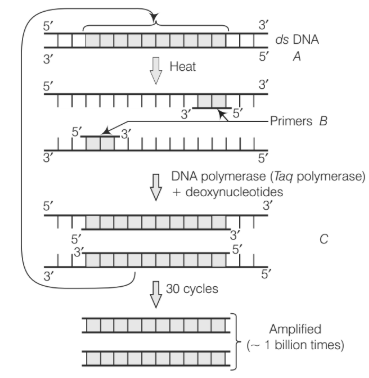
11. Identify and explain A, B and C in the PCR diagram given below.
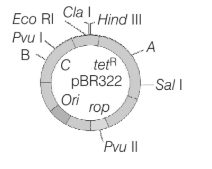
12. Name the regions marked A, B and C.
Long Answer Type Questions
1. For selection of recombinants, insertional inactivation of antibiotic marker has been supercoded by insertional inactivation of a marker gene coding for a chromogenic substrate. Give reasons.
2. Describe the role of Agrobacterium tumefaciens in transforming a plant cell.
3. Illustrate the design of a bioreactor. Highlight the difference between a flask in your laboratory and a bioreactor, which allows cells to grow in a continuous culture system.
Class 12 Biology Chapter 10 Exemplar Solutions PDF
Exemplar solutions are the best way to understand the core concepts of a chapter, especially for subjects like biology. Here is the CBSE Class 12 Biology Chapter 10 Exemplar Solutions in PDF format that you can download for free!
Additional Study Materials
- Biotechnology: Principles and Processes – Competency-Based Questions
- Strategies for Enhancement in Food Production- Exemplar Solutions
- Microbes in Human Welfare- Exemplar Solutions