NIOS Biology 314 Question Paper Oct 2017
1 MARK QUESTIONS
1. Which of the following bacteria fixes nitrogen in the soil?
(A) Azotobacter
(B) Salmonella
(C) Rhizobium
(D) Streptomyces
2. Which of the following organs is not part of male reproductive system of cockroach?
(A) Testis
(C) Ejaculatory duct
(B) Vas deferens
(D) Penis
3. Which of the following is a modified leaf?
(A) Cladode
(B) Phyllode
(C) Phyllotaxy
(D) Phylloclad
4. Which of the following animals is radially symmetrical?
(A) Bony fish
(B) Jellyfish
(C) Earthworm
(D) Ascaris
5. Which of the following terms is used for flowers which remain closed until pollination?
(A) Homogamy
(C) Isogamy
(B) Cleistogamy
(D) Anisogamy
6. Which of the following is a monosaccharide?
(A) Sucrose
(B) Maltose
(C) Glucose
(D) Lactose
7. Deficiency of which vitamin causes night blindness?
(A) B12
(B) A
(C) C
(D) D
8. Which of the following infections induces life-time immunity?
(A) Common cold
(C) Smallpox
(B) Influenza
(D) Pneumonia
2 MARKS QUESTIONS
9. List the various modes of nutrition in Bacteria.
Ans: The four nutritional categories found in bacteria are :
- Autotrophs
- Saprotrophs
- Symbionts
- Parasites
10. Give one example of each of the following:
(a) a reptile without limbs
(b) a flying mammal
(c) a pouched mammal
(d) an egg-laying mammal
Ans:
- Snake
- Bat
- Kangaroo
- Duck-bill platypus
11. Classify the organisms with following characters in their respective group:
(a) Autotrophs; no vascular tissue; sex organs antheridia and archegonia
(b) Autotrophs; vascular tissue present; sex organs antheridia and archegonia
(c) Autotrophs; vascular tissue present, ovules enclosed in ovary
(d) Autotrophs; vascular tissue present, ovules naked
Ans:
- Bryophytes
- Pteridophytes
- Angiosperms
- Gymnosperms
12. What are the characteristics of meristematic tissue? Where are meristems located?
Ans: Meristematic tissues are constantly dividing, immature and undifferentiated cells without any intercellular spaces. There are three types of meristematic tissue.
- Apical meristem: In the root and shoot tips
- Intercalary meristem: At the base of leaves or bases of internodes
- Lateral meristem: Cambium, which is found between xylem and phloem, as well as in the bark.
13. Mark the following statements as true or false:
(a) Origin of lateral shoots is endogenous.
(b) In stems vascular bundles are radial.
(c) In dicot stems vascular bundles are closed.
(d) In monocot stem vascular bundles are scattered.
Ans:
- True
- False
- False
- True
14. Answer the following:
(i) Which photosystem is operational during cyclic photophosphorylation?
(ii) Which organisms show cyclic photophosphorylation?
(iii) How does P680 regain its lost electrons?
(iv) Which reaction centre brings about splitting of water?
Ans:
- PS I
- Cyanobacteria, photosynthetic bacteria and plants
- The oxidised P680 regains its lost electrons from water molecules.
- PS II
15. What is the importance of decomposers in nature? Give two examples.
Ans: Decomposers are the organisms that feed on dead organic matter, called detritus, of all the trophic levels and help in recycling the nutrients. They make up the final trophic level in a food chain.
16. Name the processes involved in the following activities:
(a) Mechanical process of taking in atmospheric air into the lungs and giving out CO2.
(b) Quick closing of eyelids on noticing an object suddenly approaching the eye.
Ans:
- Breathing or pulmonary ventilation
- Simple reflex
17. Give reasons: Blood group of ‘O’ type can be given to all groups, and a person with blood group ‘AB’ can receive blood from all groups.
Ans: Blood group of ‘O’ type can be given to all groups because there are no antigens in this blood group. A person with blood group AB can receive blood from all groups because there are no antibodies present in the blood of Group AB.
18. Give two advantages and two disadvantages of vegetative reproduction.
Ans:
- Offspring are identical to the parent. The desired varieties can thus be preserved genetically for use.
- Improved varieties of ornamental plants and fruit trees can be multiplied easily.
19. Name the following:
(i) Hereditary congenital defect caused due to the absence of both B and T cells.
(ii) Blood vessel that brings deoxygenated blood from the lower parts of the body to right auricle.
Ans:
- Severe Combined Immuno Deficiency (SCID).
- Inferior vena cava
20. What are the steps of transcription in prokaryotes?
Ans: Transcription in prokaryotes
- Cistronic DNA, which carries the information for the protein to be synthesised, unwinds in the presence of enzymes helicase and topoisomerase.
- RNA polymerase begins to catalyse the synthesis of mRNA, signalled by a protein called sigma factor.
- mRNA is synthesised complementary to cistronic DNA, and a Rho factor signals RNA polymerase to complete transcription.
- The strand of DNA that bears the code for transcription of the specific protein is called the sense strand of DNA, opposed to the antisense strand, which is not transcribed.
4 MARKS QUESTIONS
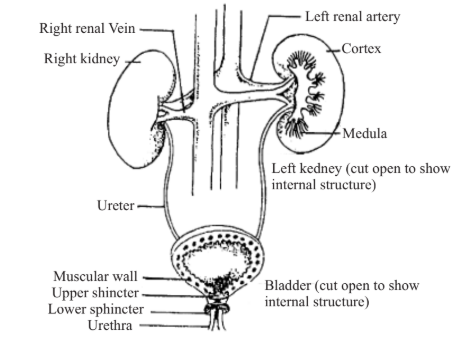
21. Draw labelled diagrams of the following:
(a) Excretory organs of man
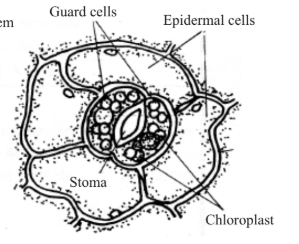
(b) Stomatal apparatus of a dicot leaf
Ans:
- Excretory organs of man
- Stomatal apparatus of a dicot leaf
22. Differentiate between:
(a) Gametophytic phase and sporophytic phase in Bryophytes
(b) Zoospore and Zygospore in Chlamydomonas
Ans:
- Gametophytic phase and sporophytic phase in Bryophytes
| Gametophytic Phase | Sporophytic Phase |
| Haploid phase, generally autotrophic | Diploid phase, heterotrophic or partially autotrophic |
| Has multicellular sex organs called antheridia and archegonia, bearing sterile jacket surrounding the gametes | Has a spore-producing structure |
| Produces gametes | Produces spores |
| Gametes are produced by mitosis | Spores are produced by meiosis |
| Dominant phase occupies most of the life period | Short-lived phase which remains attached to the gametophyte |
- Zoospore and Zygospore in Chlamydomonas
- Zoospore is a type of asexual reproduction in Chlamydomonas, produced when there is plenty of water available. Zoospores are thin-walled and have flagella.
- The zygote of Chlamydomonas develops a thick wall around itself and develops brown to black coloured pigmentation, which is called a zygospore, to tide over unfavourable conditions.
23. (a) What are the various steps of nitrate assimilation in plants? Give equations.
(b) What is the importance of excretion? Name an ammoniotelic animal.
Ans:
- Nitrate is absorbed by most plants and reduced to ammonia with the help of two different enzymes. The first step conversion of nitrate to nitrite is catalysed by an enzyme called nitrate reductase. This enzyme has several other important constituents, including FAD, cytochrome, NADPH or NADH and molybdenum.

- Importance of excretion
- Excretion is necessary for the elimination of nitrogenous wastes formed during the metabolism of proteins (amino acids) and nucleic acids.
- Elimination of excess salts like NaCl, vitamins, bile pigments (from the breakdown of old RBCs) and certain medicines and drugs, and
- Removal of excess water or its retention in case of a shortage of water. This is to maintain the required quantity of water (osmoregulation) in the body.
24. Name the hormones secreted by posterior lobe of pituitory gland; their mode of action and abnormality produced because of its deficiency.
Ans:
- Antidiuretic hormone (ADH): Increases absorption of water from the kidney tubules (osmoregulation). Its deficiency causes diabetes insipidus.
- Oxytocin: Stimulates contractions of the uterus during childbirth.
25. (a) Name the scientists:
(i) Discovered bacterial transformation in Streptococcus pneumoniae.
(ii) Awarded Nobel Prize for working out the structure of DNA.
(b) What are the functions of tRNA?
Ans:
- Scientists
- Frederick Griffith
- James Watson and Francis Crick
- tRNA carries anticodons that recognise codons on the mRNA. tRNA also transfers amino acids to their respective positions during protein synthesis.
26. (a) What will be the progeny of a carrier female for colour blindness with a colour blind male?
(b) “In honeybee males have no father and cannot have sons, but have a grandfather and can have grandsons”. Explain.
Ans: a) Colour blindness
Parents: XXC x XY
| Gametes | X | Y |
| X | XX Normal daughter | XY Normal son |
| XC | XCXCarrier daughter | XCYColour blind son |
b) In honey bees, fertilised eggs emerge as females and unfertilised eggs develop into males. The male, which is called a drone, is produced from unfertilized haploid eggs. And thus, male honeybees contain a single set of chromosomes. The female honeybees, which are worker bees and queen bees, are produced from fertilised eggs and therefore are diploid. They contain two sets of chromosomes. In this case, only females are produced by sexual reproduction. Thus, in honey bees, males have no father and cannot have sons, but have a grandfather and can have grandsons.
6 MARKS QUESTIONS
27. (a) Why water and Roughage are important part of our diet? Explain.
(b) Where does heartbeat originate? How is this impulse conducted to heart muscles? What is the effect of this impulse on various chambers of the heart?
Ans:
- Water and roughage are an important part of our diet because,
| Water | Roughage |
| Water is essential for the transport and digestion of food material.It helps excrete waste, maintain body temperature.It also acts as solvent in various reactions in the body. | Roughage helps with bowel movement and prevents constipation. Helps retain water in the body and maintain optimum blood sugar and cholesterol.It also cleans out digestive tracts and protects against digestive ailments. |
- Heartbeat originates at the Sinu-Atrial Node or S.A. Node, which is a modified part of the muscular wall in the upper corner of the right atrium.
- As a result right atrium contracts, the tricuspid valve is pushed open, and deoxygenated blood enters the right ventricle. At the same time, the bicuspid valve is pushed open and oxygenated blood flows into the left ventricle.
- When an impulse comes from the SA node to the AV node (Atrio-Ventricular Node), the contracted atria begin to relax.
- The impulse passes to the Bundle of HIS lying in the interventricular septum and then passes to the Purkinje Fibres lying in the walls of the ventricles.
- As a result, ventricles contract (Ventricular systole).
28. (a) What is mutation? What are point and chromosomal mutations? List various types of chromosomal aberrations.
(b) Explain regulation of gene expression in prokaryotes by giving example of lac-operon.
Ans:
- A mutation is a sudden, inheritable change in the structure, content, and organisation of genetic material. Mutations happening in a single gene is called point mutations. A mutation that affects many genes is called a chromosomal mutation. The types of chromosomal aberrations are,
- Deletion
- Inversion
- Duplication
- Translocation
- In Prokaryotes, the Lac operon is an excellent example of control of gene expression in prokaryotes (bacteria). It is an inducible system and is switched on in the presence of the substrate lactose. Enzymes for metabolising lactose are galactosidase, permease, and transacetylase, and genes that code for them get switched on. In the absence of lactose, they remain switched off.
- The lac operon consists of a regulator gene- i, promoter gene – p, operator gene – o, and structural genes- z, y, and a that code for enzymes Galactosidase, Permease and Transacetylase.
- When the substrate lactose is absent, the regulator protein blocks the operator gene o. Thus, RNA polymerase cannot find the promoter gene, keeping the structural genes switched off.
- When lactose is present, the regulator protein is attracted to lactose.
- The o site opens and RNA polymerase finds the promoter; genes z, y, and a are switched on, transcription begins, and the three enzymes are synthesised inside the cell.
29. (a) What are the main characteristics of tropical rainforests? What type of plants and animals are found in these forests?
(b) What is biodiversity? Why is it important to maintain ecosystem? What are the threats to biodiversity?
Ans:
- Main characteristics of tropical rainforests are,
- Temperature and light intensity are very high
- Rainfall is greater than 200 cm per year.
- The soil of these regions is rich in humus,
- The rate of turnover of the nutrients is very high, leading to high productivity and have highest standing crop and biomass.
- The vegetation includes broad evergreen trees of about 200 feet, like bamboos, ferns, shrubs, etc. Epiphytes and woody vines (lianas) are also abundant. Many tree species show buttresses (swollen stem bases) and leaves with drip tips.
- Biodiversity can be defined as the flora and fauna, i.e. variety of all plants, animals, and microbes of a region. Biodiversity is essential for the maintenance of the ecosystem. It maintains the gaseous composition of the atmosphere, controls the climate, helps in natural pest control, and pollination of plants by insects and birds, soil formation and conservation, water purification and conservation, geochemical cycles, etc. It is under threat due to the following reasons:
- (i) Destruction of habitat by cutting down trees, filling up the wetland, ploughing of grassland or burning a forest.
- (ii) The population explosion
- (iii) Industrialisation and urbanisation
- (iv) Pollution of soil, air and water changes the habitat quality and may reduce or eliminate sensitive species.
- (v) Mining activities pollute the air and water and threaten the survival of the animals nearby.
- (vi) Construction of dams, roads and railways destroys huge patches of forests, grassland, etc..
- (vii) Indiscriminate killing of animals for different purposes has resulted in their reduction.
- (viii) Introduction of exotic/foreign species in an area threatens the survival of existing natural biodiversity; e.g., water hyacinth clogs rivers and lakes and threatens the life of many aquatic species in our country.
30. (a) What is biotechnology? What are its applications in the field of agriculture?
(b) Who is considered the father of immunology? How are T cells produced and give their functions?
Ans:
- Biotechnology is defined as the industrial application of living organisms and their biological processes, such as biochemistry, microbiology, and genetic engineering, to make the best use of the microorganisms for the benefit of mankind.
- Biotechnology has also made possible the production of crops with improved disease resistance, herbicide-tolerant, and insecticide-resistant. Plants with improved nutritional value for livestock have also been obtained through biotechnology.
- Edward Jenner is considered the father of Immunology.
- T-cells are lymphocytes that leave bone marrow in an immature state during foetal and early stages of life. They are carried to the thymus, where they mature. The mature T-cells migrate to the peripheral lymphoid organs, where they undergo mitosis to produce a large number of daughter cells. Their main functions are,
- (i) Regulate immune response.
- (ii) Mediate cell-mediated immune (CMI) response.
- (iii) Induce B-cells to produce antibody.
Additional Study Materials
- NIOS Class 12 Biology PYQ April 2025 Set A
- NIOS Class 12 Biology PYQ Oct 2024 Set A
- NIOS Biology Paper 2024 April Set A Solved
- NIOS Class 12 Biology PYQ April 2023 Set A
- NIOS Class 12 Biology PYQ Oct 2022 Set A
- NIOS Class 12 Biology PYQ April 2022 Set A
- NIOS Class 12 Biology PYQ Feb 2021 set A
- NIOS Class 12 Biology PYQ Oct 2021 Set A
- NIOS Class 12 Biology PYQ Oct 2019 Set A
- NIOS Class 12 Biology PYQ April 2019 SetA
- NIOS Class 12 Biology PYQ Oct 2018
- NIOS Class 12 Biology PYQ April 2018 Set A