NIOS Plus Two Biology Question Paper April 2017
1 MARK QUESTIONS
1. Pick the odd one out:
(A) UAA
(B) AUG
(C) UAG
(D) UGA
2. Which of the following is a true fish?
(A) Dogfish
(B) Jellyfish
(C) Starfish
(D) Silverfish
3. The type of placentation seen in Bhindi is
(A) marginal
(B) parietal
(C) superficial
(D) axile
4. The narrow-spectrum antibiotic used against few pathogenic bacteria is
(A) erythromycin
(B) tetracycline
(C) streptomycin
(D) chloramphenicol
5. Sea anemone, a Cnidarian, gets attached to the shell of hermit crab. This type of association is known as
(A) commensalism
(B) parasitism
(C) mutualism
(D) neutralism
6. Which one of the following is an example of a unicellular fungus?
(A) Penicillium
(B) Yeast
(C) Mushroom
(D) Lichens
7. Vascular bundles that are open, conjoint with xylem in endarch condition is a characteristic of
(A) dicot root
(B) monocot root
(C) monocot stem
(D) dicot stem
8. A cross between the F1 progeny and a homozygous recessive parent is known as
(A) testcross
(B) reciprocal cross
(C) monohybrid cross
(D) dihybrid cross
2 MARK QUESTIONS
9. Why does insectivorous plant eat insects when it is capable of carrying out photosynthesis?
Ans: Insectivorous plants eat insects when it is capable of carrying out photosynthesis to overcome nitrogen deficiency, as they grow in soils having acute nitrogen deficiency.
10. With the help of equations, briefly explain double fertilization.
Ans: One sperm fuses with the egg (syngamy) and forms a diploid zygote. The other sperm fuses with the secondary nucleus to form the primary endosperm nucleus which is triploid in nature. Since two types of fusion, syngamy and triple fusion take place in an embryo sac, the process is termed as double fertilization.
11. Define the following terms:
(a) Humus
(b) Soil erosion
(c) Terracing
(d) Deforestation
Ans:
- Humus is a brown or black organic substance consisting of partially or wholly decayed vegetable or animal matter that provides nutrients for plants and increases the ability of soil to retain water.
- Soil erosion is the removal of top layers of soil by wind and water.
- Terracing is dividing a slope into several flat fields to control the rapid run of water. It is practised mostly in hilly areas.
- Deforestation is the cutting down of trees in forests.
12. Chromosomal change in structure is termed as chromosomal aberration. List four types of chromosomal aberrations.
Ans: Deletion, inversion, duplication and translocation.
13. Name the respiratory organs in cockroaches and earthworms.
Ans:
- Cockroach: Tracheae.
- Earthworms: Skin on the body
14. Distinguish between pioneer community and climax community.
Ans: The assemblage of pioneer plants – plants that invade the bare land, where soil is initially absent for the first time- is collectively called pioneer community. The terminal (final) stage of succession forms the community which is called the climax community.
15. (a) What are transgenic plants?
(b) Name a soil bacterium which is commonly used to produce transgenic plants.
Ans:
- Plants that are genetically modified are called transgenic plants.
- Bacillus thuringiensis (Bt).
16. Define the following terms with appropriate examples:
(a) Multiple alleles
(b) Codominance
Ans:
- The alternative forms of a gene, in more than two copies are called multiple alleles.
- Codominance is the expression of both dominant alleles of a gene.
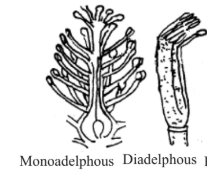
17. With the help of diagrams and appropriate examples, distinguish between monadelphous and diadelphous stamens.
Ans:
- Monadelphous – filaments fused into one bundle but anthers are free e.g. China rose
- Diadelphous – filaments fused to form two bundles e.g. Pea
18. List any four functions of roughage in our daily diet.
Ans: Functions of roughage
- It helps with bowel movement.
- It cleans our digestive tracts and protects the body from digestive ailments.
- It prevents constipation.
- It helps in retaining water in the body.
- It helps in maintaining optimum levels of blood sugar and cholesterol.
19. (a) Name a gymnosperm which fixes nitrogen.
(b) Name the special protein present in legume nodules.
Ans:
- Cycas
- Leghaemoglobin
20. (a) Why is the number of trophic levels restricted to four or five in a food chain?
(b) List any two human activities that has led to increase in atmospheric CO2.
Ans:
- Ans: The number of organisms is reduced at each higher level but the size of organisms is increased. This is why the number of steps in a food chain is limited to 4-5.
- Carbon dioxide is continuously increasing in the atmosphere due to human activities such as industrialization, urbanization, and increased use of automobiles.
4 MARK QUESTIONS
21. What is meristematic tissue? Name its types and its appropriate locations.
Ans: Meristematic tissues are constantly dividing, immature and undifferentiated cells without any intercellular spaces. There are three types of meristematic tissue.
- Apical meristem: In the root and shoot tips
- Intercalary meristem: At the base of leaves or bases of internodes
- Lateral meristem: Cambium, which is found between xylem and phloem, as well as in the bark.
22. Explain briefly the packaging of the DNA molecule in a eukaryotic chromosome.
Ans:
- At intervals, DNA molecules are coiled around a “core particle,” which is an octamer, that is made of 8 histone proteins forming a ball-like structure.
- Each core particle with DNA around it is called a nucleosome. Under the electron microscope, the eukaryotic chromosome looks like a string of beads (string being the DNA molecule and beads the nucleosomes).
- The string is then coiled to form a solenoid, and the solenoid is coiled again (supercoiling), ultimately to form the chromosome.
- In this way, the long DNA molecule becomes thicker and thicker and shorter and shorter
23. (a) Distinguish between essential amino acids and non-essential amino acids, giving appropriate example in each case.
(b) Name any two fat-soluble vitamins and state their functions in the human body.
Ans:
- Essential and non-essential amino acids
- Essential amino acids: These are the amino acids that can not be synthesised in the animal body and must be supplied with food, e.g., leucine.
- Non-essential amino acids: which can be synthesised in the body, particularly from carbohydrates, and need not be supplied in the diet. e.g. alanine.
- Fat-soluble vitamins: Vitamin A, D, E, and K
- Vitamin A- Maintains vision and skin
- Vitamin D- Keeps teeth and bones healthy. It also helps absorb calcium and phosphorus.
24. (a) What is the main objective of vaccination?
(b) Name the three main types of vaccines available giving an appropriate example in each case.
Ans:
- The objective of vaccination is to introduce the attenuated germs into the body. The body then generates a specific population of memory cells. These memory cells can rapidly increase in number on renewed contact with the same antigen, and more antibodies can be produced to protect against infection.
- Three main types of vaccines are available :
- Killed organisms as vaccines: Examples: typhoid, cholera, pertussis (whooping cough), rabies, and poliomyelitis.
- Live attenuated (weakened) organisms as vaccines; Examples: BCG, Rubella, measles, and polio.
- Toxoid vaccines : Examples: diphtheria and tetanus.
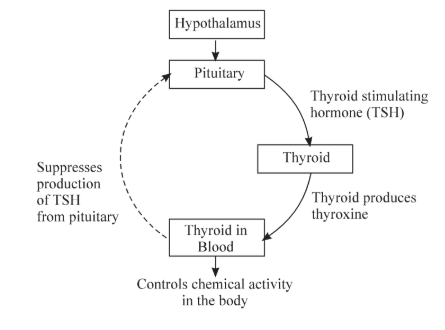
25. With the example of thyroxine, briefly explain the feedback mechanism in hormone action.
Ans: The Hypothalamus releases a hormone, TSH-RH (TSH-Releasing Hormone), which instructs the anterior pituitary to release TSH (thyroid-stimulating hormone). The TSH stimulates the thyroid to release thyroxine. If the level of thyroxine in the blood increases, the pituitary stops the release of TSH. When the level of thyroxine falls in the blood, the thyroid gets stimulated to secrete more of it. In the feedback mechanism, the starting point of an activity receives back the information on whether to continue or increase, or to slow down or even stop.
26. (a) List two examples each of tropic movements and turgor movements.
(b) Name the hormones concerned with the following functions:
(i) Initiation of flowering in plants
(ii) Induces ripening in fruits
(iii) Promotes cell elongation
(iv) Prevents aging in plant parts
Ans:
- Tropic movements and Turgor movements
- In tropic movements, plants are fixed but their parts. E.g.. Flowers move in the direction of light. Roots growing towards gravity.
- Turgor movements are due to differences in water potential in different parts of the plant. Eg. the Leaf closes in the insectivorous plant, Venus flytrap when an insect enters. z Mimosa pudica, called ‘chhui mui ’ in Hindi, droops when touched.
- Hormones and functions
- Initiation of flowering in plants: Florigen
- Induces ripening in fruits: Ethylene
- Promotes cell elongation: Auxin
- Prevents aging in plant parts: Cytokinins
6 MARK QUESTIONS
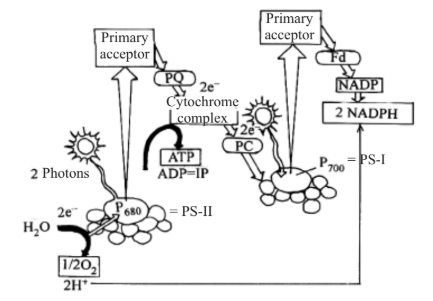
27. (a) With the help of diagrammatic representation, explain non-cyclic photophosphorylation.
(b) What is the role of (i) RuBisCO and (ii) PEPCO, and where are they present?
(c) State the law of limiting factor.
Ans:
- Non-cyclic photophosphorylation
- Role of RuBisCO and PEPco
- Rubisco: Ribulose Bisphosphate Carboxylase/oxygenase. Rubisco is a part of the C3 cycle and combines with CO2 to produce a C3 compound called PGA.
- PEPco: PEP carboxylase. PEPCo is a part of the C4 pathway and combines with CO2 to form a C4 compound called OAA.
- Law of limiting factor: When a process is affected by various factors, the rate of the process depends upon the pace of the slowest factor. For example, when light, temperature, and carbon dioxide are available in optimal levels, photosynthesis will be maximum. However, if one of these becomes suboptimal when others are optimal, it will reduce the photosynthetic rate.
28. Answer the following:
(a) Name the chemical the cell wall is made of, which is unique to bacteria.
(b) Give an example of Basidiomycetes.
(c) Name the association in which the fungi is associated with the roots of plants.
(d) Name the gametophyte of the fern plant.
(e) State two main characteristics of phylum Arthropoda.
(f) State two differences between striated and unstriated muscles.
Ans:
- Peptidoglycan
- Mushroom
- Mycorrhizae
- Prothallus
- Phylum Arthropoda
- Segmented body, which can be differentiated into head, thorax, and abdomen
- The head and thorax are often fused to form a cephalothorax
- Striated and unstriated muscles (any two)
| Striated Muscles | Unstriated Muscles |
| Attached to the skeleton are like head, limbs, face, etc. | Located in the walls of body organs like the stomach, intestines. |
| Elongated, cylindrical, and unbranched fibres | Spindle-shaped, tapering. |
| Microfibrils are arranged in a way that striations are seen. | No striations were seen in the non-uniform microfibril arrangement |
| Sacrolemma, the tough membrane present | No sacrolemma |
| Multinucleated and peripheral nuclei | Uninucleated and centrally positioned |
| Blood supply rich | Poor blood supply |
| Contracts at will | Contractions involuntary |
29. (a) Draw a neat and labelled diagram of the female reproductive system in humans.
(b) Where does the following phenomenon take place in females?
(i) Fertilization
(ii) Implantation
(c) State any two effects of uncontrolled population growth in our nation.
Ans:
- Female reproductive system in humans

- Location of
- Fertilization: Fallopian tube
- Implantation: Walls of the uterus
30. (a) Where does the heartbeat originate in the heart?
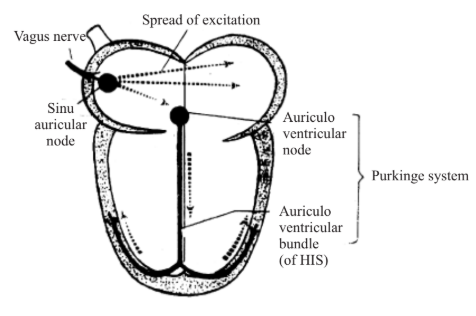
(b) Draw a neat diagram of the internal structure of the heart and label the nodes involved in the heartbeat. With the help of arrows, trace the route of the conduction of impulse for a heartbeat.
(c) Name any two heart-related disorders.
Ans:
- The heartbeat starts with the contraction or systole of the atria, followed by relaxation or diastole. The lubb sound or 1st heart sound occurs due to the closure of atrioventricular valves, the atrial systole.
- Conduction of impulse in the heart
- Heart-related disorders: Atherosclerosis and Arteriosclerosis.
Additional Study Materials
- NIOS Class 12 Biology PYQ April 2025 Set A
- NIOS Class 12 Biology PYQ Oct 2024 Set A
- NIOS Biology Paper 2024 April Set A Solved
- NIOS Class 12 Biology PYQ April 2023 Set A
- NIOS Class 12 Biology PYQ Oct 2022 Set A
- NIOS Class 12 Biology PYQ April 2022 Set A
- NIOS Class 12 Biology PYQ Feb 2021 set A
- NIOS Class 12 Biology PYQ Oct 2021 Set A
- NIOS Class 12 Biology PYQ Oct 2019 Set A
- NIOS Class 12 Biology PYQ April 2019 SetA
- NIOS Class 12 Biology PYQ Oct 2018
- NIOS Class 12 Biology PYQ April 2018 Set A
- NIOS Class 12 Biology PYQ Oct 2017 Set A