NIOS Biology Question Paper 2019 Oct Set A
1 MARK QUESTIONS
1. Which of the following infections causes life-time immunity?
(A) Common cold
(B) Smallpox
(C) Influenza
(D) Pneumococcal pneumonia
2. Which of the following disorders is sex linked?
(A) Haemophilia
(B) Thalassemia
(C) Sickle cell anaemia
(D) Mongolism
3. Which of the following is an endangered species?
(A) Wild buffalo
(B) Chital
(C) Sambar
(D) Asiatic elephant
4. Which of the following organs stores sperm in man?
(A) Seminal vesicles
(B) Urethra
(C) Vas deferens
(D) Epididymis
5. Which of the following is an example of locomotion?
(A) Stretching an arm to pick a fruit
(B) A bird jumps to a tree
(C) Frog shoots its tongue to catch an insect
(D) Cow wags its tail to drive away flies
6. Which of the following statements is true?
(A) The lubb sound of the heart is due to closure of semilunar valve.
(B) Pulmonary vein carries oxygenated blood.
(C) Heartbeat originates at A.V. node.
(D) Arteries have semilunar valves.
7. The value of vital capacity of lungs is:
(A) 500ml
(B) 5500-6000 ml
(C) 3400-4800 ml
(D) 2000-3000 ml
8. Which of the following N2-fixing microbes is free-living?
(A) Cyanobacteria
(B) Rhizobium
(C) Azospirillum
(D) Azotobacter
2 MARKS QUESTIONS
9. Match the following:
| Column-A | Column-B |
| (i) Iodine | (A) Delayed blood clotting |
| (ii) Iron | (B) Night blindness |
| (iii) Vitamin K | (C) RBC |
| (iv) Vitamin A | (D) Goitre |
Ans: (i)- (D), (ii) – (C), (iii) – (A), (iv) – (B)
10. Give full form of the following: AIDS and ECG
Ans:
- AIDS: Acquired Immuno Deficiency Syndrome
- ECG: Electrocardiogram
11. Express the process of photosynthesis by an equation.
Ans:
12. Name the two types of photophosphorylation during photosynthesis. In which of these photolysis of water takes place?
Ans: The two types of photophosphorylation are cyclic and non-cyclic photophosphorylation. The photolysis of water takes place in the non-cyclic photophosphorylation.
13 Name the technique of growing plants without soil. Why vigorous bubbling of air is essential for this technique?
Ans: Hydroponics. Vigorous bubbling of the air is routinely done to provide sufficient oxygen to the root system.
14. Name the reducing agents needed to reduce molecular N2 to ammonia during biological nitrogen fixation. Why is ammonia thus produced not released but is converted to amino acids?
Ans: Reducing agents are NADH2 and FADH2. Ammonia is converted into amino acids, as free ammonia is toxic to living cells.
15. Which are the main sites through which transpiration occurs? What is the effect of light on the rate of transpiration?
Ans: Transpiration occurs through stomata found on the leaf surface. Light has no direct effect on the rate of transpiration, but indirectly it controls the stomatal opening, and secondly, by affecting the temperature.
16. Give any four uses of algae.
Ans:
- Provide food for fish as part of phytoplankton (organisms floating on the water surface)
- These are rich sources of vitamins A and E.
- Many marine forms are important sources of iodine, potassium, and other minerals.
- Blue-green algae increase the soil fertility by fixing atmospheric nitrogen.
17. How does haemoglobin help in the transportation of O2 in the blood?
Ans: Four molecules of oxygen form a reversible bond with haemoglobin, forming the compound oxyhaemoglobin. When the oxygenated blood reaches the tissue surface, there is a high concentration of CO2 in the tissues, oxygen having been used up, and a low concentration of O2. As a result, the bonds holding oxygen and haemoglobin in Hb (4O2) become unstable and blood releases oxygen and takes up CO2.
18. What type of cell organelles and cell wall are found in Bacteria?
Ans: The bacterial cell wall is made up of a chemical, peptidoglycan, unique to bacteria, lipids, polysaccharides, and some proteins. Membrane-bound organelles like the endoplasmic reticulum, mitochondria, chloroplasts, and the Golgi complex are absent. Only 70s ribosomes are present. One circular chromosome made of a double helical molecule of DNA is located in a region of the cytoplasm called the nucleoid.
19. What is Diabetes mellitus? What are its symptoms?
Ans: Non-secretion or under-secretion of insulin leading to the presence of more than normal sugar in the blood, which is called diabetes mellitus. Common symptoms are,
- Has higher glucose in the blood;
- Excretes a great deal of urine loaded with sugar;
- Feels thirsty because of loss of water through too much urination;
- Loses weight and becomes weak. In some cases, the patient even loses their eyesight.
20. Explain Binocular vision.
Ans: Binocular vision. In all primates, including humans, both eyes are placed forward. Each eye views at a slightly different angle. The images from the two eyes are perceived to overlap inside the brain, giving the impression of depth (3-dimensional/stereoscopic vision).
4 MARKS QUESTIONS
21. Give one term for the following relations:
(a) One organism receives benefit at the cost of the other.
(b) An interaction between different individuals of the same species.
(c) An interaction between two populations in which both species are harmed to some extent.
(d) Association between insect-pollinating flowers and pollinating insects.
Ans:
- Parasitism
- Intraspecific interaction
- Competition
- Mutualism
22. Differentiate between:
(A) DNA and RNA
(B) Fraternal twins and Identical twins
Ans:
- DNA and RNA
| DNA | RNA |
| Double-stranded molecule | Single-stranded molecule |
| Contains deoxyribose sugar | contains ribose sugar. |
| The pyrimidine base complementary to Adenine is Thymine | The pyrimidine base complementary to adenine is Uracil, not thymine, in RNA |
| DNA has only one function, that is to bear hereditary information | Many species of RNA, such as mRNA, tRNA, and rRNA, with different functions. RNA is the genetic material in retroviruses. |
| DNA can duplicate on its own | RNA is synthesized on a DNA template |
- Fraternal twins and identical twins
- When two eggs are released, fertilized by two different sperm, they are called fraternal twins. It could be both boys, both girls, or a boy and a girl. They are non-identical.
- When only one egg is released and fertilized, and this zygote divides into two, and each of these cells grows into independent individuals, they are called identical twins. They are identical in all aspects.
23. Write short notes on:
(A) Osteoporosis
(B) Meristematic tissue
Ans:
- Osteoporosis:
- Osteoporosis is an age-dependent disorder with loss of the normal density of bone. The bones become fragile and are easily fractured.
- Bones that are affected by osteoporosis can fracture with only a minor fall or injury.
- Elderly men and women are most susceptible because of hormonal changes that occur with advancing age.
- There are no symptoms of osteoporosis, and affected people may not realise it until a bone fracture occurs.
- Meristematic tissue:
- Mostly found in the root and shoot tips.
- There are three types of meristematic tissue: Apical, intercalary, and lateral.
- Composed of immature or undifferentiated cells without intercellular spaces.
- The cells may be rounded, oval, or polygonal; always living and thin-walled.
- Each cell has abundant cytoplasm and a prominent nucleus.
- Vacuoles may be small or absent.
24. Assign the following plants to their respective division:
(A) Vascular tissue present, Seeds not enclosed in ovary
(B) Vascular tissue absent, Plant body haploid, Sex organs jacketed
(C) Vascular tissue present, Plant body diploid, Prothallus present
(D) Vascular tissue present, Seeds enclosed in ovary, Seeds have one cotyledon.
Ans:
- Gymnosperms
- Bryophytes
- Pteridophytes
- Angiosperms
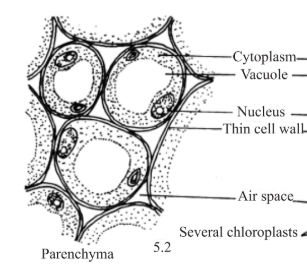
25. Draw the following and label its parts:
(A) Stomatal apparatus of Dicots
(B) Parenchyma
Ans:
- Stomatal apparatus of Dicots

- Parenchyma
26. Name the hormones that:
(A) Induces parthenocarpy
(B) Induces dormancy in seeds
(C) Is gaseous in nature
(D) Suppresses the growth of lateral buds
Ans:
- Gibberellins
- Abscisic acid
- Ethylene
- Auxin
6 MARKS QUESTIONS
27. (a) What is the relation between increasing population, agricultural development, and environmental degradation?
(b) What is vegetative propagation? What are its advantages and disadvantages?
Ans:
- Increasing population, agricultural development, and environmental degradation: In order to meet the food requirements of the ever-increasing population of the country, new agricultural techniques have been adopted. Some of these have proved to be detrimental to the environment.
- Reproduction of new plants from the portion of the vegetative parts of a plant is very common and is called vegetative reproduction.
- Advantages
- Rapid means of reproduction and spread.
- Offspring are identical to parents. The desired varieties can thus be preserved genetically for use.
- Food storage organs allow perennation or survival in adverse conditions.
- Improved varieties of ornamental plants and fruit trees can be multiplied easily.
- Vegetative propagation is a quicker, easier, and less expensive method of multiplying plants.
- Disadvantages
- Overcrowding and competition for space occur unless separated artificially.
- New varieties cannot be produced by this method except by mutation.
- Diseases typical of the species are rapidly transmitted and can be detrimental to a crop.
- Advantages
28. (a ) Explain the following terms:
(i) Dominant trait
(ii) Test cross
(ii) Dihybrid cross
(b) Explain how a haemophilic father passes on this defect to 50% of his grandsons through his daughters.
Ans:
- Explanation
- Dominant Trait: Out of the two alleles or allelographs of a trait, the one that expresses itself in a heterozygous organism in the F1 hybrid is called the dominant trait.
- Test Cross: Test cross is the Crossing of the F1 progeny with the homozygous recessive parent.
- Dihybrid Cross: The cross in which two parents differing in two pairs of contrasting characters are considered simultaneously for the inheritance pattern is called a dihybrid cross.
- When a haemophilic male has a defective sex linked gene located on the X chromosome, he transmits the defective X chromosome to his daughter only during reproduction. The female who has this gene transmits it to her son and daughter both with equal probability. So the male passes on his recessive sex linked trait to 50% of his grandsons through his daughter.
29. (a ) What do you understand by conservation of natural resources? Why do we need to conserve natural resources? Give any 4 reasons.
(b) What is the chemical nature of fats? State any 4 functions of fats.
Ans:
- Conservation is the proper management of a natural resource to prevent its exploitation, destruction, or degradation. We need to conserve natural resources,
- To maintain ecological balance to support life.
- To preserve different kinds of species (biodiversity).
- To make the resources available for present and future generations.
- To ensure the survival of the human race.
- Chemically, fats are triglycerides and contain more carbon and hydrogen with less oxygen. Functions of fats are: (any four)
- Fats are the richest sources of energy. On biological oxidation, one gram of fat provides 37 kJ of energy.
- Form structural components of the cell cytoplasm and the cell membrane.
- Help in absorption of fat-soluble vitamins A, D, E, and K
- It acts as a precursor of various hormones.
- It can be stored for subsequent use by the body.
- Subcutaneous fats serve as insulator in the body, thus protecting it from cold weather and pressure.
- Stored fat provides padding to protect the vital organs of the body from shocks.
- Helps in the synthesis of vitamin D and steroid hormones in the body.
30. (a) Name two types of phagocytic cells. Where are these found? Give two important features of these cells.
(b) What are transgenic organisms? Which bacterium is used to introduce required genes in plants? Name a transgenic plant and an animal.
Ans:
- Phagocytic cells: Microphages and macrophages. Microphages are found in WBCs, and macrophages are seen in the liver and spleen. Important features of phagocytic cells are,
- They rapidly engulf the foreign molecular agent oncoming in contact or when they come in contact.
- They contain digestive enzymes to break down engulfed material.
- They are an important link between innate and acquired immunity.
- Genetically engineered organisms carrying foreign genes are termed transgenic organisms. Bacillus thuringiensis is used to introduce required genes in plants. Bt crops and transgenic goats are examples.
Additional Study Materials
- NIOS Class 12 Biology PYQ April 2025 Set A
- NIOS Class 12 Biology PYQ Oct 2024 Set A
- NIOS Biology Paper 2024 April Set A Solved
- NIOS Class 12 Biology PYQ April 2023 Set A
- NIOS Class 12 Biology PYQ Oct 2022 Set A
- NIOS Class 12 Biology PYQ April 2022 Set A
- NIOS Class 12 Biology PYQ Feb 2021 set A
- NIOS Class 12 Biology PYQ Oct 2021 Set A