NIOS Class 12 BIOLOGY April 2023 SET A
1 MARK QUESTIONS
1. Select the correct sequence from the following options given below:
(A) Cell, tissue, organ, organ system, and organism
(B) Organism, tissue, organ system, cell, and organ
(C) Organism, organ system, tissue, cells, and organs
(D) Tissue, cells, organism, organ, and organ system
2. The association between maternal and foetal tissue is called:
(A) endometrium
(B) placenta
(C) umbilical chord
(D) wall of uterus
3. Niche is understood as:
(A) Space between two habitats
(B) Functional role of species in a habitat
(C) Space available on a tree
(D) Space shared by two or more species
4. In the alcohol manufacturing industry, the organisms used is:
(A) Saccharomyces
(B) Streptomyces
(C) Chlamydomonas
(D) Leuconostoc
5. During asexual reproduction, Rhizopus produces a large number of:
(A) Spores
(B) Gametes
(C) Buds
(D) Fission – forms
6. The inflorescence of Mustard is the ideal example of this type of inflorescence:
(A) Raceme
(B) Cymose
(C) Corymb
(D) Head
7. Desert plants conserve water by
(A) developing waxy coating on leaves.
(B) having more stomata.
(C) having broad leaves.
(D) having more hydathodes.
8. The phyto-hormone used as weedicide is –
(A) Auxin
(B) Gibberellins
(C) 2, 4-D
(D) Ethylene
2 MARK QUESTIONS
9. What are non-specific immune responses? Write any two examples of it.
Ans: Non-specific immune responses are those that non-selectively protect against foreign substances or cells without having to recognise their specific identities. Phagocytosis (engulfing of particulate matter) by macrophages and extracellular killing by proteins known as ‘complement’.
10. With the help of a schematic sequential flow chart, show the flow of information from genes to cytoplasm, during the process of protein synthesis.
Ans: For protein synthesis, first, the information coded in DNA is copied as a complementary messenger RNA molecule. This is termed as Transcription. Messenger RNA carrying information moves out of the nucleus into the cytoplasm, attaches to the ribosomes to translate the information in the form of a protein. This is termed Translation.
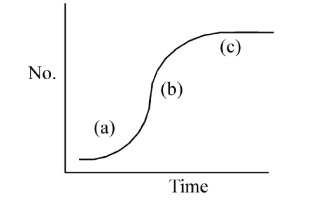
11. Label the parts a, b, and c of the following curve. Name the curve. What does it depict?
Ans:
- Slow growth
- Rapid growth
- No growth
The curve is called the Sigmoid curve. It depicts the increase in cell number (growth rate) against time.
12. How is a nucleoside different from a nucleotide?
Ans: A base and a sugar combine to form a nucleoside. When a phosphate group gets attached to the nucleoside, it becomes a nucleotide.
- Base+ sugar = Nuceloside
- Base + Sugar + phosphate = Nucelotide
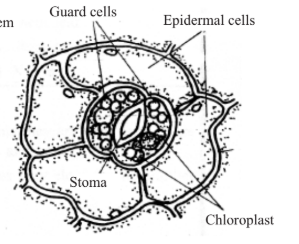
13. Draw a lined diagram of stomatal apparatus found in Dicots and label its any four parts.
Ans:
14. The plant Nepenthes lives in nitrogen-deficient soils. How does it get Nitrogen, necessary for its living?
Ans: Nepenthes feed on insects and rely on them as the source of nitrogen. Their shiny surface and nectar attract the insects. Their digestive enzymes digest these insects into amino acids, which are absorbed by the inner surface of their leaves.
15. (a) Name two microbes which help plants in getting nutrients. Explain how?
(b) Write any one example.
Ans:
- Rhizobium and Azotobacter are two microbes that help plants get nutrients. Rhizobium lives in the roots of legumes where it fixes atmospheric nitrogen into ammonia, which is later converted into amino acids. Azotobacter makes the soil fertile by fixing atmospheric nitrogen.
- Rhizobium lives in the roots of Pea plants.
16. What is the source of O2 released during photosynthesis? What is the process called? Also, write its equation.
Ans: Water molecule, H2O, is the source of O2, which is released during photosynthesis. The process that splits the water molecule that release O2 is called photolysis.

17. What is cellular respiration? Write its products. Write the name of organelle involved in this process.
Ans: The biochemical process, which occurs within cells and oxidises food to obtain energy, is known as cellular respiration.

It occurs in the mitochondria.
18. Explain the process of Sex determination in honey bees.
Ans: In honey bees, fertilised eggs emerge as females and unfertilised eggs develop into males. Since fertilised eggs and females are diploid, and unfertilised eggs and males are haploid.
19. Write the functions of following organs of male reproductive system of man:
(a) Seminal vesicles
(b) Prostate glands
Ans:
- Seminal vesicles are small white sacs at the anterior end of the ejaculatory duct that store sperm.
- Prostate glands secrete an alkaline fluid that keeps the sperm alive and helps them to swim vigorously.
20. Write any two important characters of insect-pollinated flowers. Write one example of it.
Ans:
- Flowers are usually large, coloured, and showy to attract insects.
- Some of these flowers secrete nectar to attract insects. Salvia flowers show special adaptations for pollination by bees.
4 MARK QUESTIONS
21. Name of some plants are given in column-‘A’. Select appropriate type of roots from column ‘B’ and make the pair.
| Column-A | Column-B |
| (a) Banyan | (i) Tuberous root |
| (b) Money plant | (ii) Epiphytic root |
| (c) Sweet potato | (iii) Climbing root |
| (d) Orchids | (iv) Prop root |
| (v) Napiform root |
Ans:
| Column-A | Column-B |
| (a) Banyan | (iv) Prop root |
| (b) Money plant | (iii) Climbing root |
| (c) Sweet potato | (i) Tuberous root |
| (d) Orchids | (ii) Epiphytic root |
22. (a) Define ecotone.
(b) Why grasslands and wetlands are considered as ecotone? Explain with the help of one example of each.
Ans: An Ecotone is a transitional zone between two ecosystems.
- Grasslands represent an ecotone (a zone between two ecosystems) and are found between forests on one side and deserts on the other.
- Wetlands are between aquatic and terrestrial ecosystems. They show an edge effect and form an ecotone.
23. (a) Draw a neat and labelled diagram of a DNA molecule showing formation of new DNA strands.
(b) In which direction does a new strand of DNA is formed during replication?
(c) What are Okazaki fragments?
Ans:
- Formation of new DNA strands.
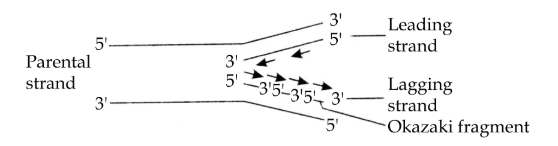
- New strands are formed from the 5’ end to the 3’ end.
- The DNA synthesis on the lagging strand is discontinuous by forming small pieces. These fragments are called Okazaki fragments.
24. (a) Name any four types of immunoglobulins produced in human body.
(b) What is triple vaccine? At what stage is it administered in human beings? Name the diseases it prevents.
Ans:
- Types of immunoglobulin found in the human body are IgD, IgA, IgE, IgG, and IgM.
- A triple vaccine carries antigens for three diseases. DPT has diphtheria and tetanus toxoids, and for pertussis, Bordetella pertussis, the whooping cough organism. The vaccine is given in the infant age.
25. Write any three differences between aerobic and anaerobic respiration. Write one example for each type.
Ans: Any three.
| Aerobic respiration | Anaerobic respiration |
| Takes place in the presence of oxygen. | Takes place in the complete absenceof oxygen. |
| Leads to the complete oxidation of the organic substrate. | Incomplete oxidation of the organic substrate takes place. |
| It is most common in higher organisms (both plants and animals). | Takes place in lower organisms such as bacteria, fungi, and in higher animals under limiting conditions of oxygen (e.g., in muscles when oxygen present is insufficient). |
| C6H12O6 → 6CO2 + 6H2O + 6O2 +38 ATP | C6H12O6 → 2Ethyl alcohol + 2CO2 +2 ATP(as in yeast) C6H12O6 → 2 Lactic acid + 2 ATP (muscles) |
| Takes place in the cytoplasm and mitochondria in eukaryotes and the plasma membrane in prokaryotes. | Takes place in the cytoplasm. |
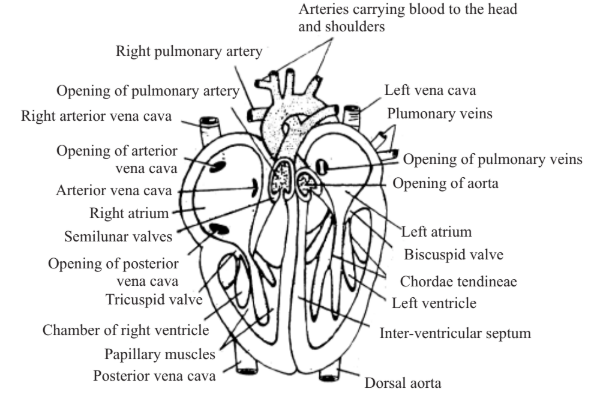
26. To show the internal structure of human heart draw a lined diagram of it and label the following structures: auricles, ventricles, aorta, pulmonary artery, bicuspid valve and tricuspid valve.
Ans:
6 MARK QUESTIONS
27. (a) (a) Define Mendel’s law of independent assortment.
(b) Explain it with the help of Punnett square.
(c) Write the phenotypic ratio of F2 generation.
Ans:
- The law of independent assortment states that the inheritance of factors controlling one character does not depend on the inheritance of any other factor controlling any other character.
- In a cross between a red tall plant and a white dwarf plant. (TTRR x ttrr) with gametes: TR, tr
F1: TtRr
When the F1 is selfed, the F2 is obtained as follows.
| Gametes | TR | Tr | tR | tr |
| TR | TTRR (Tall red) | TTRr (Tall red) | TtRR (Tall red) | TtRr (Tall red) |
| Tr | TTRr (Tall red) | TTrr (Tall white) | TtRr (Tall red) | Ttrr (Dwarf White) |
| tR | TtRR (Tall red) | TtRr (Tall red) | ttRR (Dwarf red) | ttRr (Dwarf red) |
| tr | TtRr (Tall red) | Ttrr (Dwarf white) | ttRr (Dwarf red) | Ttrr (Dwarf white) |
The F2 showed independent assortment of two pairs of genes. R for red flower, r for white flower, T for tallness, and t for dwarfness.
- The phenotypic ratio in F2 is 9 Tall Red: 3 Tall White: 3 Dwarf Red: 1 Dwarf white
28. (a) Write one character of following plant tissues. Also mention their location.
(i) Parenchyma (ii) Xylem (iii) Meristematic tissue
(b) Write name of one organism having following structures/characters:
(i) Canal system
(ii) Tentacles
(iii) Absence of digestive system
(iv) Suckers
(v) Jointed legs
(vi) Tube feet
Ans:
- Characters and location
- Parenchyma: These are living cells with thin walls. They are found in the pith and cortex of roots and stems.
- Xylem: Xylem is a conducting tissue that conducts water and salts upward from roots to leaves. It is found in vascular bundles.
- Meristematic tissue: Composed of immature or undifferentiated cells without intercellular spaces. It is found at the root and shoot tips.
- Organisms having these characteristics:
- Canal system: Sponges.
- Tentacles: Hydra
- Absence of digestive system: Planaria
- Suckers: Fasciola
- Joined legs: Crab
- Tube feet: Starfish
29. (a) Name any two food items that could prevent Vitamin D deficiency in our body.
(b) Name the disease caused due to deficiency of Vitamin A and also write any one symptom of it.
(c) Write any three methods for conservation of soil.
Ans:
- Milk, egg, cod liver oil.
- Night blindness- Cannot see in dim light.
- Soil conservation:
- Planting of trees and vegetation reduces soil erosion.
- Dividing a slope into several flat fields to control the rapid run of water, especially in hilly areas.
- Grazing should be allowed only in specified areas.
30. (a) In photosynthesis, there are two reactions: light and dark reactions. Why are they called so? Explain.
(b) What are the products obtained in each reaction?
(c) What are P680 and P700?
Ans:
- Light reactions are reactions of photosynthesis that are light-dependent and cannot happen without the presence of light. Eg. Electron Transport Chain. The reactions of photosynthesis that are independent of light i.e,. Light is not necessary, but can continue in light as well if products of the light reaction are available, are called dark reactions. Eg. reduction of CO2.
- Products
- Light reaction: ATPs and O2.
- Dark reaction: Glucose, NADP+, and ADP
- P680 is the reaction centre of chlorophyll a in PS II, with the maximum absorption at 680 nm wavelength. P700 is the reaction centre of chlorophyll a in PS I with a maximum absorption at 700 nm wavelength.
Additional Study Materials
- NIOS Class 12 Biology PYQ April 2025 Set A
- NIOS Biology Paper 2024 April Set A Solved
- NIOS Class 12 Biology PYQ Oct 2024 Set A