NIOS Biology Question Paper 2024 Class 12 April
SECTION–A (1 MARK QUESTIONS)
1. Name of the technique used for detecting genetic disorders in a foetus is
(A) Amniocentesis
(B) ultrasound
(C) X-ray
(D) MRI
2. Which of the following makes up the final trophic level in a food chain?
(A) Parasite
(B) Producer
(C) Decomposer
(D) Carnivore
Or
What does the following sequence represent?
Blue-green algae → Crustose lichens → Foliose lichens → Mosses→ Shrubs → Dicotyledonous trees
(A) Genetic drift
(B) Ecological succession
(C) A food pyramid
(D) Phylogenetic trend
3. The largest lymphoid organ in the human body is
(A) bone marrow
(B) thymus
(C) adrenal
(D) spleen
Or
The condition caused due to oversecretion of thyroxine is
(A) goitre
(B) hyperthyroidism
(C) cretinism
(D) myxoedema
4. Cephalothorax is a characteristic feature present in the phylum
(A) Echinodermata
(B) Mollusca
(C) Arthropoda
(D) Annelida
Or
Heart is three-chambered in reptiles. But a partially divided ventricle (i.e., four-chambered heart) is present in
(A) salamander
(B) frog
(C) snake
(D) crocodile
5. When both male and female flowers are present on the same plant, the plant is said to be
(A) unisexual
(B) monoecious
(C) dioecious
(D) bisexual
6. Excessive intake of iron in diet causes
(A) scurvy
(B) hypervitaminosis
(C) anaemia
(D) hemosiderosis
7. A broad-spectrum antibiotic, used against pathogenic bacteria, is
(A) penicillin
(B) paracetamol
(C) erythromycin
(D) streptomycin
8. A cross between the F1 progeny and the homozygous recessive parent is known as
(A) test cross
(B) dihybrid cross
(C) reciprocal cross
(D) monohybrid cross
Or
The phenotypic ratio, in the case of incomplete dominance in Mirabilis jalapa, is
(A) 9: 3: 3: 1
(B) 3: 1
(C) 1: 4: 6: 4: 1
(D) 1: 2: 1
9. Pick the odd one out.
(A) UGA
(B) AUG
(C) UAG
(D) UAA
Or
Pick the mRNA codon which will pair with the anticodon UCA of tRNA.
(A) GAU
(B) AGU
(C) AUG
(D) TGT
10. Which of the following bacteria helps to set milk into yoghurt?
(A) Mycobacterium
(B) Lactobacillus
(C) Azotobacter
(D) Pneumococcus
Or
Which of the following is not a product of fermentation?
(A) Bread
(B) Acetic acid
(C) Butanol
(D) Ligase
11. The special protein present in the root nodules of legumes, which helps in nitrogen fixation, is
(A) leghaemoglobin
(B) nitrogenase
(C) chlorophyll
(D) haemoglobin
12. Which of the following is an example of an oviparous mammal?
(A) Kangaroo
(B) Duck-billed platypus
(C) Whale
(D) Bat
Or
Endoparasitic flatworm found in the human intestine of an infected person is
(A) millipede
(B) ascaris
(C) tapeworm
(D) liver fluke
13. Which of the following is a contractile protein?
(A) Keratin
(B) Collagen
(C) Trypsin
(D) Myosin
14. In C4 plants, the initial acceptor of CO2 is
(A) Ribulose bisphosphate (RuBP)
(B) Phosphoenolpyruvic acid (PEP)
(C) Oxaloacetic acid (OAA)
(D) Phosphoglyceric acid (PGA)
15. The disease for which bio-engineered vaccine has already been developed is
(A) smallpox
(B) tetanus
(C) hepatitis B
(D) pertussis
16. The edible part of the coconut is
(A) fleshy thalamus
(B) mesocarp
(C) pericarp
(D) endosperm
Or
The example of hypanthodium is
(A) Tulsi
(B) Peepal
(C) Sunflower
(D) Euphorbia
SECTION–B (2 MARKS)
Note: Question Nos. 17 to 28 are objective-type questions carrying 2 marks each.
17. Fill in the blanks (attempt any two from A to D):
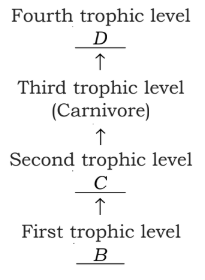
The flowchart given below is a diagrammatic representation of trophic levels in a A in an ecosystem :
Ans:
- B- Producers
- C- Herbivores
- D- Decomposers
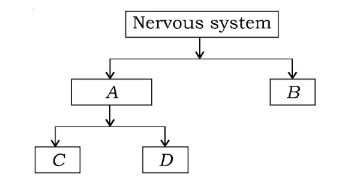
18. Complete the flowchart with the basic components of the nervous system (attempt any two from A to D):
Ans:
- A: Central Nervous System
- B: Peripheral Nervous System
- C: Brain
- D: Spinal cord
19. Choose the odd one in each of the following:
(a) Ovary → Fallopian tube → Ureter → Vagina
(b) Graafian follicle → Leydig cells → Corpus luteum
Ans:
- Uterer
- Leydig cells
20. Draw the diagram as given below in your answer book and label the parts marked A and B in the following diagram:
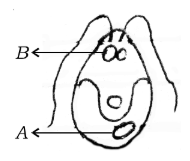
Ans:
- A: Pyrenoid
- B: Contractile vacuole
21. Match the items in Column I with the suitable items in Column II :
| Column–I | Column–II |
| (a) Brush bordered epithelium | (i) Lining of air sacs in lungs |
| (b) Squamous epithelium | (ii) Lining of trachea |
| (iii) Lining of stomach | |
| (iv) Lining of intestine |
Ans:
- – (iv)
- – (i)
22. Fill in the blanks (attempt any two from A to D) :
A and B are two adaptations to promote cross-pollination in flowers, while C and D are two devices to ensure self-pollination.
Ans:
- Unisexuality
- Dichogamy
- Cleistogamy
- Homogamy
23. Match the items in Column I with the suitable items in Column II :
| Column–I | Column–II |
| (a) Stilt root | (i) Turnip |
| (b) Fusiform root | (ii) Banyan |
| (iii) Sugarcane | |
| (iv) Radish |
Ans:
- – (iii)
- – (iv)
24. Many organisms with separate sexes have a pair of specific types of chromosomes called sex chromosomes. In humans, A are responsible for homogametic females, and B are responsible for the heterogametic male.
In birds, it is C for females and D for male chromosomes. Attempt any two from the above blanks A to D).
Ans:
- XX
- XY
- ZW
- ZZ
25. Fill in the blanks with suitable words (attempt any two from A to D):
The secretion of milk from the mammary glands is called A. The first secretion that comes from the mammary glands of the mother is called B. The synthesis of milk from the mammary glands is stimulated by the hormone C, which is secreted by the anterior lobe of the pituitary gland. Another hormone D, is secreted by the posterior lobe of the pituitary gland, which stimulates the release of milk from the mammary glands.
Ans:
- Lactation
- Colostrum
- Prolactin
- Oxytocin
26. In the Column I of the following table, recipient blood groups are given. For safe transfusion, fill in the boxes of Column II with the correct donor in each case (attempt any two from (a) to (d) ):
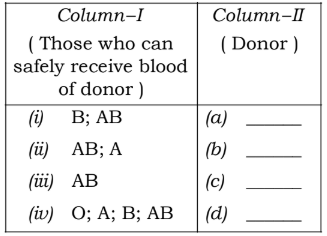
Ans:
- B
- A
- AB
- O
27. Given below are the interactions between two species. Identify the two wrong statements for interactions from the following:
(a) Both species cannot survive without the other is called mutualism.
(b) Penicillium secretes antibiotics which inhibit the growth of bacteria. This interaction is known as predation.
(c) When one species is benefitted and the other is harmed, it is known as parasitism.
(d) One species is benefitted and the other is unharmed or neutral. This interaction is known as commensalism.
Ans:
- (a) Both species cannot survive without the other, and this is called mutualism.
- (b) Penicillium secretes antibiotics that inhibit the growth of bacteria. This interaction is known as predation.
28. Identify the type of inflorescence of the diagram given below:
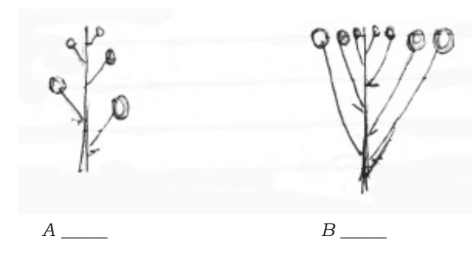
28. Identify the type of inflorescence of the diagram given below:
Ans:
- Raceme
- Corymb
SECTION–C
Note: Question Nos. 29 to 37 are very short answer-type questions carrying 2 marks each.
29. Write the main functions of B-cells and T-cells in the immune system.
Ans:
Functions of B-cells
- Initiate antibody-mediated immune response.
- Transform into plasma cells, which secrete antibodies.
Functions of T-cells (any two)
- Regulate immune response.
- Mediate cell-mediated immune (CMI) response.
- Induce B-cells to produce antibodies.
Or
Differentiate actively acquired immunity from passively acquired immunity.
Ans:
- Actively acquired immunity is developed due to infections that induce lifetime immunity or that provide immunity for a shorter period.
- Passively acquired immunity is developed by the transfer of antibodies from the mother to the fetus, through the mother’s milk to children, etc.
30. Name the two diseases caused by the deficiency of protein or carbohydrate or both in the diet of a child. Also, list any two characteristic symptoms of any one deficiency disease.
Ans:
Diseases caused by a deficiency of proteins
- Marasmuc
- Kwashiorkor
Symptoms of Marasmus
- Wasting of muscles reduces the child to skin and bones.
- Folded skin.
- Sunken eyes, thin face, thinning of limbs, and abdominal walls.
31. What are meristems? Write the location of the following meristems in the plant:
(a) Apical meristem
(b) Lateral meristem
Ans:
- Root and shoot tips
- Cambium between the xylem and phloem, and also in cork
Or
What are the main functions of the muscular tissue? Where are the following muscles located?
(a) Striated muscles
(b) Unstriated muscles
Ans: The main functions of muscular tissue are locomotion and movement.
- Attached to the skeleton are features like a head, limbs, and face etc.
- In the walls of body organs like the stomach, intestines.
32. Draw a diagrammatic structure of an antibody, and label the specific antigen-binding site.
Ans:
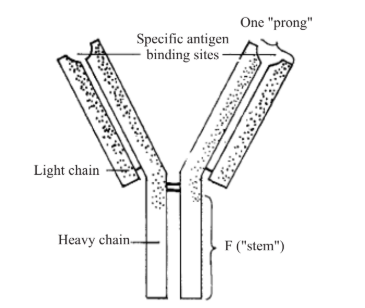
Ans:
33. Write any four functions of proteins in our body.
Ans:
- Structurally, proteins form an integral part of the membranes
- Functionally, in the form of enzymes, they play a vital role in metabolic reactions.
- Synthesis of DNA is regulated by proteins (enzymes).
- Proteins are so important that nucleic acids directly regulate protein synthesis
Or
What are vitamins? Vitamins are grouped into two classes. Name them and give one example of each.
Ans: Vitamins are organic compounds required in the diet of animals for their healthy growth.
Vitamins are classified according to their solubility into two groups :
- Water-soluble, e.g., vitamin B and ascorbic acid
- Fat-soluble vitamins (viz. A, D, E, K)
34. (a) What types of roots are found in plants growing in marshy areas?
(b) Write the name of the tissue present in the aerial roots of epiphytes, which helps in the absorption of moisture from the atmosphere.
Ans:
- Pneumatophores
- Velamen
Or
How will you distinguish between the vascular bundles of a dicot root and a dicot stem?
Ans:
| Dicot Root | Dicot Stem |
| Xylem and phloem are on alternate radii, or radial vascular bundles | Vascular bundles are collateral, xylem, and phloem on the same radius |
| Xylem is exarch | Xylem is endarch. |
35. Draw a neat and labelled diagram of a mushroom.
Ans:
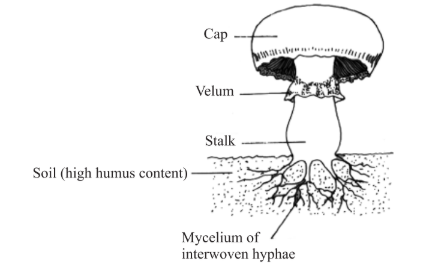
Ans:
36. With the help of a suitable example, explain the alternation of generations in bryophytes.
Ans: Alternation of generations refers to the alternation of two distinct gametophytic and sporophytic phases in regular succession during the life cycle of an individual. In bryophytes, the main plant body is a haploid gametophyte. The diploid generation is formed by the fusion of male and female gametes. Meiosis of the diploid sporogenous results in haploid spores, which germinate into the haploid plant body.
37. Define the following terms:
(a) Population
(b) Adaptation
Ans:
- A population is an assemblage of similar organisms belonging to the same species, living together in the same place at a given time.
- Adaptation is the appearance or behaviour or structure or mode of life of an organism that allows it to survive in a particular environment.
SECTION–D (3 MARKS)
Note : Question Nos. 38 to 41 are short answer-type questions carrying 3 marks each.
38. With the help of diagrams, briefly explain the following types of placentations found in the angiosperms. Give one suitable example in each case :
(a) Marginal
(b) Axile
(c) Parietal
Ans:
- Marginal: The ovary is monocarpellary and one-chambered, and the ovules are arranged along the fused margins of the single carpel. e.g., pea, gram.
- Axile: Ovary is polycarpellary syncarpous, having many chambers and ovules present on the placenta develops from the central axis formed by the fusion of the margins of two or more carpels, e.g., China rose, tomato, bhindi,
- Parietal: Ovary is polycarpellary and syncarpous, having one chamber, and ovules are attached on its inner wall where margins of adjoining carpels meet, e.g, mustard, cucumber,

Or
With the help of diagrams, briefly explain the three types of cymose inflorescence, with one suitable example in each case.
Ans:
- Monochasial cyme: Main axis ends in a flower. A lateral branch comes from one side and ends in a flower
- Dichasial cyme: Two lateral branches develop from either side of the terminal flower, and each branch ends in a flower
- Multichasial cyme: Number of lateral branches come from the sides of the terminal flower, each lateral branch ends in a flower.

39. What do you understand by the term ‘double fertilization’? Briefly explain the process and the end products formed.
Ans: During fertilization in plants, one sperm fuses with the egg (syngamy) and forms a diploid zygote. The other sperm fuses with the secondary nucleus to form the primary endosperm nucleus, which is triploid (2n+n = 3n) in nature. Since there are two types of fusion, syngamy and triple fusion, taking place in an embryo sac, the process is termed double fertilization.
40. A cross was made between a tall pea plant with red flowers (TTRR) and a dwarf pea plant with white flowers (ttrr). Work out the cross up to F2 generation. Write the phenotypic ratio of F2 generation.
Ans:
Cross between TTRR (tall red) x ttrr (Dwarf white)
Gametes formed by TTRR are TR, TR
Gametes formed by ttrr are tr and tr
| Gametes F1 | TR | TR |
| tr | TtRr- Tall red | TtRr – Tall red |
| tr | TtRr- Tall red | TtRr – Tall red |
The F1 generation is all Tall red with a genotype of TtRr.
F2 is crossed between TtRr x TtRr
The gametes procured are TR, Tr, tR, tr
| Gametes | TR | Tr | tR | tr |
| TR | TTRR – Tall red | TTRr – Tall red | TtRR – Tall red | TtRr – Tall red |
| Tr | TTRr – Tall red | TTrr – Tall white | TtRr – Tall red | Ttrr – Tall white |
| tR | TtRR – Tall red | TtRr – Tall red | ttRR – Dwarf red | ttRr – Dwarf red |
| tr | TtRr – Tall red | Ttrr – Tall white | ttRr – Dwarf red | Ttrr – Dwarf white |
The phenotypic ratio in F2 is 9 tall red: 3Dwarf red: 3 Tall white: 1 Dwarf white
41. (a) Write the differences between blood and lymph.
(b) With the help of flowchart, only show the route of blood flow and lymph flow in the human body.
Ans: (a)
| Blood | Lymph |
| Blood is red in color due to the presence of haemoglobin | Lymph is colorless |
| Flows rapidly | The flow is slow |
| Contains RBC, WBC, platelets, and plasma | Contains plasma and WBC |
(b) Route of blood and lymph flow
Route of blood flow
Heart
↓
Arteries
↓
Capillaries
↓
Veins
↓
Heart
Route of lymph flow
Tissue Spaces
↓
Lymph Capillaries
↓
Lymph Vessels
↓
Subclavian Vein
↓
Heart
Or
(a) Write the names of any two immunodeficiency disorders and give the cause of the disease.
(b) Name the two major types of lymphocytes. State where they develop and mature.
Ans:
(a) Immunodeficiency disorders
- SCID (Severe Combined Immune Deficiency Syndrome) is caused due to the absence of both T-cells and B-cells. This defect is present from birth.
- AIDS (Acquired Immune Deficiency Syndrome) causes a considerable reduction in T-cells and ultimate destruction of the Immune System. It is caused by HIV (Human Immunodeficiency Virus).
(b) Types of Lymphocytes
- T-cells mature in the thymus glands
- B-cells mature in lymphoid tissues like the tonsils and the appendix
SECTION–E (5 MARKS)
Note: Question Nos. 42 and 43 are long-answer-type questions carrying 5 marks each.
42. (a) Draw a neat diagram of a double-helical structure of DNA and label the main components.
(b) Distinguish between nucleoside and nucleotide.
Ans:
- DNA Helix
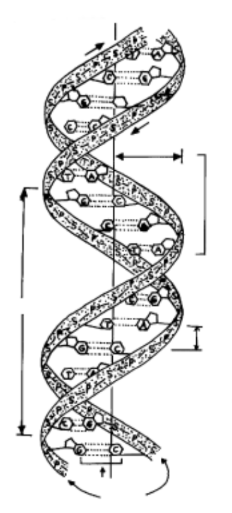
- When a base and a sugar combine, it forms a nucleoside. When a nucleoside combines with a phosphate group, it becomes a nucleotide.
Or
(a) Fertilization, ovulation, and implantation are the technical terms used to describe the reproductive events in a human female.
(i) Place them in correct sequence.
(ii) Define each of them.
(b) Describe the surgical methods of birth control in human males and females.
Ans: (a)
(i) The correct order is ovulation, fertilization, and implantation.
(ii)
- Ovulation: Egg released from the Graafian follicle under the influence of LH or Luteinising hormone.
- Fertilization: The fusion of male and female gametes.
- Implantation: The Egg is fertilized in the fallopian tube, and the Zygote begins dividing up to blastocyst formation.
(b) Vasectomy and tubectomy are the two surgical methods of birth control in males and females, respectively.
- Vasectomy is the ligation of the vas deferens through which sperm travel out of the epididymis.
- Tubectomy is the process of cutting the fallopian tubes and ligating them to prevent the ovulated egg from passing down.
43. (a) Mention the end products of the light reaction in photosynthesis.
(b) Draw the diagrammatic representation of the Calvin cycle.
(c) What is photorespiration?
Ans:
- End products of the light reaction in photosynthesis are ATP and NADPH2.
- Calvin Cycle

- The respiration that is initiated in chloroplasts and occurs in the presence of light and high concentrations of O2 (and low CO2) is called photorespiration
Or
(a) What is a reflex action?
(b) Write one suitable example of each of the following :
(i) Simple reflex action
(ii) Conditioned reflex action
(c) With the help of a neat and labelled diagram, show the nerve pathways involved in a simple reflex action.
Ans:
- Reflex action is an automatic, quick, and involuntary action in the body brought about by a stimulus.
- (i) Simple Reflex: Quick closing of eyelids on noticing an object suddenly approaching the eye.
(ii) Conditioned Reflexes: Applying brakes in your vehicle (car or bicycle) on noticing someone suddenly coming in front of it.
- The nerve pathways involved in a simple reflex action.

Additional Study Materials
- NIOS Class 12 Biology PYQ April 2025 Set A
- NIOS Class 12 Biology PYQ Oct 2024 Set A
- NIOS Class 12 Biology Terminal Exercises Solutions
- NIOS Class 12 Biology Intext Questions Solutions