
Class 12 Biology Competency-Based Questions Chapter 12
1 Mark Questions
1. Transgenic mice are being developed to replace the use of monkeys for laboratory testing of vaccines or drugs meant for humans.
Which of the following is/are POSSIBLE reasons for this move?
P) Mice and humans have similar physiology.
Q) The reproduction rate is faster in mice.
A. only P
B. only Q
C. both P and Q
D. neither P nor Q
Ans: C. both P and Q
2. There are two statements given below marked as Assertion (A) and Reason (R). Read the statements and choose the correct option.
- Assertion (A): A single-stranded DNA probe tagged with a radioactive molecule does not appear in an autoradiogram.
- Reason (R): Complementarity with DNA obtained from cloned cells forms the basis of probing using tagged DNA molecules in autoradiography.
A. Both A and R are true, but R is not the correct explanation for A.
B. Both A and R are true, and R is the correct explanation for A.
C. A is true, but R is false.
D. A is false, but R is true.
Ans: B. Both A and R are true, and R is the correct explanation for A.
Questions 207 and 208 are based on the following information.
Meera wanted to study a cytoskeletal protein called MAP2. To do so, she needed to clone the gene to obtain a recombinant MAP2 protein. She had identified the gene for this specific protein and had the cloned DNA sequence ready for further processing.
3. Which of the following is crucial for getting E. coli cells to produce the recombinant MAP2 protein from the cloned DNA?
A. inserting the DNA sequence directly into the E. coli cells
B. cutting the DNA sequence using restriction enzymes like EcoRI
C. inserting the DNA into a plasmid that can be expressed in the host E. coli cells
D. isolating the DNA sequence from the host E. coli cells and performing a polymerase chain reaction
Ans: C. inserting the DNA into a plasmid that can be expressed in the host E. coli cells
4. In the sequence of producing recombinant MAP2 protein, Meera had to perform gel electrophoresis immediately after a PCR (Polymerase Chain Reaction).
What could have been Meera’s primary goal for performing gel electrophoresis?
A. Separating the positively and negatively charged MAP2 DNA fragments.
B. Separating the cloned MAP2 DNA from other DNA fragments.
C. Separating recombinant MAP2 protein from other proteins.
D. Separating cloned MAP2 DNA from MAP2 protein.
Ans: B. Separating the cloned MAP2 DNA from other DNA fragments.
5. Shown below are three plasmids.
Cos gene initiated packaging of virus particles, and rop gene keeps a check on the copy number of the plasmid in a bacterial cell.
Which of these is ideal to be used for rDNA technology?
A. only plasmid 1
B. only plasmids 1 and 2
C. only plasmids 2 and 3
D. all – plasmids 1, 2, and 3
Ans: B. only plasmids 1 and 2
6. There are two statements given below marked as Assertion (A) and Reason (R). Read the statements and choose the correct option.
- Assertion (A): Transposons cause insertional mutations that can be treated using gene silencing.
- Reason (R): Transposons are mobile genetic elements that self-replicate via an RNA intermediate.
A. Both A and R are true, and R is the correct explanation for A.
B. Both A and R are true, but R is not the correct explanation for A.
C. A is true, but R is false.
D. A is false, but R is true.
Ans: A. Both A and R are true, and R is the correct explanation for A.
7. There are two statements given below marked as Assertion (A) and Reason (R). Read the statements and choose the correct option.
Assertion: RNA interference (RNAi) is used to protect plants against nematode infestation.
Reason: RNAi method involves silencing of a specific mRNA by a complementary dsRNA molecule that binds to and prevents translation of the mRNA.
A. A is true, but R is false.
B. A is false, but R is true.
C. Both A and R are true, and R is the correct explanation of A.
D. Both A and R are true, and R is not the correct explanation of A.
Ans: C. Both A and R are true, and R is the correct explanation of A.
8. Given below are steps involved in the gene therapy of a patient with adenosine deaminase (ADA) deficiency.
P) Lymphocytes are grown in a culture outside the human body.
Q) Lymphocytes are altered with a functional ADA cDNA.
R) Lymphocytes are collected from the blood of the patients.
S) The genetically modified lymphocytes are infused back into the patient.
Which of the following shows the correct order in which these steps must occur?
A. Q –> P –> R –> S
B. R –> S –> Q –> P
C. R –> P –> Q –> S
D. S –> R –> P –> Q
Ans: C. R –> P –> Q –> S
Given below is an image of the process involved in recombinant DNA technology.
LacZ is a gene that codes for β-galactosidase. When plated on an appropriate medium, cells that produce β-galactosidase form blue colonies, whereas those that do not produce it form white colonies.
Answer the Questions from Q9-Q12
9. Which of the following chemicals will be involved in a step that would come before step 1?
lysozyme, ethanol, ribonuclease, cellulase, protease
A. only lysozyme and ethanol
B. only cellulase, lysozyme and ethanol
C. only lysozyme, ribonuclease, protease, and ethanol
D. all – lysozyme, ethanol, ribonuclease, cellulase, protease
Ans: D. all – lysozyme, ethanol, ribonuclease, cellulase, protease
10. Which of the following will help one detect cells containing the recombinant DNA?
| Option | Ampicillin in medium | Colour of Colonies Formed |
| A | Present | Blue colonies |
| B | Absent | Blue colonies |
| C | Present | White colonies |
| D | Absent | White colonies |
A. A
B. B
C. C
D. D
Ans: C. C
11. At which step will DNA ligase be required?
A. Step 2
B. Step 3
C. Step 4
D. (DNA ligase is not required in this process)
Ans: B. Step 3
12. What would be the colour of the colonies formed by variant P?
A. only blue colonies
B. only white colonies
C. a mix of blue and white colonies
D. (They will not form any colonies.)
Ans: D. (They will not form any colonies.)
13. Polymerase chain reaction (PCR) mimics which of the following natural processes?
A. ligation
B. translation
C. replication
D. transformation
Ans: C. replication
14. Which of the following correctly states the purpose of steam in a bio-processor?
A. helps organisms grow faster
B. adds to the water content
C. maintains sterility
D. (Steam is not required in a bio-processing unit.)
Ans: C. maintains sterility
15. Similar to sexual reproduction, rDNA technology contributes to.
P) genetic mutation
Q) faster replication
R) genetic variation
S) DNA ligation
A. only R
B. only P and R
C. only P, Q, and R
D. all – P, Q, R and S
Ans: B. only P and R
16. In which of the following natural processes is recombinant DNA made?
A. prophase in mitosis
B. prophase 1 in meiosis
C. prophase 2 in meiosis
D. (Recombinant DNA cannot be made naturally).
Ans: B. prophase 1 in meiosis
17. Two statements are given below – one labelled Assertion (A) and the other labelled Reason (R).
- Assertion (A): Sexual reproduction is similar to rDNA technology because it results in variations.
- Reason (R): Variation is impossible through asexual reproduction.
Which of the following is correct?
A. Both A and R are true, and R is the correct explanation for A.
B. Both A and R are true, but R is not the correct explanation for A.
C. A is true, but R is false.
D. A is false, but R is true.
Ans: C. A is true, but R is false.
18. Two statements are given – one labelled Assertion (A) and the other labelled Reason (R).
- Assertion (A): Gene therapy is a method of treating a disorder, but cannot cure it.
- Reason (R): In gene therapy, cells are drawn from a patient and the functional gene is introduced into these cells and transferred back to the patient.
Which of the following is correct?
A. Both A and R are true, and R is the correct explanation for A.
B. Both A and R are true, but R is not the correct explanation for A.
C. A is true, but R is false.
D. A is false, but R is true.
Ans: A. Both A and R are true, and R is the correct explanation for A.
19. Given below are two statements about polymerase chain reactions.
P) It mimics DNA replication that happens in a cell.
Q) It cannot be used to amplify RNA molecules.
Which of these is/are TRUE?
A. only P
B. only Q
C. both P and Q
D. neither P nor Q
Ans: A. only P
2 Marks Questions
20. (a) How is the model organism modified before being used for chemical safety testing?
(b) What is the benefit of the modification identified in (a)?
Ans:
- (a) Genes that make the model organism more sensitive to the chemical being tested are introduced into it, creating transgenic model organisms.
- (b) Since the organism is more sensitive, it helps to study the effect of the chemical in a shorter duration as compared to a non-transgenic organism.
21. (a) What are transgenic animals?
(b) To produce transgenic animals, the gene of interest is introduced into embryonic stem cells. These stem cells are undifferentiated and the preferred target in the process of developing any transgenic animal. Give a reason why.
Ans:
- (a) Animals that have had their DNA manipulated to possess and express an extra (foreign) gene are transgenic animals.
- (b) Since embryonic stem cells are undifferentiated, they have the capability of forming all other cells of the body with their specialised functions and the inserted foreign gene.
22. CRISPR is a gene editing technique for which the developers won the Nobel Prize. Indian scientists are in the process of developing resilient and high-yield varieties of rice using this technology and providing these to Indian farmers by 2024, once approved.
(a) Which organisation would be responsible for approving such varieties?
(b) What is the purpose of establishing the organisation identified in (a)?
Ans:
- (a) GEAC (Genetic Engineering Approval/Appraisal Committee)
- (b)
- Provide decisions regarding the validity of GM research.
- Ensure the safety of introducing GM-organisms for public services
23. Plants of a region in India are constantly infested by the corn borer.
(a) What components are required in a recombinant plasmid that can produce modified plants which are resistant to the corn borer? State the purpose of each component.
(b) Give an example of a plasmid that can be used for (a).
Ans:
- (a)
- A cloning site with the cryIAb gene inserted in it to produce the toxin
- A selectable marker, such as an antibiotic resistance gene, for the selection of colonies with the recombinant plasmid
- An origin of replication so that the plasmid can replicate and make copies
- (b) Ti plasmid from Agrobacterium tumifaciens
24. Identify if the following statement is true or false.
Between formation of the dsRNA and silencing of mRNA, the dsRNA needs to undergo an additional step. Justify if true, and rewrite the correct statement if false.
Ans: True. Since dsRNA is double-stranded, it cannot automatically bind to the mRNA. So the two strands must be separated so that a single-stranded RNA is obtained, which can bind to the single-stranded mRNA, silencing it.
25. Hormones are broadly categorised as steroid hormones and protein hormones. Patients with type 2 diabetes generally have to take insulin externally. Researchers across the world believe that if insulin can be given orally, it would be ideal, as it would closely mimic the movement of natural insulin. Yet, injectable insulin is commonly prescribed by doctors. What type of hormone is insulin, and why can’t it be administered orally?
Ans:
- Insulin is a protein hormone.
- If taken orally, they will be digested by pepsin and trypsin in the stomach and small intestine into their simpler forms, thereby losing their function.
26. Give a reason why:
(a) Transgenic animals are used for the production of biological components of medicines over synthetic industrial production.
(b) In the process of testing for effects of chemicals, transgenic animals are used rather than non-transgenic ones.
Ans:
- (a)
- Industrial production is expensive when compared to production through transgenic animals.
- The components produced by transgenic animals have the possibility of being as close to the natural product as possible.
- (b) Transgenic animals are made that carry genes which make them more sensitive to toxic substances than non-transgenic animals, allowing for results in less time.
27(a) What is a disadvantage of the traditional hybridisation procedure?
(b) How has rDNA technology overcome the disadvantage identified in (a)?
Ans:
- (a) Traditional hybridisation procedures very often lead to the inclusion and multiplication of undesirable genes along with the desired genes.
- (b) Using rDNA technology, only the desired gene can be introduced into an organism without introducing other undesirable genes.
28. Anita and Dipti followed the steps mentioned below to introduce their gene of interest into the target organism.
| Step | Anita | Dipti |
| 1 | used a restriction enzyme to obtain gene of interest | used a restriction enzyme to obtain gene of interest |
| 2 | made multiple copies of the gene of interest using PCR | ligated the gene of interest with a cloning vector |
| 3 | introduced the amplified genes inthe cell | introduced the vector preparedin step 2 in the cell |
Of these, whose experiment is more likely to succeed and why?
Ans:
- Dipti’s experiment is more likely to succeed.
- Since Anita introduced her gene as it is, it did not have an origin of replication to replicate on its own and would get degraded over time.
29. Karan wanted to cut a DNA fragment, which was 800 base pairs long, from a vector. He followed each step of the protocol correctly and ran the resultant sample on an agarose gel. In an earlier attempt in extracting DNA from onion cells, he had seen DNA form a thread-like precipitate in ethanol. Given below is an image of the gel after he finished running his sample in it.
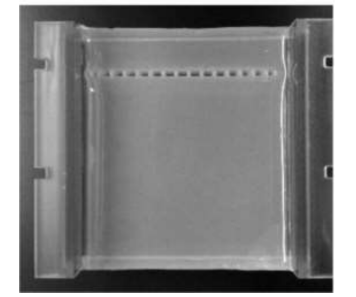
(a) Why does he not see the same thread-like precipitate in the gel?
(b) How can he ensure he has obtained the desired result?
Ans:
- (a) When DNA is extracted from several cells, it is much bigger in size than 800 base-pairs and is present in a larger volume and so it can be seen with the naked eye.
- (b) When stained with ethidium bromide and kept under UV light, the agarose gel should show a band of DNA corresponding to 800 base pairs on the marker.
30. Nidhi performed gel electrophoresis after treating one vector with restriction enzymes. She added one mixture in well Q and another mixture in well R. Given below is an image of the results.
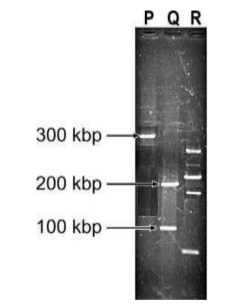
(a) What can be concluded about the mixtures loaded in wells P and Q?
(b) What is the likely reason that the fragments in wells Q and R are different?
Ans:
- (a) Well P contains the uncut vector, whereas well Q contains the vector cut by a restriction enzyme.
- (b) The vector in well Q has been cut by a restriction enzyme that has two sites, whereas the vector in well R has been cut either by different enzymes or by one enzyme that has more than two sites.
31. Explain why vectors that have restriction site/s within a marker gene are preferred for recombinant DNA technology.
Ans:
- When a target gene is inserted into a marker gene which has a restriction site, it inactivates the production of the marker.
- The absence of a characteristic that was coded for by the marker is useful in the detection of cells with the recombinant vectors.
3 Marks Questions
32. (a) What are genetically modified organisms?
(b) Transgenic mice models are preferred over human models to study several human diseases, such as Alzheimer’s. Is this statement TRUE? Give a reason to support your answer.
Ans:
- (a) Plants, bacteria, fungi and animals whose genes have been altered by manipulation are called Genetically Modified Organisms.
- (b) The statement is true. Transgenic mice allow for studying the progression of diseases in a shorter time than in humans due to the short life span of the mice.
33. X is the first restriction enzyme isolated from strain H of Bacillus amyloliquefaciens. This enzyme cuts between two guanine bases of the following palindromic sequence:
5’-G G A T C C-3’
3’-C C T A G G-5’
(a) Name the restriction enzyme X. Explain how you arrived at this name.
(b) Draw the DNA fragments produced due to the action of enzyme X on the palindromic sequence shown above.
Ans:
- (a)
- Name of the enzyme: BamHI
- The convention used to name a restriction enzyme is that the first letter comes from the genus (Bacillus) and the next two letters from the species (amyloliquefaciens).
- The fourth letter refers to the strain (strain H).
- The Roman number in the end indicates the order in which the enzyme was isolated from the strain (first enzyme).
- (b)
- 5’-G and G A T C C-3’
- 3’-C and C T A G-5’
34. In 1997, an American company obtained patent rights on Basmati rice, allowing them to market a ‘new’strain of Basmati rice in the United States and overseas.
This ‘new’ Basmati strain was really derived from Indian farmers’ varieties.
(a) What is this unauthorised act called? Define it.
(b) State TWO ways in which Indian farmers are set to lose due to this unauthorised act.
(c) State TWO measures that different countries are taking to prevent such unauthorised exploitation of their bio-resources.
Ans:
- (a)
- Biopiracy
- Refers to the use of bio-resources by multinational companies and other organisations without proper authorisation from the countries and people concerned, without compensatory payment.
- (b)
- Authorisation
- Compensation
- (c)
- The benefits of bio-resources should be shared between developed and developing countries.
- Implementing laws for issues such as patent terms, emergency provisions and research and development initiatives.
35. Kavya and David needed to cut out a 200 base-pair (bp) long DNA fragment from a 650 bp long vector. Enzyme A cuts at 350 bp and at 550 bp, whereas enzyme B does not cut the vector. They followed the given steps to do this:
| Step | David | Kavya |
| 1 | Take 3 micrograms of the vector | Take 3 micrograms of the vector |
| 2 | Add 2 microlitres of enzyme A | Add 2 microlitres of enzyme B |
| 3 | Incubate at 37°C for 2 hours | Incubate at 37°C for 2 hours |
| 4 | Run the sample on an agarose gel | Run the sample on an agarose gel |
Given below is an image of the gel that was run with the samples.
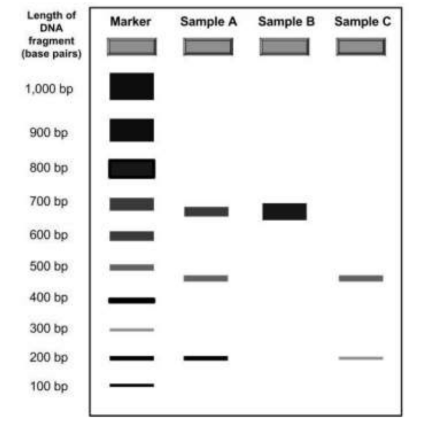
(a) What is the purpose of the marker?
(b) Which of these shows the samples run by David and Kavya? Justify your answer.
Ans:
- (a) The marker acts as a reference to identify the size of the fragments that are visible on the gel.
- (b)
- Sample C belonged to David.
- David followed the procedure properly and so can see two correct bands (200bp of the fragment and 450 bp of the remaining vector).
- Sample B belonged to Kavya
- Since enzyme B does not cut the vector, it remains intact when run on the gel.
36. Given below is a diagram of a bio-reactor with some of its parts labelled P and Q..
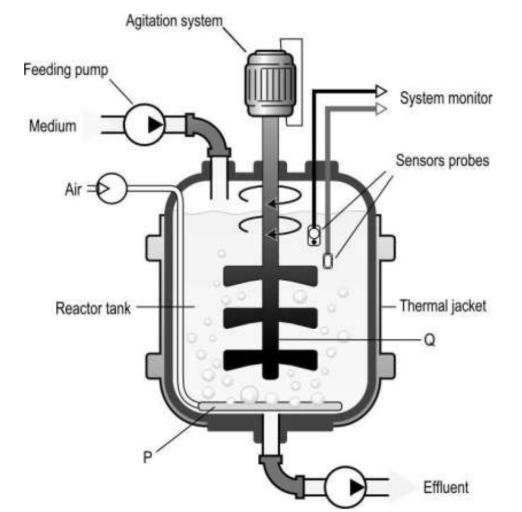
(a) Which type of organisms can MOST likely be used if part P is not made a part of the bio-reactor? Why?
(b) Identify the name and purpose of part Q.
(c) How does the thermal jacket help in the process?
Ans:
- (a) Anaerobic organisms. Since the aerator ensures the supply of oxygen for aerobic organisms to
- respire and function, anaerobic organisms will not need this to carry out life processes.
- (b) Q -stirrer/agitator. Purpose – The stirrer facilitates even mixing and oxygen availability throughout the bioreactor.
- (c) To maintain temperature throughout the process
37. (a) Give a reason why, although a toxin, Bt toxins are deadly for insects but not for plants producing them.
(b) Describe the steps in which Bt toxins act on insects.
Ans:
- (a) Bttoxins exist as inactive protoxins when produced by the plant and become active only when they are ingested by insects.
- (b)
- A plant/part of a plant producing Bt toxins is ingested by an insect.
- The inactive protoxin form of the Bt toxin gets converted into an active form of
- toxin due to the alkaline pH of the gut, which solubilises the crystals.
- The activated toxin binds to the surface of midgut epithelial cells and creates pores.
- These pores cause cell swelling and lysis and eventually cause the death of the insect.
38. ELISA is a test used for early detection of an infection.
(a) What components of a disease can be detected using ELISA?
(b) Describe the components that can be checked if one wants to identify whether an individual is allergic to pollen or not.
Given below is an image of an ELISA test result with two of its cells marked P and Q. A coloured cell indicates a positive result, whereas an uncoloured cell is a negative result.
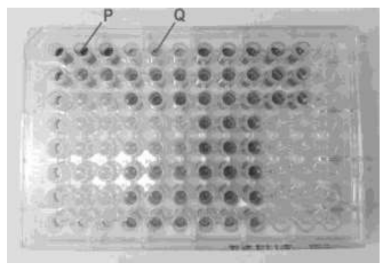
(c) The colour of P is darker than the colour of Q. What could this possibly indicate?
Ans:
- (a) Presence of antigen/antibodies to an antigen can be detected using ELISA.
- (b)
- Antigen from pollen
- IgE antibodies
- (c) P may have more antigen/antibodies as compared to Q.
39. (a) What causes adenosine deaminase (ADA) deficiency?
(b) What are the THREE methods that are currently used for the treatment of ADA?
(c) What is the problem with the methods described in (b)? How can this problem be overcome?
Ans:
- (a) ADA is caused due to the deletion of the gene coding for adenosine deaminase.
- (b)
- Bone marrow transplantation
- Enzyme replacement therapy
- Gene therapy
- (c)
- Problem – all three methods are not completely curative.
- A way to overcome – introducing the gene coding for ADA from marrow cells into early embryonic cells could permanently cure the disorder.
40. Given below is the step-by-step process in the formation of yoghurt (curd) in a bioreactor.
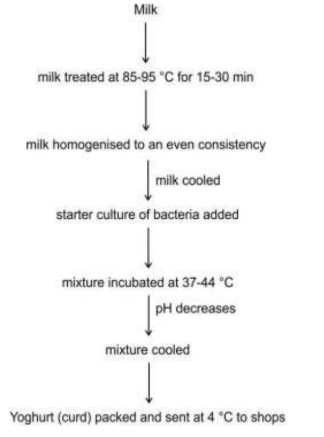
(a) Why does the pH start decreasing a while after the mixture is incubated at 37-44 °C?
(b) From the flowchart, identify two systems that the bioreactor would have.
Give a reason to support your answer.
Ans:
- (a)
- As the bacteria start to grow, they use up the oxygen in the system.
- After a while, the oxygen gets used up and anaerobic respiration begins, which leads to the formation of lactic acid, causing a decrease in the pH.
- (b)
- Oxygen delivery system: After the starter culture is added, oxygen is also added, which will need a delivery system.
- Stirrer: Once oxygen is added, the system would need to be mixed thoroughly so that oxygen is available throughout the bioreactor.
- Sterilisation unit: Milk needs to be sterilised before the addition of the starter culture to remove any other microorganisms already present in it.
5 Marks Questions
41. Given below is an image of a hormone which is required for the treatment of a disease.
(a) Identify the hormone and the disease that is caused due to its insufficient secretion.
(b) State whether the following statement about this hormone is true or false. Justify if true, correct if false.
‘The structure in the image is a protein and is the precursor form of the hormone.’
(c) Which characteristic helped you arrive at your answer in (b)?
(d) Describe the challenge in the large-scale production of this hormone using rDNA techniques and how it was overcome.
Ans:
- (a)
- Hormone – insulin
- Disease – diabetes
- (b) False. Correct statement – The structure in the image is a protein and is the final/active/mature form of the hormone.
- (c) The c-peptide, which is part of the precursor form, is missing in the structure shown, indicating that it is the final form.
- (d) Challenge – getting insulin assembled into a mature form without the c-peptide sequence. Overcome – chains A and B were produced separately by rDNA technology in E.coli cells, extracted and combined by creating disulphide bonds to form human insulin.
42. According to recent reports, MIT engineers have embedded genes from fireflies into watercress plants, inducing them to give off dim light for nearly four hours. To create these plants, the MIT team turned to luciferase, the enzyme that gives fireflies their glow. Luciferase acts on a molecule called luciferin, causing it to emit light. Another molecule called co-enzyme A helps the process by enhancing luciferase activity. None of these molecules are naturally produced by plants.
[Sourced and edited from: https://www.dailymail.co.uk/sciencetech/article-5178531/MIT-creates-bioluminescent-trees-glow-like-fireflies.html]
(a) Describe briefly the step-by-step process that should be followed in creating these plants.
(b) Draw a diagram of the possible vector used in (a).
Ans:
- (a)
- DNA from the fireflies needs to be isolated.
- This DNA and a suitable vector need to be digested by a restriction enzyme, electrophoresed and eluted from the gel.
- The required gene sequences for the three genes need to be amplified using PCR.
- The vector and the genes of interest need to be ligated together to create recombinant vectors, and cells containing the recombinant vector can be selected using the appropriate marker.
- These vectors can be transformed into a plant embryo through the use of micro-particles.
- (b)
- The origin of replication
- Restriction site/cloning site
- Selectable marker
- Three genes of interest coding for luciferase enzyme, luciferin, and co-enzyme A
43. The plasmid shown below is 7866 base pairs in length and contains genes that confer resistance to antibiotics tetracycline and ampicillin. The bp at which the restriction site is present is also shown.
(a) While working in the lab, Reema took three individual samples of the plasmid. She added different restriction enzymes, EcoRI, HindIII, and BamHI, separately in each of the samples. But she forgot to label the samples in a hurry. She ran the three digested samples on an agarose gel electrophoresis to see the fragments. The results are shown below:
Considering that complete restriction digestion had happened, help her identify which sample is digested by what enzyme.
(b) Next, Seema digested a target DNA with HindIII, ligated it with plasmids digested with the same enzyme, and transferred them into a bacterial cell. How will she distinguish the transformant with a recombinant plasmid from a non-transformant? Give a reason to support your answer.
Ans:
- (a)
- Sample 1: EcoRI
- Sample 2: BamHI
- Sample 3: Hind III
- (b)
- She can grow the culture on a media plate containing ampicillin and tetracycline.
- Since cutting with HindIII will disrupt the ampicillin resistance gene and not the tetracycline resistance gene, only cells containing the plasmid ligated with the target DNA will grow.
44. Naturally growing potatoes show bruises (black discolouration) when they get damaged. Bruising occurs when the tissue is crushed and cells rupture, releasing enzymes that produce a black discolouration. A gene has been identified that codes for this enzyme. A company wants to produce potatoes that do not show these bruises.
(a) Describe the steps by which they can produce such potatoes that do not show bruises.
(b) What is the process called?
Ans:
- (a)
- Creating a Ti plasmid which has the sense and anti-sense RNA, the latter complementary to the mRNA coding for the enzyme.
- Introducing these plasmids into the host plant.
- The sense and anti-sense RNA would combine to form a dsRNA
- The two strands split, and the anti-sense RNA binds to the mRNA coding for the enzyme, causing the black discolouration, silencing it.
- (b) RNA interference (RNAi)
45. Golden rice is a variety of rice that has been genetically modified to produce a compound called β-carotene, which gets converted to Vitamin A when metabolised in the human body. This was done by introducing the genes coding for three enzymes – ‘psy’ and ‘LCYB’ from daffodil and ‘crtI’ from the soil bacterium Erwinia uredovora.
(a) With the help of a diagram, describe the process by which golden rice can be made.
(b) Name the vector used in the process.
(c) Give a reason why the vector identified in (b) should be used.
Ans:
- (a) Correct illustration of the process – drawing 3 genes of interest from 2 sources, inserting them into a plasmid cut with the same restriction enzyme, introducing the plasmid into rice embryos/cells
- Step-by-step description of the process with correct terminology.
- (b) Ti plasmid
- (c) The Ti plasmid can replicate well in the plant genome/Its genes can be expressed in the environment of the plant genome.
46. Papaya is a widely cultivated crop in several regions. However, its production was limited by papaya ringspot disease, which is caused by the Papaya ringspot virus (PRSV). Papaya plants infected by PRSV show symptoms of yellowing, discolouration of leaves, and ‘ringspots’ on the fruit. PRSV belongs to the genus Potyvirus, which has a single-stranded RNA as its genetic material.
(a) Explain the step-by-step process to inhibit the viral RNA from surviving in the papaya plants, thus creating disease-resistant varieties of papaya.
(b) Name the biotechnological process described in (a) and give a reason why it is the appropriate process to be used in this case.
Ans:
- (a)
- The viral RNA is isolated and converted to a dsDNA structure.
- The dsDNA so formed is inserted into an appropriate vector (Agrobacterium or viral vector).
- The vectors are then introduced into the host plant, where they transcribe the mRNA for this gene.
- Whenever the virus infects the plant and injects its RNA into the host plant, the host plant transcribes the viral RNA.
- The mRNA produced from the vector binds to the transcribed viral RNA.
- This prevents the viral RNA from being transcribed and therefore survives in the host plant without infecting the plant.
- (b)
- RNAi or RNA interference
- RNAi helps in the in vitro silencing of a gene/set of genes so that they lose their function.
47. Growth hormone injection treatment is prescribed for children who have been diagnosed with growth hormone (GH) deficiency and other conditions causing short stature and insufficient growth. This hormone is produced by the pituitary gland in humans, so the gene for this hormone was isolated from the pituitary gland and introduced into phGH407 vectors for production. However, a problem with this was that the protein so produced was 26 amino acids longer than the active growth hormone (24 amino acids long), and so this method could not be used.
(a) Given that the amino acid sequence of the active growth hormone was known, use a diagram to explain how human growth hormone could be produced outside the body.
(b) The vector consists of a lac gene, which codes for the enzyme β-galactosidase. Describe how this gene can help with the selection of colonies containing the transgene.
Ans:
- (a)
- From the amino acid sequence, the gene for growth hormone needs to be synthesised chemically.
- The gene of interest is cut using a restriction enzyme, and the same restriction enzyme is used to cut the vector within the lac gene.
- The gene obtained is inserted into the vector using a ligase.
- These are transformed into E.coli cells/host cells for production.
- (b)
- In recombinants, since the lac gene is inactivated, after insertion of the gene of interest, it does not produce the β-galactosidase enzyme, which results in colourless colonies when a chromogenic substrate is added.
- In non-recombinants, since the lac gene is still active, it produces the enzyme β-galactosidase, which results in blue colonies when a chromogenic substrate is added.
Additional Study Materials
- Microbes in Human Welfare – Competency-Based Questions
- Biotechnology: Principles and Processes – Competency-Based Questions