
Class 12 Biology Competency-Based Questions Chapter 8
1 Mark Questions
1. In addition to being a vector, the female Anopheles mosquito also acts as a host for the malarial parasite, Plasmodium.
Choose the option that supports the role of the female Anopheles mosquito as a host.
A. Liver cells serve as the site for the multiplication of Plasmodium.
B. Plasmodium completes part of its lifecycle in the female Anopheles.
C. The female Anopheles mosquito lays eggs in stagnant pools of water.
D. The female Anopheles mosquito transmits Plasmodium to humans by biting.
Ans: B. Plasmodium completes part of its lifecycle in the female Anopheles.
2. Immunosuppressants are administered to patients post-organ transplantation
and also to those suffering from autoimmune disorders.
In which of the following ways are immunosuppressants helpful?
A. They trigger allergic response.
B. They eliminate unhealthy tissues.
C. They control the cell-mediated response.
D. They differentiate between self and non-self parts of the body.
Ans: C. They control the cell-mediated response.
3. Enzyme-linked immunosorbent assay (ELISA) is used for testing if the patient is suffering from AIDS or not. In this test, the enzyme-linked antibodies bind to ________ in the blood sample and help in their detection. Fill in the blank –
A. HIV DNA
B. HIV RNA
C. HIV antibody or antigen
D. HIV reverse transcriptase
Ans: C. HIV antibody or antigen
4. As a part of increasing immunity against COVID-19, a small part of the virus is administered to people as a vaccine.
Which of the following types of immunity is the above an example of?
A. Naturally acquired active immunity
B. Naturally acquired passive immunity
C. Artificially acquired active immunity
D. Artificially acquired passive immunity
Ans: C. Artificially acquired active immunity
5. Two statements are given below – one labelled Assertion (A) and the other labelled Reason (R).
Assertion (A): Salmonella infects various human organs via the bloodstream.
Reason (R): Only Salmonella sps can withstand the high pH of the blood.
Which of the following is correct?
A. Both A and R are true, and R is the correct explanation for A.
B. Both A and R are true, but R is not the correct explanation for A.
C. A is true, but R is false.
D. A is false, but R is true.
Ans: C. A is true, but R is false.
6. During plasma transfusions from healthy persons, individuals acquire all the components present in the plasma of the healthy person.
Which of the following types of immunity is the above an example of?
A. Naturally-acquired active immunity
B. Artificially-acquired active immunity
C. Naturally-acquired passive immunity
D. Artificially-acquired passive immunity
Ans: D. Artificially-acquired passive immunity
7. Complete DiGeorge Syndrome is when the child is born without the thymus. Which of the following processes is likely to be impaired in such individuals?
A. Red blood cell production
B. Thyroxine production
C. Antibody production
D. Antigen production
Ans: C. Antibody production
8. Antibiotics are most effective against which type of infection?
A. Filaria
B. Ringworm
C. Tuberculosis
D. Rheumatoid arthritis
Ans: C. Tuberculosis
9. It is caused by a fungi. An individual infected with it shows dry scaly lesions on various body parts.
Which of the following diseases do these hints refer to?
A. Ringworm
B. Filariasis
C. Amoebiasis
D. Ascariasis
Ans: A. Ringworm
10. Which of these infections is NOT caused by a worm?
A. Filariasis
B. Ringworm
C. Round worm
D. Elephantiasis
Ans: A. Filariasis
11. Two statements are given below – one labelled Assertion (A) and the other labelled Reason (R).
Assertion (A): Malignant tumors are more dangerous to the affected organism than benign tumors.
Reason (R): Unlike malignant tumors that tend to stay localized in the same region, benign tumors spread to various body organs.
Which of the following is correct?
A. Both A and R are true, and R is the correct explanation for A.
B. Both A and R are true, but R is not the correct explanation for A.
C. A is true, but R is false.
D. A is false, but R is true.
Ans: C. A is true, but R is false.
12. A research team working on a rapid diagnostic test to detect Haemophilus influenzae is in search of appropriate candidates to obtain patient samples. Patients with which of the following symptoms would serve as suitable candidates to obtain samples?
A. Abdominal pain, fatigue, nausea, and fever
B. Cough, chest pain, and fever
C. A history of asthma
D. Swelling in the legs
Ans: B. Cough, chest pain, and fever
13. Two statements are given below – one labelled Assertion (A) and the other labelled Reason (R).
Assertion (A): The liver is the highest affected organ by the consumption of alcohol as compared to the other organs.
Reason (R): Alcohol received by the liver gets chemically reduced to produce alkanes, which are very harmful.
Which of the following is correct?
A. Both A and R are true, and R is the correct explanation for A
B. Both A and R are true, but R is not the correct explanation for A.
C. A is true, but R is false.
D. A is false, but R is true.
Ans: C. A is true, but R is false.
14. Name the technique that relies on the difference in response to help an individual fight a disease. Explain the underlying mechanism of the technique.
Ans: Vaccination. Vaccination uses harmless pathogen components to trigger memory cells for
a rapid, potent immune response upon real pathogen exposure, aiding in the fight against the actual pathogen.
2 Marks Questions
15. Mark the following statement as true or false and give a reason for your answer. Immune responses to allergens are an example of passive acquired immunity.
Ans: False. Immune responses to allergens involve the production of specific antibodies, leading to allergic reactions, and are not the result of receiving pre-formed antibodies. Hence, it is an example of active acquired immunity but not passive acquired immunity.
16. An example of active acquired immunity is when an Rh-negative pregnant woman is given Rh immunoglobulin to prevent her immune system from reacting against Rh-positive fetal blood cells, to reduce the chances of hemolytic diseases in the newborn. Mark the above statement as true or false and justify your answer.
Ans: False. A Rh-negative pregnant woman does not produce any antibodies, but receives Rh immunoglobulin containing pre-formed antibodies against Rh-positive blood cells from an external source. This is not an example of active acquired immunity, but is an example of passive acquired immunity.
17. Movement of cilia in coordinated waves to sweep mucus and trapped pathogens out of the respiratory tract is an example of passive innate immunity. Mark the above statement as true or false and justify your answer.
Ans: False. It is an active physical defense mechanism that helps to prevent the entry and build-up of pathogens in the respiratory system and does not involve any external source of immune components. Thus, it is an example of active innate immunity.
18. From an immunological point of view, predict the consequential events arising from the following situations:
(a) A person is transplanted with a kidney without tissue matching.
(b) A person with the O+ blood group receives a blood transfusion from a donor with the A+ blood group.
Ans:
- (a) The immune system may recognize the kidney as foreign, and a cell-mediated immune response develops that can lead to inflammation, tissue damage, and rejection of the transplanted organ.
- (b) Anti-A antibodies in the recipient’s plasma will react with A antigens on the transfused red blood cells, causing agglutination, hemolytic reaction, and possible tissue damage.
19. The graph given below shows the levels of antibodies against a pathogen over a period of 30 years in a person’s body.
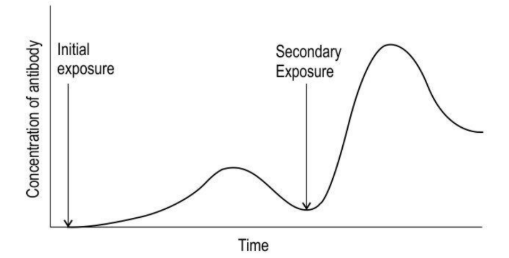
(a) What do the 2 peaks mean?
(b) Explain the reason behind the difference in the size of the 2 peaks.
Ans:
- (a) The two peaks represent primary and secondary immune responses/the increase in antibody levels in the blood due to infection.
- (b) The difference in peak sizes is due to memory cells: the primary response takes time to recognize the pathogen and generate antibodies, while memory cells formed during this response enable a faster and stronger secondary response, producing a larger peak.
20. What happens when:
(a) A newborn is not breastfed.
(b) A tumour cell enters the bloodstream.
Ans:
- (a) Lack of breastfeeding in newborns can result in lower passive immunity, potentially increasing susceptibility to infections due to the absence of protective factors present in breast milk.
- (b) A tumour cell that enters the bloodstream can reach a distant tissue and possibly form a secondary tumour, or metastasis, in that location.
21. The image depicts the transmission of Leishmaniasis, a disease prevalent in the tropics and sub-tropics of Africa, Asia, the Americas, and southern Europe. The symptoms include skin ulcers, fever, low erythrocyte count, and enlarged spleen and liver.
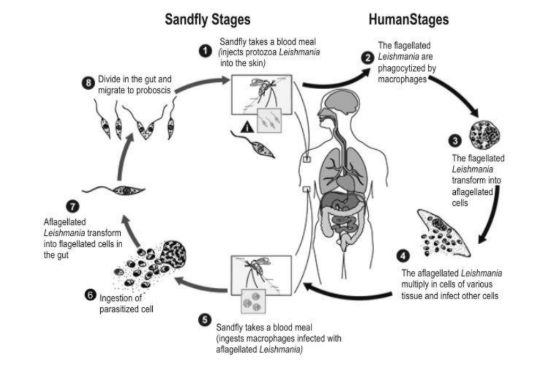
Based on the image, identify the:
a) Pathogen
b) Vector
c) Host
Ans:
- a) LEISHMANIA or protozoa
- b) Sandfly
- c)
- Human
- Sandfly
3 Marks Questions
22. Human Immunodeficiency Virus (HIV) causes Acquired Immunodeficiency Syndrome (AIDS).
(a) Mention any FOUR characteristics of the HIV virus that contribute to its severity?
(b) Why is AIDS classified as a syndrome and not a disease?
Ans:
- (a)
- While different viruses attack various organ systems, HIV targets the immune cells, such as T cells, impairing the immune response and making the body more susceptible to infections and cancers.
- It has a higher mutation rate, which helps its rapid evolution and the emergence of new variants that can evade immune responses and antiretroviral drugs.
- HIV integrates its genetic material into the host cell’s genome, making it difficult for the immune system to eliminate infected cells. This allows the virus to persist in the body over time.
- HIV causes a latent infection in some cells, where it remains inactive and hidden from the immune system. This latent reservoir makes complete eradication of the virus extremely challenging.
- (b) AIDS is a collection of symptoms/diseases rather than a single distinct condition.
23. A group of researchers wants to study a protein’s involvement in promoting contact inhibition.
(a) Suggest a type of cell into which they can express this protein, allowing them to evaluate the extent of its functional capabilities. Give a reason to support your answer.
(b) Mention any FOUR factors that can lead to the formation of cells identified in (a).
Ans:
- (a)
- Tumor/Cancerous cells
- Expressing them in tumour cells will help in identifying their ability to promote contact inhibition, as these cells have already lost that property.
- (b)
- Ionising radiations like X-rays and gamma rays
- Non-ionizing radiations like UV rays
- Chemical carcinogens
- Infection by oncogenic viruses
24. HIV-infected cells continue to remain alive while the viruses are being replicated inside them and released. Describe THREE ways in which this strategy helps the viral infection process.
Ans:
- Infected cells provide a protected environment where the virus can constantly replicate and assemble new viral particles.
- Infected cells help the viral particles evade immune detection.
- Some infected cells enter a latent state, allowing the virus to persist without active replication.
- The slow release of viruses from infected cells ensures a continuous supply of virus particles, increasing the chances of infecting neighbouring cells and spreading the infection.
25. Why does a malarial parasite invade red blood cells instead of other cells? Mention any THREE reasons to explain the same.
Ans:
Attacking the red blood cells of the human hosts helps the Plasmodium
- Evade detection by the immune system
- Access nutrients and oxygen-carrying haemoglobin
- Development of sexual-stage parasites (gametocytes) in red blood cells ensures that the parasite can continue its life cycle in the mosquito host.
- The periodic release of merozoites leads to synchronized cycles of fever in the host, increasing the likelihood of mosquito feeding during a period when the gametocytes are present, facilitating transmission.
26. A patient with a viral infection is showing symptoms such as cough, nasal congestion, sore throat, and tiredness, and is diagnosed with the common cold.
(a) Mention the causative agent and the mode of spreading of the disease that could result in the above symptoms and the disease.
(b) Arrange the respiratory regions from most to least concentration of virus particles and the infected cells: trachea, bronchioles, and alveoli. Justify your answer.
Ans:
- (a)
- Rhinovirus
- spread if the droplets resulting from the cough or sneezes of an infected person are inhaled or through shared contaminated items
- (b)
- Trachea>Bronchioles>alveoli
- Rhinovirus attaches and infects cells in the upper respiratory tract, and typically does not reach this deep into the respiratory system.
27. Mark the following statements as TRUE or FALSE, and support your answer with a reason.
(i) Vector-borne diseases are caused only by protozoans.
(ii) All infectious diseases caused by bacteria spread through air.
(iii) Only infectious diseases are caused by virus.
Ans:
- (i) FALSE. Elephantiasis is a vector-borne disease caused by worms.
- (ii) FALSE. Typhoid is caused by a bacterium, and it spreads through contaminated food
- and water.
- (iii) FALSE. Some forms of cancer are caused by oncogenic viruses.
28. An infection with Wuchereria bancrofti leads to symptoms such as swollen lymph nodes.
(a) What are the hosts that Wuchereria bancrofti resides in?
(b) Give TWO reasons why the lymphatic system provides a better environment for Wuchereria bancrofti than the circulatory system.
Ans:
- (a) The hosts in which Wuchereria bancrofti resides are as follows
- Humans
- Mosquitoes
- (b) The lymphatic system offers a more favourable environment for Wuchereria bancrofti as compared to the circulatory system because of the following reasons.
- The slower flow rate of the lymphatic system as compared to the circulatory system makes it a more stable environment for the parasite to thrive in.
- As the lymphatic system contains fewer immune cells than the circulatory system, parasites residing in it can evade detection by the immune system.
- As compared to blood, the lymphatic fluid is a more constant source of lipids, proteins, and other essential nutrients needed for the growth of Wuchereria bancrofti.
5 Marks Questions
29. Drug abuse is a common problem faced by countries around the world today due to its impact on the health and well-being of an individual.
(a) How is the cocaine consumed? What impact does it have on the body?
(b) Some drugs make an individual sleepy, while others make them hyper-energetic. Using appropriate examples, explain this statement.
(c) Why does a regular drug abuser have withdrawal symptoms when consumption of the drug is suddenly stopped?
Ans:
- (a)
- Cocaine is usually consumed by snorting/smoking.
- Both these actions involve the respiratory system, and so cocaine consumption can interfere with the regular functioning of the respiratory tract.
- (b)
- Heroin is a drug that acts as a depressant to the functioning of the nervous system, and so it slows down bodily functions and makes an individual sleepy.
- Cocaine is a drug that stimulates the nervous system, thereby making an individual feel very energetic.
- (c)
- Using drugs chronically makes the body accustomed to functioning in the presence of the drug.
- Sudden removal of the drug from the body leads to the body asking for the drug through improper functioning or withdrawal symptoms.
30. An individual has been consuming drugs of a specific kind, which has caused high blood pressure, anxiety, paranoia, and aggressive behaviour.
(a) Identify the class of drugs that could potentially be detected in his bloodstream.
(b) Based on the class identified in (a), state any TWO
(i) examples of drugs that belong to it.
(ii) long-term physical and mental effects EACH if consumption of the drugs is continued.
(iii) treatment or support strategies that could assist him in addressing his drug usage.
Ans:
- (a) The class of drugs that could potentially be detected in his blood is stimulants.
- (b)
- (i)
- Cocaine
- Nicotine
- Caffeine
- Ephedrine
- Amphetamines
- (ii)
- Respiratory problems
- Cardiovascular problems like heart strokes
- Liver damage
- Kidney damage
- Gastrointestinal problems like ulcers and acidity.
- Higher risk of suicidal thoughts
- Depression and anxiety
- loneliness due to loss of relationships
- lower attention span
- Mood swings
- (i)
- (iii)
- Counselling
- Help from support groups and proper education
- Help from family members and friends
- Medication
- Rehabilitation programs
31. Two patients – X and Y, who had recently consumed drugs, were brought to a rehabilitation centre. While it is established that each of them consumed either morphine or cocaine, their specific drug consumption remained undisclosed. During the mandatory tests, X exhibited heightened alertness with bouts of hallucinations, while Y appeared drowsy. Further, the resting heart rate of X was high, and that of Y was slower than normal.
(a) Based on these observations, identify the drug that each patient is likely to have consumed.
(b) Which category of drugs does each drug identified in (a) belong to?
(c) Mention any THREE ways in which society’s overall well-being is likely to be affected by the misuse of such drugs.
Ans:
- (a)
- X – Cocaine
- Y – Morphine
- (b)
- Cocaine – Coka alkaloids
- Morphine – Opioids
- (c)
- Increase in crime rate
- Increase in the number of unhealthy people due to short-term and long-term
- effects of drugs
- Burden on healthcare systems
- Disruption in relationships with family and friends
- Reduction in educational attainment and workforce productivity
Additional Study Materials
- Sexual Reproduction in Flowering Plants- Competency-Based Questions
- Human Reproduction – Competency-Based Questions
- Reproductive Health – Competency-Based Questions
- Principles of Inheritance and Variation – Competency-Based Questions
- Molecular Basis of Inheritance – Competency-Based Questions
- Evolution – Competency-Based Questions