Class 12 Biology Competency-Based Questions Chapter 6
1 Mark Questions
1. Two statements are given below – one labelled Assertion (A) and the other labelled Reason (R).
Assertion (A): Only one strand of DNA is transcribed.
Reason (R): Strands having complementary bases code for the same proteins.
Which of the following is correct?
A. Both A and R are true, and R is the correct explanation for A.
B. Both A and R are true, but R is not the correct explanation for A.
C. A is true, but R is false.
D. A is false, but R is true.
Ans: C. A is true, but R is false.
2. If a bacterial cell contains ‘x’ g of DNA, which of the following correctly depicts the amount of DNA at the end of each phase of the cell cycle?
| G1 | S | G2 | M | |
| P | x | 2x | x | x |
| Q | 2x | 2x | x | x |
| R | 2x | 2x | 2x | x |
| S | x | 2x | 2x | x |
A. P
B. Q
C. R
D. S
Ans: D. S
3. Which of the following occurs as a result of DNA replication being semi-conservative?
A. Chromosome number becomes half in the gametes.
B. Each chromosome has half DNA and half RNA.
C. Parental characters are found in each chromosome.
D. Each new DNA strand has half the number of nucleotides compared to the parent DNA strand”
Ans: C. Parental characters are found in each chromosome.
4. An organism has 6 X 10⁹ bp in its DNA. Which of the following is likely to be closest in height to the length of its DNA molecule?
- A wardrobe: 2 m
- A tall tree: 20 m
- An A4 sheet: 20 cm
- A eukaryotic nucleus: 10-10 m
A. A wardrobe
B. A tall tree
C. An A4 sheet
D. A eukaryotic nucleus
Ans: A. A wardrobe
5. Which of the following is true about the structure of DNA and RNA?
P) The nitrogenous base is devoid of an OH group in DNA.
Q) The nitrogenous base of RNA gains the OH group lost by DNA.
R) The pentose sugar in RNA combines with an extra OH group.
S) The pentose sugar in DNA loses an OH group to form deoxyribose.
A. only P
B. only S
C. only R and S
D. only P and Q
Ans: B. only S
6. Keratin is a common protein found in the human body, with its gene on chromosome no. 12. Centromeres are constricted regions on the chromosome that help during cell division. In which of the following regions will the keratin gene and centromere be found?
| Option | Keratin | Centromere |
| P | Euchromatin | Euchromatin |
| Q | Heterochromatin | Heterochromatin |
| R | Euchromatin | Heterochromatin |
| S | Heterochromatin | Euchromatin |
A. P
B. Q
C. R
D. S
Ans: C. R
7. In Griffith’s experiment, when he injected a mixture of heat-killed S strain (virulent) and live R bacteria (non-virulent), the mice died.
What type of colony/ies would he observe when the bacteria from the dead mice would be plated on a culture medium?
A. Only rough colonies would be observed.
B. Only smooth colonies would be observed.
C. Both rough and smooth colonies would be seen.
D. Each colony would have a mix of both rough and smooth textures.
Ans: C. Both rough and smooth colonies would be seen.
8. Given below are some statements about DNA replication.
- DNA replication is semiconservative.
- One of the DNA strands is replicated in a discontinuous fashion.
- Each strand of parental DNA acts as a template for the new strand.
- DNA replication shows a low level of accuracy.
Based on the statements, pick the correct option.
A. P and S are true, and S is the reason for P
B. P and Q are true, and Q is the reason for P
C. P and R are true, and R is the reason for P
D. S and Q are true, and Q is the reason for S
Ans: C. P and R are true, and R is the reason for P
9. Two statements are given below – one is an Assertion (A) and the other is a Reason (R).
- Assertion (A): DNA-dependent RNA polymerase catalyses polymerisation in the 5′ to 3′ direction.
- Reason (R): The strand with 5′ to 3′ polarity is called the coding strand.
Which of the following is correct?
A. Both A and R are true, and R is the correct explanation for A.
B. Both A and R are true, but R is not the correct explanation for A.
C. A is true, but R is false.
D. A is false, but R is true.
Ans: B. Both A and R are true, but R is not the correct explanation for A.
10. Which of the following statement/s are correct example/s of the degenerate feature of the genetic code?
- UAA and UAG act as terminator codons.
- CUA codes for leucine in bacteria as well as humans.
- Valine is coded for by GUU and GUC.
A. only Q
B. only R
C. only P and Q
D. only P and R
Ans: B. only R
2 Marks Questions
11. Purines have two rings in their nucleotide structure, whereas pyrimidines have only one ring. Given below is an image of their structures.
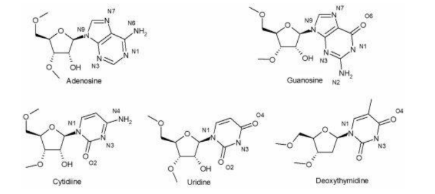
(a) The distance between the two strands of a DNA molecule ___________ (increases/decreases / remains the same) from one end to
another.
(b) Under what hypothetical circumstances would the distance between two strands be different from what is seen presently?
Ans:
(a) remains the same
(b) The distance would vary if purines or pyrimidines base-paired within themselves i.e if a purine paired with another purine, that part of the double strand would be broader than areas where two pyrimidines paired with one another.
12. Like the lac operon, prokaryotes contain several other operons that are regulated in different ways. The trp operon is one such operon that has five genes that code for enzymes required for tryptophan biosynthesis. Tryptophan is an amino acid that is required by the bacterial cell for the formation of various proteins. Tryptophan itself regulates the expression of the trp operon. The lac operon is induced by lactose, whereas the trp operon is repressed by tryptophan. Using the understanding of how the lac operon works, justify why this statement could be true.
Ans:
- The lac operon encodes proteins required for the breakdown of lactose and hence needs to be produced when lactose is present in the cell. So here, lactose acts as an inducer of gene expression.
- The trp operon encodes proteins required for tryptophan biosynthesis and hence is not required when tryptophan is present in the medium. So tryptophan acts as a repressor to prevent the expression of the trp operon genes.
13. Describe TWO DNA technological processes that were used in the Human Genome Project.
Ans:
- Restriction digestion: DNA being very long, had to be broken into smaller pieces, which could be done using restriction digestion.
- rDNA technology: The small sequences of DNA had to be amplified for sequencing, and since the sequence was not known, it had to be cloned in a suitable host using vectors for amplification.
14. Over the years, researchers have gathered enough evidence to suggest that RNA was the first genetic material which was slowly replaced by DNA. Give TWO reasons why RNA was replaced by DNA as the genetic material.
Ans:
- RNA consists of ribose sugars where the hydroxyl group (-OH) is exposed to hydrolysis and degradation, whereas DNA consists of deoxyribose sugars.
- RNA is single-stranded, whereas DNA is double-stranded with complementary bases forming hydrogen bonds that release free energy, making it thermodynamically stable.
- The double helix helps to keep the nucleotide bases away from reactive species that may exist in the cell’s environment.
15. In a quiet neighbourhood, a woman had been murdered at her home when her roommates were supposedly away. Her roommates were two twin brothers (S1 and S2) and another woman (S3). The investigating officer found the skin of murderer under her fingernails. The officer sent the DNA from the skin sample, along with DNA from the roommates, for DNA profiling. Given below is an image of the bands obtained.
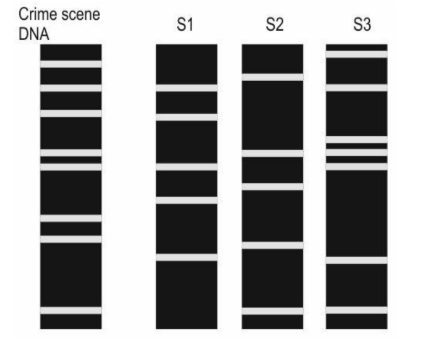
(a) Who is likely to be the murderer? Give a reason to support your answer.
(b) S1 and S2 are twin brothers. What can you conclude about them from the image?
Ans:
- (a) S3/woman is the murderer. The DNA profile of S3 has the greatest match/50% match with the DNA obtained on the crime scene.
- (b) They could be non-identical twins. Since their DNA profiles do not match completely with each other, they are likely to be non-identical twins.
16. Given below is a representation of the structure of the tRNA with two of its parts
marked P and Q are the amino acid acceptor end of the tRNA.
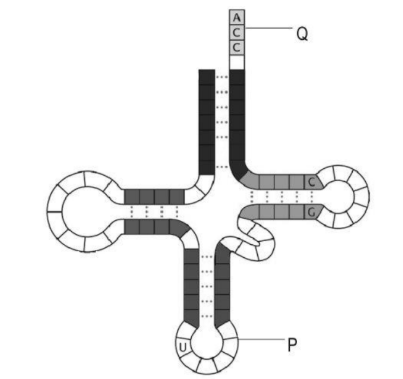
(a) What is loop P called?
(b) How can the polarity of the tRNA molecule be identified from the image?
(c) Write the 5′-3′ anticodon sequence in a tRNA molecule for the start and stop codon.
Ans:
- (a) anticodon loop
- (b) The amino acid acceptor end is 3′
- (c)
- Start codon anticodon: 5′ – UAC – 3′
- The stop codon does not have a tRNA molecule.
17. A DNA molecule is much longer than the length of the nucleus of a cell. Describe the organisation of DNA inside a nucleus.
Ans:
- Positively charged basic histone proteins combine to form a unit of 8 molecules called the histone cluster.
- DNA is wrapped around the histone cluster to form a nucleosome.
- Many such nucleosomes repeat to form a bead-in-a-string structure called the chromatin, which is a thread-like body.
- The chromatin is further packaged with the help of non-histone chromosomal proteins to fit into the nucleus.
18. A DNA sequence consists of 35% cytosine nucleotides. What would be the percentage of adenine nucleotides in the same DNA sequence? Justify your answer.
Ans:
According to Chargaff’s rule,
If, C = 35%, then G = 35%
If C and G make up 70% of the sequence, then A and T will make up 30%
So, A = T = 15%
19. Justify:
- RNA polymerase cannot transcribe a gene by itself.
- The terminator sequence can be used to define the template strand.
Ans:
- RNA polymerase is only capable of catalysing the process of elongation. It associates transiently with the initiation factor and the termination factor to initiate and terminate the transcription, respectively.
- The terminator sequence is located at the 3′ end of the coding strand and can help identify the coding strand, the opposite of which is the template strand.
20. The expressions of genes are regulated by metabolic, physiological and environmental factors/conditions. With the help of TWO examples, justify this statement in the case of eukaryotes.
Ans: Glucose in the body is used by cells to produce energy, which causes glucose levels in the blood to reduce and signal the pancreas to produce less insulin, thereby reducing the transcription and translation of genes coding for insulin.
The presence of mutagens in the environment impacts the expression of genes related to growth such that excessive uncontrolled growth begins in some cells, leading to cancer.
3 Marks Questions
21. Give a reason why:
(a) The absence of RNA polymerase III can interfere with the translation of nuclear genes.
(b) Defining a gene present in DNA is complicated, particularly in eukaryotes.
(c) In bacteria, translation and transcription happen almost simultaneously.
Ans:
- (a) RNA polymerase III is responsible for the transcription of tRNA, which is crucial for the process of translation.
- (b) In eukaryotes, the coding sequences (exons) are interrupted by non-coding sequences (introns), which do not appear in the mature mRNA, which complicates the definition of a gene in a DNA segment.
- (c) Since the mRNA does not require any processing to become active
OR
- Since transcription and translation take place in the same compartment of the cell.
22. Given below is the sequence of an mRNA, the image of the genetic code. Assume that this sequence begins with a start codon.
5′ – GCUAUCAAGUACCUA – 3′
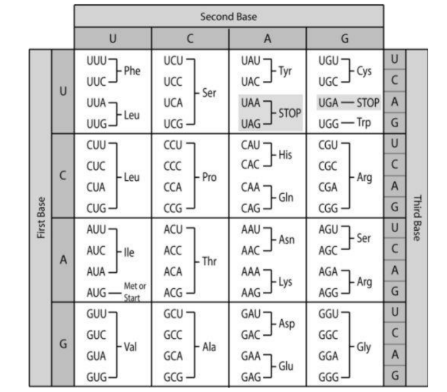
(a) Identify the amino acid sequence to which this mRNA will be translated.
(b) Identify the type of mutation and the change in the protein sequence in the following:
(i) Cytosine in codon 4 gets modified to uracil
(ii) GCU gets added after the second cytosine in the sequence
Ans:
- (a) ALA ILE LYS TYR LEU
- (b)
- (i)
- Point mutation
- No change in the protein sequence
- (ii)
- Frameshift mutation/insertion
- An alanine amino acid gets added between isoleucine and lysine.
- (i)
OR
- An amino acid, alanine, is added in the third position.
23. Expressed sequence tags (ESTs) are short cDNA molecules formed from mRNA molecules isolated from a cell. In eukaryotes, ESTs are said to be useful to identify coding regions of a genome, but not DNA sequences. Justify why this statement is TRUE.
Ans:
- Genes in eukaryotes generally have non-coding sequences called introns present between the coding sequences or exons.
- The mRNA in eukaryotes is formed after post-transcriptional modifications such as intron splicing and the addition of a poly-A chain.
- So, the cDNA formed from it will not have the intron sequence in the actual DNA sequence, but will just have the sequence of the exons.
24. Justify the following statements:
(a) The amino acid sequence can be derived from the mRNA sequence, but the reverse cannot be done easily.
(b) mRNA synthesis happens in the nucleus, but protein synthesis happens outside the nucleus.
(c) Splicing of the hnRNA is an important post-translational modification.
Ans:
- (a) Each codon codes for only one amino acid, and so the amino acid sequence can be derived from an mRNA sequence; however, each amino acid is coded for by more than one codon, and so each amino acid can be back-traced to one or more codons.
- (b) The DNA is transcribed into an mRNA sequence, which is present in the nucleus, whereas translation is done by ribosomes, which are present in the cytoplasm or on the rough endoplasmic reticulum.
- (c) If splicing does not happen, the non-coding portions of the DNA/introns will also get translated, disrupting the amino acid sequence of the intended protein.
25. The process of DNA fingerprinting involves the use of the Southern blotting technique. In this technique, DNA is run on an agarose gel and then transferred to a nitrocellulose or nylon membrane. Finally, the DNA bands are visualised through autoradiography.
(a) Share your understanding of why the DNA needs to be transferred to the nitrocellulose membrane.
(b) What would be the charge on the nitrocellulose membrane? Give a reason to support your answer.
(c) Identify the type of label present on the VNTR probe. Justify your answer.
Ans:
- (a) An agarose gel contains pores, and DNA may not firmly attach to the gel. For hybridisation and visualisation, the DNA needs to be immobilised, for which a nitrocellulose membrane is used.
- (b) Positively charged. Since DNA is negatively charged, the positive charge on the membrane will help with easy binding.
- (c) Radioactive label. Since autoradiography is used, it can be concluded that the VNTR probe would be radioactively labelled.
26. Although DNA replication by polymerases is an energetically expensive process, it still proves to be an efficient process. Justify the statement.
Ans:
- It is considered efficient because it catalyses the polymerisation of a large number of nucleotides in a very short time.
- They are highly accurate to avoid mutations.
- Even though the process needs a lot of energy, the deoxyribose triphosphates act both as substrate and energy providers for the reaction, as the two terminal phosphates are high-energy phosphates.
27. Given below is a DNA sequence.
5′ – TAACGATCGTACATGGAT – 3′
Identify the mRNA sequence that is transcribed from this DNA sequence.
Can this sequence be translated? Give a reason to support your answer.
[Note: Assume no post-transcriptional and post-translational modifications will take place.]
Ans:
- (a)
- Identify the complementary strand 3′ – ATTGCTAGCATGTACCTA – 5′
- Find the mRNA sequence:
- UAA CGA UCG UAC AUG GAU
- (b)
- No
- The first codon of this sequence codes for a stop codon.
28. What does a translational unit comprise?
If a codon CGA that codes for arginine is present on the mRNA after codon AUG, describe how the translation process will be done step-wise.
Ans:
A translation unit is the sequence of mRNA that codes for an amino acid sequence (polypeptide) with a start codon on one end and a stop codon on the other.
- Charging of tRNA: Arginine is charged in the presence of ATP and linked to its specific tRNA molecule.
- The small subunit encounters the mRNA.
- The large subunit, which has two sites for RNA to bind, has the initiator tRNA and the arginine tRNA bound to it.
- Here, methionine and arginine form a peptide bond with each other in the presence of a catalyst before the ribosome moves ahead.
4 Marks Questions
29. What are the four properties needed in a molecule to function as genetic material? Compare these parameters between the DNA and RNA.
Ans:
- (a)
- Can replicate
- Should be stable
- Allow for slow mutations
- Ability to express itself
- (b)
- Both DNA and RNA can replicate.
- RNA is unstable when compared to DNA, due to the presence of the 2′-OH group at every nucleotide, which makes it easily degradable.
- Both DNA and RNA can mutate.
- Both can express themselves – RNA can do it directly by forming proteins, whereas DNA can do it by forming RNA first.
5 Marks Questions
30. With the help of experiments done by various scientists over 40 years, it was finally concluded that DNA is the genetic material.
(a) Before DNA, which molecules were considered to be genetic material?
(b) What was concluded from Griffith’s experiments using S and R strains of mice?
(c) Briefly describe two experiments that led to the conclusion that DNA is the genetic material.
(d) Today, if the contents of a nucleus of a human cell were extracted, it can be concluded that DNA is the genetic material, as that is the only biomolecule present in the nucleus. Justify this statement as true or false.
Ans:
- (a) Proteins
- (b) The transfer of genetic material can transform a cell to perform a different function.
- (c)
- Avery, MacLeod and McCarthy purified biochemicals (DNA, RNA and protein) from the heat-killed S cells to see which ones could transform live R cells into S cells and found that DNA alone from S bacteria caused R bacteria to become transformed.
- Hershey and Chase allowed bacteriophages with radioactively (32P) labelled DNA and bacteriophages with radioactively (35S) labelled protein coats to infect two separate populations of bacteria and found that only radioactively (32P) labelled DNA was found to enter/be transferred to the bacterial cells.
- (d)
- False
- The nucleus contains other biomolecules, such as proteins, as well, and so the extract would also show the presence of other biomolecules.
31. The lac operon is a polycistronic gene that helps a bacterial cell in metabolising lactose. It consists of an inducer (i) gene that represses the transcription of lac genes under certain environmental conditions.
(a) Why is the lac gene called polycistronic?
(b) What would happen if there were a mutation blocking the translation of:
(i) Gene Z
(ii) Gene Y
(c) What happens to the expression of the lac operon when the growth medium is provided with:
(i) both glucose and lactose
(ii) only galactose
Ans:
- (a) It has a single promoter for multiple connected genes.
OR
- A single mRNA is transcribed to be translated into multiple proteins.
- (b)
- (i) Lactose would not be able to enter/permeate into the bacterial cell.
- (ii) Lactose would enter the cell but not be broken down into glucose and galactose.
- (c)
- (i) Glucose is the preferred carbon source and is consumed first, while lactose induces the lac operon, producing small levels of the lac proteins.
- (ii) In the absence of lactose, the repressor protein will continue binding to the operator of the lac operon, preventing transcription of its genes.
32. One strand of a DNA segment is made up of repeats of adenine and cytosine –
5′ ACACACAC 3′. Explain the formation of a dinucleotide (AC) and its base pair from nitrogenous bases.
Ans:
- A nitrogenous base is linked to the OH of 1′ C pentose sugar through an N-glycosidic linkage to form adenosine and cytidine nucleosides.
- Next, a phosphate group is linked to the OH of 5′ C of a nucleoside through a phosphoester linkage, forming adenine and cytosine nucleotides.
- The 3 ‘C of adenine links to the 5’C of cytosine to form a 3′-5’ phosphodiester linkage to form a dinucleotide.
- Similarly, a dinucleotide is formed between thymine and guanine.
- Finally, adenine forms two hydrogen bonds with thymine, and cytosine forms three hydrogen bonds with guanine to form the dinucleotide base pairs.
33. State TWO points of similarity between the process of replication and transcription in humans. Describe the fate of the products of replication and transcription with respect to the following:
location of the product/s
lifespan of the product/s
In which phase/s of the cell cycle do these processes occur?
Ans:
- (a)
- Both processes involve the copying of a DNA molecule.
- Both processes take place in the nucleus of the cell.
- (b)
- Location: DNA strands formed after replication continue to stay in the nucleus, whereas mRNA formed after transcription moves/is exported to the cytoplasm.
- Lifespan: DNA strands formed after replication continue to remain in the nucleus as long as the cell is living, whereas mRNA is degraded after translation.
- (c)
- DNA replication: S phase
- DNA transcription: throughout the cell cycle
34. Why is the enzyme ligase not required in DNA amplification using PCR?
What will happen if DNA polymerase is used in PCR? Give a reason to support your answer.
State one advantage of PCR over DNA replication.
For any given sequence of nucleotides, DNA replication is faster than PCR. Justify.
Ans:
- a. Since no Okazaki fragments are formed in PCR amplification, ligase is not required in the process.
- b. In PCR, heat is used to denature/separate the dsDNA.
- DNA polymerase cannot withstand this high temperature and will denature.
- PCR can be used to amplify any sequence of nucleotides – RNA or DNA, whereas
- DNA replication is only for DNA sequences.
- c. PCR can be used to amplify just one gene as well, unlike DNA replication, which
- involves duplication of the entire genome.
- d. For a given sequence, DNA replication is much faster as all three steps (denaturation, annealing and replication) happen simultaneously, whereas in PCR, it happens one by one, which takes longer.
Additional Study Materials
- Sexual Reproduction in Flowering Plants- Competency-Based Questions
- Human Reproduction – Competency-Based Questions
- Reproductive Health – Competency-Based Questions
- Principles of Inheritance and Variation – Competency-Based Questions








Cool Post.