Class 12 Agriculture Sample Paper 2020 Solved
PART A: EMPLOYABILITY SKILLS (10 MARKS)
Answer any 4 questions out of the given 6 questions of 1 mark each:
1. Write any 2 ways in which communication can be done.
Ans: Verbal and Non-verbal
2. What do you understand by active listening?
Ans: The act of mindfully hearing and attempting to comprehend the meaning of words spoken by another in a conversation or speech.
3. Explain music as a self-motivator.
Ans: Music is the language of the soul. A good, inspiring piece touches everybody’s heart and
can help create miracles.
4. Write keyboard shortcut for cut and paste command.
Ans: CTRL+ C and CTRL + V
5. What do you understand by adaptability in being an entrepreneur?
Ans: Adapting to changing conditions is an essential part of running your life — and your business. The business landscape changes all the time and you have to be ready for it. Without adaptability, you are going to find yourself in serious trouble.
6. What do you mean by green jobs in building and construction?
Ans: Green buildings use eco-friendly materials, benefit the environment by conserving energy.
Answer any 3 questions out of the given 5 questions of 2 marks each:
7. Write advantages of active listening.
Ans:
- It helps you truly understand what people are saying.
- It can help build rapport with your interviewer.
- It can help reduce your nervousness during an interview.
8. Write any two Basic personality traits.
Ans: Extraversion, Agreeableness, Conscientiousness, Emotional stability, Openness to experience.
9. Write any two advantages of spreadsheet.
Ans:
- Built-in functions make calculations easier, faster, and more accurate.
- Large volumes of data can be easily handled and manipulated.
- Data can be exported to or imported from other software.
10. Explain Financial barrier in becoming an entrepreneur.
Ans: Availability of funds is a major concern for starting a business. A delay in the source of finance can delay starting or running a business.
11. Write any two green jobs that are associated with water conservation.
Ans: Water treatment specialist, Water Auditor, Water policy Analyst, Water resource planning manager, Water Quality Monitoring, Water conservation Representative.
PART B: SUBJECT SKILLS (60 MARKS)
Answer any 10 questions out of the given 12 questions:
12. Name any three major oilseed crops of India.
Ans: Soybean, Rapeseed & Mustard, Sunflower.
13. Name any three major cereal crops of India.
Ans: Rice, wheat, maize.
14. Where is the Central Potato Research Institute (CPRI) located in India?
Ans: Shimla in Himachal Pradesh
15. Name any four micronutrients required for raising a healthy crop.
Ans: Iron (Fe), manganese (Mn), zinc (Zn), copper (Cu)
16. Name any two major cropping systems of India?
Ans: Rice–wheat, Maize–wheat cropping system
17. Name any three major pulse crops of India.
Ans: Chickpea, pigeonpea, mungbean
18. Name any two value-added products that can be prepared from tomato fruit?
Ans: Tomato sauce, tomato ketchup
19. Honey is produced by ……….
Ans: Honeybees
20. Name any two Cole group vegetables.
Ans: Cabbage, cauliflower
21. Where is the National Centre of Organic Farming located in India?
Ans: Ghaziabad (UP)
22. Name two important earthworm species used in vermi-composting.
Ans: Eisenia foetida, Eudrilus euginae
23. Name any two nitrogen-containing fertilizers.
Ans: Urea, Calcium Ammonium Nitrate (CAN)
Answer any 7 questions out of the given 9 questions of 2 marks each:
24. Define the term soil fertility.
Ans: It refers to the ability of soil to sustain crop plant growth, i.e. to provide plant habitat and result in sustained and consistent yields of high quality.
25. Define the term crop rotation.
Ans: Crop rotation is the practice of growing a series of dissimilar or different types of crops in the same area in sequenced seasons or in a year.
26. How can we prepare the fruit jam.
Ans: Fruit jam:
- Step 1 – Pick the fruits.
- Step 2 – Wash the jars and lids.
- Step 3 -Wash and hull the fruits.
- Step 4 – Crush the fruits.
- Step 5 – Add sugar.
- Step 6 – Mix the fruits with the pectin and cook to a full boil while stirring.
- Step 7 – Cool the jam & pack the jars.
27. What is post-harvest management?
Ans: Post-harvest management involves all kinds of operations/treatments after harvest of the economic produce. For example, the freshly harvested commodity/horticultural produce is made to undergo these treatments to minimize losses and increase its shelf-life, and add value to the product.
28. Explain the term ‘plant-based bio-pesticides’ with examples.
Ans: Plant-based bio-pesticides are plant-derived, naturally occurring phytochemical pesticides that control pests by various mechanisms with less or no harm to human beings and crop plants.
29. What is bee-keeping?
Ans: Beekeeping (or apiculture) is the maintenance of honey-bee colonies/hives for honey, beeswax, propolis, and royal jelly, etc., besides pollinating the crops/fruits.
30. Discuss the integrated disease management.
Ans: Integrated disease management is the integration of the various disease management practices to prevent and manage diseases in crops. It is the combination of preventative or curative measures that can be put in place to minimize the risk of disease infection and spread.
31. What are the principles of food preservation?
Ans: Principles of food preservation comprise of the methods of food preservation that slow down or prevent altogether the action of the agents of spoilage. At the same time, during food preservation, the food should not be damaged. The food preservation principles are:
- Controlling microorganisms
- Controlling enzymes
- Controlling insects, rodents, birds, and other physical causes of food deterioration.
32. Define organic farming.
Ans: Organic farming is a system that avoids or largely excludes the use of synthetic inputs (such as fertilizers, pesticides, hormones, food additives, etc), and to the maximum extent feasible relies upon crop rotations, crop residues, animal manures, off-farm organic waste, mineral grade rock additives, and biological systems of nutrient mobilization and plant protection.
Answer any 7 questions out of the given 9 questions of 3 marks each:
33. Discuss the concept of safe food and important food regulations.
Ans: The Food Safety and Standards Authority of India (FSSAI) has been created under the Food Safety and Standards Act, 2006, for laying down science-based standards for articles of food and to regulate their manufacture, storage, distribution, sale, and import to ensure the availability of safe and wholesome food for human consumption.
Food Safety and Standards Act (FSS), 2006, is the primary law for the regulation of food products. This act also sets up the formulation and enforcement of food safety standards in India.
34. Enlist major post-harvest management steps of fruits and vegetables.
Ans: Major post-harvest management steps of fruits and vegetables:
- Pre-harvest treatment
- Harvesting at maturity
- Safe harvesting
- Pre-cooling & washing
- Surface drying
- Cool/cold storage
- Safe transport
- Safe handling
35. Discuss the role of food production in national economy and national food security.
Ans: Role of food production in the national economy and national food security
- With a five-fold increase in food grain production from 50 million tonnes in 1950-51 to about 285 million tonnes in 2017-18, India has moved away from dependence on food aid to become a net food exporter.
- The agriculture and food production sector plays a vital role in the Indian economy.
- India is the world’s largest producer of pulses, rice, wheat, spices, and spice products.
- Over 70 per cent of the rural households depend on agriculture.
- Agriculture is an important sector of the Indian economy as it contributes about 17% to the total GDP and provides employment to over 60% of the population.
- Since the Green Revolution in the 60s, India has become self-sufficient in meeting national food and nutritional needs.
- Currently, India is capable of feeding its growing population, besides exporting surplus food, which is an indicator of national food security.
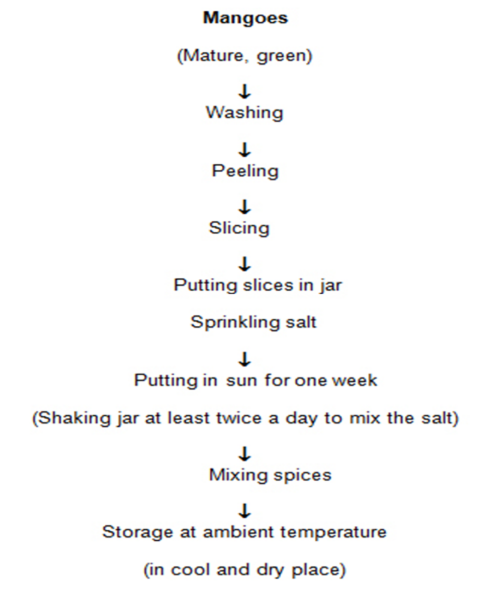
36. Make a flow chart for making mango pickle.
Ans:
37. Describe any three methods employed to dry the flowers and foliage.
Ans: Three methods employed to dry the flowers and foliage:
- Hanging flowers and foliage to dry naturally: This is a very easy method to dry flowers, and in this method, flowers are dried by tying them into small bundles and hanging them upside down in a warm and ventilated place away from direct sunlight, that is, in a cool dark area.
- Drying flowers and foliage in a drying chamber (hot air drying): In this method, flowers and foliage are dried in a convection chamber that has a fan. The temperature should be maintained between 30 to 35oC, and this process takes many hours to a few days to dry the flowers. The flowers are placed into slots in a wire mesh and placed in the chamber. The time for the drying process also depends on the number of flowers being dried at one time within the chamber.
- Preserving or drying flowers and foliage using a microwave: In this method, the flowers are placed between two kitchen towels and then dried in the microwave. Since an extra few seconds can burn the flowers, care needs to be taken with the number of seconds or minutes they are microwaved. After a minute of microwaving, it is best to check the flowers every few seconds to avoid burning them.
38. Enlist the major components of IPM, and discuss briefly.
Ans: IPM: IPM is an ecosystem-based strategy that focuses on long-term prevention of pests or their damage through a combination of techniques, such as biological control, habitat manipulation, modification of cultural practices, and use of resistant varieties.
Major components of IPM:
- Chemical practices: Use of chemical pesticides to keep the pest population below economic loss.
- Cultural practices: Cultural methods of pest control consist of regular farm operations in such a way that either destroy the pests or prevent them from causing economic loss.
- Mechanical practices: Removal and destruction of pests or their eggs, larvae, or pupae through mechanical means.
- Regulatory practices: In this process, regulatory rules framed by the government are brought into force under which seeds and infested plant materials are not allowed to enter the country or from one part to another part of the country. These are known as quarantine methods and are of two types i.e., domestic and foreign quarantine.
- Biological practices: Biological control of insect pests and diseases through biological means is the most important component of IPM. In a broader sense, biocontrol is the use of living organisms to control unwanted living organisms (pests). In other words, deliberate use of parasitoids, predators, and pathogens to maintain pest population at a level below those causing economic loss either by introducing a new bio-agent into the environment of the pest or by increasing the effectiveness of those already present in the field.
- Bio-pesticides: These are microorganisms that infest and cause diseases in their hosts, as a result of which the hosts are killed. Major groups of pathogens are fungi, viruses, and bacteria. Some nematodes also cause diseases in some insect pests.
39. Enlist various irrigation methods used in India? Discuss the drip method in brief.
Ans: Irrigation method refers to the manner in which irrigation water is applied to the field. There are four principal methods of irrigation:
- Surface irrigation method
- Sub-surface Irrigation method
- Drip irrigation method
- Sprinkler irrigation method
Drip irrigation: In this method, irrigation is given by using small-diameter PVC tubing with devices called emitters or drippers at selected places near the base of plants. The losses by deep percolation and evaporation are minimal. This method is good for economizing water use.
Advantages of the drip irrigation method:
- No deep percolation losses.
- Maintains optimum moisture.
- Economize water use.
- Fertilizer can also be applied along with irrigation water.
Disadvantages of drip irrigation method:
- High cost.
- Rats and other animals may damage the system.
- Dirty water cannot be used.
- Does not work under very low pressure.
40. Discuss gulkhand and rose water, two important processed products of rose.
Ans: Gulkhand and rose water, two important processed products of rose:
- Gulkhand: Gulkhand is sun-cooked and cured over a long period with just Damask rose petals, candy sugar & assorted spices. Slow sun-cooking imparts depth & richness to the already concentrated floral, fruity and caramelized flavours of Gulkhand.
- Rose water: Rose water is flavoured water made by steeping rose petals in water. Additionally, it is the hydrosol portion of the distillate of rose petals, a by-product of the production of rose oil for use in perfume. It is used to flavour food, as a component in some cosmetic and medical preparations, and for religious purposes throughout Europe and Asia.
41. Discuss the mushroom production technology in detail.
Ans: Mushrooms are the fruiting bodies of a fungus. Mushrooms grow on compost. Commercial mushroom cultivation is a process utilizing waste materials such as horse manure, chicken manure, pig manure, wheat straw, rice straw, corn cobs, wood bark, sawdust, and cottonseed hulls to produce a delicious and nutritious food.
Mushroom production technology consists of six steps: Phase I composting, Phase II composting, spawning, casing, pinning, and cropping. These steps are described sequence-wise. Compost provides nutrients needed for mushrooms to grow.
Answer any 3 questions out of the given 5 questions of 5 marks each:
42. What is the concept of integrated nutrient management? Discuss its major components in detail.
Ans: Integrated nutrient management (INM) aims at achieving a harmony in the judicious and efficient use of chemical fertilizers in conjunction with organic manures, crop residues, green manures, legumes in cropping systems, use of bio-fertilizers and other locally available nutrient sources for sustaining soil health and environment as well as crop productivity on a long-term basis.
Components of INM: Components of INM include judicious use of chemical fertilizers, organic manures, crop residues, green manures, legumes, and bio-fertilizers.
- Chemical Fertilizers: Use of chemical fertilizers in balanced proportions and recommended amounts is the quickest way of boosting crop production. Further, chemical fertilizers alone are unable to maintain and sustain the long-term soil health and crop productivity because they are unable to supply organic matter and micronutrients like organic manure. Hence, the integrated use of inorganic fertilizers with organics increases the efficiency of applied nutrients and soil health.
- Organic Manures: The organic manures, which are mainly prepared from animal dung/urine and plant residues, are referred to as organic manures. FYM is the most important and commonly used organic manure in India. Common organic manures are FYM, compost from farm litter, night soil, sewage and sludge, green manure, poultry manure, vermicompost, biogas slurry, crop residues, etc.
- Legume Crops in Rotation: Legumes can form an important component of the INM system when grown for grain or fodder in rice-wheat cropping systems, intercropped with other non-legumes, or when introduced as green manure crops. Legumes act as soil fertility restorers due to their ability to obtain N from the atmosphere in symbiosis with Rhizobium. It plays a vital role in N-fixation and economizing the N use.
- Bio-Fertilizers: Bio-fertilizers are microbial inoculants of bacteria, algae, fungi alone or in combination, and they augment the availability of nutrients to the plants. These microorganisms are used for the treatment of seeds, seedlings, and application to soil or in composting to increase soil fertility and help in crop growth and high yield. Rhizobium, Azotobacter, and Phosphobacteria, BGA, and Azolla are the major bio-fertilizers.
43. Discuss the major Government Schemes for the food sector.
Ans: Major Government Schemes for the food sector:
- Soil Health Card Scheme: The scheme has been introduced to issue the Soil Health Cards to all farmers in the country. The Soil Health Cards provide information to farmers on the nutrient status of their soil, along with recommendations on the appropriate dosage of nutrients to be applied for improving soil health and its fertility.
- National Mission for Sustainable Agriculture (NMSA): It aims at promoting Sustainable Agriculture through climate change adaptation measures, enhancing agriculture productivity especially in rainfed areas, focusing on integrated farming, soil health management, and synergizing resource conservation.
- Pradhan Mantri Krishi Sinchai Yojana (PMKSY): It was launched with the motto of ‘Har Khet Ko Paani’ for providing end-to-end solutions in the irrigation supply chain, viz., water sources, distribution network, and farm-level applications.
- Paramparagat Krishi Vikas Yojana (PKVY): It is implemented with a view to promoting organic farming in the country.
- National Agriculture Market (e-NAM): It provides an e-marketing platform at the national level and supports the creation of infrastructure to enable e-marketing.
- Micro Irrigation Fund (MIF): The main objective of the fund is to facilitate the States in mobilizing the resources for expanding coverage of Micro Irrigation.
- Agriculture Contingency Plan: The Purpose is to tackle aberrant monsoon situations leading to drought and floods, extreme events (heat waves, cold waves, frost, hailstorms, cyclones) adversely affecting crops, livestock, and fisheries (including horticulture).
- Rainfed Area Development Programme (RADP): Implemented for Rainfed Area Development.
- National Watershed Development Project for Rainfed Areas (NWDPRA): The scheme was launched for the twin concepts of integrated watershed management and sustainable farming systems.
- Pradhan Mantri Fasal Bima Yojana (PMFBY): The objective is to facilitate prompt claims settlement on crop insurance.
- Livestock Insurance Scheme: It aims to provide a protection mechanism to the farmers and cattle rearers against any eventual loss of animals due to death.
- National Scheme on Welfare of Fishermen: This scheme provides financial assistance to fishers.
- Scheme on Fisheries Training and Extension: It provides training for the fishery sector.
- Gramin Bhandaran Yojna.
- National Horticulture Board (NHB)
- National Horticulture Mission (NHM)
- Small Farmer Agri-Business Consortium (SFAC) assistance to cold storage
- Agricultural and Processed Food Products Export Development Authority
- (APEDA) assistance for the cold chain
- Pradhan Mantri Kaushal Vikas Yojana (PMKVY)
44. Discuss various biofertilizers used in Indian agriculture and their application methodology.
Ans: Various biofertilizers used in Indian agriculture are:
- Nitrogen fixing biofertilizers: Rhizobium, Azospirillium, and Azotobacter
- Phosphorous solubilizing biofertilizers: Bacillus, Pseudomonas, and Aspergillus
- Phosphate-mobilizing biofertilizers: Mycorrhiza
- Plant growth-promoting biofertilizers: Pseudomonas sp.
Rhizobium: Rhizobium can fix nitrogen in association with leguminous plants.
Rhizobium inoculation ensures adequate N supply for legumes (cowpea, green gram, blackgram, pea, chickpea, groundnut, soybean, berseem, subabul) in place of N fertilizer and observed that Rhizobium can fix 50-300 kg N/ha.
Azotobacter: Azotobacter are free-living bacteria that fix atmospheric nitrogen in cereal crops and do not need a specific host plant. Azotobacter helps in saving 10 to 20 kg N/ha, and it produces growth-promoting substances (vitamins of the B group, indole acetic acid, and gibberellic acid) which improve seed germination and growth of an extended root system. It is recommended for Rice, wheat, millets, other cereals, cotton, vegetables, sunflowers, mustard, flowers, etc.
Azospirillium: The bacteria have been found to live within the root of sorghum, pearl millet, and rage plants. They fix atmospheric nitrogen at the rate of 15-30 kg N/ha and secrete growth regulatory substances. It is recommended for paddy, maize, wheat, sorghum, sugarcane, etc.
Phosphate-Solubilizing Microorganisms: Phosphorus is one of the most important essential plant nutrients. Large amounts of phosphorus are fixed in the soil. The solubilization effect of phospho-bacteria is generally due to the production of organic acids that lower the soil pH and bring about the dissolution of bound forms of phosphate, which increases the availability of phosphate in soil. Phosphate-solubilizing microorganisms include efficient strains of bacteria, fungi, yeast, and actinomycetes. It is recommended for all the crops.
Vesicular Arbuscular Mycorrhiza (VAM): VAM symbiosis refers to a mutualistic, symbiotic relationship formed between fungi and living roots of higher plants. The plant roots transmit substances to the fungi, and the fungi aid in transmitting nutrients and water to the plant roots. Further, VAM fungi solubilise inorganic forms of nutrients through the release of low molecular weight organic acids.
Plant Growth Promoting Rhizobacteria (PGPR): Plant growth-promoting rhizobacteria (PGPR) are a group of free-living bacteria that colonize the rhizosphere and benefit the root growth. Bacteria of diverse genera were identified as PGPR, of which Bacillus and Pseudomonas sp. are dominant.
Application Methodologies of Biofertilizers:
| Application method for seed, soil & planting materials | Procedure |
| Seed treatment with biofertilizers | This method varies crop to crop depending on its duration. Generally, for a short duration (less than 6 months), 10-15 packets (each of 200 g) are mixed with 40-60 kg of well-decomposed cattle manure or with 40-60 kg of soil for one acre of land. A mixture of bio-fertilizer and cattle manure sprinkled with water is then broadcast into the soil at the time of sowing. For long-duration crops, 20-30 packets of bio-fertilizer (each containing 200 g) are mixed with 80-120 kg of manure/acre. |
| Seedling treatment | A sufficient quantity of water and organic fertilizer or field soil to form a slurry, and the seedling roots are immersed in this slurry for about 30 minutes before planting, so that the roots are well drenched with the slurry. |
| Sugarcane sett treatment | Biofertilizers are mixed with a sufficient quantity of water and organic fertilizer, and sugarcane sets are soaked in the mix of biofertilizers + water + organic fertilizer for about an hour and planted in the fields. |
| Soil application | This method varies crop to crop depending on its duration. Generally, for a short duration (less than 6 months), 10-15 packets (each of 200 g) are mixed with 40-60 kg of well-decomposed cattle manure or with 40-60 kg of soil for one acre of land. A mixture of bio-fertilizer and cattlemanure sprinkled with water is then broadcast into the soil at the time of sowing. For long-duration crops, 20-30 packets of bio-fertilizer (each containing 200 g) are mixed with 80-120 kg of manure/acre. |
45. Discuss in detail the commercial cultivation of marigold.
Ans: Commercial cultivation of marigold:
- Soil: Marigolds can be cultivated in a wide variety of soils. A deep, fertile, friable soil having good water-holding capacity and aeration is suitable for its cultivation. Sandy loam soil with a pH of 7.0-7.5, having good drainage, is most preferred.
- Climate: The environmental conditions markedly influence the growth and flowering of marigolds. Mild temperatures during the growing period greatly improved flowering.
- Varieties: Pusa Narangi Gainda, Pusa Basanti Gainda, Pusa Arpita, Bidhan Marigold-1, Bidhan Marigold-2, etc.
- Propagation method: Mostly through seeds and in some varieties by cuttings.
- Planting distance: Generally distance between rows is kept 45-60 cm, and from plant to plant it is 30-45 cm.
- Insect pests: Red spider mite, hairy caterpillars, and leaf hoppers
- Diseases: Damping off, Leaf spots and blight, flower bud rot, and viral diseases.
46. Discuss the major Government Schemes for the promotion of organic farming.
Ans: Major Government Schemes for promotion of organic farming:
- Paramparagat Krishi Vikas Yojana (PKVY): Paramparagat Krishi Vikas Yojana (PKVY), a sub-component of Soil Health Management (SHM) scheme under National Mission of Sustainable Agriculture (NMSA), aims at the development of models of excellence in organic farming through a mix of traditional wisdom and modern science in a value chain mode to install sustainability, ensure long-term soil fertility build-up, resource conservation, and offer safe and healthy food grown through organic practices without the use of agro-chemicals. PKVY also aims at empowering farmers through institutional development through clusters for not only in farm practices management, input production, quality assurance, but also in value addition and direct marketing through innovative means. Participatory Guarantee System under the PGS-India programme will be the key approach for quality assurance under the PKVY.
- Mission Organic Value Chain Development for North Eastern Region: Realizing the potential of organic farming in the North-Eastern Region of the country, Ministry of Agriculture and Farmer Welfare has launched a Central Sector Scheme entitled “Mission Organic Value Chain Development for North Eastern Region” for implementation in the states of Arunachal Pradesh, Assam, Manipur, Meghalaya, Mizoram, Nagaland, Sikkim and Tripura, during the 12th plan period. The scheme aims at the development of certified organic production in a value chain mode to link growers with consumers and to support the development of the entire value chain, starting from inputs, seeds, certification, the creation of facilities for collection, aggregation, processing, marketing, and brand-building initiatives.
Class 12 Agriculture Sample Paper 2020 PDF
Click here to download CBSE Class 12 Agriculture Sample Paper 2020 and start your exam preparations.
Additional Study Materials
- Agriculture Sample Paper 2025
- Agriculture Sample Paper 2024
- Agriculture Sample Paper 2023
- Agriculture Sample Paper 2022 Term I
- Agriculture Sample Paper 2022 Term II
- Agriculture Sample Paper 2021