The NIOS Class 12 Biology Immunobiology An Introduction chapter explains the body’s defence mechanisms. Students learn about immunity, antigens, antibodies, vaccines, and the immune system. It also covers diseases related to immunity. With solved terminal exercises, exam preparation becomes effective and structured.
This chapter is essential for linking biology with health and medicine. It strengthens the knowledge of students and prepares them well for NIOS Class 12 Biology examinations and future studies.
NIOS Class 12 Biology Immunobiology An Introduction
1. Define the term immunity.
Immunity is broadly defined as “the capacity of the body to recognise materials as foreign to itself and to neutralise, eliminate, or metabolise them with or without injury to its own tissues”.
2. What are the main defence mechanisms operating in our body?
There are four defence mechanisms in our body:
- 1. Immunity to defend the body from infections.
- 2. Metabolic defence to metabolise and detoxify foreign chemicals.
- 3. Stoppage of bleeding (Hemostasis) to prevent blood loss.
- 4. Resistance to stress mainly through the release of hormones.
3. ‘Immune system is a complex network of cells, tissues, and soluble factors’. Justify this statement.
Immunity is mainly provided by a complex network of cells, tissues, and soluble factors. This network is collectively referred to as the ‘immune system’. Cells participating in the immune response are organised into discrete ‘lymphoid tissues and organs’.
4. Describe the process of antibody production.
B-cells are responsible for the production of antibodies. Activated B-cells transform into plasma cells. Plasma cells produce thousands of antibody molecules per second before they die in a day or so. Some of the B-cell progeny do not differentiate into plasma cells but rather become ‘memory cells’ which produce antibodies in the event of the antigen reappearing again in the future. Helper T-cells (TH) promote the response of B-cells, resulting in antibody production.
5. List main functions of T-cells.
Main functions of T-cells
- (i) Regulate immune response.
- (ii) Mediate cell-mediated immune (CMI) response.
- (iii) Induce B-cells to produce antibodies.
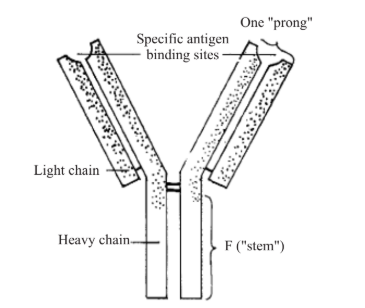
6. Draw a schematic diagram of the structure of an antibody.
7. What are the main physical barriers of the body?
Physical barriers are the first line of defence that prevent the entry of germs into the body. They are,
- Skin: The outer tough layer of skin is formed of keratin and is almost impermeable to germs. Sebaceous glands in the skin generate an acidic environment by producing lactic acid, which kills many pathogens.
- Epithelial lining of various organs: The respiratory tract, the alimentary tract (the gut), and the urino-genital tract have an exterior epithelial cell layer covered by a protective mucous lining. In the respiratory tract, cilia covering the external surface of the epithelial cells continually beat upwards towards the nasopharynx, and this helps to expel particles and pathogens. Epithelial cells are constantly renewed, and their removal expels pathogens lodged on their surface.
- Body secretions: Body secretions, such as sweat and secretion from the eyes, also ward off pathogens. Other body fluids contain bactericidal molecules, that is, capable of killing bacteria (e.g., spermine in seminal fluid, hydrochloric acid in gastric juice). If the germs somehow enter the body by evading physical barriers of the body, the other two main defence mechanisms come into play – phagocytosis and the bactericidal effect of soluble chemical factors collectively known as the complement system.
8. Describe important features of phagocytic cells.
Important features of phagocytic cells
- 1. They rapidly engulf the foreign molecular agent oncoming in contact or when they come in contact with it.
- 2. They contain digestive enzymes to break down engulfed material.
- 3. They are an important link between innate and acquired immunity.
9. Give one main difference between passively acquired immunity and actively acquired immunity.
- Actively acquired immunity is brought about in an individual through infections or transfer from an immunised individual through blood or serum components.
- Passively acquired immunity is developed by transfer of antibodies from the mother into the foetus through the placenta or through the mother’s milk.
10. Define the process of attenuation.
The process of vaccinating with live attenuated or weakened organisms against diseases such as measles, polio, etc, is called attenuation. Attenuation mimics the natural behaviour of the organism without causing disease. The actively multiplying organism provides a sustained antigen supply.
11. Name two toxoid vaccines.
Toxoid is a chemically or physically modified toxin that is no longer harmful but retains immunogenicity.. Examples of toxoid vaccines are diphtheria and tetanus.
12. What do the following abbreviations mean?
(i) BCG (ii) DPT (iii) MMR
- BCG: Bacilli Calmette Guerin
- DPT: Diphtheria, Measles, Pertussis
- MMR: Measles, Mumps, and Rubella