The chapter NIOS Biology Reproduction In Plants explains sexual and asexual reproduction in plants. Students learn about pollination, fertilization, seed formation, and dispersal. This chapter highlights how plants ensure continuity of life.
With solved terminal exercises, learners can practice exam-oriented questions effectively. It provides a strong understanding of plant life cycles and reproduction strategies. This chapter is a key part of the NIOS Class 12 Biology and supports exam preparation with clarity.
NIOS Biology Reproduction In Plants
1. Explain the term isogamy, taking Chlamydomonas as an example.
Isogamy is the mode of sexual reproduction where the male and female gametes are morphologically identical but physiologically different, as seen in Chlamydomonas eugametos and C. eherenburgii.
- In Chlamydomonas, both the male and female cells become non-motile by losing their flagella.
- Their protoplasm undergoes mitotic divisions to produce 32-64 daughter cells.
- These daughter cells develop flagella, become motile, and are released into the water by a rupture of the mother cell.
- Each of these acts as a gamete that looks identical but functions differently physiologically.
- These gametes fuse to form quadriflagellate zygotes.
- The diploid zygotes form zygospores to overcome unfavourable conditions.
- When favorable conditions arise, the zygote divides meiotically to form four haploid zoospores, each of which develops into a new Chlamydomonas.
2. Describe scalariform conjugation in Spirogyra.
Scalariform Conjugation (conjugating filaments give a ladder-like appearance).
- Two filaments come to lie very close to each other so that the cells of the two filaments pair septum to septum and face to face.
- The pairing cells of the two filaments form a contact with the help of a tube called the conjugation tube.
- Cytoplasmic contents of each cell round off to act as a gamete.
- A gamete from one cell (male) passes to the other cell (female) through the conjugation tube, by amoeboid movement.
- The cells of each filament act either as male or female.
- The contents of two gametes fuse in the female cell and form a diploid zygote. Consequently, after the sexual fusion of gametes, all the cells of the male filament are empty, whereas each cell of the female filament has one thick-walled diploid zygospore.
- The zygospore develops a thick wall around itself and develops dark brown to black pigment to tide over the unfavourable period.
- On the return of favourable conditions, the diploid nucleus divides by meiosis into four haploid nuclei. Three of these nuclei degenerate.
- On germination, the wall of the zygospore ruptures, and a small tube-like structure, containing one haploid nucleus, comes out.
- The small tube develops into a long filament by repeated mitotic cell divisions.
3. Differentiate between annuals, biennials, and perennial plants.
- (a) Annuals: The plants which complete their life cycle, including flowering to seed formation within one season, are called annuals, eg, pea.
- (b) Biennials: Plants that complete their life cycle in two seasons are called biennials. In the first season, these plants remain in the vegetative state, and in the second season, they produce flowers, fruits, and seeds, and then die, e.g., radish.
- (c) Perennials: Plants that live for several years are termed perennials. Their vegetative stage may last from one to a few years, after which they produce flowers, fruits, and seeds every year, e.g., mango, peepal, and neem.
4. Give significance of pollination.
When mature pollen grains, released from the anther, are carried to the stigma of a flower
of the same or different species, it is called pollination.
Importance of Pollination:
- 1. It results in fertilization and stimulates the ovule to convert into a seed.
- 2. New varieties of plants are formed through a new combination of genes in the case of cross-pollination.
- 3. During pollination pollen tube produces growth hormones which stimulate the ovary to develop into a fruit.
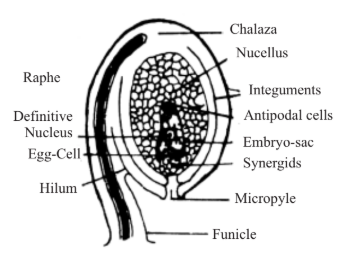
5. Draw a labelled sketch of a mature ovule.
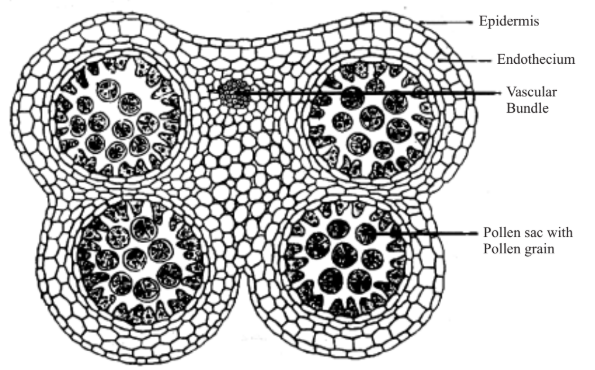
6. Give a labelled diagram of a mature pollen grain.
7. Mention important characteristics in Anemophilous and Hydrophilous plants.
Characteristics of anemophilous plants:
- (i) Flowers are small, without colour, nectar, and scent.
- (ii) Flowers produce a large number of pollen grains to allow for wastage when pollen grains are carried by wind to another flower.
- (iii) The pollen grains are small, light, and sometimes provided with ‘Wings’.
- (iv) The stigmas are comparatively large, protruding, and sometimes hairy, to trap pollen grains from the wind, for example, grasses and some cacti.
Characteristics of hydrophyious plants
- (i) Pollen grains are produced in large numbers.
- (ii) Pollen grains float on the surface of water till they land on the stigma of female flowers, e.g., Hydrilla, Vallisneria.
8. Give the significance of fertilisation.
Significance of Fertilisation
- (i) Gives stimulus for the growth of the ovary, leading to fruit formation.
- (ii) Helps in the recombination of characters as genes from two different individuals combine and form the zygote.
9. Mention the changes that take place when the fruit ripens.
The following changes take place during the ripening of fruit:
- (i) Starch is converted into sugar.
- (ii) The production of various organic substances (esters) gives a different texture, taste, and flavour.
- (iii) The breakdown of chlorophyll leads to changes in the colour of the skin of the fruit.
10. Define the following terms:
(a) Corm (b) Scion (c) Callus (d) Micropropagation (e) Vegetative reproduction
- (a) Corm: An underground modification of the stem having buds that develop into a new plant.
- (b) Scion: Scion is a piece of stem cutting taken from a desired plant, and that is inserted into the stem of the stock plant for grafting.
- (c) Callus: When a piece of tissue or an organ is grown in a nutrient medium under sterilized conditions, it grows rapidly to form an unorganized mass called callus.
- (d) Micropropagation: Micropropagation is the technique of growing tissues or organs or a single cell in controlled conditions to grow a new plant.
- (e) Vegetative reproduction: Vegetative propagation is the formation of new plantlets from
- vegetative (somatic) cell, buds or organs of the plant.
11. In what ways do plants reproduce vegetatively without human assistance?
- 1. The underground modification of stems, like rhizome (in ginger), tuber (potato), bulb (onion), and corm (zamikand), are provided with buds which develop into a new plant and are therefore used to carry out vegetative propagation of the plant in the field. Plants with subaerial modification, such as Pistia (offset) and Chrysanthemum (sucker), are also used for vegetative propagation.
- 2. Similarly, tuberous roots (Asparagus and sweet potato) can also be used for propagation, as these roots have adventitious buds that grow into a new plant.
- 3. Sometimes even leaves contribute to the propagation of plants, for example, leaves of Bryophyllum and Kalanchoe have buds on the margin, and these buds grow into small plantlets. When detached from the mother plant, they grow into independent plants.
- 4. In plants like Agave and Oxalis, multicellular bodies called bulbils develop from flower buds. These are called bulbils, which, when they fall on the ground, grow into a new plant.
12. In what ways do plants reproduce vegetatively with human assistance?
- (a) Cuttings: Many plants like rose, Bougainvillea, Croton, Coleus, money plant, and sugarcane are grown through their stem cuttings. Cuttings of these plants can be grown even in water, where they strike roots and develop adventitious buds.
- (b) Layering: In this method, a lower branch of a plant is bent down and covered with moist soil, leaving the growing tip above the soil. A ring of bark is removed from the stem before it is bent down. In a few weeks, when enough roots have developed on the underground portion above the ringed part, it is cut off from the parent plant and grows separately as an independent plant. Example: Jasmine, strawberry, grapevine, Bougainvillea.
- (c) Aerial layering or Gootee is a similar practice where bending of branches is not possible because of the height of the plant or due to the woody nature of the stem. In this method, a ring of bark is removed from a selected branch, and it is covered with moist moss and enclosed in a polythene sheet. When roots appear, the stem is cut below the roots and planted to form a new plant.
- (d) Grafting: It is especially important for the propagation of seedless varieties of plants. It consists of inserting a small branch into a rooted plant. The rooted plant, taken as a stock, is resistant to diseases and is physically sturdy. In this stock, a branch is inserted, which is known as a scion or graft. This scion or graft is the stem cutting from the desired plant. Usually, the grafted end of the stock and scion fit well with each other and are bound firmly with tape or a rubber band until their tissues unite and vascular continuity is established. Grafting is mostly practised in dicot plants. Grafting has been found extremely useful in propagating improved varieties of various flowers and fruits like rose, Bougainvillea, Citrus, mango, apple, etc.
13. Define and give an example of each of the following:
(a) Rhizome (b) Stolon (c) Cutting (d) Layering (e) Grafting
- (a) Rhizome: Rhizome is an irregularly shaped, modified underground stem that stores food.
- (b) Stolon: Stolon is a horizontally running modified stem with roots and nodes.
- (c) Cutting: Cutting is the piece of stem that is cut from the parent plant and that is buried in the soil to grow a new plant.
- (d) Layering: Layering is the process of growing a new plant by rooting a tender branch of the plant in the soil. Once it grows, it is cut from the parent plant and grows independently.
- (e) Grafting: Grafting is the process of inserting a small stem cutting into the stem of another older plant.
14. What are the advantages and disadvantages of vegetative reproduction?
Advantages
- (a) Rapid means of reproduction and spread.
- (b) Offspring identical to parent. The desired varieties can thus be preserved genetically for use.
- (c) Food storage organs allow perennation or survival in adverse conditions.
- (d) Improved varieties of ornamental plants and fruit trees can be multiplied easily.
- (e) Vegetative propagation is a quicker, easier, and less expensive method of multiplying plants.
Disadvantages
- (a) Overcrowding and competition for space unless separated artificially.
- (b) New varieties cannot be produced by this method except by mutation.
- (c) Diseases typical of the species are rapidly transmitted and can be detrimental to a crop.
15. In what way is vegetative reproduction simple?
Vegetative propagation is quicker, easier, simpler, and less expensive than other methods. It uses a small cutting, buds, or other smaller parts of the plant for propagation.
16. Write short notes on
(a) Runner (b) Sucker (c) Bulb (d) Tuber
- (a) Runner: A Runner is a specialised stem part with roots that grows near the ground and creeps along it with nodes. Eg. Grass
- (b) Sucker: Sucker is a sub-aerial stem modification with underground parts and growing obliquely upwards, giving rise to a new plant. Eg. Banana
- (c) Bulb: Bulbs are an underground stem modification with a condensed and disjunct stem with some scale leaves. They can grow into a new plant from the terminal buds with adventitious roots growing from the sides. E.g.. Onion.
- (d) Tuber: A Tuber is another underground stem modification that stores starch. These are edible parts that also grow buds that grow into new plants.
17. In brief, describe the various steps of micropropagation.
- A small piece of tissue, organ, or even a single cell is taken from a plant and is transferred to a sterilized container with nutrient medium in aseptic conditions.
- The tissue grows very, very fast into an unorganised mass, called a callus.
- The callus can be maintained and multiplied for an indefinite period.
- When small portions of the tissue are transferred to another specialised medium with hormones, it induces differentiation, and plantlets (little plants) are formed.
- The plantlets can be transplanted into pots and or soil by a gradual process and are grown to mature plants.
18. What is the significance of micropropagation?
Advantages of micropropagation
By this method, an indefinite number of identical plants can be obtained vegetatively starting from a small amount of parent tissue.
In orchids, carnations, Chrysanthemum, and Asparagus, micropropagation is being successfully tried in some parts of our country.
19. If a branch of the dasehri mango is grafted on a tree producing a desi mango. What type of mangoes will be produced on the grafted branch and on other branches of the tree?
The grafted branch produces dasehri mango, while the non-grafted branches continue to produce desi mango. Here, only the branch that carries the scion will have a new variety growing on it, while the scion, the desi mango tree, continues to produce offspring that are identical to it.






Hello very cool site!! Guy .. Beautiful .. Amazing ..
I’ll bookmark your site and take the feeds additionally?
I’m happy to seek out a lott of useful information right here in the publish,
we’d like develop more techniques on this regard, thank you for sharing.
. . . . .
my blog post Cristine