
Class 12 Biotechnology Sample Paper 2022 Term II
Time allowed: 2 hours
Max. Marks 35
SECTION A
1. Why is r-HUEPO preferred over blood transfusion in such cases where a person has excessive blood loss due to accidents?
Ans: No donor is required for transfusion, no transfusion facilities, no risk of transfusion-related infection (any two)
OR
Differentiate between primary and secondary animal cell cultures.
Ans: The maintenance of the growth of cells under laboratory conditions in a suitable culture medium is known as primary cell culture. The primary cell culture is sub-cultured in fresh growth media to develop secondary cultures.
2. Sterile seeds may be formed during crosses between distantly related plants. What could be the reason for this, and how can it be overcome?
Ans:
- a. Abnormal development of the endosperm causes premature death of the hybrid embryo and leads to sterile seeds.
- b. The embryo from such sterile hybrid seeds can be excised at an appropriate time and cultured on a suitable nutrient medium to produce a novel hybrid.
3. Pichia pastoris has many advantages as an eukaryotic expression host. Justify giving two reasons.
Ans:
- a. It has strong inducible promoters.
- b. It is capable of making post-translational modifications similar to those performed by human cells.
- c. Downstream processing is simpler as Pichia does not secrete its own proteins into the fermentation medium.
4. Name any two databases important in bioinformatics.
Mention the type of information that may be obtained from these databases.
Ans:
| Database | Information Available |
| EMBL(European MolecularBiology Laboratory) | Nucleotide sequence |
| Nucleotide sequence | Annotated protein sequence |
| PDB (Protein Database) | Three-dimensional structure of proteins |
| Ribosomal RNA database | rRNA subunit sequences |
| PALI database | Phylogenetic analysis and alignment of proteins |
OR
Suggest two possible ways for analyzing a given sequence using bioinformatics.
Ans: Any Two:
- 1. Processing raw information: The experimentally determined sequence (raw information) is processed using bioinformatics tools into genes, the proteins encoded, and their function, the regulatory sequences, and inferring phylogenetic relationships.
- 2. Genes: Gene prediction can be done by using computer programs like Gene Mark for bacterial genomes and GENSCAN for eukaryotes.
- 3. Proteins: Protein sequences can be inferred from the predicted genes by using simple computer programs.
- 4. Regulatory sequences: Regulatory sequences can also be identified and analysed by using bioinformatics tools.
- 5. Inferring phylogenetic relationships: Information regarding the relationships between organisms can be obtained by aligning multiple sequences, calculating evolutionary distance, and constructing phylogenetic trees.
- 6. Making a Discovery: Using the bioinformatics tools and databases, the functions of unknown genes can be predicted.
5. State any two applications of protoplast culture in plant biotechnology.
Ans:
- a. Somatic Hybrids
- b. Cybrids ( Cytoplasmic hybrids )
- c. Genetic transformations
- d. Metabolic studies
6. Patients who are administered OKT3 do not suffer from an acute renal allograft rejection. Why?
Ans: T-cells play a major role in the rejection of foreign grafts, and hence, they are responsible for the kidney transplant rejection.
OKT3 is a monoclonal antibody that targets CD3 surface markers (antigens) present on mature T-cells and removes them from circulation and hence preventing acute renal allograft rejection.
SECTION B
7 a. What do you mean by gene knock-out? (1)
b. Give any two advantages of the preparation of mouse models using gene knockouts useful? (2)
Ans: a. Gene knock-out selectively removes a gene.
b. Used to understand the genetic basis of diseases, new diagnostic and therapeutic modalities.
8 a. How are artificial seeds produced? (1)
b. State two ways in which artificial seeds are different from embryonic seeds. (2)
Ans: a. Use of certain hormones can convert somatic cells into a state similar to embryos, which are encapsulated to produce artificial seeds.
b. Artificial seeds are bigger/long-term storage/potential for automation.
9. Write the steps of BLAST involved in the comparison of DNA sequences. 3
Ans: The given sequence is compared with sequences in the database using substitution matrices that specify scores to either ‘reward’ a match or ‘penalize’ a mismatch.
- Top-scoring matches are ranked according to set criteria that serve to distinguish between similarity due to ancestral relationship or due to random chance.
- True matches are further examined thoroughly with other details accessible through Entrez and other tools available at NCBI.
10 a. How can microbial cultures be used for the production of different metabolites?
b. A recently discovered microbial strain gives us the desired metabolite in nanomolar concentration. Suggest two ways of improving the production of the desired metabolite.
Ans: a. Production of food, vaccines/ Production of primary metabolites; acids, alcohol/ Production of secondary metabolites: antibiotics/ Biotransformation reactions: enzymatic, steroids (Any one )
b. Strain improvement is done to maximize metabolite production by:
- Mutant selection: There are two methods – the Physical Method, the Chemical Method
- Genetic engineering
11 a. What are edible vaccines? (1)
b. How are edible vaccines advantageous over recombinant vaccines produced by bacterial fermentation? (2)
Ans: a. The genes encoding antigenic proteins can be isolated from pathogens and expressed in plants. Such transgenic plants or their tissues producing antigens can be eaten for vaccination/immunization. These are called edible vaccines.
b. Edible vaccines offer the following advantages over conventional vaccines.
- Low cost
- Alleviation of storage problems
- Easy delivery system by feeding (any other relevant point) (Any Two)
OR
How can one obtain virus-free sugarcane plants from virus-infected plants? Are these plants virus-resistant? Give reasons for your response.
Ans: Micropropagation using meristems.
No, these are not virus-resistant.
Because meristems are virus-free but do not have resistance genes.
12 a. How are the hybridoma cells selected from the culture of B-cells and Myeloma cells while fusing them in hybridoma technology? (1)
b. Which monoclonal antibody is used to treat the early stages of breast cancer, and how does it work? (2)
Ans: a. Using HAT medium
b. Monoclonal antibody, which is used to treat the early stages of breast cancer, is Herceptin (trastuzumab).
It works by attaching itself to HER2 receptors by blocking them from receiving the growth signals.
SECTION C
13. Microbial growth kinetics
Cell growth includes an increase in its number. A typical bacterial growth curve is shown in the figure below-
Diagram 1

Growth kinetics is an autocatalytic reaction, which implies that the rate of growth is directly proportional to the concentration of cells.

Doubling time, which is the time taken by the population to double through one round of cell division, is inversely related to specific growth rate.
- a. In the microbial growth curve depicted above (Diagram 1), in which phase is the microbial cell-specific growth rate calculated (from phases AB/BC/CD/DE)? What is this phase called? (2)
- b. Refer to Table 1 and calculate the generation time and specific growth rate constant of a bacterial population in which the number of bacteria increases from 104 cells /ml to 107 cells /ml during four hours of exponential growth. (3)
Ans: a. The phase in which microbial cell-specific growth rate is calculated is BC.
Log phase
b. n = 3.3 (log107-log104)
3.3(3) = 10
t = 240/10 = 24 min
Specific Growth rate constant = 0.693/1440 = 4.8×10⁻⁴/s
OR
Management of Diabetes
Insulin delivery is still the most effective method of pharmacotherapy in cases of extremely high hyperglycemia. The production process has been divided into several stages as depicted below in the flow chart:
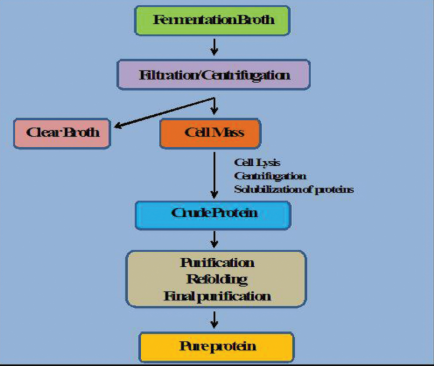
.
At each stage of insulin production, qualitative and quantitative analyses were performed to confirm the identity and purity of the desired protein.
- a. In a fermentation medium depicted above, a few workers processed clear broth for the production of the desired protein, but were unable to get any yield. What could be the possible reason for this?
- b. How is the outcome of the process affected if the number of processing steps is reduced while obtaining pure protein from the fermentation medium?
- c. Which type (recombinant insulin or cattle-derived insulin) will be produced in the above depicted flow chart?
- d. Name a metabolite that is produced using clear broth rather than cell mass.
- e. How is crude protein different from the desired protein?
Ans:
- a. The recombinant insulin is intracellular, and to isolate it, we need to rupture the cells, as the broth will lack the recombinant insulin.
- b. Minimising steps: Cost-effective/ less denaturation of protein /higher yield.
- c. Recombinant insulin
- d. Antibiotics(term) /any example of antibiotics
- e. Crude protein will have several unwanted proteins that need to be purified.
Additional Study Materials
- Biotechnology Sample Paper 2025
- Biotechnology Sample Paper 2024
- Biotechnology Sample Paper 2023
- Biotechnology Sample Paper 2022 Term I