Grazing food chain refers to the series or sequence of energy and nutrient transfer from organisms of the lowest trophic level, or the producers, to organisms in the highest trophic level.
This type of food chain starts from green plants or phytoplankton that process energy with the help of photosynthesis. The other organisms that feed on them will get a part of this energy, depending on their position in this chain.
Characteristics of the Grazing Food Chain
- Sunlight is the primary source of energy for the grazing food chain. The producers convert this energy into usable forms with the help of photosynthesis.
- Factors such as oxidation of plants, microbial attacks, water flow, decay of the plant, etc, affect this food chain.
- It helps fix inorganic nitrogen in the soil.
- It contributes energy to the environment through respiration, decay, and other methods.
- Members of this food chain are macroscopic organisms.
- The grazing food chain starts with producers such as green plants.
- Herbivores that feed on producers or the primary consumers are the next in this chain.
- The next link in the grazing food chain is the secondary consumers of carnivores.
- Tertiary consumers or secondary carnivores are the next link in this chain.
Energy Assimilation
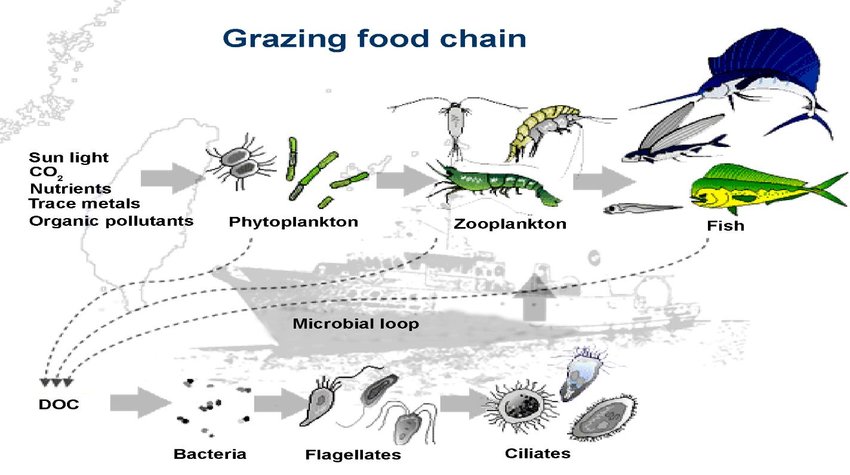
The grazing food chain has a unidirectional energy flow from one trophic level to the next. As it passes from one level to the next, the total energy will gradually decrease. Much of the energy is utilized by the organism for various activities.
The energy assimilation of the producers is in the form of starch. The herbivores that feed on the producers assimilate energy stored as different molecules such as carbohydrates, fats, proteins, and other complex molecules. Energy required for these transformations is generated through respiration.
This sequence continues till the end of the grazing food chain or the tertiary carnivores. The ultimate disposition of energy in each level is through the same processes, such as respiration, decay of their body parts, consumption by the organisms in the next level, etc.
This means that the gross energy assimilation of the tertiary carnivores comes from the primary consumers of herbivores. Thus, a grazing food chain is a representation of energy transfer from one trophic level to another.
Examples of the Grazing Food Chain
The grazing food chain can be seen in aquatic and terrestrial ecosystems. In the aquatic ecosystem, it starts from phytoplankton, which are eaten by zooplankton. They are eaten by fish and then reach humans or other higher aquatic animals. Phytoplankton represent the lowest trophic level.
In a terrestrial ecosystem, grass or green plants are the lowest trophic level. Herbivores such as rabbits, deer, cows, etc, are primary consumers. Fox, lion, tiger, etc, are on the next level, and eagle or vulture are at the highest trophic level.
In either case, there would only be 4-5 levels of trophic levels since a huge portion of energy is lost at each level and only a small portion of energy is transferred to the next level. This results in an energy insufficiency that does not give room for a longer chain.