Reproduction Class 10 Competency Based Questions
1 Mark Questions
1. Two statements are given – one labelled Assertion (A) and the other labelled Reason (R). Read the statements carefully and choose the option that correctly describes statements A and R.
- Assertion (A): Oral contraceptive pills and copper-T do not prevent sexually transmitted diseases.
- Reason (R): Sexually transmitted diseases are transmitted by contact with mucous membranes of infected organs.
- Both A and R are true, and R is the correct explanation of A.
- Both A and R are true, but R is not the correct explanation of A.
- A is true, but R is false.
- A is false, but R is true.
Ans: a. Both A and R are true and R is the correct explanation of A.
2. The diagram below represents the male human reproductive system.
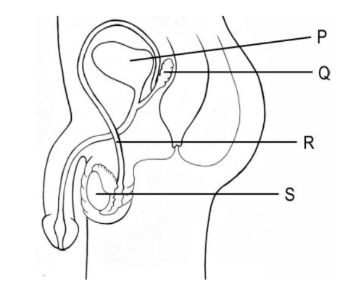
Identify the part that is responsible for the secretion of testosterone.
- P
- Q
- R
- S
Ans: d. S
3. “The biological sex of an individual only depends on the sperm cell.” Is the above statement true or false? Justify your answer.
Ans: True. All egg cells contain only X chromosomes. It is the sperm that may contain an X or aY chromosome and so depending on which sperm unites with the egg, the biological sex of the individual is determined.
Case Study #1
In the diagram below, each labelled region (P to W) represents a certain combination of reproductive processes found in an animal. Each labelled region is characterised by the different circles that it is (or is not) a part of.
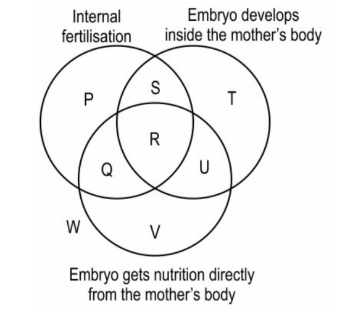
Answer the following questions based on this diagram.
4. Name any one animal whose mode of reproduction is represented by region P.
Ans: Any animal that lays eggs after internal fertilisation such as birds, lizards, etc.
5. Contraceptives help in preventing pregnancies. What function would a contraceptive loop inserted at T serve?
- Stopping sperm from reaching and fertilizing eggs
- Stopping the release of sperm
- Blocking the release of eggs
- Stopping egg creation
Ans: a. Stopping sperm from reaching and fertilizing eggs
6. Bindu wants to produce a hybrid variety of tomatoes. She has tomato plants X and Y belonging to two different varieties, one with smooth, long fruits and the other with wrinkled, round fruits. Tomatoes have bisexual flowers. Bindu carries out the following steps carefully to cross-pollinate the flowers of plants X and Y:
- She removes a part of the flowers of the tomato plant X just before the flowers bloom.
- She manually pollinates the flowers of tomato plant X using pollen from the flowers of tomato plant Y.
- She ties small plastic bags around the pollinated flowers of tomato plant X. The plastic bags are removed after a couple of days.
What could be the reason for covering the pollinated flowers of plant X?
Ans: to prevent pollen from other plants from reaching the stigma
7. ‘In vitro fertilisation’ is a process of fusing a human egg and sperm outside a woman’s body, in a laboratory. After fertilisation, the zygote is allowed to develop into an embryo for 2-6 days. The embryo is then implanted in the woman’s uterus, where it develops normally.
Which labelled region in the diagram BEST represents reproduction via in vitro fertilisation?
Ans: Part labelled U.
Case Study #2
Bindu wants to produce a hybrid variety of tomatoes. She has tomato plants X and Y belonging to two different varieties, one with smooth, long fruits and the other one with wrinkled, round fruits.
Tomatoes have bisexual flowers. Bindu carries out the following steps carefully to cross-pollinate the flowers of plants X and Y:
1. She removes a part of the flowers of the tomato plant X just before the flowers bloom.
2. She manually pollinates the flowers of tomato plant X using pollen from the flowers of tomato plant Y.
3. She ties small plastic bags around the pollinated flowers of tomato plant X. The plastic bags
are removed after a couple of days.
8. Bindu carried out step 1 to prevent self-pollination. Which part did she remove?
Ans: Stamens/Anther
9. Plants produced through vegetative propagation are genetically identical to their parents. What could be the biggest disadvantage of vegetative propagation?
Ans:
- Both the parent plant and the progeny will be susceptible to the same pathogen which can wipe out the entire population.
- Less genetic diversity as no new variety will be produced
2 Marks Questions
10. The description of a species of fish called ‘guppy’ is given below:
“Guppies are live-bearing fish, with a gestation period of 21-30 days. Once inseminated, female guppies can store sperm in their ovaries, which can continue to fertilise ova up to eight months, meaning the female mate can give birth to the male’s offspring long after the male’s death.”
(a) Based on the given information, which labelled regions CAN guppies belong to?
(b) What additional information is required to identify the labelled region in the diagram that guppies ACTUALLY belong to?
Ans:
(a) R or S
(b) whether the embryo gets nutrition directly from the mother’s body
11. A farmer bought some strawberries and liked the taste. He decided to grow his own strawberries that should have the same taste.
(a) Which method of cultivation should the farmer adopt?
(b) Why would the farmer choose this method?
Ans:
- (a) asexual reproduction / vegetative propagation
- (b) because fruit produced through vegetative propagation would carry conserved parental characteristics
12. What could be the TWO most likely reasons for unicellular organisms to reproduce only through asexual reproduction?
Ans:
- They can produce a large number of offspring in a small period of time.
- The offspring are adapted to survive in the same environment.
3 Marks Questions
13. planarians can regenerate lost body parts due to the presence of specialised cells called neoblasts. These specialised cells multiply and make a large mass of cells from which different cells undergo changes to become different types of cells and tissues.
(a) In plants, in which type of tissue are cells that have a function similar to neoblasts found?
(b) How do the characteristics of a planarium formed by regeneration compare with the characteristics of the original planarium? Justify your answer.
Ans:
(a) meristematic tissue
(b)
- They will be the same.
- Regeneration does not involve the mixing of gametes.
14. Compare the reproductive parts of flowers and humans and answer the questions below:
(a) Which part of the human female reproductive system has a similar function as the stigma in a flower? Give a reason to support your answer.
(b) Testes in the male reproductive system would correspond to which part of the male reproductive system in a flower? Justify.
(c) The style of a flower and the fallopian tube in humans correspond functionally with each other. Is this statement true? Justify your answer.
Ans:
(a)
Part – Cervix/Vagina
- Reason – The stigma of the flower serves as the point of entry of the male gametes/pollen grains; similarly, the cervix serves as the point of entry of the male gametes/sperm in humans/ vagina receives the male gametes in humans.
(b)
- Part – anther
- Function – produces male gametes in the form of pollen, just like testes, which produce sperm
(c)
- False
- Reason – the main function of the fallopian tube is to serve as the point of fertilisation, which is not the function of the style in flowers.
4 Marks Questions
15. Water hyacinths reproduce both sexually and asexually. They reproduce sexually by producing seed through flowers, and asexually by bud formation or fragmentation. It undergoes reproduction through either of the methods depending on environmental conditions. Water hyacinths bloom freely in water-rich conditions, whereas reproduction for survival is more effort-intensive in water-scarce conditions.
(a) Explain why this variation in reproduction is required in water hyacinths.
(b) Which mode of reproduction is likely to occur in the following conditions? Justify:
(i) abundance of water
(ii) scarcity of water
Ans:
(a)
- The population of each species thrives in its specific habitat/niche, having particular environmental conditions which can change due to reasons beyond the organisms’ control
- Having variation ensures greater chances of survival through such changes.
(b) (i)
- Asexual reproduction
- In its natural environment, the organism is likely to undergo an energy-efficient method of reproduction, such as asexual reproduction.
(ii)
- Sexual reproduction
- In a stressed environment, the organism is likely to opt for the effort-intensive method for survival.