NIOS Question Paper Class 12 April 2019 Set A
1 MARK QUESTIONS
1. Which of the following bacteria causes cholera?
A) Vibrio cholerae
B) Rhizobium
C) Azotobacter
D) Lactobacillus
2. One of the macronutrients given below plays a key role in food production and normal growth of the plant.
A) Boron
B) Copper
C) Carbon
D) Uranium
3. Name the complex tissue which function as a unit to conduct water and minerals upward from root to leaves.
A) Phloem
B) Parenchyma
C) Xylum
D) Sclerenchyma
4. Identify the fluid found in the Cavities of the brain.
A) Cerebrospinal fluid
B) Serum
C) Grey matter
D) Plasma
5. Choose the plant hormone which induces “Parthenocarpy”.
A) Auxin
B) Gibberelins
C) Ethylene
D) Lactic acid
6. Identify the following figure:
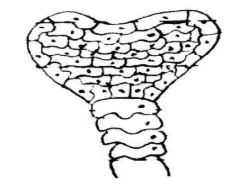
A) Sac
B) Leaf
C) Embryo
D) Seed Coat
7. With reference to organisation of life, Rana tigrina comes into which category?
A) Community
B) Species
C) Organism
D) Biome
8. Which of the following enzyme is called “Joining Enzyme”?
A) Plasmids
B) DNA ligase
C) Protease
D) Amylase
2 MARKS QUESTIONS
9. Define the term inflorescence. What are the major types of inflorescence in flowering plants?
Ans: Inflorescence is the arrangement of flowers on the floral axis called the peduncle. The two major types of inflorescence are racemose and cymose.
10. Observe the diagrams and answer the following:
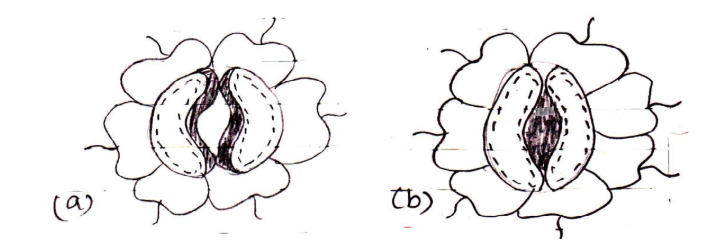
a) Are these types of stomata found in monocots or dicots?
b) Mention their main function.
Ans:
- Stomata in dicots.
- Stomata help in gaseous exchange and allow the loss of water vapour during transpiration.
11. Give an example for each of the following:
a) Aerobic bacteria which fix nitrogen
b) Anaerobic bacteria, which fix nitrogen
c) Cyanobacteria, which fix nitrogen
d) Photosynthetic non-sulphur bacteria, which fix nitrogen
Ans:
- Azotobacter
- Clostridium
- Anabaena
- Rhodospirillum
12. Where does spinal cord is located in human beings? Mention its main function.
Ans: The spinal cord extends from the medulla of the brain downward almost the whole length of the backbone. Its main function is to carry out reflexes below the neck and conduct both sensory impulses and motor responses to and from the brain.
13. Give reasons:
a) Habitat is called an address of the organism.
b) Fins are an adaptations of fish to aquatic life.
Ans:
- Habitat is the physical environment in which an organism lives and is thus considered its address.
- An adaptation is the appearance, behaviour, structure or mode of life of an organism that allows it to survive in a particular environment. The presence of gills and fins are examples of adaptation of fish to an aquatic habitat.
14. What is the importance of balanced diet? Reason out the special diet recommendation to pregnant and lactating women?
Ans: A balanced diet contains all essential nutrients in suitable proportions and amounts to provide necessary energy and keep the body in a healthy state. A pregnant woman has to feed the developing embryo; therefore, she has a special need for extra nutrients. Similarly, nursing mothers (who breastfeed their babies) also need a special diet to take care of their additional requirements of lactation (milk formation). So their diet should contain more protein, calcium and vitamins.
15. a) Why are human testes located outside the abdominal cavity?
b) Name the pouch in which they are present.
Ans:
- Testis are extra-abdominal, that is, present outside the abdomen in a pouch called the scrotum. The scrotum acts as a thermoregulator. It helps in maintaining the temperature of the testes at about 2-3°C lower than the body temperature. This temperature is suitable for the development of sperm.
- The pouch in which they are present is called the scrotal sac or scrotum.
16. How is the phenotypic ratio of F2-generation in dihybrid cross is different from monohybrid cross?
Ans: Crosses involving plants differing in the inheritance of one contrasting feature only are called monohybrid crosses. Crosses involving two contrasting features are termed dihybrid crosses.
In a monohybrid cross, tallness and dwarfness were involved, TT x tt,
The F1 was all tall with a genotype of Tt as the gene for tallness is dominant over that for dwarfness.
In the F2, Tt x Tt, the results will be
| Gametes | T | t |
| T | TT | Tt |
| t | Tt | tt |
The phenotype of F2 here is 3 Tall: 1 dwarf.
In a dihybrid cross, two contrasting characters are taken into consideration- height and colour of the flower.
In a cross between a tall red plant with a dwarf red,
Parents: TTRR x ttrr
Gametes: T, T, R, R x t, t, r, and r
F1: TtRr.
When F1 is selfed,
| Gametes | TR | Tr | tR | tr |
| TR | TTRRTall red | TTRrTall red | TtRRTall red | TtRrTall red |
| Tr | TTRrTall red | TTrrTall white | TTRrTall red | TtrrTall white |
| tR | TtRRTall red | TtRrTall red | ttRRDwarf red | ttRrDwarf red |
| tr | TtRrTall red | TtrrTall white | ttRrDwarf red | TtrrDwarf white |
Thus, F2 shows 9 Tall red, 3 Tall white, 3 Dwarf red, and 1 dwarf white.
17. Answer the following:
a) Which phase of growth curve shows rapid and maximum growth?
b) What is the term used for inducing early flowering in plants at low temperatures?
c) Name the specially designed equipment used to measure the rate of growth of shoot length of plants.
d) What is the hypothetical plant hormone which is responsible for initiation of flowering in plants?
Ans:
- Log phase
- Vernalisation
- Auxanometer
- Florigen
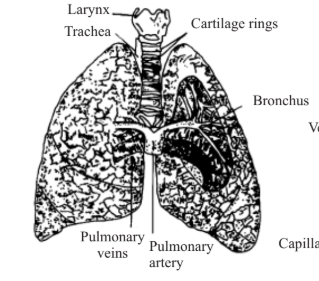
18. Draw a neat diagram of human lung and label the Larynx and trachea parts:
Ans:
19. Write any four advantages of Bio-diesel.
Ans:
Bio-diesel has several advantages; some of them are given below- (any four)
- It is an agriculture-based fuel substitute.
- It can be made from both vegetable oil and animal fats.
- It can be used without major modifications in engines.
- It does not need a separate infrastructure for storage and delivery.
- Handling biodiesel is safer.
- Planting of Jatropha curcus will utilise wasteland in our country.
- Its combustion emits less carbon monoxide, sulphates, unburnt hydrocarbons and particulate matter, thus reducing air pollution.
20. Write any two effects of the following:-
a) Excess intake of Iron.
b) Excess intake of Vitamin D
Ans:
- Excess intake of Iron: Constipation and diarrhoea, Nausea and vomiting, heartburn, or epigastric pain
- Excess intake of Vitamin D: Deposition of calcium in soft tissues of the body, like kidneys, drowsiness, nausea, or loss of weight.
4 MARKS QUESTIONS
21. Write short notes on:
a) Mode of nutrition in Yeast.
b) Sexual recombination in Bacteria.
Ans:
- Yeast is saprotrophic. It can directly absorb simple sugar (glucose), but for obtaining sucrose (cane sugar) it gives out the enzyme invertase or sucrase, which breaks down sucrose into simple sugars. The simple sugars are then simply absorbed into the cell.
- Some bacteria show a primitive mode of sexual reproduction. It is different from sexual reproduction in higher forms. The steps are:
- Two conjugating (lie very close for the transfer of genes) bacteria are held together by pili.
- A segment of a DNA strand is transferred from one bacterium to another bacterium.
22. Give reasons:
a) Sino-atrial node is called pacemaker of the heart.
b) Person with blood group ‘O’ called Universal donor.
Ans:
- Since the Sinu-atrial Node initiates and regularises the heartbeat, it is also called the pacemaker. The pacemaker is influenced by nerves, hormones, CO2 and O2 content of blood, and heat.
- Blood groups of O type can be given to all groups. It is thus the Universal Donor. This is because there are no antigens in the blood of Group O.
23. Differentiate between “Monocot stem and Dicot stem”.
Ans:
| Monocot Stem | Dicot Stem |
| Epidermal hairs absent | Epidermal hairs present |
| Hypodermis is sclerenchymatous | Hypodermis is collenchymatous |
| Ground tissue undifferentiated | Ground tissues are differentiated into cortex, endodermis, pericycle, pith, and medullary rays. |
| Vascular bundles are numerous, scattered and close | Vascular bundles are limited, arranged in a ring and open. |
| Bundle sheath present | Bundle sheath is absent |
| Xylem vessels are arranged as Y-shape | Xylem vessels are arranged in a radial row |
| Water cavity present | Water cavity absent |
| Secondary growth absent | Secondary growth is present. |
24. A man with ‘A’ blood group married a woman with blood group ‘B’. Work out a cross to show possible blood groups that can be expected in their offspring.
Ans:
Parents: A x B
Genotype: IAIA x IBIB
| Gametes | IB | IB |
| IA | IAIB | IAIB |
| IA | IAIB | IAIB |
All their offspring will have the AB blood group.
25. a) Which phase of cell-cycle DNA replication takes place?
b) Describe in brief the process of “Transcription in Prokaryotes”.
Ans:
- DNA duplication takes place during the S-phase.
- The flow of genetic information from cistronic DNA to mRNA is called Transcription. It occurs in the following steps–
- Cistronic DNA, which carries the information for the protein to be synthesised, unwinds in the presence of enzymes helicase and topoisomerase.
- RNA polymerase begins to catalyse the synthesis of mRNA, signalled by a protein called sigma factor.
- mRNA is synthesised complementary to cistronic DNA, and a Rho factor signals RNA polymerase to complete transcription.
- The strand of DNA which bears the code for transcription of the specific protein is called the sense strand of DNA, opposed to the antisense strand, which is not transcribed.
26. Draw a schematic diagram of “Carbon Cycle”.
Ans:
6 MARKS QUESTIONS
27. a) Write any four salient features of Class-Aves with two examples.
b) Define “Alteration of generation”, with one example.
Ans:
- Features of Class Aves (any four)
- The body is covered with feathers, and scales are present only on the hind limbs
- The body is divisible into three parts: head, neck and trunk.
- Jaws with a horny beak, no teeth.
- Hind limbs with four digits adapted for perching, walking or swimming
- Bones with air spaces to make the skeleton light (pneumatic bones).
- Forelimbs modified into wings for flight.
- The alternation between two phases in the life cycle between a gametophytic and a sporophytic generation is called alternation of generations. Eg. The main body of bryophytes is the gametophyte, and the diploid zygote is the only sporophyte in their lives.
28. a) What is the other name for “Adaptive immune response”?
b) State the role of T-cells and B-cells in Adaptive immune response.
c) Biotechnologists refer to “Agrobacterium tumefaciens” as a natural genetic engineer. Give reasons to support the statement.
Ans:
- Specific immune response.
- Adaptive immune response is of two types- cell-mediated and antibody-mediated. Cell-mediated immune responses are mediated by the T-cells. The antibody-mediated responses are carried out by B-cells, which produce plasma cells that secrete antibodies.
- Agrobacterium tumefaciens has a plasmid which can be inserted into plant cells. Agrobacterium tumefaciens causes galls (tumours) in several plants. The information for the production of galls is present on a plasmid (Ti) in the bacterium. A segment of DNA from the plasmid can be transferred into a plant cell. In the Ti plasmid, gall-forming genes can be removed and substituted by desired genes. The plasmid can then be used to transform plant cells.
29. a) Name the scientist who discovered C3 cycle.
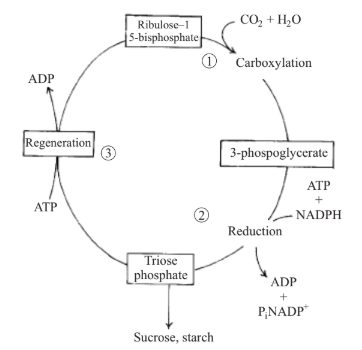
b) Draw a neat schematic diagram of C3 cycle in plants.
c) Justify your answer why C4 plants are most efficient than C3 plants?
Ans:
- Melvin Calvin
- Calvin Cycle
- C4 plants are more efficient than C3 plants because C4 plants have no photorespiration and thus there is no loss of additional carbon dioxide, due to the breakdown of RuBP to Glycolate and CO2.
30. a) What is “Criss-Cross inheritance”?
b) Why is red-green colour blindness more common in males than females?
c) How is colour blindness inherited? Explain with the help of flow chart.
Ans:
- The type of inheritance of a recessive sex linked character from father to daughter and then from the daughter to her sons is known as criss-cross inheritance or sex linked or X-linked inheritance.
- The defective gene for red-green colour blindness is located on the X chromosome. In males, a single defective gene causes the disease, while in females, it requires the presence of two defective genes. This is why this disease is more common in males than in females.
- In males, the single X chromosome is received from the mother. Hence, a defective gene for colour blindness on the X chromosome of the mother is passed on to the son and expressed as a defect. The daughter who receives the defective gene becomes a carrier.
Parents: XXC x XY
Gametes: X, XC, and X, Y
| Gametes | X | Y |
| X | XX Normal daughter | XYNormal son |
| XC | XCXCarrier daughter | XCYColour blind son |
Additional Study Materials
- NIOS Class 12 Biology PYQ April 2025 Set A
- NIOS Class 12 Biology PYQ Oct 2024 Set A
- NIOS Biology Paper 2024 April Set A Solved
- NIOS Class 12 Biology PYQ April 2023 Set A
- NIOS Class 12 Biology PYQ Oct 2022 Set A
- NIOS Class 12 Biology PYQ April 2022 Set A
- NIOS Class 12 Biology PYQ Feb 2021 set A
- NIOS Class 12 Biology PYQ Oct 2021 Set A
- NIOS Class 12 Biology PYQ Oct 2019 Set A