NIOS Class 10 Science Chapter 28 Question Answers
INTEXT QUESTIONS 28.1
1. What is the valency of carbon?
Ans: 4
2. What is the nature of bonds formed by carbon?
Ans: Covalent
3. Why does carbon form a large number of compounds?
Ans: Because of catenation, the possibility of the existence of isomers and the presence of various functional groups.
4. Name the branch of chemistry which is devoted to the study of carbon compounds.
Ans: Organic chemistry
5. How many electrons are needed by a carbon atom to complete its octet?
Ans: 4
INTEXT QUESTIONS 28.2
1. Which allotropic form of carbon has been discovered few years back?
Ans: Fullerenes
2. Each carbon atom is linked to how many carbon atoms in
(i) Diamond
(ii) Graphite
Ans: (i) 4 (ii) 3
3. Why diamond has high melting point?
Ans: Because a large amount of heat energy is required to break the three-dimensional network of covalent bonds.
4. Is diamond a conductor of electricity? Give reason for your answer.
Ans: No. Because there are no free electrons.
5. Why is graphite a good lubricant?
Ans: Because of weak bonding forces between layers of carbon atoms in graphite, they can slide over each other.
6. Give two uses of graphite.
Ans: As electrodes, lubricant, pencil leads, vessels for melting metals (any two).
7. What kind of structure is possessed by fullerenes?
Ans: Closed structure similar to football.
8. Name the three microcrystalline forms of carbon and give their use.
Ans:
- Charcoal – absorption of coloured impurities
- Coke – reducing agent in metallurgy
- Carbon black – pigment in inks or in automobile tyres
INTEXT QUESTIONS 28.3
1. Classify the following compounds as organic or inorganic:
(i) Sugar
(ii) calcium carbide
(iii) kerosene
(iv) carbon dioxide
(v) carbon disulfide
Ans:
(i), (iii) – Organic
(ii), (iv) – inorganic
2. Give two differences between organic and inorganic compounds.
Ans:
- (i) Organic compounds have low melting and boiling points, whereas inorganic compounds have high melting and boiling points.
- (ii) Organic compounds dissolve in organic solvents, whereas inorganic compounds dissolve in water and not in organic solvents.
INTEXT QUESTIONS 28.4
1. What is dry ice?
Ans: Carbon dioxide
2. Which gas, carbon monoxide or carbon dioxide, is a major air pollutant?
Ans: Carbon monoxide
3. Which gas is used in carbonated drinks?
Ans: Carbon dioxide
4. Name the gas which is a major contributor to the greenhouse effect.
Ans: Carbon dioxide
5. Name the products obtained by the fermentation of sugar.
Ans: Carbon dioxide and ethanol
INTEXT QUESTIONS 28.5
1. What is the difference between saturated and unsaturated compounds?
Ans: In saturated compounds, single bonds are present between carbon atoms, whereas in unsaturated compounds, double or triple bonds are present between carbon atoms.
2. Give two examples each of (i) saturated compounds and (ii) unsaturated compounds.
Ans: Saturated: methane, ethane Unsaturated: ethene, propyne
3. Name the alkane which has three carbon atoms.
Ans: Propane
4. Define isomers.
Ans: Isomers are compounds which have the same molecular formula but have different structures.
5. What is the full form of IUPAC?
Ans: International Union of Pure and Applied Chemistry.
6. Name the following alkyl groups:
(i) — CH3 (ii) — C2H5
Ans: (i) methyl (ii) ethyl
7. Give IUPAC name of these compounds
Ans: (a) 2-methylbutane (b) 2,3-dimethylbutane
INTEXT QUESTIONS 28.6
1. Identify the functional groups present in the following compounds:
(i) CH3CH2OH (ii) CH3Cl (iii) C2H2 (iv) CH3 — COOH
In the next section, you will study about some simple compounds which contain some of the above-mentioned functional groups.
Ans:
1. (i) hydroxyl (— OH) (ii) — Cl (iii) Alkyne (iv) Carboxylic
INTEXT QUESTIONS 28.7
1. What is wood alcohol?
Ans: Methanol
2. What is glycerin? Which functional group is present in it?
Ans: Glycerin is 1,2,3-propanetriol. It contains the hydroxyl functional group.
3. How is ethanol produced?
Ans: It is produced by the fermentation of carbohydrates such as glucose and starch present in grapes, barley, etc.
4. Give two examples of compounds having aldehyde functional group.
Ans: Formaldehyde, acetaldehyde
5. What is the use of acetone?
Ans: It is used as a solvent.
6. Which acid is present in vinegar?
Ans: Acetic acid
7. Name the compound which has an aldehyde group and is used as a flavour.
Ans: Vanillin
8. Give IUPAC Name of the following compounds
(a) C2H5OH (b) CH3COOH
(c) HCHO (d) CH3 — CO — CH3
Ans: (a) Ethanol (b) Ethanoic acid (c) Methanal (d) Propanone
9. Name the functional group present in the following compounds
(a) C2H5OH (b) CH3COOH
(c) HCHO (d) CH3-CO-CH3
Ans: (a) Alcohol (b) Carboxylic (c) Aldehyde (d) Ketone
TERMINAL EXERCISES
1. Why carbon cannot form ionic bonds?
Ans: Due to unfavourable energy considerations, it cannot gain four electrons by ion formation and hence attain the electronic configuration of neon. Due to the same reason, it is also not possible for carbon to lose these four electrons and attain the noble gas configuration of helium.
2. What is catenation?
Ans: The ability of carbon to form long chains of carbon atoms is called catenation.
3. What types of bonds are formed by the carbon atom?
Ans: Carbon atoms mainly form covalent bonds by sharing their four electrons on their outermost shell. It can form four covalent bonds, i.e. it is tetravalent in nature. The sharing of four more electrons from other atoms completes the octet of the carbon atom, and it attains stability by forming four covalent bonds.
4. Name the three allotropic forms of carbon.
Ans: The three allotropic forms of carbon are diamond, graphite and fullerenes.
5. How do natural diamonds form?
Ans: Diamonds are formed inside the Earth under the conditions of high temperature (about 1500°C) and high pressure (about 70,000 atmospheres).
6. Name two places where diamonds are found.
Ans: Panna in Madhya Pradesh and Wajrakarur in Andhra Pradesh.
7. Why is diamond hard?
Ans: In a diamond crystal, each carbon atom is linked to four other carbon atoms by covalent bonds in a tetrahedral fashion to form a three-dimensional arrangement. This three-dimensional network of covalently bonded carbon atoms provides a rigid structure to diamonds. This rigidity makes diamond a very hard substance.
8. Give two uses of diamond.
Ans:
- (i) It is used in the cutting and grinding of other hard materials.
- (ii) It is also employed in instruments used for cutting glass and drilling rocks.
- (iii) It is used in jewellery. Beautiful ornaments are made with diamonds. The high refractive index of diamond (2.5) makes it very brilliant when it is properly cut and polished.
9. Compare the physical properties of diamond and graphite.
Ans:
| Diamond | Graphite |
| Diamond is hard | Graphite is soft |
| Colorless material | Black in colour |
| Does not conduct electricity | Good conductor of electricity |
| High density | Lower density than diamond |
| Melting point at 3500°C | Melting point is 3700°C |
| Cannot be converted | Graphite can be converted to diamond by applying higher atmospheric pressure and temperature. |
| Used in jewellery | Used in making pencil lead, containers, lubricants, etc. |
10. How can graphite be converted into diamond?
Ans: Graphite can be converted to diamond by applying a very high atmospheric pressure and temperature. Graphite is heated at 1500 °C in the presence of a metal such as nickel and iron under a pressure of 50000 to 65000 atmospheres.
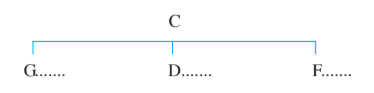
11. Create a flow chart as shown below to compare the various allotropes of carbon.
1. Names of Allotropes ………… ………… …………
2. Place where found ………… ………… …………
3. One use ………… ………… …………
4. Appearance ………… ………… …………
5. Arrangement of C atoms
Ans:
| Names of Allotropes: | Diamond | Graphite | Fulleren |
| Place where found: | Panna in Madhya Pradesh | Under the Earth | On Earth |
| One use | In jewellery | Making pencil lead | Used as superconducting materials, |
| Appearance | Hard and colourless | Metallic lustre | Football shaped |
| Arrangement of C atoms | Tertrahedral | Trigonal planar arrangement | Closed structure |
12. What is activated charcoal? How is it prepared?
Ans: Activated charcoal is a pulverised form whose surface has been made free from any adsorbed materials by heating with steam. It is widely used for adsorbing coloured impurities and bad odours from water and other substances.
13. Given below are pictures of three microcrystalline or amorphous forms of graphite. Name them and write one use of each.
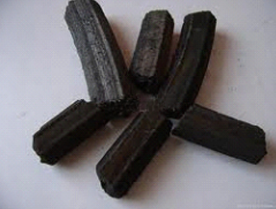
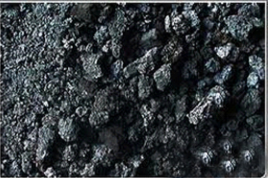
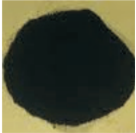
Name …………………………..
Use …………………………..
Ans:
| Name | Charcoal | Coke | Carbon black |
| Use | Used for absorbing impurities and bad odours. | Used as a reducing agent in metallurgy | Used as a pigment in ink |
14. Name the products formed when
(i) Wood is strongly heated in absence of air.
(ii) Coal is strongly heated in the absence of air.
(iii) Hydrocarbons are heated in limited supply of oxygen.
Ans:
- (i) Wood is strongly heated in the absence of air: Charcoal
- (ii) Coal is strongly heated in the absence of air: Coke
- (iii) Hydrocarbons are heated in a limited supply of oxygen: Carbon black
15. Why is CO toxic in nature?
Ans: CO is toxic because it reduces the oxygen-carrying capacity of blood by binding with haemoglobin, the red pigment of blood.
16. Give two uses of CO and CO2.
Ans:
| CO | CO2 |
| It is used as a reducing agent in metallurgical processes to reduce metal oxides. | Solid carbon dioxide, also called dry ice, is used as a refrigerant. |
| It is used in the synthesis of several organic compounds. | It is used in the production of carbonated drinks. |
| In the presence of a catalyst, it can combine with hydrogen to give methanol(CH3OH). | It is used in the production of washing soda (Na2CO3.10H2O) and baking soda (NaHCO3). |
| It forms carbonyl compounds. Nickel carbonyl Ni(CO)4 is used in the refinement of nickel. | |
| It is used as a fuel. |
17. For the following state one point of differences between the following pairs of terms
(i) Organic compounds and inorganic compounds
(ii) Carbon Monoxide and carbon dioxide
(iii) Aliphatic and aromatic compounds
Ans:
- (i) Organic compounds and inorganic compounds: Organic compounds were defined as those compounds which originated from living organisms. The compounds of carbon, which are not organic compounds, are called inorganic compounds.
- (ii) Carbon Monoxide and Carbon Dioxide: Carbon monoxide is formed when carbon or hydrocarbons are burned in a limited supply of oxygen. Carbon dioxide is formed when carbon-containing substances are burnt in excess of oxygen.
- (iii) Aliphatic and aromatic compounds: Aliphatic compounds are derived from fats and oils. Aromatic compounds have a characteristic smell.
18. What is a homologous series?
Ans: A series of compounds that differ from one another by a -CH2 unit is called a homologous series.
19. Name 10 carbon compounds of a homologous series. Write their molecular formula and derive a general formula for the series.
Ans:
- Methane CH4
- Ethane C2H6
- Propane C3H8
- Butane C4H10
- Pentane C5H12
- Hexane C6H14
- Heptanes C7H16
- Octane C8H18
- Nonane C9H20
- Decane C10H22
20. What is general formula for the homologous series of (i) alkanes (ii) alkenes (iii) alkynes?
Ans:
- (i) Alkanes – CnH2n+2
- (ii) Alkenes – CnH2n
- (iii) Alkynes – CnH2n–2
21. What is the molecular formula for ethane?
Ans: Ethane C2H6
22. Given here are four prefixes: But- , Eth- , Meth- , Prop- , and Suffix –ane to develop the names of alkanes. How many carbon atoms do each of these alkanes contain?
Ans:
- Butane – Four
- Ethane – Two
- Methane – One
- Propane – Three
23. Draw the Chemical Structure of Butane and Isobutane and based on it justify that they are isomers.
Ans:

They are the isomers of butane as they have the same molecular formula (C4H10) but have different structures.
24. Give IUPAC name of the following compounds:
(i) CH3 — CH = CH2
(ii) CH3 — HC = CH — CH3
(iii) CH3 — OH
Ans:
- Propene
- Butene
- Methanol
25. Give an example of a compound which has carboxylic (-COOH) functional group.
Ans: Acetic acid.
26. (a) Of the following which has single bond, double bonds and triple bonds between C-C atoms? Alkynes, alkane, alkene
(b) Name their simplest compounds and write the molecular formula.
Ans:
- Alkane: Single bond – Methane CH4
- Alkene: Double bond – Ethene C2H4
- Alkyne: Triple bond – Ethyne C2H2
27. Give one use of each of the following:
(i) Methanol (ii) ethanol (iii) glycerin
Ans:
- Methanol: It is used in the synthesis of acetic acid and many adhesives, fibres and plastics.
- Ethanol: It is used as a solvent for organic compounds.
- Glycerin: Used in skincare products
28. What is the difference between the structure of an aldehyde and a ketone?
Ans: In aldehydes, the carbonyl group is at the end of the carbon chain. In ketones, the carbonyl group is at the middle with two carbon atoms on either side.
29. What is (i) dry ice (ii) wood alcohol (iii) formalin (iv) vinegar
Ans:
- (i) Dry ice: Solid carbon dioxide
- (ii) Wood alcohol: Methanol
- (iii) Formalin: An aqueous solution of formaldehyde,
- (iv) Vinegar: Acetic acid
30. To which group of carbon compounds do each of the carbon compounds used for the following belong?
(i) To ripen fruits
(ii) In oxy-acetylene torch
Ans: They belong to the alkynes group.
31. Name the carboxylic acid present in vitamin C.
Ans: Ascorbic acid
32. Which acid is present in citrus fruits?
Ans: Citric acid
33. Your teacher has asked you to procure sources of formic acid and butyric acid. Which two sources will you collect and bring?
Ans: Formic acid from ants and butyric acid from rancid butter.
34. Name the carboxylic acids found in :
(i) Lemon (ii) Vitamin C (iii) Sour milk (iv) Rancid butter (v) Ants
Ans:
- (i) Lemon: Citric acid
- (ii) Vitamin C: Ascorbic acid
- (iii) Sour milk: Lactic acid
- (iv) Rancid butter: Butyric acid
- (v) Ants: Formic acid
Additional Study Materials
- Chapter 1 Measurement in Science and Technology
- Chapter 2 Matter in our Surroundings
- Chapter 3 Atoms and Molecules
- Chapter 4 Chemical Reaction and Equations
- Chapter 5 Atomic Structure
- Chapter 6 Periodic Classification of Elements
- Chapter 7 Chemical Bonding
- Chapter 8 Acids, Bases, and Salts
- Chapter 27 Metals and Non-metals