NIOS Class 10 Science Chapter 25 Question Answers
INTEXT QUESTIONS 25.1
1. What is meant by the terms (1) Heredity and (2) Variation?
Ans:
(i) Passing down similar characters generation after generation.
(ii) Differences in gene combinations.
2. Why is Mendel considered as the founder or father of genetics?
Ans: He had initiated work on heredity/genetics.
3. Formulate a sentence to demonstrate your understanding of the terms ‘dominant’ and ‘recessive.’
Ans:
(i) The gene that may express itself despite the presence of the other (Dominant).
(ii) Expression only in the absence of the dominant gene. (Recessive).
4. Name the scientist who discovered that Mendelian factors are present on chromosomes.
Ans: Sutton
5. Give the synonym for Mendelian factor.
Ans: Gene.
INTEXT QUESTIONS 25.2
1. Name the sex chromosomes.
Ans: X and Y
2. How many autosomes do humans have?
Ans: 22 pairs or 44 chromosomes
3. Why does an organism (except bacteria) have a diploid number of chromosomes?
Ans: Because one chromosome of a pair is received from the father and one from the mother.
4. State any two typical features of chromosomes.
Ans:
(i) present in pairs
(ii) seen only during cell division
(iii) present in a fixed number, etc. (any other).
5. Define a gene with respect to its chemical nature.
Ans: Genes are segments of a DNA molecule. So it is made of Deoxyribonucleic acid or DNA.
6. State the three major steps in DNA replication.
Ans:
- Unwinding of the double helix.
- Formation of new molecules of DNA complementary to each DNA strand
- Winding of one new and one parental DNA strand
7. Why is DNA fingerprinting a foolproof test?
Ans: Because the DNA of every individual is unique.
INTEXT QUESTIONS 25.3
1. What is a gene made of?
Ans: DNA
2. To which blood group would a person having genes IAi belong?
Ans: Blood group A
3. If a Y-bearing sperm fuses with an egg, what will be the sex of the individual developing from the zygote?
Ans: Male
4. How many X chromosomes can be found in the cells of the body of (i) a boy, and (ii) a girl?
Ans:
- For a boy, 44 autosomes and one X and one Y chromosome
- For a girl, 44 autosomes and 2 X chromosomes
5. How many molecules of DNA are present in one chromosome?
Ans: One molecule of DNA
INTEXT QUESTIONS 25.4
1. What will be the blood group of an individual with genetic combination IA IB?
Ans: AB
2. How can a person be normal for a trait even when carrying one defective gene for that trait?
Ans: The other member of the pair is dominant and masks the effect of the recessive gene.
3. Which is the safest blood group for donation if an accident victim of an unknown blood group has to be given immediate blood transfusion?
Ans: ‘O’ positive.
4. On which kind of chromosome, the autosomes or the sex chromosomes, are defective genes causing Thallasemia, colour blindness, and Haemophilia located?
Ans: Thallasemia – autosome, colour blindness, and haemophilia on the X chromosome.
5. Name the therapy in which a defective gene is substituted by a normal gene.
Ans: Gene replacement therapy.
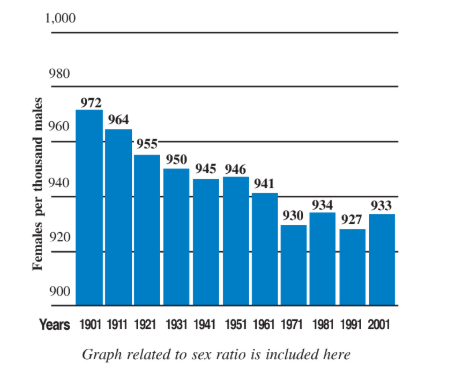
6. The given box diagram represents the ratio of females to males, or the sex ratio in our country for 10 decades (1901 to 2001). Answer the following questions in light of your knowledge of sex determination and the data presented in the box diagram.
- What does the bar diagram show? _________________
- As per scientific knowledge regarding sex determination, what should be the sex ratio or the male-to-female ratio at a given point of time. _____________
- Assign one reason to the trend showing deviation from the expected sex ratio.
- In what ways is such a trend unfavourable? ________________________
- Suggest a way by which such a trend can be stopped. ___________________
- Do you notice any reversal in the trend? What would you attribute it to?
Ans:
- The bar diagram shows the proportion of females in the population over a decade
- 1:1
- Female foeticide;
- Male-to-female ratio becomes lopsided
- Banning sex tests of unborn babies; increasing awareness
- Yes, awareness and education/ No- with reasons.
TERMINAL EXERCISES
1. Which statement is true for ‘genes’? Select the correct answer
(a) Genes are imaginary factors.
(b) Genes are fragments of DNA.
(c) Genes are present in the cytoplasm.
(d) Genes are not inherited.
Ans: (b) Genes are fragments of DNA.
2. What are “factors” named by Mendel called today?
Ans: Factors are referred to as genes today that are present in chromosomes and that control certain features.
3. What is the chemical nature of a gene? Name the three components of this chemical.
Ans: Genes are segments of DNA. Each DNA contains
- A nitrogenous base
- A deoxyribose sugar
- A phosphate
4. Where are genes located?
Ans: Genes are located on chromosomes.
5. State two differences between autosomes and sex chromosomes.
Ans:
- There are 22 pairs of autosomes, while sex chromosomes are just one pair.
- Autosomes do not determine the sex of the individual. Sex chromosomes determine the sex of the individual.
6. Define heredity, variation, genetic disorder and sex chromosomes.
Ans:
- Heredity: The passing down of similar characteristics generation after generation is termed ‘heredity’.
- Variation: Differences in gene combinations or differences even among members of the same family is called ‘variations’.
- Genetic disorder: A disorder caused due to the presence of a defective gene is called a genetic disorder.
- Sex chromosomes: Sex chromosomes are a pair of chromosomes that determine the sex of the individual. XY becomes a male, and XX is a female.
7. Why does DNA have to be duplicated before cell division?
Ans: Before cell division, the DNA molecule of a chromosome replicates (duplicates) to give two molecules of DNA, which are called ‘chromatids.’ These chromatids remain attached at a point called the centromere and separate to form two chromosomes during cell division.
8. Mention the main steps in DNA replication.
Ans: The major steps of DNA duplication are simplified below.
- i. The double-stranded DNA molecule unwinds with the help of certain enzymes to expose two strands of DNA.
- ii. A DNA polymerase enzyme catalyses the formation of a new daughter strand, which can form a double helix with one strand of the parental DNA molecule. So two DNA molecules, each with a parental strand and a new strand, are generated.
- iii. The two identical DNA molecules then become two chromatids, which remain attached by a centromere.
9. What will be the blood group of the following, which contain the genes IAi?
Ans: Genes with IAi become the blood group A.
10. Why is haemophilia found mostly in boys?
Ans: The genes for haemophilia are located on the X chromosome. When the offspring inherit this defective gene, in females, its effect is masked by a normal gene on the other X chromosome. However, in males, the only X chromosome bears the defective gene, the son suffers from the genetic disorder, as male has only one X chromosome and one Y chromosome, and so the defective gene does not get masked.
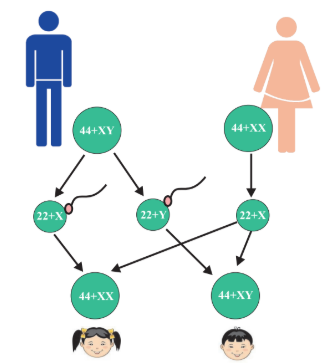
11. With the help of a line diagram, explain the chromosomal basis of a zygote developing into a male child.
Ans:
12. What is the basis of sex determination in humans?
Ans: The combination of sex chromosomes with autosomes determines whether the foetus will be a boy or a girl.
- The female gamete contains 22 autosomes and one X chromosome.
- Male gametes are either the 22 autosomes with an X chromosome or the 22 autosomes with a Y chromosome.
- The zygote formed by the fusion of the 22+X from the female with the 22+X from the male becomes a female.
- On the other hand, the zygote formed from the 22+X and 22+Y becomes a male.
13. Write notes on any one genetic disorder.
Ans: Thalassemia.
The affected person’s body will be unable to produce haemoglobin as the pair of genes controlling the haemoglobin production is defective. They will need frequent blood transfusions to survive. The defective gene is present on their autosome.
14. What is meant by “gene replacement therapy”?
Ans: Gene replacement therapy is the technique of removal or replacement of the defective gene in an individual with a new or normal one.
15. Rahul’s maternal grandfather (mother’s father) was colour-blind. What are the chances of Rahul being colour-blind if his father has normal colour vision?
Ans: The gene for colour blindness sis located on the X chromosome, which is passed down to a son from the mother. If Rahul’s mother had inherited the defective gene, she would be a carrier. It means that his mother has one defective X chromosome and one normal X chromosome.
In such a case where the mother is a carrier and the father has normal vision, the chances of Rahul being colorblind are 50% if he received the defective X chromosome from his mother.
Additional Study Materials
- Chapter 19 Classification of Living Organisms
- Chapter 20 History of Life on Earth
- Chapter 21 Building Blocks of Life – Cell and Tissue
- Chapter 22 Life Process I: Nutrition, Transportation, Respiration, and Excretion
- Chapter 23 Life Processes II: Control and Coordination
- Chapter 24 Life Processes III: Reproduction