NIOS Class 10 English Chapter 5 Question Answer
INTEXT QUESTIONS 5.1
I. Answer the following questions by choosing the correct option from those given below:
1. ‘At the circus, I did not have any chance to study human beings . They had sat peacefully while I cowered before Captain’s whip. I got a totally wrong idea of human beings at that angle.’ Who does ‘I’ in the above lines refer to?
a. the people
b. the tiger
c. the Captain
Ans: b. the tiger
2. The tiger says ‘He did not have any chance to study human beings’ because:
a. he was so engrossed in his act that he did not look up at the audience.
b. his Captain had always kept him locked up in a cage.
c. having only seen people at the circus show he did not realize that they were scared of the tiger.
Ans: c. having only seen people at the circus show he did not realize that they were scared of the tiger.
3. ‘at that angle’ refers to:
a. the tiger’s opinion about people from his performing ring in the circus.
b. the spectators’ opinion about the tiger at the circus.
c. the Captain’s opinion of the spectators.
Ans: a. the tiger’s opinion about people from his performing ring in the circus.
4. ‘They withdrew into their homes and even there remained nervous. All doors and windows everywhere were shut, bolted and sealed.’ Who does ‘they’ refer to in the above line?
a. the tiger and his Captain
b. the people at the circus
c. the general public in the town
Ans: c. the general public in the town
5. Why did ‘they’ withdraw into their homes?
a. they were scared of the tiger.
b. they were given an alert warning.
c. they were advised by the Captain to go inside as a precaution.
Ans: a. they were scared of the tiger.
6. By saying, ‘Some even thought that I was some extraordinary creature who might pass through the walls and lie in wait on the roof or in the basement’, the author means to convey that:
a. he was unable to pass through the walls.
b. people thought that the tiger could emerge from anywhere and attack them.
c. if he did not wait for his prey he would have to go hungry.
Ans: b. people thought that the tiger could emerge from anywhere and attack them.
7. At the circus, the people would usually:
a. sit quietly and watch the tiger’s antics.
b. run away on seeing a tiger.
c. throw stones to chase the tiger away.
Ans: a. sit quietly and watch the tiger’s antics.
8. The tiger got a chance to go out into the town because:
a. his Master wanted him to graze in the pastures to satisfy his hunger.
b. his Master was cruel and he wanted to run out of his clutches.
c. he found an unguarded passage and stepped out unnoticed.
Ans: c. he found an unguarded passage and stepped out unnoticed.
II. On the basis of your understanding of the text, complete the table below with details of the tiger’s thoughts and what different people did on seeing the tiger. One example has been done for you.
| Different people | Public reaction | Reasons for their behaviour | Tiger’s thoughts | |
| a. | The spectators at the circus | Sat peacefully and watched the circus. | They were sure that the tiger was tamed and he would not harm anyone. | People are strong and fearless |
| b. | People on the road |
Ans:
| Different people | Public reaction | Reasons for their behaviour | Tiger’s thoughts | |
| a. | The spectators at the circus | Sat peacefully and watched the circus. | fled from the street, some climbed the trees, and some hid in drainand behind pillars. | People are strongand fearless |
| b. | People on the road | fled from the street, some climbed the trees and some hid in drainand behind pillars. | They were terrified of the tiger. | Confused/amused Why should a simple tiger have any interest in them, either todestroy or to safeguard? |
III. When did the tiger realise that he was totally wrong about the opinion he had formed about human beings?
Ans: The tiger’s opinion about men changed when he came out on the street and saw men running for their lives.
IV. Give at least three reasons why you think the people at the circus were not scared of the tiger. One has been done for you.
1. The circus ring had an iron railing around it and the tiger could not have come close to the spectators.
Ans: The possible reasons could be any two of the following:
- 1. The animals at the circus were well-trained to face audiences.
- 2. The animals were well fed, so they were never hungry enough to attack.
- 3. The animals were tamed.
- 4. Adequate security measures were taken by the authorities to ensure that no untoward event would take place.
LET US LEARN NEW WORDS 5.1
Complete the following similes by using words from the box given below. You may use your own comparisons too.
lead, star, night, owl, stream, ice.
1. as clear as a ————————
Ans: stream
2. as heavy as ——————
Ans: lead
3. as dark as the ——————
Ans: night
4. as bright as a ———————
Ans: star
5. as cold as ——————
Ans: ice
6. as wise as an ———————
Ans: owl
III. Complete the following sentences by using words from the box given below.You may also refer to a dictionary to see the meanings of the words before using them.
abandoned, spilled, nervous, cowered, handcuffed, seized
1. The dog ____________ at the sound of crackers on Diwali day.
Ans: cowered
2. The police _______ the dangerous criminal before taking him to the court for his trial.
Ans: handcuffed
3. People living on the banks of the river ________ their homes and fled to safer places when they realised that the water level in the river was soon going to cross the danger mark.
Ans: abandoned
4. Excitement seemed to have ___________ the soldiers posted on the border when they heard that their favourite film stars were going to visit them.
Ans: seized
5. If we have studied well there is no reasons to feel ________ during examiantions.
Ans: nervous
6. The bowl of soup fell from his hands and all the soup ____________________ onto the floor.
Ans: spilled
INTEXT QUESTIONS 5.2
Answer the following questions.
1. ‘If my tail trails down to the street, if I am blocking your threshold, it is because
I’m eleven feet tip to tail. I can’t help it, I’m not out to kill. I’m too full.’
a. Why does the tiger tell us his measurements?
b. What does he want to tell them by saying, ‘I’m too full’?
c. Where and what did he have for his food?
Ans:
- a. He says this to show how long he is.
- b. He wanted to tell them that they need not fear him for he was not going to attack them.
- c. He had found something to eat in the green fields.
2. ‘Never use the words ‘beast’ or ‘brute’.’
a. Who said these words and to whom?
b. Why did he/she say so?
c. What does this tell us about the speaker?
Ans:
- a. The Master spoke these words to the teachers.
- b. He wanted them to understand that using such harsh words was being rude to a harmless and noble creature.
- c. These words show that the Master was kind and that he understood his animals well.
3. The tiger went off to sleep in the Headmaster’s room because:
a. he was very tired and needed rest.
b. he liked cool floors.
c. he had eaten too much and was feeling lazy.
Ans: b. he liked cool floors.
4. The Master could not answer the question because:
a. he did not know the answer.
b. he thought that was a profound question that could not be answered casually.
c. living in the circus with the tiger all the time, he had forgotten his name.
Ans: b. he thought that was a profound question that could not be answered casually.
5. Why were the coffee drinkers at the restaurant uttering low moans?
Ans: The people were frightened of the tiger. Seeing the tiger lying at the entrance of the restaurant, the coffee drinkers were scared because the way to go out was blocked.
6. How was the tiger blocking the threshold?
Ans: He sat in such a way that his long body covered the entire door width.
7. Why were the school children so excited?
Ans: The school children were both excited and scared. They were also happy to know that the school was going to be closed early.
8. Where did the tiger go finally?
Ans: He walked up to the Headmaster’s room.
9. What did the Headmaster do on seeing the tiger in his office?
Ans: The Headmaster got onto the table from where he heaved himself up to the attic.
10. Why was the Master angry with the teachers?
Ans: He was angry with the teachers because they were using unkind words for the tiger and were rude to him also.
11. The word ‘profound’ refers to something which is felt or experienced deeply or intensely, or something with a deep meaning. For example, ‘Gandhi Ji’s non-violent method of protest against Britishers had a profound effect on the people of India.’ The teachers asked the Master a question which sounded simple, but it was not so. The Master thought it was a question with a deep meaning. What was the profound question put to the Master?
Ans: ‘What a reckless man you are. Who are you?’
LET US LEARN NEW WORDS 5.2
I. What do the following words in italics mean? Tick the right answer. You may use your dictionary to help you.
1. I noticed a dignified man jumping on his table and heaving himself into an attic.
‘dignified’ means:
a. respectful and graceful
b. important person
c. tall and handsome
Ans: a. respectful and graceful
‘heaving’ means:
a. making a big sound
b. pulling and lifting
c. taking a deep breath
Ans: b. pulling and lifting
‘attic’ means:
a. a small store room in a building
b. a room in the basement of a building
c. a room at the top of a building
Ans: c. a room at the top of a building
2. Now that this brute is safely locked up we must decide…
‘brute’ means:
a. a large animal
b. a wild and ferocious animal
c. a dumb creature
Ans: b. a wild and ferocious animal
3. ‘Why not?’retorted my master, at which they looked upset and angry.
‘retorted’ means:
a. gave a polite reply
b. gave an angry and quick reply
c. gave a stupid reply
Ans: b. gave an angry and quick reply
II. Antonyms are words which give opposite meanings. Some examples are given below.
good – bad
up – down
obedient – disobedient
weak – strong
proper – improper
Read the words and phrases given in Column A and Column B. Match the words in Column A with their opposite meanings given in Column B by drawing a line across. One word in Column B is extra.
| Column A | Column B |
| in front of | strong |
| fearful | cowered |
| protect | attack |
| weak | behind |
| extraordinary | fearless |
| ordinary |
Ans:
| Column A | Column B |
| in front of | behind |
| fearful | fearless |
| protect | attack |
| weak | strong |
| extraordinary | ordinary |
III. Now complete the following paragraph by filling in the blanks using some of the words in the above list. The words can be picked from any of the two columns above. One blank has been filled for you as an example.
Last week the children of our village decided to celebrate ‘Earth Day’ in an extraordinary way. We decided to put up a street play through which we wanted to educate all our village elders the need to __________ our environment. We wrote the script, made animal masks and even composed music using tins, plates and brooms.
On the appointed day we all gathered __________ the park. It was decided that our animal characters would emerge from ___________ the crowd to add a surprise element. It was fun to see the commotion in the crowds when animal characters jostled their way through them.
Through our play we were able to show how animals could live in peace and harmony if their habitat was not disturbed. The _________ animals protected the _______ so they could move around in a _________ manner. The village elders appreciated our efforts. They understood the importance of preserving natural resources.
Ans: protect, in front of, behind, strong, weak, fearless.
IV. Given below is a crossword grid. Below the grid are some words and phrases. Find their antonyms in the text. Write the antonyms next to these words. Then complete the crossword puzzle grid with the antonyms. One word has been filled in as an example.
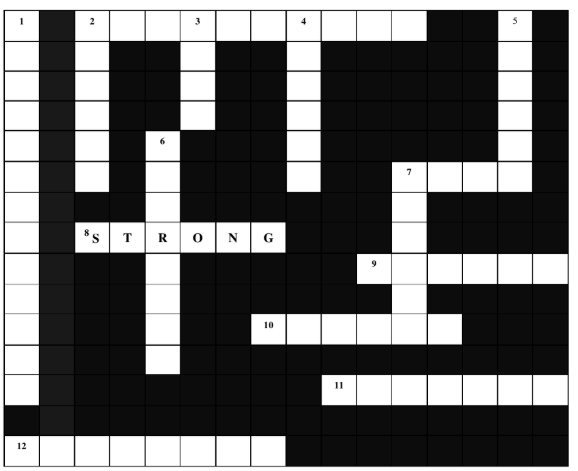
Clues:
| Across | Down |
| 2. violently | 1. ordinary |
| 7. beautiful | 2. proceeded |
| 8. weak | 3. warm |
| 9. a brave person | 4. Like |
| 10. released | 5. dangerously |
| 11. descended | 6. fearful, afraid |
| 12. careful | 7. Done |
Ans:
5.3 LET US LEARN GRAMMAR
Exercise 1
1. Study the table below. Using the words from each column make five sentences.
| Subject | Past Perfect Tense had + action word | Action that followed | |
| The patient | had | died | before the doctor arrived |
| The plane | landed | by the time we reached the airport | |
| I | read the book | before we reached the station | |
| My parents | decorated the hall | before the visitors arrived | |
| They | planted trees | before the monsoon arrived | |
Ans:
- The patient had died before the doctor arrived.
- The plane had landed by the time we reached the airport.
- I had read the book before we reached the station.
- My parents had decorated the hall before the visitors arrived.
- They had planted trees before the monsoon arrived.
2. Based on a similar pattern, write two new sentences of your own.
Ans:
- She had completed her homework before the teacher entered the classroom.
- The train had left by the time we reached the platform.
Exercise 2
1. Read the following sentences and write them in indirect speech.
a. The invigilator said to the students, ‘Stop writing.’
Ans: The invigilator told the students to stop writing.
b. The officer said to the peon, ‘Bring a file cover for me.’
Ans: The officer told the peon to bring a file cover for him.
c. Anil said to his friend, ‘Please take out the car while I lock the room.’
Ans: Anil requested his friend to take out the car while he locked the room.
d. The ticket collector said to Varun, ‘Why didn’t you buy a full ticket for your son?’
Ans: The ticket collector asked Varun why he had not bought a full ticket for his son.
e. ‘May I borrow your English book for the evening?’ said Usha to Rajni.
Ans: Usha asked Rajni if she might borrow her English book for the evening.
f. The parents said to the Principal, ‘Please admit our daughter in your school.’
Ans: The parents requested the Principal to admit their daughter to his school.
g. Father said to his son, ‘Switch off the television. I am getting disturbed.’
Ans: Father told his son to switch off the television as he was getting disturbed.
h. Anita said to Nikhil, ‘Help your younger sister in her studies.’
Ans: Anita advised Nikhil to help his younger sister in her studies.
i. Hitendra said to Shyam, ‘Have a cup of tea with me, please.’
Ans: Hitendra requested Shyam to have a cup of tea with him.
j. I said to him, ‘Come in.’
Ans: I told him to come in.
TERMINAL QUESTIONS
I. Given below are events that took place in the story. But the order is mixed up. Read the sentences and put the events in their correct sequence by writing the number of the sentence in the brackets provided. One answer has been done as an example.
1. A tiger entered the market place (i)
2. The cops escorting the prisoner ran away leaving their prisoner. ( ____ )
3. People fell off the horse driven carriage as the horse tore from its Jutka. ( ___ )
4. The tailor hid in the cupboard. ( ____ )
5. The prisoner got a chance to run away. ( ____ )
6. The townspeople hid in their homes and locked up their rooms. ( ____ )
7. The tiger followed the children through the school gates. ( ____ )
8. The teachers locked him up and kept a watch on him. ( ____ )
9. The tiger walked into the Headmaster’s room. ( ____ )
10. The Headmaster climbed up into the attic. ( ____ )
11. The Master reached the school. ( ____ )
12. The children rushed upstairs and shut themselves in the school hall. ( ____ )
13. The tiger went off to sleep on the cool floor. ( ____ )
14. The teachers used harsh words like ‘brute’ and ‘beast’ for the tiger. ( ____ )
15. The people at the restaurant froze in their seats at the sight of the tiger. ( ____ )
16. The Master was angry with the teachers for using harsh words for the tiger. ( _ )
17. The Master was called a reckless man. ( ____ )
Ans:
- 1. A tiger entered the marketplace. (i)
- 15. The people at the restaurant froze in their seats at the sight of the tiger. (ii)
- 3. People fell off the horse-driven carriage as the horse tore from its jutka. (iii)
- 6. The townspeople hid in their homes and locked up their rooms. (iv)
- 4. The tailor hid in the cupboard. (v)
- 2. The cops escorting the prisoner ran away, leaving their prisoner. (vi)
- 5. The prisoner got a chance to run away. (vii)
- 7. The tiger followed the children through the school gates. (viii)
- 12. The children rushed upstairs and shut themselves in the school hall. (ix)
- 8. The teachers locked him up and kept a watch on him. (x)
- 14. The teachers used harsh words like ‘brute’ and ‘beast’ for the tiger. (xi)
- 11. The Master reached the school. (xii)
- 16. The Master was angry with the teachers for using harsh words for the tiger. (xiii)
- 9. The tiger walked into the Headmaster’s room. (xiv)
- 10. The Headmaster climbed up into the attic. (xv)
- 13. The tiger went off to sleep on the cool floor. (xvi)
- 17. The Master was called a reckless man. (xvii)
II. The Master did not like people using harsh words like ‘brute’ or ‘beast’ for the tiger. Why?
Ans: The Master did not like people calling the tiger a ‘brute’ or ‘beast’ because he believed that the tiger was not cruel by nature. According to him, the tiger behaved according to its instincts and had not harmed anyone deliberately. He felt that human beings are often more violent and cruel than animals. Therefore, he thought it was unfair to insult the tiger with harsh words.
III. ‘You are asking a profound question. I’ve no idea who I am! All my life I have been trying to find the answer. Are you sure you know who you are?’ Explain the Master’s response in 60 words?
Ans: The Master’s response shows that he was a thoughtful and philosophical man. When asked who he was, he said he had spent his whole life trying to understand his true identity. He believed that knowing oneself is a deep and difficult question. By asking the tiger the same question, he suggested that even humans are unsure about their real nature and purpose.
Additional Study Materials
- Chapter 1: Snake Bite Textbook Solutions
- Chapter 2: How The Squirrel Got His Stripes
- Chapter 3: Kondiba A Hero Textbook Solutions
- Chapter 4: Tall Trees Textbook Solutions