NIOS Biology Question Paper 2024 Class 12 Set B
SECTION–A (1 Mark Questions)
1. The bacteria that help in the conversion of milk into curd:
(A) Azotobacter
(B) Clostridium
(C) Salmonella
(D) Lactobacillus
2. Which one of the following is the living part of xylem?
(A) Tracheid
(B) Vessel
(C) Xylem Fibre
(D) Xylem Parenchyma
3. The blood protein that provides factors for clotting is:
(A) Albumin
(B) Fibrinogen
(C) Globulin
(D) Thrombin
4. Which one of the following represents the gametophyte of fern?
(A) Indusium
(B) Sorus
(C) Prothallus
(D) Frond
5. The formation of RNA from DNA is known as
(A) Translation
(B) Transcription
(C) Transformation
(D) Transduction
6. Which one of the following transports Oxygen to tissues?
(A) Lymphocytes
(B) Monocytes
(C) Granulocytes
(D) Erythrocytes
7. The biological community in an area or ecosystem is a complex network of interactions.
Interactions may be of various types. In commensalism type
(A) One species gets benefited, and the other species is neither harmed nor benefitted.
(B) One species is inhibited and the other is unaffected.
(C) One species is benefited and the other is harmed and inhibited.
(D) Both the species are benefitted.
8. Biotechnology helps in synthesizing enzymes from cloned genes. Your friend wants to
manufacture meat tenderisers. Which enzyme would you recommend to him?
(A) Lipases
(B) Proteases
(C) Amylases
(D) Glucoisomerases
9. A man with normal vision for red-green colour marries a woman who is the carrier of red-green colour blindness. What percentage of her sons will be red-green colour blind?
(A) 100%
(B) 75%
(C) 25%
(D) 50%
10. Which one of the following adaptations is seen in plants to promote self-pollination?
(A) Cleistogamy
(B) Dichogamy
(C) Unisexuality
(D) Self-sterility
11. Corpus luteum produces
(A) Oestrogen
(B) Androgens
(C) Progesterone
(D) Prolactin
12. Identify “A” in the given diagram
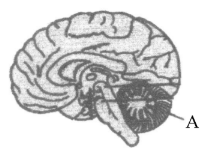
(A) Cerebellum
(B) Cerebrum
(C) Medulla oblongata
(D) Pons
13. Which one of the following is not produced due to undersecretion of thyroxine?
(A) Goitre
(B) Cretinism
(C) Myxoedema
(D) Rickets
14. Which one of the following is not the step of microinjection process in biotechnology?
(A) Collection and in vitro maturation of oocytes
(B) In vitro fertilization with male semen
(C) Microinjection of “input DNA” into male pronuclei
(D) Infection of pre-implantation embryos with retroviruses carrying foreign DNA
15. Identify the immunoglobulin found in highest concentration in our body
(A) IgD
(B) IgA
(C) IgG
(D) IgM
16. In the given food chain identify the trophic level of frog.
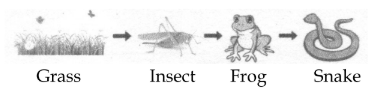
(A) First trophic level
(B) Second trophic level
(C) Third trophic level
(D) Tertiary trophic level
SECTION – B (2 Marks Questions)
Question No 17 – 28 objective type questions carry 2 marks each (with 2 sub-parts of 1 mark each). Attempt these questions as per the instructions given for each of the questions.
17. Photosynthesis occurs in green parts of the plants, mostly the leaves, which have chloroplasts. The thylakoids of chloroplast contain pigments which absorb light of different wavelengths and carry out the photochemical reactions. These pigments are packed into functional clusters called photosystems-PS-I and PS-II.
(a) Name the pigments that constitute the photosystems.
(b) What is the function of Photosystems?
Ans:
- (i) Chlorophyll a, P700, P680.
- (ii) To trap the solar energy and convert it into chemical energy
18. Read the following passage and fill in the blanks with appropriate words.
(Attempt any two parts A-D)
Criss Cross inheritance in humans
A .and B . are examples of sex-linked inheritance in humans. The defective gene is located on C . chromosome. Thus a single defective gene causes disease in males while two defective genes ( D . condition) only can cause the disease in females.
Ans:
- A – Red-green colour blindness
- B – Haemophilia
- C – X chromosome
- D – Homozygous condition
19. Match the statement given in Column-I with the right option in Column-II
| Column-I | Column-II |
| (i) Copper-T | (a) Interfere with the ovulation process and prevent fertilization |
| (ii) Condoms | (b) Prevent sperms from meeting the ovulated egg |
| (c) Implantation is not possible | |
| (d) Permanently prevent fertilization |
Ans:
(i) Copper-T – (a) Interfere with the ovulation process and prevent fertilization
(ii) Condoms – (b) Prevent sperm from meeting the ovulated egg
20. Name the following
(i) Excretory organs of earthworm – __________
(ii) Naked seeds are the characteristic feature of this group of plants – __________
Ans:
- (i) Nephridia.
- (ii) Gymnosperms
21. Match Column I with the functions given in Column II.
| Column-I | Column-II |
| (i) Stilt roots | (a) Roots which grow vertically up in the air and help in respiration |
| (ii) Assimilatory roots | (b) Roots developing from nodes and provide anchorage |
| (c) Roots which penetrate the host plant and suck food from host | |
| (d) Roots with chlorophyll manufacture food |
Ans:
- (i) Stilt roots – (b) Roots developing from nodes and provide anchorage
- (ii) Assimilatory roots – (d) Roots with chlorophyll and manufacture food
22. Observe the diagrams given below and assign the correct name from the list supplied.
(Attempt any two parts from A-D)
(Rhizome, Tuber, Corm, Bulb)
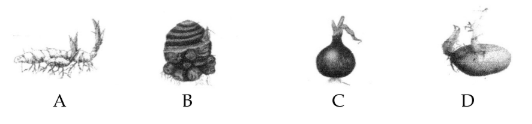
Ans:
- Rhizome – A
- Tuber – D
- Corm – B
- Bulb – C
23. Study the diagram given below carefully and answer the questions that follow. Identify the processes “A” and “B”.
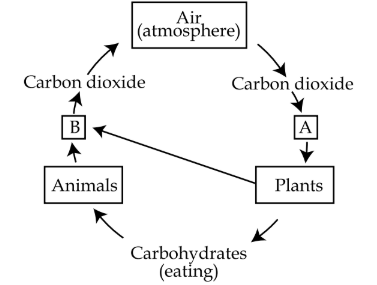
Ans:
- A – Photosynthesis
- B – Respiration
24. Supply the technical term for the following
(a) Division of other cells in embryo sac like synergids or antipodal cells to give rise to additional embryos.
(b) The process in which the zygote may divide to give rise to two or more cells each of which develops into a separate embryo.
Ans:
- Adventive polyembryony.
- Cleavage polyembryony.
25. Study the flow chart and complete it by substituting A-D with suitable words. (Attempt any two parts from A-D).
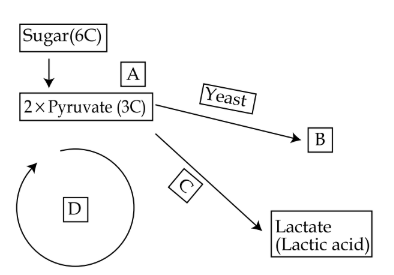
Ans:
- A – Glycolysis
- B – Ethanol + CO2
- C – Anaerobic respiration in Muscle cells
- D – Krebs’ Cycle
26. Fill in the spaces A and B in the sentences given below
(a) Cell-mediated immune response is mediated by A .
(b) Humoral immune responses is mediated by B .
Ans:
- Cytotoxic T-cells and natural killer cells.
- Antibodies are secreted by plasma cells.
27. Tropical rainforests are found in tropical regions with high rainfall. Such forests are well developed over the western coast of India and north north-eastern Himalayas and scattered in Southeast Asia. They have high light intensity and temperature. The soil is rich in humus.
(a) Why do tropical forests have very high productivity?
(b) How are the trees in tropical forests differ from temperate deciduous forests?
Ans:
- Tropical rainforests have soil rich in humus with a very high turnover of nutrients, which leads to high productivity and have the highest standing crop and biomass.
- Trees of deciduous forests shed their leaves in autumn, and new foliage grows in spring. On the other hand, tropical forests are characterized by evergreen trees that remain green throughout the year.
28. Minerals are micronutrients required in varying amounts for proper functioning, normal growth, and keeping good health of our body. They do not supply energy to our body but are essential for protection against diseases and also have role in body functions. Choose the incorrect pairs of minerals with reference to their function.
(a) Calcium: Healthy bones and teeth
(b) Iodine: thyroxine formation
(c) Phosphorus: clotting of blood
(d) Iron: maintenance of water balance
Ans: Incorrect pairs are,
- (c) Phosphorus: clotting of blood
- (d) Iron: maintenance of water balance
SECTION – C
29. (a) Why is the process of fertilization in flowering plants said to be double fertilization?
Ans: In flowering plants, one sperm fuses with the egg (syngamy) and forms a diploid zygote. The other sperm fuses with the secondary nucleus to form the primary endosperm nucleus, which is triploid in nature. Since two types of fusion, syngamy and triple fusion, take place in an embryo sac, the process is termed double fertilization.
OR
(b) What is the function of Endosperm in the flowering plants? Write the names of any types of endosperms.
Ans: Endosperm provides food to the developing embryo. Types of endosperm include nuclear type, cellular type, and helobial type.
30. Identify the type of neuron given in the diagram and state the function of axon.
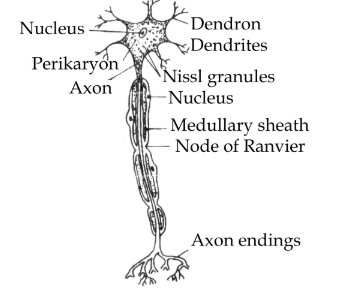
Ans:
- It is a neuron that conducts nerve impulses.
- Axon: An axon carries the impulse from the cell body towards its terminal branches, which may either pass on the impulse to another neuron, or into a muscle or gland to bring about the required action.
31. (a) Following is the representation of how a plasmid isolated from bacterium that causes galls in several plants is used to produce transgenic plants.
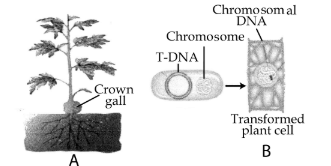
(i) Name the bacterium that causes galls in plants.
(ii) Name the plasmid used to transmit the desired genes.
Ans:
(i) Agrobacterium tumefaciens causes galls (tumours) in plants.
(ii) Ti plasmid
OR
(b) Given below is the picture of a normal mouse (A) and a transgenic mouse (B).
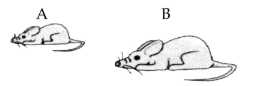
Why is there an increase in the size of mouse (B).
Ans: A Gene for growth hormone from rats was microinjected into mouse eggs. These mice grew larger than their littermates. This was because the rat gene got integrated into the mouse DNA and was being expressed.
32. A group of food items is given in the table. Categorize them into energy-providing foods and bodybuilding foods.
Cereals, legumes, meat, sugar, oil, fish, egg, jaggery
Ans:
- Energy-providing foods: Cereals, Sugar, oil, and jaggery
- Body Building Foods: Legumes, meat, fish, and eggs.
33. Observe the given diagram and answer the questions that follow.
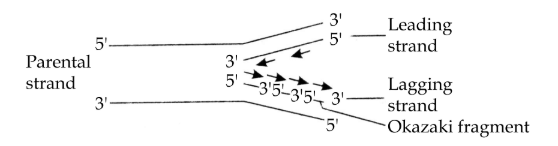
(a) In which direction does the enzyme DNA polymerase catalyses DNA replication – 5′ to 3′ or 3′ to 5′?
(b) Which enzymes join the Okazaki fragments to form a complete DNA strand?
Ans:
- In 5’-3’ direction
- Enzyme ligase
34. What are the four nutritional categories found in bacteria?
Ans: The four nutritional categories found in bacteria are,
- Autotrophs
- Saprotrophs
- Symbionts
- Parasites
35. (a) Name the two biochemical reactions for biosynthesis of amino acids in plants.
Ans:
(i) Reductive amination reaction
(ii) Transamination reaction
OR
(b) Name the two proteins found in root nodules and help in nitrogen fixation.
Ans:
(i) Leghaemoglobin
(ii) Nodulins
36. Identify A in the diagram given below and state its function
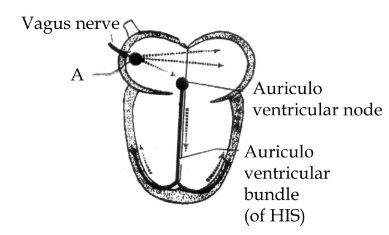
Ans:
- A- Sinu auricular node.
- It initiates and regularises the heartbeat. Therefore, it is also called the pacemaker.
37. State one difference and one similarity between straited muscles and cardiac muscle.
Ans:
- Difference: While the striated muscles are unbranched fibres, cardiac muscles are branched.
- Similarity: Both striated and cardiac muscles are elongated and cylindrical.
SECTION – D (3 Marks Questions)
38. (I) Observe the Lac operon diagram given below and answer the questions that follow.
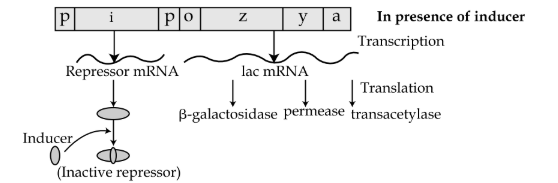
(a) Which substance acts as inducer in this operon?
(b) Where does RNA polymerase bind to initiate transcription?
(c) What are the genes z, y, a called as?
Ans:
- Lactose is the inducer in this operon.
- RNA polymerase binds to the promoter gene p.
- Genes z, y, and a are structural genes, where gene a codes for the enzymes galactosidase, permease, and transacetylase.
OR
(II) Study the karyotype given below and answer the questions that follow.
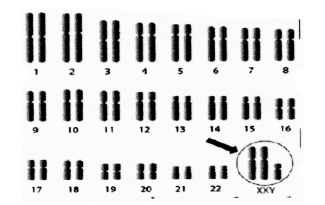
(a) What is this disorder known as?
(b) How many chromosomes are present in the individuals with this disorder?
(c) State one typical feature of this syndrome.
Ans:
- Klinefelter’s syndrome
- This individual male has 47 chromosomes with an extra X chromosome.
- A typical feature of this syndrome is being tall and mentally retarded.
39. Deficiency in minerals in our food may lead to deficiency diseases. Name which mineral deficiency may lead to the following :
(a) Pernicious anaemia
(b) Pellagra
(c) Scurvy
Ans:
- Pernicious anaemia – Deficiency of Vitamin B12
- Pellagra – Deficiency of Vitamin B3 (niacin)
- Scurvy – Deficiency of vitamin C
40. (a) Define obesity.
(b) List any two causes of obesity.
(c) State two Harmful effects of obesity.
Ans:
- The overweight and bulkiness of a person’s body due to the accumulation of carbohydrates and fats is called obesity.
- Two causes of obesity are overeating and insufficient exercise
- Hypertension and atherosclerosis are two harmful effects of obesity.
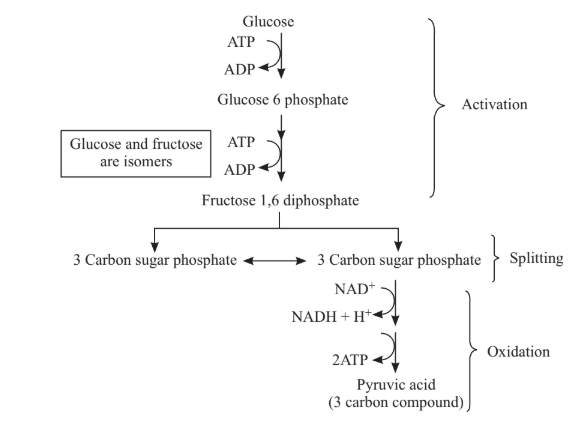
41. (I) Illustrate the 3 major phases in glycolysis.
Ans: The three major phases of glycolysis are activation, splitting of glucose, and oxidation.
OR
(II) Distinguish between C3 and C4 plants with reference to the following characteristics.
Features C3 Plants C4 Plants
(a) Carbon dioxide acceptor
(b) Carbon dioxide fixing enzymes
(c) First product of photosynthesis
Ans:
| C3 Plants | C4 Plants | |
| (a) Carbon dioxide acceptor | 5-Carbon sugar- ribulose biphosphate or RuBP | Phosphoenol pyruvic acid or PEP, |
| (b) Carbon dioxide fixing enzymes | Ribulose bisphosphate carboxylase/oxygenase or Rubisco. | Phosphoenol pyruvate carboxylase (PEP carboxylase) |
| (c) First product of photosynthesis | 3-Phosphoglyceric acid (PGA). | Oxaloacetic acid (OAA). |
SECTION – E (5 Marks Questions)
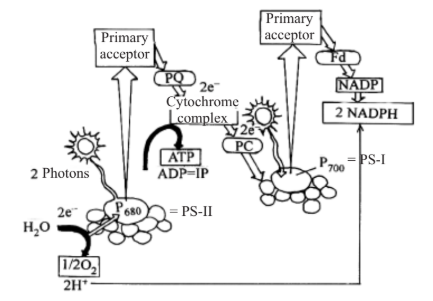
42. (a) Explain non-cyclic photophosphorylation with a schematic diagram.
Ans: Cyclic photophosphorylation occurs in photosynthetic bacteria, which lack PS-II, and it involves PSI only. During this process, electrons from PSI are not passed on to NADP. Instead, the same electrons are returned to the oxidised P700 molecule. During this downhill movement of electrons, ATP formation takes place. Thus, this is termed cyclic photophosphorylation.
OR
(b) Name the valves present in the Human heart? Where are they present? How are the heart sounds produced?
Ans:
- Right atrio-ventricular valve or tricuspid valve, and left atrio-ventricular valve or bicuspid valve.
- The atrio-ventricular valves are between the Atria and the Ventricles.
- The heartbeat starts with the contraction or systole of the atria, followed by relaxation or diastole. The lub sound or 1st heart sound occurs due to the closure of atrioventricular valves, the atrial systole.
43. (a) A snapdragon plant with red flowers (RR) is crossed with a plant with white flowers
(rr). Work out the cross upto F2 generation. Find out the phenotypic and genotypic ratio.
Ans:
| Parents | RR x rr |
| Gametes | R, R x r, r |
| F1 | Rr (Pink) |
| F2 | 1 red: 2 Pink: 1 White |
| 1RR: 2Rr: 1rr |
OR
(b) A tall pea plant with red flowers (TTRR) is crossed with white dwarf plants (ttrr). Work out the phenotypic ratio in F2 for this cross.
Ans:
Cross between TTRR (tall red) x ttrr (Dwarf white)
Gametes formed by TTRR are TR, TR
Gametes formed by ttrr are tr and tr
| Gametes | TR | TR |
| tr | TtRr – Tall red | TtRr – Tall red |
| tr | TtRr – Tall red | TtRr – Tall red |
F1 generation is all Tall red with a genotype of TtRr.
F2 is crossed between TtRr x TtRr
The gametes procured are TR, Tr, tR, tr
| Gametes | TR | Tr | tR | tr |
| TR | TTRR – Tall red | TTRr – Tall red | TtRR – Tall red | TtRr – Tall red |
| Tr | TTRr – Tall red | TTrr – Tall white | TtRr – Tall red | Ttrr – Tall white |
| tR | TtRR – Tall red | TtRr – Tall red | ttRR – Dwarf red | ttRr – Dwarf red |
| tr | TtRr – Tall red | Ttrr – Tall white | ttRr – Dwarf red | Ttrr – Dwarf white |
The phenotypic ratio in F2 is 9 tall red: 3Dwarf red: 3 Tall white: 1 Dwarf white
Additional Study Materials
- NIOS Class 12 Biology PYQ April 2025 Set A
- NIOS Class 12 Biology PYQ Oct 2024 Set A
- NIOS Biology Paper 2024 April Set A Solved
- NIOS Class 12 Biology PYQ April 2023 Set A
- NIOS Class 12 Biology PYQ May 2025 Set B