NIOS Biology Question Paper 2022 Oct Set A
1 MARK QUESTIONS
1. Bacteria is included in Kingdom Monera because its body has:
(A) Single cell
(B) Multicellular structure
(C) Mitochondria
(D) Cellulose cell wall
2. Isogamy type of sexual reproduction is found in:
(A) Flowering plants
(B) Gymnosperms
(C) Chlamydomonas
(D) Amoeba
3. Seed coat develops from this part of the ovule:
(A) Integuments
(B) Nucellus
(C) Chalaza
(D) Carpel
4. In an aquatic ecosystem, the producers are:
(A) Zooplanktons
(B) Phytoplanktons
(C) Crabs
(D) Fishes
5. Rhizome of ginger is a modified:
(A) Stem
(B) Leaf
(C) Root
(D) Adventitious root
6. Plasmodium belongs to phylum:
(A) Cnidaria
(B) Protozoa
(C) Annelida
(D) Arthropoda
7. Endonucleases are:
(A) Molecular scissors
(B) Plasmids
(C) Recombinants
(D) DNA fragments
8. Guttation is performed by:
(A) Stomata
(B) Parenchyma
(C) Hydathodes
(D) Xylem
2 MARK QUESTIONS
9. Explain the tissue culture technique. Mention the 2 (two) advantages of it.
Ans: In tissue culture, a cell from a plant can be grown in a nutrient medium to grow into a plant in the presence of nutrients and specific growth hormones. Its advantages are,
- It allows for mass production quickly
- Produce genetically identical plants.
10. Which phytohormone is called growth inhibitor? Name the part of the plant that produces it.
Ans: Abscisic acid is called the growth inhibitor. It is synthesised in leaves.
11. Name any two disorders caused by single gene. How can it be rectified?
Ans: Haemophilia and Sickle cell anaemia. Somatic cell gene therapy is one way to rectify such diseases, where a gene for the production of certain proteins is inserted into the genome.
12. Match the following, picking up one from each column.
| Column – A | Column – B |
| (a) China rose | (i) Reproductive organ |
| (b) Flower | (ii) Monadelphous stamen |
| (c) Pollen grains | (iii) Ovary |
| (d) Embryosac | (iv) Microspore |
Ans:
| Column – A | Column – B |
| (a) China rose | (ii) Monadelphous stamen |
| (b) Flower | (i) Reproductive organ |
| (c) Pollen grains | (iv) Microspore |
| (d) Embryosac | (iii) Ovary |
13. Why is molybdenum considered as “Micronutrient” of plants? What is its role in plants?
Ans: Molybdenum is required in minute quantities and thus is called a micronutrient. It is required for nitrogen fixation. Activates the enzyme nitrate reductase.
14. Explain Hydrotropism and Phototropism giving one example for each.
Ans: Hydrotropism is a type of tropic movement in plants in response to the external stimulus, water. E.g.. Roots grow towards water.
Phototropism is the tropic movement in plants in response to the external stimulus of light. Eg. the Stem grows towards light.
15. Differentiate Vasectomy from Tubectomy. Write 2 points for each.
Ans:
- Vasectomy is the ligation of the vas deferens through which sperm travel out of the epididymis, to prevent sperm from going out of the body.
- Tubectomy is the sterilisation of a woman by cutting the fallopian tubes and ligating them so that an ovulated egg cannot pass down for fertilisation.
16. Explain the role of the enzymes RUBISCO and PEPco in C4 cycle.
Ans: In C4 plants, PEPCo or the PEP carboxylase is the primary carbon acceptor, which catalyses the carboxylation of phosphoenol pyruvic acid or PEP, to form oxaloacetic acid. This process happens in the mesophyll cells. This, when transported to the bundle sheath cell, releases a carbon dioxide molecule. In the bundle sheath, RUBISCO helps fix this CO2 molecule through the Calvin cycle, preventing photorespiration.
17. What is “Central Dogma”? How does information flow from nucleus to cytoplasm? Write in an equation form.
Ans: The transfer of information from genes to the site of protein synthesis constitutes the Central Dogma. The central dogma operates from the DNA in the nucleus to messenger RNA (transcription). mRNA moves out of the nucleus to the cytoplasm, where it is translated to form a protein.
DNA (Transcription) → RNA (Translation) → Protein
18. How is diffusion different from osmosis? Write any two important differences between two.
Ans: Diffusion is the movement of small molecules, while osmosis is the movement of water molecules.
Difference between diffusion and osmosis.
| Diffusion | Osmosis |
| Molecules of substances move from their region of higher concentration to the regions of lower concentration. | Movement of water molecules from the region of their higher concentration to the region of their lower concentration through a semipermeable membrane. |
| Does not require a membrane | Occurs across a semipermeable membrane. |
19. What are the two PEM disorders seen in our country? Write at least one symptom for each one.
Ans:
Marasmus and Kwashiorkor are two PEM disorders. Symptoms of Marasmus are,
- Wasting of muscles reduces the child to skin and bones.
- Folded skin.
- Sunken eyes, thin face, thinning of limbs and abdominal walls.
- Retarded physical and mental growth.
- Ribs become prominent (Pigeon chest).
- Oedema and skin pigmentation are absent.
4 MARK QUESTIONS
21. (a) Draw and label sigmoid growth curve.
(b) Explain the three important phases of growth. Which phase is the longest one?
Ans: (a)
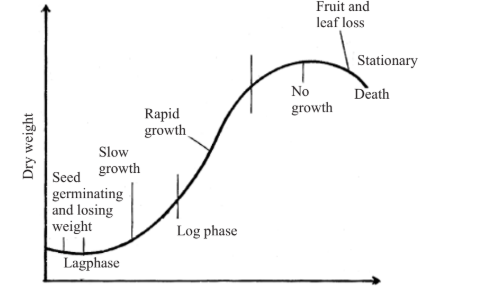
(b) The three phases of growth are,
- (i) Lag Phase – This is the initial phase of growth when the rate of growth is very slow.
- (ii) Log Phase – It shows rapid growth and is maximum during the entire life span.
- (iii) Stationary Phase – Here, the rate of growth starts decreasing, and finally it stops.
The log phase is the longest one.
22. Explain the following briefly with one example for each:
(a) Passive immunity
(b) Active immunity
Ans:
- Passive immunity is an acquired immunity brought about by the transfer of an actively immunised individual through blood, serum component, etc. Eg. Transfer of antibodies (e.g. IgG) from mother into foetus across the placenta.
- Active immunity is an acquired immunity brought about by injection so that antibodies are produced against the infective agent and by deliberate artificial immunisation. Eg. Immunity against chicken pox after an infection.
23. (a) Draw a neat diagram of a nerve cell and label its four parts.
(b) What is the advantage of having myelin sheath around axon?
(c) What is the association of two successive neurons called?
Ans: a)
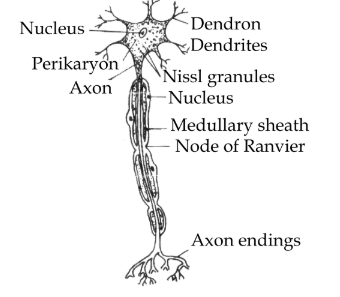
b) The myelin sheath protects the axon during electrical impulses.
c) The association of two successive neurons is called a synapse.
24. (a) What is biodiversity? What is its advantage to mankind? 4
(b) Write any four human activities which are destroying it.
Ans: a) Biodiversity can be defined as the flora and fauna, i.e. variety of all plants, animals, and microbes of a region.
b) Human activities that destroy biodiversity are,
- Destruction of habitat by cutting down trees, filling up the wetland, ploughing of grassland or burning a forest.
- Indiscriminate killing of animals for different purposes has resulted in their reduction.
- Industrialisation and urbanisation have changed and destroyed the natural habitat of plants and animals.
- Pollution of soil, air and water changes the habitat quality and may reduce or eliminate sensitive species.
25. (a) How does Nephron help in osmoregulation in our body?
(b) Where do we find malpighian tubules? How are they important for the organism?
Ans:
- Osmoregulation is the process of maintaining the solute concentration of the body fluids. As the glomerular filtrate flows through the nephron tubules, several useful substances such as glucose, amino acids, and mineral ions are reabsorbed through the walls of the renal tubule, which helps maintain the water and salt balance.
- Malpighian tubules are the excretory organs of cockroaches that help excrete uric acid and other nitrogenous waste. The cells of the tubules remove nitrogenous waste and certain salts from the haemolymph and then pump them into the lumen of the tubule. Most of the salt and water is pumped back into the haemolymph by Malpighian tubules, and in this way the nitrogenous wastes are eliminated as almost dry matter.
26. Give one-word answers to the statements given below.
(a) Plant cells that continue dividing.
(b) Xylem and Phloem together called.
(c) Plant cells having similar cells.
(d) Dead tissue that gives support to soft tissues in stem.
Ans:
- Meristematic cells
- Vascular tissues or conducting tissues
- Tissue
- Sclerenchyma
6 MARK QUESTIONS
27. (a) Draw a neat diagram of transverse section (T.S) of human ovary and label its following parts:
(i) Primary follicle
(ii) Graffian follicle
(iii) Corpus luteum
(iv) Released ovum
(b) Write location, and function of each of the following:
(i) Fallopian tube
(ii) Endometrium
(iii) Fimbriae
Ans:
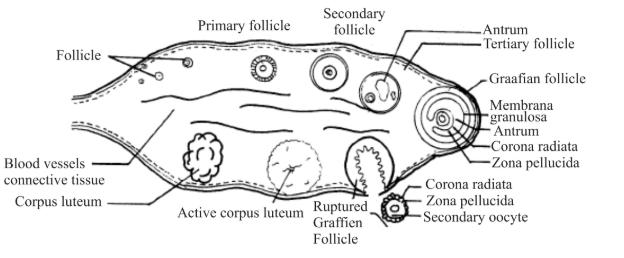
-
- Fallopian tubes are oviducts through which the egg passes to the uterus
- The endometrium is the innermost layer of the uterus that is rich in blood vessels.
- Fimbriae are finger-like projections that help the egg pass through to the oviduct.
28. (a) Write one function of each of the following: 6
(i) RBC
(ii) Platelets
(iii) Plasma
(b) Why a person with blood group AB can’t donate blood to the persons with other blood groups, i.e, A, B, and O, explain.
Ans:
-
- RBC- transports oxygen and carbon dioxide
- Platelets help in blood clotting
- Plasma transport of products of digestion from the small intestine to various tissues.
- A person with the AB blood group contains both antigen A and antigen B in the blood. Blood group A contains antibody b, the blood group B contains antibody a and those with the O group contain both antibody a and antibody b. If their blood is mixed with blood group AB, it will cause a life-threatening transfusion reaction as the respective antibodies react with the antigens in the AB blood group.
29. (a) Why do we consider a habitat as address of an organism and niche as its profession? Write definition of both the terms.
(b) What is the role of
(i) Vit.A
(ii) Ca++ and
(iii) Glucose in our body?
Ans:
- Habitat is the physical environment in which an organism lives and is thus considered its address. Niche is the sum of all the activities and relationships of a species by which it uses the resources in its habitat for its survival and reproduction. In other words, a niche is the functional characteristics of the species, thus considered its profession.
-
- Vitamin A is essential for the synthesis of visual pigment and helps maintain vision.
- Calcium helps with the formation of bones and teeth. It is also essential for nerves and muscles.
- Glucose is the main source of energy for our body and is also the only source of energy for the central nervous system.
30. Answer the following: 6
(a) 2 important characters of phylum Arthropoda and phylum Annelida.
(b) 4 important characters of mammals.
(c) 4 important characters of angiosperms.
Ans:
| Phylum Arthropoda | Phylum Annelida |
| Segmented body differentiated into head, thorax and abdomen. | Elongated, segmented, coelomate (true body cavity) worm-like animals. |
| Jointed legs for locomotion, one pair each on some or all body segments | The body is provided with setae or parapodia for locomotion. |
- Characteristics of mammals
- Presence of milk (Mammary) glands.
- The body is divisible into head, neck, trunk and tail; tail is absent in some.
- Digits usually end in claws, nails or hoofs.
- Sweat and oil glands are present in the skin.
- Characteristics of angiosperms
- Seeds enclosed in fruits
- Plants bear flowers and reproductive structures.
- May have a single or two cotyledons.
- Have well-developed vascular bundles.
Additional Study Materials
- NIOS Class 12 Biology PYQ April 2025 Set A
- NIOS Class 12 Biology PYQ Oct 2024 Set A
- NIOS Biology Paper 2024 April Set A Solved
- NIOS Class 12 Biology Terminal Exercises Solutions
- NIOS Class 12 Biology Intext Questions Solutions