NIOS Biology Question Paper 2022 April Set A
1 MARK QUESTIONS
1. Which of these plants exhibits Saprophytic mode of nutrition?
(A) Monotropa
(B) Cuscuta
(C) Nepenthes
(D) Money plant
2. A baby is born with a genetic disorder. His cells have 47 chromosomes, and his karyotype is 45 + XY. Name the disorder he is suffering from:
(A) Sickle cell anaemia
(C) Down’s Syndrome
(B) Turner’s Syndrome
(D) Klinefelter’s Syndrome
3. Which of the following is a broad-spectrum antibiotic?
(A) Penicillin
(B) Erythromycin
(C) Paracetamol
(D) Streptomycin
4. The cell wall is made up of a chemical which is unique in bacteria. Name the chemical.
(A) Peptidoglycan
(B) Chitin
(C) Lignin
(D) Cellulose
5. Which of the following antibodies is present in Colostrum that provides immunity to the newborn infant?
(A) IgG
(B) IgE
(C) IgM
(D) IgA
6. One of your class fellow put some dry grams in water overnight. Next morning, it was fully swollen. Name the phenomenon involved.
(A) Osmosis
(C) Plasmolysis
(B) Imbibition
(D) Diffusion
7. What does the following sequence represent?

(A) Genetic Drift
(C) Ecological Succession
(B) A food Pyramid
(D) Phylogenetic trend
8. Which of the following is an example of an Arachnida?
(A) Centipede
(C) Nereis
(B) Cockroach
(D) Spider
2 MARK QUESTIONS
9. (a) Write the name of the hormone secreted by the Human Placenta.
(b) Write the name of the hormone which stimulates the development of male characteristics during puberty.
Ans:
- The placenta produces the hormone progesterone.
- Testosterone
10. (a) Expand the abbreviation PEM.
(b) Write the Name of one disease caused due to PEM.
Ans:
- Protein Energy Malnutrition (PEM)
- Marasmus
11. Where can you locate the following structures in plants?
(a) Perianth
(b) Bulliform cells
Ans:
- On the flower whorls
- Inside the epidermis of monocot leaves
12. Distinguish between Mutualism and Symbiosis. Write one suitable example of each from animal world.
Ans: Mutualism is a close association between two species in which both species benefit. Symbiosis is a type of mutualism where the interacting species cannot live without the each other, as they depend completely on each other for their survival.
13. Name the Phytohormones involved in the following functions:
(a) Prevents ageing in plant parts.
(b) Closing of the Stomata.
Ans:
- Cytokinins
- Abscisic acid:
14. Distinguish between Antigen and Antibody.
Ans: An antigen is any foreign molecule that can trigger a specific immune response. An antibody is a protein molecule produced in animals in response to an antigen.
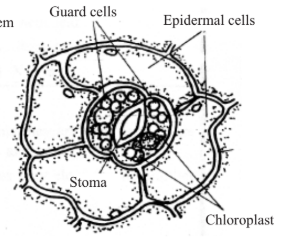
15. Draw a neat and labelled diagram of an Open Stomata in a Dicot Plant.
Ans:
16. Expand the following abbreviations and state how they are useful in daily life.
(a) CNG
(b) PNG
Ans:
- CNG: Compressed Natural Gas
- PNG: Piped Natural Gas
17. Why do insectivorous plants eat insects when it is capable of carrying out photosynthesis?
Ans: Insectivorous plants eat insects when it is capable of carrying out photosynthesis to overcome nitrogen deficiency, as they grow in soils having acute nitrogen deficiency.
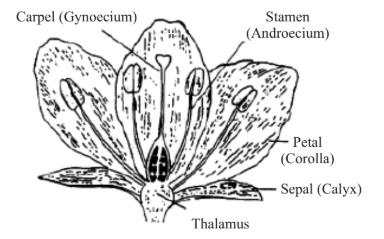
18. Draw a neat diagram of a longitudinal section of a typical flower and label the four whorls.
Ans:
19. After a surgery, a man was advised to include more proteins and Iron in his diet. Give reasons and also mention one source of each nutrient.
Ans: Protein – body-building food required during healing after surgery.
Source: Dal, pea, beans, soybean, gram (any one)
Iron: Builds blood as it is part of the Hb molecule.
Source: Liver, Leafy vegetables like spinach, egg, molasses, grains, peanuts (any one)
20. Name the surgical methods of Contraception in human males and females. Also mention the basic procedure involved in the two methods.
Ans:
- Vasectomy in males, where the vas deferens is ligated (tied) by the surgeon to prevent sperm from going out of the body.
- Tubectomy in females, where the fallopian tubes are cut and ligated to prevent the ovulated egg from passing down for fertilisation.
4 MARKS QUESTIONS
21. (a) Where are the two biodiversity hotspots found in India?
(b) Distinguish between in situ Conservation and ex situ Conservation. Also, write one suitable example of each.
(c) With the help of a suitable example, define the term Endangered species.
Ans:
- The eastern Himalayan hot spot extends to the north–eastern India and Bhutan. The Western Ghats extend from the southwest towards Gujarat.
- In-situ conservation includes the protection of plants and animals within their natural habitats or in protected areas. Ex-situ conservation is the conservation of plants and animals outside their natural habitats.
- Endangered species are those which have been reduced in number to a critical level and are facing a high risk of extinction in the near future. Eg. Asiatic lion.
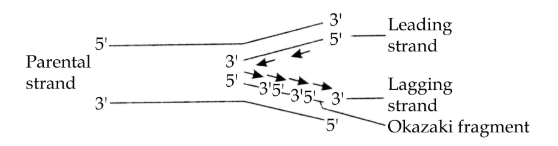
22. Briefly explain the various steps involved in the mechanism of DNA replication. Also, draw a diagram to show the formation of new DNA strands.
Ans: Replication occurs through the following steps :
- Unwinding of the DNA double helix: The two strands of the replicating DNA molecule separate by the action of the enzyme Helicase. The topoisomerase enzyme keeps it open.
- Synthesis of the primer: A Primer is a short RNA molecule of about 5 to 10 bases. It is formed in the presence of the enzyme primase. The primer provides a 3’-OH group for attachment of the new DNA strand.
- Synthesis of new DNA strand: The opened strands of DNA form the template. New strands complementary to template get synthesized. At the replication fork, a new DNA strand begins to synthesise, attaching itself to the primer, in the presence of the enzyme DNA polymerase. It begins synthesis from its 5’ end, and a DNA strand complementary to one of the unwound parental DNA strand gets synthesized. The new strand of DNA continues to be synthesized uninterrupted and is termed as the leading strand.
23. (a) What are Vaccines? What do you understand by second-generation vaccines? Write the names of any two diseases for which these vaccines are already in use.
(b) Expand BCG and mention its usage.
Ans:
- Vaccines are biological preparations that contain mild or attenuated (weakened) germs that are introduced into the body to induce the immune system to produce necessary antibodies. Second-generation vaccines are vaccines that are produced by genetic engineering or recombinant DNA technology. Eg., Vaccines for Hepatitis B and Herpes.
- BCG – Bacillo Calmette-Guérin. It is given to prevent tuberculosis.
24. (a) With the help of a flow chart, show the non-cyclic Photophosphorylation taking place in Photosynthesis. Mention the products formed in this phase.
(b) Where does this process take place in plants?
Ans:
- Non-cyclic photophosphorylation
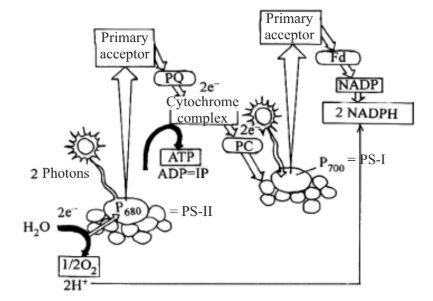
The products formed in this phase are, ATP, NADPH2 and O2.
- It takes place in the thylakoid membranes of chloroplast.
25. (a) Draw a neat and proportionate diagram of the Female Reproduction System of humans. Label its four parts.
(b) Where do the following processes take place?
(i) Fertilisation
(ii) Implantation
Ans:
- Female reproductive system in humans
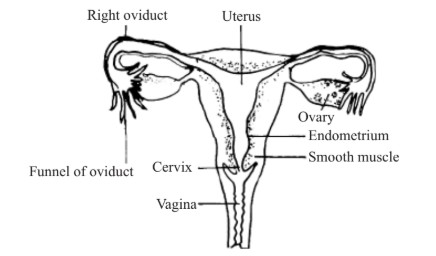
- These processes take place
- Fertilization: fallopian tubes
- Implantation: Wall of the uterus
26. With the help of well-labelled diagrams, distinguish between:
(a) Androecium in Peaflower and Hibiscus.
(b) Venation in the leaves of Dicot and Monocot plants.
Ans:
- Androecium in Pea flower and Hibiscus
- Pea flower: Androecium has 10 stamens, arranged in two whorls (9+1), which is a diadelphous condition.
- Hibiscus: Androecium consists of an indefinite number of monadelphous stamens. The lower parts or filaments join together to form the staminal tube.
- Venation in dicots and monocots.
- Reticulate venation – veins forming a network in dicots.
- Parallel venation – veins arranged in parallel rows in monocots
6 MARKS QUESTIONS
27. (a) With the help of a flow chart, describe the steps involved in the Coagulation of blood.
(b) Why is a person with blood group ‘AB’ called a Universal recipient?
(c) Give an example of a lymphoid organ? Name the two major types of cells present in them and state the general function they perform in the body.
Ans:
- Steps in the coagulation of blood.
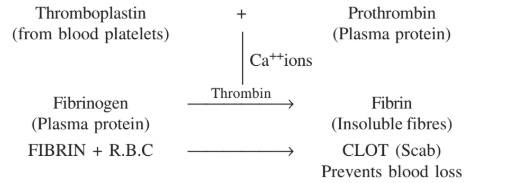
- Blood group AB can receive blood from all other groups and is thus called Universal Recipient. No Antibodies present in the blood of Group AB, so no reaction with antigens of other blood groups.
- The spleen is the largest lymphoid organ that helps destroy old and worn-out blood cells or RBCs. Cells found in the spleen are T-cells and B-cells.
28. (a) Explain the Sex Determination in Humans. Differentiate between Homogametic and Heterogametic individuals.
(b) A colour blind man marries a woman who has normal colour vision. A son and a daughter born to them are colour blind. Explain this with the help of a self-explanatory flow chart
Ans:
- Sex chromosomes in human males are morphologically dissimilar – XY. They produce two different gametes- X and Y. They are called heterogametic individuals. Human females carry similar sex chromosomes, XX, and they produce similar gametes, such as X and X. They are called homogametic individuals. When an egg (X) is fertilised by an X gamete from the father, the child becomes a female, and if the egg is fertilised by a Y gamete, the child will be a male.
- For both the son and daughter to be colour blind, the mother has to be a carrier, as the gene for colour blindness comes from the X chromosome. Since the mother has normal vision, she carries a normal gene. Thus, their genotypes could be
Father: XᶜY (affected) and Mother: XᴺXᶜ (carrier)
| Xᴺ (mother) | Xc (mother) | |
| Xᶜ (father) | XᶜXᴺ | XᶜXᶜ |
| (daughter — carrier, normal vision) | (daughter — colour blind) | |
| Y (father) | XᴺY | XcY |
| (son — normal vision) | (son — colour blind) |
29. a) Write the four main characteristics of Phylum Chordata.
(b) State one main difference between Chondrichthyes and Osteichthyes and give one suitable example of each.
(c) Write the scientific names of the following:
(i) Tapeworm
(ii) Moss plant
Ans:
- The main characters of Phylum Chordata are,
- Notochord is present at some stage of life, in most cases, replaced by the backbone.
- Dorsal tubular nerve cord.
- Gill slits are present at some stage of life. (larva or adult)
- A body with a head and trunk, and two pairs of appendages.
- Chondrichthyes: Mouth is ventral. Eg. Scoliodon. Osteichthyes: Mouth is terminal. Eg. Labeo.
- Scientific names
- Tapeworm: Taenia
- Moss Plant: Funaria
30. (a) Draw a neat and labelled diagram of the Excretory organs in humans.
(b) List the role of liver in Excretion. (2 points)
(c) Write the name the excretory organ in Cockroach.
Ans:
- Excretory organs in humans
- The liver breaks down excess amino acids into urea and sugar. Urea is excreted in urine, and sugar is stored for use.
- Malpighian tubules.
Additional Study Materials
- NIOS Class 12 Biology PYQ April 2025 Set A
- NIOS Biology Paper 2024 April Set A Solved
- NIOS Class 12 Biology PYQ Oct 2024 Set A
- NIOS Class 12 Biology Terminal Exercises Solutions
- NIOS Class 12 Biology Intext Questions Solutions