NIOS Biology Previous Year Question Paper 2025 Set B
SECTION A (1 mark)
Note: Question Nos. 1 to 16 consist of multiple-choice type questions (MCQs) carrying 1 mark each.
1. Self-pollination is observed in pea plants as their
(A) stamens and pistils develop at the same time (synchronous) in closed flowers
(B) stamens and pistils develop at different times
(C) stamens and pistils are found in different plants
(D) male and female sex organs are found in different flowers
2. Fibres of plants are made up of dead tissue like coir of coconut. The tissue is
(A) parenchyma
(B) sclerenchyma
(C) xylem
(D) collenchyma
3. Oversecretion of insulin causes
(A) hypoglycemia
(B) hyperglycemia
(C) diabetes insipidus
(D) stunted growth
4. Cambium is a/an
(A) apical meristem
(B) intercalary meristem
(C) lateral meristem
(D) complex tissue 1
5. The chemical secreted by ants while walking on a trail is
(A) pheromone
(B) TSH
(C) interferon
(D) acetylcholine 1
6. Which of the following is not a photosynthetic pigment?
(A) Chlorophyll
(B) Carotenoids
(C) Xanthophyll
(D) Leghaemoglobin
7. During collection of ova from females for having test tube babies, which of the following hormones is administered?
(A) FSH
(B) Oxytocin
(C) Testosterone
(D) Prolactin
8. Oxytocin is the hormone secreted by pituitary for
(A) uterine contraction for childbirth
(B) formation of corpus luteum
(C) ovulation
(D) menstrual cycle
9. The types of inflorescence with one example each are given below. Identify the wrong pair.
(A) Hypanthodium — fig
(B) Umbel — coriander
(C) Cymose — wheat
(D) Racemose — mustard
10. What would be the genotype of the parents if offspring have the phenotypes in 1: 1 proportion?
(A) Tt × Tt
(B) TT × TT
(C) Tt × TT
(D) Tt × tt
11. Bacteria are preferred in experiments of recombinant DNA technology because
(A) bacteria have a huge single chromosome
(B) they have extranuclear chromosomes—the plasmid
(C) their chromosomes have exons and introns
(D) they have pili on their body surface
12. Elderly people often get their bones fractured during a slightest fall. The possible condition diagnosed in them is
(A) obesity
(B) osteomalacia/osteoporosis
(C) anaemia
(D) rickets
13. Fraternal twins are produced when
(A) two ova are fertilized by two sperms
(B) fertilized ovum divides into two independent cells each develops into two separate individuals
(C) ova are developed into two embryos without fertilization
(D) twins produced from one egg fail to separate
14. Cyanocobalamin is
(A) vitamin A
(B) vitamin D
(C) vitamin B12
(D) vitamin C
15. Restriction enzymes are also called
(A) ligases
(B) molecular scissors
(C) isomerases
(D) polymerases
16. The important character brought into Bt cotton is
(A) resistance towards pests
(B) shiny fibre
(C) production of antibiotics
(D) rich carbohydrate
SECTION–B (2 marks)
Note: Question Nos. 17 to 28 are objective-type questions carrying 2 marks each.
17. The flow of blood is shown in diagram through heart, labelled as A, B, C and D. Identify any two of them.
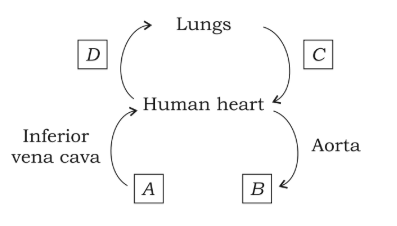
Ans:
- Tissues with very little oxygen and lot of CO2
- Different parts of the body
- Pulmonary veins
- Pulmonary artery
18. Write appropriate answers in the blanks (attempt any two): 1×2=2
(a) _____ tissue is protective.
(b) Blood is _____ tissue.
(c) The tissue that conducts food material in plants is _____.
(d) Palisade parenchyma is found in _____ organ.
Ans:
- Periderm
- Connective
- Phloem
- Dicot leaves
19. Match the items of Column I by selecting suitable option from Column II:
| Column–I | Column–II |
| (a) The largest lymphoid organ | (i) Liver |
| (b) Bone marrow | (ii) Spleen |
| (iii) Thyroid | |
| (iv) Haemopoiesis |
Ans: (a) – (ii) Liver, (b) – (iv) Haemopoiesis
20. Identify the wrong statements (any two):
(a) Gametes are unicellular haploid.
(b) Spores have haploid nucleus.
(c) Zygotes have diploid nucleus.
(d) Zoospores are non-motile.
Ans:
(b) Spores have haploid nucleus.
(d) Zoospores are non-motile.
21. Match the items of Column–I by selecting suitable option from Column–II:
| Column–I | Column–II |
| (a) Aggregate fruits | (i) Develop from inflorescence |
| (b) Simple fruits | (ii) Develop from polycarpellary ovary |
| (iii) Develop from single ovary | |
| (iv) Parthenocarpic fruit |
Ans: (a) – (ii) Develop from polycarpellary ovary
(b) – (iii) Develop from single ovary
22. Write two differences between DNA and RNA.
Ans: Any two
| DNA | RNA |
| Double-stranded molecule | Single-stranded molecule |
| Contains deoxyribose sugar | contains ribose sugar. |
| Pyrimidine base complementary to Adenine is Thymine | Pyrimidine base complementary to adenine is Uracil no thymine in RNA |
| DNA has only one function, that is to bear hereditary information | Many species of RNA, such as mRNA, tRNA, and rRNA, with different functions. RNA is the genetic material in retroviruses. |
| DNA can duplicate on its own | RNA is synthesized on a DNA template |
23. Match the items given in Column–I with the suitable items given in Column–II:
| Column–I | Column–II |
| (a) Acrosome | (i) Contains mitochondria |
| (b) Neck of sperm | (ii) Centriole |
| (iii) Flagellum | |
| (iv) Contains enzymes |
Ans: (a) – (iv) Contains enzymes, (b) – (i) Contains mitochondria
24. Identify A and B from the diagram given below:
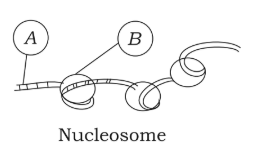
Ans:
- DNA
- Histone octamer
25. Some people tend to take vitamins in excessive amounts. Excessive intake of water-soluble vitamins may not cause harm. But the excess amount of fat-soluble ones are poisonous to body.
(a) What is hypervitaminosis?
(b) Name two fat-soluble vitamins.
Ans:
- The disease caused by the presence of vitamins in excessive quantities in the body is called hypervitaminosis.
- Fat-soluble vitamins are vitamins A, D, E, and K
26. Red-green colour blindness is a sex-linked disorder. Observe the flow chart of the disease given below:
(a) Which parent is contributing the gene for colour blindness to the offspring?
(b) What are the chances of the daughters showing the disease to these parents?
Ans:
- The mother is contributing the gene for colour blindness.
- Daughters will not show this disease in this cross as two defective genes (homozygous condition) can only cause the disease in females.
27. Study the following passage and fill in the blanks with appropriate words [attempt any two parts from A–D]:
A is an association between maternal and foetal tissue. B is a tough structure which serves as the blood vascular connection between foetus and uterine wall. The embryo is enclosed in a sac called C , which is filled with D . It acts as shock absorber to protect embryo from damage.
Ans:
- Placenta
- Umbilical cord
- Amnion
- Amniotic fluid
28. Given below is the sequence to succession of communities in a habitat. Fill in the gaps A and B with appropriate answer:

Ans:
- Lichens
- Shrubs
SECTION–C (2 mark)
Note: Question Nos. 29 to 37 are very short answer-type questions carrying 2 marks each.
29. Which tissue bears the following characters?
(a) Small and compactly packed cells which divide continuously.
(b) End walls open and cells join to form a long tube having dead cell wall.
Ans:
- Meristematic tissue
- Xylem vessels
30. Why are bacteria called monerans. Support your answer giving any two characters.
Ans: Bacteria are prokaryotic as they lack a true nucleus without a nuclear membrane. They are also unicellular organisms.
Or
Maize is a monocot plant. Give any two valid reasons for considering of so.
Ans: Maize has a fibrous root system, which is a main characteristic of monocots. Maize lacks secondary growth in its stem and can easily bend.
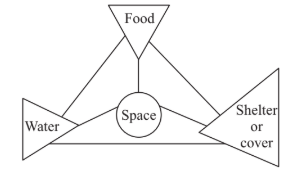
31. With the help of lined diagram only, show the structural components of a habitat.
Ans:
32. Name two types of enzymes produced in large scale through genetic engineering. Mention one use of each of enzymes.
Ans:
- Proteases: Used in the manufacture of detergents, meat tenderisers.
- Amylases: Used in the manufacture of beer, bread, and textiles
Or
Write the names of two hormones produced in large scale through recombinant DNA technology. Name one therapeutic application for each.
Ans:
- Insulin for Diabetes mellitus
- Growth hormones for Pituitary dwarfism
33. Tetracycline is a broad-spectrum antibiotic. Why do we say so? What is the source of it?
Ans: Broad-spectrum antibiotics can be used against more than one kind of pathogenic bacterium. Tetracycline is obtained from Streptomyces sp.
34. Write any four important functions of proteins in our body.
Ans: Functions of proteins (any four)
- Proteins are required for building and maintaining body tissues.
- Proteins are found in all the enzymes e.g. Trypsin, pepsin and rennin.
- Some proteins function as hormones to regulate many body functions. For example, insulin is a hormone that regulates blood glucose levels in the body.
- Proteins also act as antibodies and protect the body from an antigen (a foreign agent).
- Transport protein carries different substances from the blood to the tissues in the body. Haemoglobin is a transport protein.
35. Brain is covered by three membranes called _____. The space between them is filled with _____ fluid.
Ans: Meninges and cerebrospinal fluid.
36. How do immigration and emigration affect the existing population density?
Ans: Immigration refers to the movement of individuals into a new area. It increases the population. The movement of individuals of a population out of a region permanently is termed emigration. Emigration reduces the population.
Or
A rapidly growing population has more number of individuals of reproductive age. What is the growth pattern of the population if more pre-reproductive individuals are present in the population?
Ans: If there are pre-reproductive individuals present in the population. There will be an exponential growth in the population. After reaching a peak, there will be a sudden crash or decline due to environmental or other factors.
37. Write the names of two organisms belong to each one of the following groups:
(a) Arthropoda
(b) Aves
Ans:
- Arthropoda: Scorpion, Prawns, Millipede, Cockroach (any two)
- Aves: Ostrich, Kiwi, Pigeon, Crow.
SECTION–D (3 marks)
Note: Question Nos. 38 to 41 are short answer-type questions carrying 3 marks each.
38. (a) Briefly explain the transformation in bacteria.
(b) Why do we consider DNA replication as semiconservative? Explain briefly.
Ans:
- Transformation in bacteria is the process by which a bacterium takes up genetic material from its surroundings and incorporates it into its own DNA, leading to a change in its characteristics. This was first demonstrated by Frederick Griffith in 1928 using Streptococcus pneumoniae. He found that harmless rough (R) bacteria became virulent when mixed with heat-killed smooth (S) virulent bacteria. Later, in 1944, Avery, MacLeod, and McCarty proved that DNA was responsible for this transformation, showing that DNA is the transforming principle in bacteria.
- DNA replication is semiconservative, since in the two new molecules formed, one parental strand is conserved and the other strand is newly synthesized. Messelson and Stahl experimentally proved the semiconservative mode of DNA replication.
Or
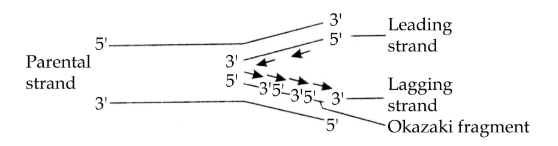
Draw a replicating DNA molecule showing—
(a) parental strand;
(b) Okazaki fragments;
(c) leading strand;
(d) replication fork.
Ans:
39. Define the following terms:
(a) Amnion
(b) Demography
(c) Population growth rate
Ans:
- Amnion: From the first few weeks of development, the embryo is enclosed in a sac called amnion which is filled with amniotic fluid.
- Demography is the scientific and statistical study of the human population. It deals with population growth, its composition (age, sex ratio), and its distribution in space.
- Population growth rate is the difference between the birth rate and the death rate.
Or
Write three effects of uncontrolled population growth on a nation.
Ans:
- Increasing population and transportation: An Increase in population requires a corresponding increase in the means of transport. The increase in the number of automobiles as a consequence of phenomenal population growth has increased the pollution load (air pollution, water pollution, and solid waste pollution).
- Increasing population and education: Education is most important for economic and social upliftment. Although the literacy rate is growing, we still have a very large number of illiterates in the country. The increasing population further adds up to the problems of providing education to all.
- Increasing population, agricultural development, and environmental degradation: In order to meet the food requirements of the ever-increasing population of the country, new agricultural techniques have been adopted. Some of these have proved to be detrimental to the environment.
40. Write the name of one surgical method of contraception carried on in human males. Explain how it is performed.
Ans: Vasectomy: In males, the vas deferens, through which sperm travel out of the epididymis, is ligated (tied) by the surgeon to prevent sperm from going out of the body. This method is temporary and can be reversed by the surgeon if required. For permanently preventing fertilization, the vas deferens is cut and the open ends ligatured (tied by thread).
Or
Write the name of one contraception carried on in human females. Describe the procedure adopted for it.
Ans: Oral contraceptive pills are tablets that have to be taken as per directions from a medical practitioner. These pills interfere with ovulation and, in turn, prevent fertilization.
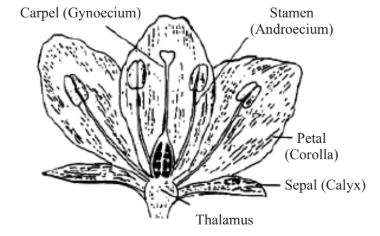
41. Draw a neat diagram of a typical bisexual dicotyledonous flower and label its four whorls (parts):
Ans:
SECTION–E ( 5 marks)
Note: Question Nos. 42 and 43 are long answer-type questions carrying 5 marks each.
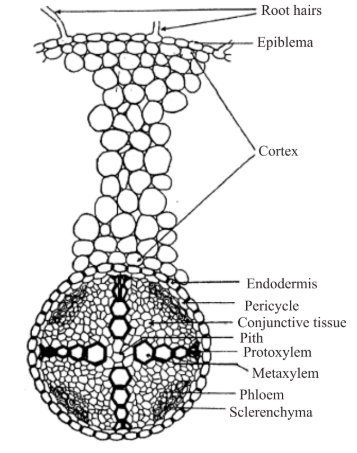
42. Draw a transverse section of a dicot root and label the following parts:
Epiblema, cortex, endodermis, pericycle, protoxylem, metaxylem, phloem and pith
Ans:
Or
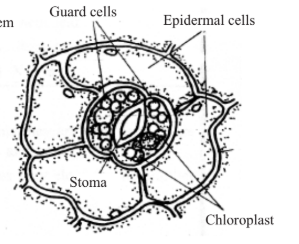
(a) With the help of a diagram, describe the structure of stomatal apparatus of a dicot leaf.
(b) Where are they located in xerophytes?
(c) What are bulliform cells? Where are they found? Write one important function of these cells.
Ans:
- In dicot leaves, the stomatal apparatus is made up of two semicircular guard cells surrounding a pore-stoma. The guard cells contain chloroplasts and regulate the opening and closing of stomata. Stomatal pore opens into the intercellular spaces (substomatal cavity) of the mesophyll. The number, shape, and distribution of stomata vary depending on the plant, whether it is a xerophyte or a mesophyte.
- On the lower surface.
- Bulliform cells are a special type of cell (motor cells) found on the upper leaf surface of some monocots. They help the leaf to roll and unroll due to a change in its turgidity.
43. Following is the information given with regard to the respiratory processes in living beings. Fill in the gaps with appropriate answers: 1×5=5
| Type of respiration | Raw material | Site | Products |
| Aerobic | – | Cytoplasm and mitochondria | – |
| Anaerobic | – | – | CO2 + 2 ATP |
| Krebs Cycle | – | Mitochondria | CO2 + NADH2 |
Ans:
| Type of respiration | Raw material | Site | Products |
| Aerobic | C6H12O6 | Cytoplasm and mitochondria | CO2 + H2O + 38ATP |
| Anaerobic | C6H12O6 | Cytoplasm | CO2 + 2 ATP |
| Kreb’s Cycle | 2 Pyruvic acid | Mitochondria | CO2 + NADH2 |
Or
Complete the following statements: 1×5=5
(a) Muscular pain we get after prolonged exercise is due to _____.
(b) Lenticels are found in _____. Their function is _____.
(c) Each NADH2 molecule produces _____ ATP molecules.
(d) Photosynthesis is a _____ path and respiration is a catabolic path.
Ans:
- Lactic acid
- Bark of woody plants facilitates gaseous exchange
- 3ATPs
- Anabolic
Additional Study Materials
- NIOS Class 12 Biology PYQ April 2025 Set A
- NIOS Class 12 Biology PYQ Oct 2024 Set A
- NIOS Biology Paper 2024 April Set A Solved
- NIOS Class 12 Biology PYQ April 2023 Set A
- NIOS Class 12 Biology PYQ Oct 2022 Set A
- NIOS Class 12 Biology PYQ April 2022 Set A
- NIOS Class 12 Biology PYQ Feb 2021 set A
- NIOS Class 12 Biology PYQ Oct 2021 Set A
- NIOS Class 12 Biology PYQ Oct 2019 Set A
- NIOS Class 12 Biology PYQ April 2019 SetA