NIOS Biology Exam Paper April 2016
1 MARK QUESTIONS
1. An example of Nastie movement is
(A) Opening and closing of stomata.
(B) Flowers of Portulaca bloom during the day and the petals close at sunset
(C) Mimosa pudica droops when touched.
(D) Leaf closes in an Insectivorous plant when the insect enters
2. A male child with Down’s syndrome would have which one of the following Karyotypes?
(A) 44 + XXY
(B) 44 + XO
(C) 45 + XY
(D) 44 + XY
3. The blood group recipients who can receive blood from blood group AB are
(A) AB
(B) O, A, B, AB
(C) A, AB
(D) B + AB
4. Identify the scientific name of the organism which is used in large scale in the brewery and bakery industries due to its fermentation properties.
(A) Streptomyces aurifaciens
(B) Lactobacillus
(C) Saccharomyces cerevisiae
(D) Streptococcus
5. Apomixis is
(A) Effect of low temperature on flowering
(B) Development of plants without fusion of gametes
(C) Development of plants in darkness
(D) Mixing of characters due to fusion of gametes
6. Pick the odd one out:
(A) Industrialisation
(C) Pollution
(B) Wildlife sanctuaries
(D) Population explosion
7. The volume of air inhaled and exhaled during normal breathing is known as
(A) Vital capacity
(C) Residual volume
(B) Lung capacity
(D) Tidal volume
8. Haldi and Onion belong to:
(A) Sub-aerial stem modification
(B) Aerial modification of stem
(C) Underground modified stem
(D) Root modification
2 MARKS QUESTIONS
9. Roughage is not a food, but it forms an important part of our diet. Give reasons.
Ans: Roughage is mainly composed of cellulose, which helps in bowel movement and prevents constipation. It helps clean out the digestive system and protects the body from various digestive ailments. It also helps retain water in the body and thus is considered an important part of our daily diet.
10. Name the following:
(a) A stage when menstruation and ovulation stops in human females.
(b) The fluid surrounding the developing embryo.
Ans:
- Menopause
- Amniotic fluid
11. Where are the following valves situated?
(i) Semi-lunar valve
(ii) Bicuspid value.
Ans:
- Semi-lunar valves are present all along the length of the vein at intervals to prevent backflow of blood.
- A bicuspid valve is found between the left atrium and the left ventricle
12. A girl is twelve years old, and is advised by her doctor to have a balanced diet. What did the doctor mean by this statement? As a growing girl what are some of her nutritional needs?
Ans: A balanced diet contains all essential nutrients in suitable proportions and amounts to provide necessary energy and keep the body in a healthy state. As a growing girl, she needs more food in proportion to their body weight. Such as,
- Extra protein to make new tissues for growth,
- More calcium and phosphorus are needed for the formation of bones and red blood cells.
- Vitamin A for the development of healthy eyesight
- Vitamin C for general health
- Vitamin D for healthy bones.
13. Do you consider Potato as a stem or root? Give any two reasons for your choice. List the functions this modification will perform.
Ans: A Potato is an underground modified stem called a tuber. Its swollen tips of underground lateral branches of stem store food as starch, bear “eyes”. Each eye is a node which bears buds and scars of scale leaves. They serve two functions –
- Act as perennating structures by remaining leafless and dormant in winter but giving off aerial shoots under favourable conditions (next season)
- Store food and become thick and fleshy.
14. Depending on the pigments present, the algae are called blue, green, brown or red algae. Name the pigments which impart these colours in the algae.
Ans:
- Blue pigment: Phycocyanin)
- Brown pigment: Fucoxanthin
- Red pigment: Phycoerythrin
15. Name the plant hormones concerned with the following functions:
(a) Ripening of fruits
(b) A dicot weedicide.
Ans:
- Ethylene
- 2, 4-D (2, 4-dichlorophenoxy acetic acid) acts as a dicot weedicide.
16. List any four methods of checking soil erosion and improving soil fertility.
Ans: The removal of the top layers of soil by wind and water is called soil erosion. The methods for checking soil erosion and improving soil fertility are.
- Maintenance of soil fertility: The fertility can be maintained by adding manure and fertilisers regularly as well as by rotation of crops.
- Control on grazing: Grazing should be allowed only in specified areas.
- Reforestation: Planting of trees and vegetation reduces soil erosion.
- Terracing: Dividing a slope into several flat fields to control the rapid run of water. It is practised mostly in hilly areas.
- Contour ploughing: Ploughing at right angles to the slope allows the furrows to trap water and check soil erosion by rainwater.
17. (a) Distinguish between ‘broad-spectrum antibiotics’ and ‘narrow-spectrum antibiotics’.
(b) State two drawbacks of antibiotics.
Ans:
- Difference
- Broad-spectrum antibiotics are those that can be used for more than one kind of pathogenic bacterium. Eg. Chloramphenicol
- Narrow-spectrum antibiotics are used against a few pathogenic bacteria. Eg. Penicillin
- Drawbacks of using antibiotics
- Some people are allergic to a particular antibiotic.
- Some disease-causing bacteria undergo mutation and become resistant to a particular antibiotic to which they were sensitive earlier.
18. Distinguish between true fruit and false fruit giving appropriate examples.
Ans: A true fruit is a ripened ovary that develops after fertilisation. Eg., mango, orange, etc. Sometimes, along with the ovary, other floral parts like the thalamus, receptacle or calyx may develop as part of fruit; such fruits are called false fruits. e.g. apple, pear (thalamus), fig (receptacle).
19. (a) Where do the following events take place in the human female?
oogenesis, fertilisation; implantation
(b) State the function of colostrum.
Ans:
- Events taking place at
- Oogenesis: Ovary
- Fertilisation: Fallopian tube
- Implantation: On the walls of the uterus
- Colostrum: Colostrum is rich in nutrients, fats, proteins, and antibodies (Immunoglobulin A-IgA) that provide passive immunity to the newborn infant.
20. Give one main function of each of the following:
Cerebrum, Cerebellum, Medulla oblongata and Spinal cord.
Ans:
- Cerebrum: Processes sensory information.
- Cerebellum: Maintain body balance
- Medulla oblongata: Controls heartbeat and movement of the alimentary canal.
- Spinal cord: Carries out reflexes below the neck.
4 MARKS QUESTIONS
21. Explain briefly in four steps how a long double-stranded DNA molecule get packaged in the chromosome.
Ans:
- At intervals, DNA molecules are coiled around a “core particle” which is an octamer, that is made of 8 histone proteins forming a ball-like structure.
- Each core particle with DNA around it is called a nucleosome. Under the electron microscope, the eukaryotic chromosome looks like a string of beads (string being the DNA molecule and beads the nucleosomes).
- The string is then coiled to form a solenoid, and the solenoid is coiled again (supercoiling), ultimately to form the chromosome.
- In this way, the long DNA molecule becomes thicker and thicker and shorter and shorter
22. (a) Why is excretion considered as one of the important life processes?
(b) Which is the most toxic form of nitrogenous waste? Name an organism that excretes it.
Ans:
- Excretion is an important life process because,
- Excretion is necessary for the elimination of nitrogenous wastes formed during the metabolism of proteins (amino acids) and nucleic acids.
- Elimination of excess salts like NaCl, vitamins, bile pigments (from the breakdown of old RBCs) and certain medicines and drugs
- Removal of excess water or its retention in case of a shortage of water. This is to maintain the required quantity of water (osmoregulation) in the body.
- Ammonia is the most toxic form of nitrogenous waste. Eg. Amoeba
23. (a) Draw a schematic diagram of the structure of antibody.
(b) What is antigenic determinant?
Ans:
- Antibody
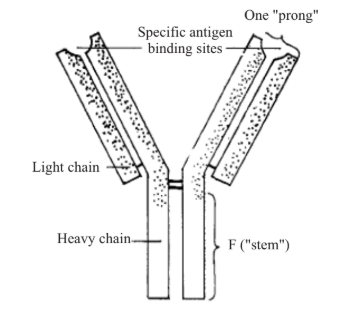
- An antigenic determinant is the cluster of a series of epitopes of an antigen.
24. Match the items in Column A with those in Column B.
| Column A | Column B |
| (a) Tendon | (i) Nerve cell |
| (b) Sarcolemma | (ii) Monocot leaf |
| (c) Phloem | (iii) Cardiac muscle |
| (d) Node of Ranvier | (iv) Clotting of blood |
| (e) Bulliform cells | (v) translocation |
| (f) Sinu-atrial Node | (vi) joins muscle to bone |
| ( g ) Intercalated disc | (vii) outer tough membrane of striated muscles |
| ( h ) Blood platelets | (viii) heart beats |
Ans:
| Column A | Column B |
| (a) Tendon | (vi) joins muscle to bone |
| (b) Sarcolemma | (vii) outer tough membrane of striated muscles |
| (c) Phloem | (v) translocation |
| (d) Node of Ranvier | (i) Nerve cell |
| (e) Bulliform cells | (ii) Monocot leaf |
| (f) Sinu-atrial Node | (viii) heart beats |
| ( g ) Intercalated disc | (iii) Cardiac muscle |
| ( h ) Blood platelets | (iv) Clotting of blood |
25. Give scientific names of:
(a) Two beneficial fungi and the benefits they provide.
(b) Two harmful fungi and the harm they cause.
Ans:
- Beneficial fungi
- Agaricus campestris is edible
- Yeast is used for fermentation in bread, soya sauce, etc.
- Harmful fungi
- Puccinia graminis (Wheat Rust) causes brown patches on the leaves and stems of wheat plants.
- Rhizopus or (Bread Mould) grows on bread
26. With the help of flow-charts, distinguish between Sex-determination in humans and in birds.
Ans:
Sex Determination in Humans: Humans have one set of sex chromosomes. A male is heterozygous (XY) and a female is homozygous (XX).
Sex Determination in Birds: Birds have two sets of sex chromosomes. Males are homozygotic (ZZ) and females are heterozygotic (ZW).
6 MARKS QUESTIONS
27. Enumerate any four characteristics of Phylum Arthropoda. Name the four main classes with two main characteristic features of each class and one appropriate example.
Ans: The Main characters of the Phylum Arthropoda are,
- Segmented body, can be differentiated into head, thorax and abdomen
- The head and thorax are often fused to form a cephalothorax
- Jointed legs for locomotion, one pair each on some or all body segments
- Exoskeleton of chitinous cuticle, shed at intervals (moulting)
- Sexes usually separate.
The main classes of Phylum Arthropoda are,
- Crustacea: Their body is covered with a dorsal covering called a carapace, and their eyes are compound. Eg. Prawn
- Myriapoda: Body has numerous segments, and each segment bears 1-2 pairs of legs. Eg. Millipede
- Insecta: Body is divisible into head, thorax and abdomen. The thorax is 3-segmented with 3 pairs of legs in each segment. Eg., Cockroach
- Arachnida: Their abdomen is usually without legs, and sexes are separate. Eg., Scorpion
28. (a) With the help of a flow chart, explain non-cyclic photophosphorylation. Where does this cycle take place, and what are the end products of this cycle?
(b) Explain briefly the biosynthetic phase of photosynthesis in C3 plants.
Where does this phase take place in plants?
Ans:
- Non-cyclic photophosphorylation takes place in the thylakoid membrane.
- C3 Cycle: In this cycle, initially, the atmospheric CO2 is accepted by a 5-carbon sugar ribulose bisphosphate (RuBP), resulting in the generation of two molecules of 3-carbon compound, 3-phosphoglyceric acid (PGA). This 3-carbon molecule is the first stable product of this pathway, and hence the name C3 cycle is given. The formation of PGA is called carboxylation. This reaction is catalysed by an enzyme called ribulose bisphosphate carboxylase/oxygenase or Rubisco.
- In the next step, PGA is reduced to 3-carbon carbohydrates called triose phosphate using NADPH2 and ATP (from light reaction). Many of these molecules are then diverted from the C3 cycle and used for the synthesis of other carbohydrates such as glucose and sucrose.
- To complete the cycle, the initial 5-carbon acceptor molecule, RuBP, is regenerated from the triose phosphates using an ATP molecule; thus, the C3 cycle continues to regenerate the CO2-acceptor (RuBP).
29. (a) The entire energy flow can be summarized into four steps. List them briefly.
(b) How would you distinguish primary succession from secondary succession?
(c) List two human activities and its impact due to increase of CO2 in the atmosphere.
Ans:
- The entire process of energy flow can be summarised in the following four steps:
- The flow of energy in an ecosystem is always linear or one-way.
- At every step in a food chain, the energy received by the organism is also used for its own metabolism and maintenance. The leftover is passed to the next higher trophic level. Thus, energy flow decreases with successive trophic levels.
- It follows the ecological thumb rule of 10%.
- The number of steps is limited to four or five in a food chain for the transfer of energy.
- Primary and Secondary Succession
- Primary succession takes place over bare or unoccupied areas such as rock outcrop, newly formed deltas and sand dunes, emerging volcano islands and lava flows as well as glacial moraines (muddy areas exposed by a retreating glacier) where no community has existed previously.
- Secondary succession is the development of a community which forms after the existing natural vegetation that constitutes a community is removed, disturbed or destroyed by a natural event like a hurricane or forest fire or by human-related events like tilling or harvesting land.
- Carbon dioxide is continuously increasing in the atmosphere due to human activities such as industrialisation, urbanisation and increased use of automobiles. This increase in atmospheric CO2 is leading to the greenhouse effect and global warming.
30. (a) Explain with the help of a diagram the synthesis of a new strand during DNA replication.
(b) Name four enzymes needed for DNA replication.
(c) If one of the DNA strands is ATGCATAAA what will the new complementary DNA strand be?
Ans:
- DNA Replication: DNA Replication: Replication occurs through the following steps :
- Unwinding of the DNA double helix: The two strands of the replicating DNA molecule separate by the action of the enzyme Helicase. The topoisomerase enzyme keeps it open.
- Synthesis of the primer: A Primer is a short RNA molecule of about 5 to 10 bases. It is formed in the presence of the enzyme primase. The primer provides a 3’-OH group for attachment of the new DNA strand.
- Synthesis of a new DNA strand: The opened strands of DNA form the template. New strands complementary to the template get synthesised. At the replication fork, a new DNA strand begins to synthesise, attaching itself to the primer, in the presence of the enzyme DNA polymerase. It begins synthesis from its 5’ end, and a DNA strand complementary to one of the unwound parental DNA strands gets synthesised. The new strand of DNA continues to be synthesised uninterrupted and is termed as the leading strand.
- Enzyme required: Helicase, topoisomerase. Primase and DNA polymerase.
- Complementary strand of ATGCATAAA is TACGTATTT
Additional Study Materials
- NIOS Class 12 Biology PYQ April 2025 Set A
- NIOS Class 12 Biology PYQ Oct 2024 Set A
- NIOS Biology Paper 2024 April Set A Solved
- NIOS Class 12 Biology PYQ April 2023 Set A
- NIOS Class 12 Biology PYQ Oct 2022 Set A
- NIOS Class 12 Biology PYQ April 2022 Set A
- NIOS Class 12 Biology PYQ Feb 2021 set A
- NIOS Class 12 Biology PYQ Oct 2021 Set A
- NIOS Class 12 Biology PYQ Oct 2019 Set A
- NIOS Class 12 Biology PYQ April 2019 SetA
- NIOS Class 12 Biology PYQ Oct 2018
- NIOS Class 12 Biology PYQ April 2018 Set A
- NIOS Class 12 Biology PYQ April 2017 Set A
- NIOS Class 12 Biology PYQ Oct 2017 Set A
- NIOS Class 12 Biology PYQ Oct 2016