NIOS Biology Class 12 Question Paper Oct 2018
1 MARK QUESTIONS
1. Inheritance of mitochondrial DNA is said to be
(A) Incomplete Dominance
(B) Criss-cross Inheritance
(C) Maternal Inheritance
(D) Polygenic Inheritance
2. Identify an Arachnid.
(A) Millipede
(B) Spider
(C) Prawn
(D) Cockroach
3. The phenomenon which makes it difficult to close a wooden door after the monsoon is
(A) Plasmolysis
(C) Imbibition
(B) Osmosis
(D) Diffusion
4. Select the vaccine used for the eradication of tuberculosis.
(A) DPT
(B) BCG
(C) MMR
(D) Polysaccharide vaccine
5. Hemosiderosis is caused due to excessive intake of which of the following?
(A) Vitamin A and D
(C) Vitamin C
(B) Calcium and Phosphorus
(D) Iron
6. Goitre is caused due to
(A) Deficiency of iodine in thyroxine
(B) Oversecretion of thyroxine
(C) Oversecretion of parathormone
(D) Undersecretion of thyroxine
7. Which of the following is not a part of the female reproductive system in Cockroach?
(A) Ovary
(B) Uterus
(C) Vagina
(D) Oviduct
8. Identify the starch-containing bodies which are integral part of the chloroplasts in green algae.
(A) Fucoxanthin
(B) Pellicle
(C) Pyrenoids
(D) Glycogen
2 MARKS QUESTIONS
9. Why is the maximum number of steps limited to four or five in a food chain?
Ans: The number of organisms is reduced at each higher level, but the size of organisms is increased.
This is why the number of steps in a food chain is limited to 4-5.
10. List any two aerial adaptations found in birds.
Ans: Aerial adaptations of birds
- Forelimbs modified into wings for flight.
- The body is covered with feathers, and scales are present only on the hind limbs
11. Draw a neat diagram of a nerve cell and label the dendrites and node of Ranvier.
Ans:
12. Name any two diseases for which bio-engineered vaccines have already been developed.
Ans: Rabies and hepatitis B.
13. (a) Name the phytohormones involved in the following functions:
(i) Closing of Stomata
(ii) Prevents ageing in plant parts
(b) Name two synthetic auxins.
Ans:
- Phytohormones
- Abscisic acid:
- Cytokinins
- Indole-3-butyric acid (IBA), 2,4-Dichlorophenoxy Acetic Acid (2,4-D), and Naphthalene Acetic Acid (NAA).
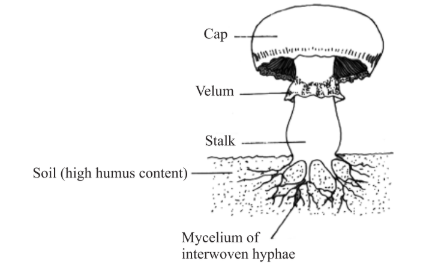
14. Draw a neat and labelled diagram of any edible basidiomycetes you have studied.
Ans: Mushroom
15. In a fruit basket, one apple was rotten, and after two days other apples also became rotten. Name the hormone which caused this rotting, and also state another function of this hormone. Ans: The hormone is ethylene. It promotes senescence and abscission of leaves and flowers.
16. Define hypervitaminosis. Give its cause.
Ans: The disease caused by the presence of vitamins in excessive quantities in the body is called hypervitaminosis. Intake of fat-soluble vitamins (vitamin A and D) can be toxic (poisonous) to the body, which may lead to certain diseases.
17. Name the type of epithelial tissue found in the following organs:
(i) lining of the small intestine.
(ii) lining of the air sacs in the lungs.
(iii) the skin.
(iv) lining of the trachea.
Ans:
- Columnar epithelium
- Squamous epithelium
- Stratified epithelium
- Ciliated columnar epithelium
18. List any four factors responsible for the unchecked growth of population in India.
Ans: Any four
- Advancement in agriculture
- Advancement in medicine
- Religious and social customs
- Industrialization
- Illiteracy
- Economic reasons
- Desire for a male child
19. Where can you locate the following structures in plants?
(i) Bulliform cells
(ii) Hydathodes
(iii) Perianth
(iv) Verticillaster
Ans:
- Epidermis of monocot leaves
- On leaves of angiosperms in a humid climate
- Flowers of the Lily family. Eg. Onion
- On the axil of leaves in Ocimum, as a series of condensed dichasial cymes at each node.
20. How will you differentiate between mutualism and symbiosis? Give appropriate examples.
Ans: Mutualism is a close association between two species in which both species benefit. Symbiosis is a type of mutualism where the interacting species cannot live without each other, as they depend completely on each other for their survival.
4 MARKS QUESTIONS
21. (a) With the help of a flow chart, show the non-cyclic photophosphorylation taking place during photosynthesis, highlighting the products formed in this phase.
(b) Where does this cycle take place in plants?
Ans:
- Non-cyclic photophosphorylation
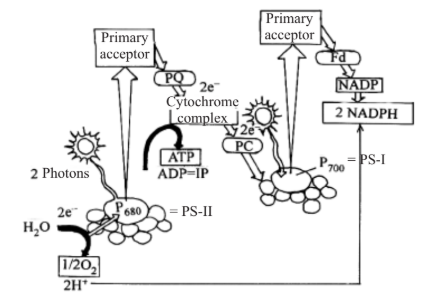
- This takes place in the thylakoids of the chloroplast.
22. (a) Draw a diagrammatic representation of the structure of antibody and label the specific antigen-binding site.
(b) Name the two subclasses of lymphocytes and state their main function.
Ans:
- Antibody
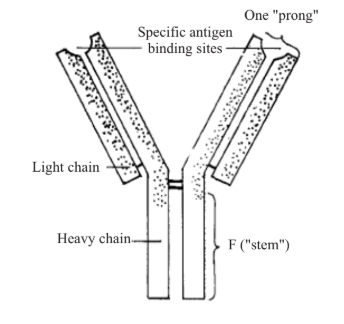
- Subclasses of lymphocytes are,
- T-cells or T-lymphocytes: Mediate cell-mediated immune response and induce B-cells to produce antibodies.
- B-cells or B-lymphocytes: Initiate antibody-mediated immune response and transform into plasma which secrete antibodies.
23. Draw a neat diagram of a mature Ovule in angiosperms and label the embryo sac and its contents.
Ans:
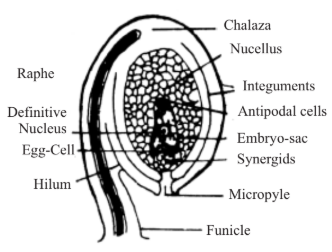
24. Give the scientific names of the following :
(i) Onion
(ii) Anyone bryophyte
(iii) The fungus from which penicillin is extracted.
(iv) Anyone annelid
Ans:
(i) Onion: Allium sepa
(ii) Any one bryophyte: Funaria
(iii) The fungus from which penicillin is extracted: Penicillium notatum
(iv) Any one annelid: Nereis
25. (a) Distinguish between leading strand and lagging strand with the help of appropriate diagram.
(b) Distinguish between nucleoside and nucleotide.
Ans:
- Leading and lagging strands
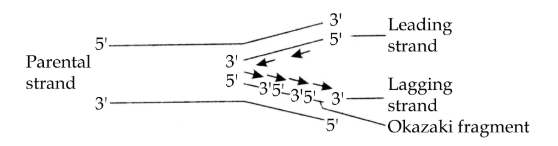
- Nucleoside and Nucleotide: When a base and a sugar combine, it forms a nucleoside. When a nucleoside combines with a phosphate group, it becomes a nucleotide.
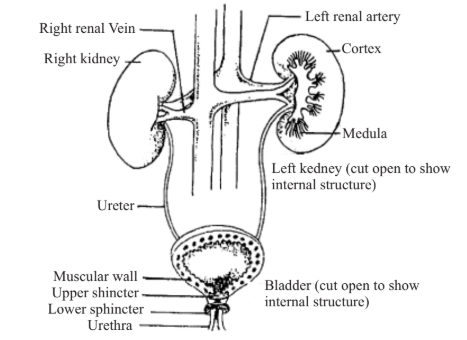
26. Draw a neat and labelled diagram of the excretory system in humans.
Ans: Excretory system in humans
6 MARKS QUESTIONS
27. (a) Classify the following abnormalities under autosomal and sex-chromosomal disorders and state (i) the Karyotype and (ii) the sex expressed in each case: Klinefelter’s syndrome, Down’s syndrome, Turner’s syndrome.
(b) Name a pre-diagnostic technique by which hereditary disorders can be detected in the foetus.
(c) A colour blind man marries a woman who has normal colour vision. A son and a daughter born to them are colour blind. Explain this with the help of a self-explanatory flow chart.
Ans:
- Autosomal and sex-chromosomal disorders
| Abnormality | Karyotype | Sex expressed | |
| Klinefelter’s syndrome | Sex-chromosomal | 44+XXY | Male |
| Down’s syndrome | Autosomal | 47, XY or 47, XX | Male or female |
| Turner’s syndrome | Sex-chromosomal | 45+XO | Female |
- Amniocentesis
- For both the son and daughter to be colour blind, the mother has to be a carrier as the gene for colour blindness comes from the X chromosome. Since the mother has normal vision, she carries a normal gene. Thus, their genotypes could be
Father: XᶜY (affected) and Mother: XᴺXᶜ (carrier)
| Xᴺ (mother) | Xc (mother) | |
| Xᶜ (father) | XᶜXᴺ | XᶜXᶜ |
| (daughter — carrier, normal vision) | (daughter — colour blind) | |
| Y (father) | XᴺY | XcY |
| (son — normal vision) | (son — colour blind) |
28. (a) (i) Seema has cut her finger and blood is coming out from the cut. A sequence of reactions takes place to prevent the loss of blood. Enumerate the steps involved in the process.
(ii) What is the process known as?
(iii) Name a genetic disorder in which bleeding does not stop naturally.
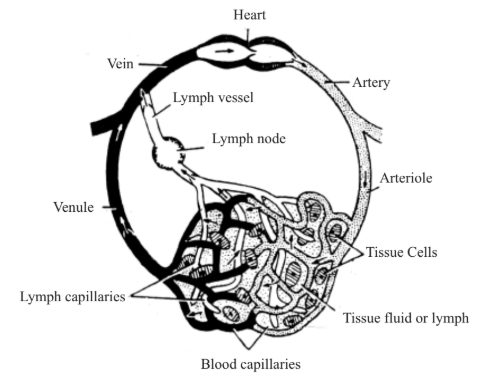
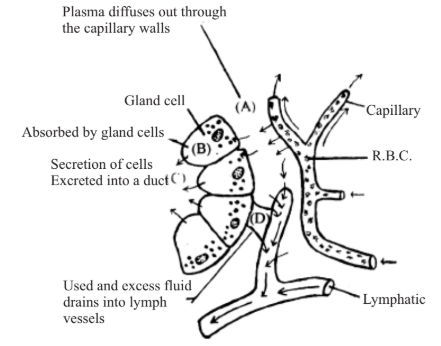
(b) With the help of flow charts, show the difference between the routes of blood and lymph flow in our body.
Ans:
- Blood loss prevention
- The sequence of reactions that takes place to prevent loss of blood.
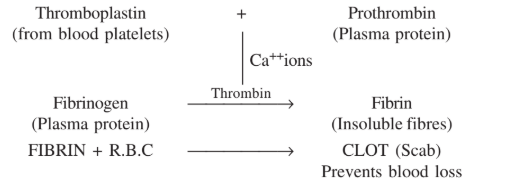
- Coagulation or clotting of blood
- Haemophilia
- Blood and Lymph flow
- Blood route
- Lymph flow
29. (a) What do you understand by sustainable development? State any two activities which will help in achieving this.
(b) Distinguish between in-situ and ex-situ strategies for conservation of biodiversity.
(c) Name any two wildlife Reserves in India and also name the species found in them.
Ans:
- Sustainable development is the development that meets the needs of the present generation and conserves resources for future generations.
- Reducing excessive use of resources and enhancing resource conservation.
- Recycling and reuse of waste materials.
- Scientific management of renewable resources, especially bio-resources.
- Planting more trees.
- Green grassy patches are to be interspersed between concrete buildings.
- Using more environmentally friendly materials or biodegradable materials.
- Use of technologies which are environmentally friendly and based on efficient use of resources.
- In situ and Ex situ strategies
- In-situ (on-site conservation includes the protection of plants and animals within their natural habitats or in protected areas. Protected areas are areas of land or sea dedicated to the protection and maintenance of biodiversity. For example: e.g., National Parks, Wildlife Sanctuaries, Biosphere Reserves, etc.
- Ex-situ (off-site) conservation is the conservation of plants and animals outside their natural habitats. These include Botanical Gardens, Zoo, Gene Banks, DNA Banks, Seed Banks, Pollen Banks, Seedling and Tissue Culture, etc.
- Wildlife reserves in India
- Kaziranga sanctuary (Assam) – one-horned rhinoceros
- Gir forest (Gujarat) – lions, chital, sambar, wild bears
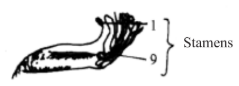
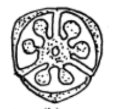
30. (a) Draw neat and labelled diagrams of the following:
(i) Stamens in Pea flower.
(ii) A hypogynous flower.
(iii) Axile placentation.
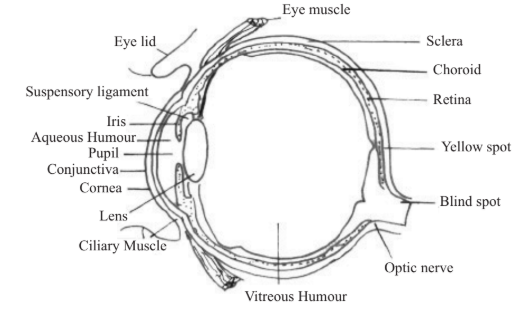
(b) Draw a neat diagram of the Vertical section of the human eye and label the following parts:
Aqueous humour; Vitreous humour; Yellow spot and Cornea.
Ans:
- Stamens in Pea flower
- Hypogynous flower

- Axile placentation
- VS of the human eye
Additional Study Materials
- NIOS Class 12 Biology PYQ April 2025 Set A
- NIOS Class 12 Biology PYQ Oct 2024 Set A
- NIOS Biology Paper 2024 April Set A Solved
- NIOS Class 12 Biology PYQ April 2023 Set A
- NIOS Class 12 Biology PYQ Oct 2022 Set A
- NIOS Class 12 Biology PYQ April 2022 Set A
- NIOS Class 12 Biology PYQ Feb 2021 set A
- NIOS Class 12 Biology PYQ Oct 2021 Set A
- NIOS Class 12 Biology PYQ Oct 2019 Set A
- NIOS Class 12 Biology PYQ April 2019 SetA