The NIOS Biology Circulation of Body Fluids Solutions covers the human circulatory system. Students learn about blood, lymph, heart functions, and circulation. It explains the transportation of gases and nutrients throughout the body.
Terminal exercise solutions are included for easy revision and exam practice. This chapter helps students connect physiology with health. It is essential for mastering human biology and preparing thoroughly for the NIOS Class 12 Biology examinations.
NIOS Biology Circulation of Body Fluids
1. Give one function of each of the following:
- (i) R.B.C.
- (ii) Platelets
- (iii) Plasma
(i) R.B.C. Functions
Transport of oxygen to tissues and a large amount of carbon dioxide back to the lungs
(ii) Platelet Functions
Initiate blood clotting.
(iii) Plasma Functions
- Transport of products of digestion from the small intestine to various tissues.
- Transport of waste products from tissues to excretory organs.
- Transport of hormones from endocrine glands to target organs.
- Maintenance of temperature by the distribution of heat all over the body.
- Provides factors for clotting of blood (Fibrinogen).
- Retention of fluids in blood (through plasma proteins).
- Maintenance of acid-base equilibrium in the blood.
- Provides body immunity through antibodies (Immunoglobulins), which are made by one kind of WBC and then released into the plasma.
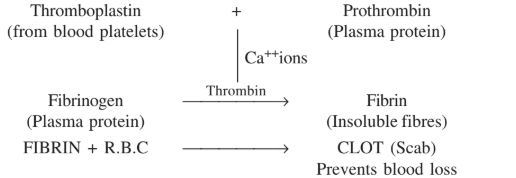
2. With the help of a flow chart, describe the steps involved in the coagulation of blood.
3. Why is a person with blood group AB called a universal recipient?
Blood group AB can receive blood from all other groups and is thus called A universal Recipient. There are no antibodies present in the blood of Group AB, so there will be no reaction with antigens of other blood groups.
4. Differentiate between the systolic and diastolic pressures. What are the values of these pressures for a normal human adult?
- The pressure of blood at the time of ventricular contraction is called systolic pressure. It should be 120 mm of mercury.
- The pressure when the ventricles are relaxed and are being filled by blood is called diastolic pressure. It must be 75 mm of mercury.
5. Give three differences between lymph and blood.
- Blood is red and lymph is colorless.
- Blood flows rapidly, while lymph flow is very slow.
- Blood contains RBCs, WBCs, platelets, and plasma. Lymph contains plasma and WBC.
- Blood flows from heart → arteries → capillaries → veins → heart
Lymph flows from Tissue spaces → lymph capillaries → lymph vessels → subclavian vein → heart.
6. What is immunity? Differentiate between active and passive immunity.
Immunity is the body’s ability to resist or protect itself from the harmful effects of disease
producing substances or organisms.
- Active Immunity: Develops during exposure to disease-causing germs. The body produces antibodies that remain in the blood to prevent further infection by that particular pathogen or disease-causing organism. A vaccine containing weakened germs is administered to provide active immunity, e.g DPT vaccine is given for developing immunity against diphtheria, pertussis (whooping cough), and tetanus, and the BCG vaccine is given for immunity against tuberculosis.
People also develop immunity against chicken pox, smallpox pox and measles after suffering from these diseases. This form of immunity is usually lifelong immunity.
- Passive Immunity: This form of immunity is short-lived. It is developed by injecting ready-made antibodies (collected from other animals). Anti-tetanus serum (ATS vaccine) provides temporary immunity against tetanus.
7. What are (i) hypertension and (ii) atherosclerosis?
- The state of having high blood pressure is called hypertension. It is usually related to stress, overweight, age, or a faulty diet.
- Deposition of fat on the inner wall of the arteries is called atherosclerosis or atheroma.
8. What is an ECG, and what is its function?
An electrocardiograph is a machine that can record the heartbeat like a graph, which is called an electrocardiogram (ECG). From the ECG, the doctor can make out which chamber of the heart is not contracting or relaxing properly and suggest treatment accordingly.