Class 12 Food Production Compartment Exam 2025
SECTION A
(Objective Type Questions) (30 Marks)
1. Answer any 4 out of the given 6 questions on Employability Skills. 4×1=4
(i) In RESPECT, ‘R’ stands for:
(A) Remember
(B) Remove
(C) Receive
(D) Respond
(ii) __________ is a state of feeling upset and annoyed.
(A) OCPD
(B) Antisocial personality disorder
(C) Stress
(D) Histrionic personality disorder
(iii) LibreOffice Impress is used to make a/an ___________.
(A) Presentation
(B) Word file
(C) Excel Sheet
(D) Workbook
(iv) The ability to make the optimum use of time, energy, and resources to achieve the desired goals is:
(A) Perseverance
(B) Interpersonal skills
(C) Decisiveness
(D) Organisational skills
(v) It is the community of living and non-living beings existing together:
(A) Ecosystem
(B) Environment
(C) Greenhouse
(D) NAPCC
(vi) The first step one needs to take to meet the target is:
(A) Work hard
(B) Make a calendar
(C) Set clear goals
(D) Prepare action plan
2. Answer any 5 out of the given 7 questions. 5×1=5
(i) To prevent curdling of curd, a spoon of ___________ may be mixed with it.
(A) Cashew paste
(B) Flour
(C) Besan
(D) Cream
(ii) Goda masala is commonly used in which cuisine?
(A) Maharashtrian
(B) Andhra Cuisine
(C) Awadhi
(D) Gujarati
(iii) Fresh green gherkin used to prepare vegetable or pulao is:
(A) Val
(B) Vatana
(C) Tindli
(D) Ver
(iv) During which century, did fast food restaurants begin to open in the US?
(A) Mid 18th
(B) Mid 19th
(C) Mid 20th
(D) Mid 21st
(v) The ideal storing temperature for yeast is:
(A) 30°C – 45°C
(B) 15°F – 30°F
(C) 20°C – 30°C
(D) 30°F – 45°F
(vi) Match the following:
| 1. Jaggery | (i) Flavouring |
| 2. Pistachio | (ii) Garnishing |
| 3. Rose Petals | (iii) Cooking medium |
| 4. Desi Ghee | (iv) Sweetening |
Choose the correct option:
(A) 1-(i), 2-(ii), 3-(iii), 4-(iv)
(B) 1-(iv), 2-(i), 3-(iii), 4-(ii)
(C) 1-(iv), 2-(i), 3-(ii), 4-(iii)
(D) 1-(ii), 2-(i), 3-(iii), 4-(iv)
(vii) Plat du jour is also known as:
(A) dessert of the day
(B) dish of the day
(C) chef’s choice
(D) dish of the week
3. Answer any 6 out of the given 7 questions. 6×1=6
(i) It is no onion, no garlic stir-fried chickpea with spices and coconut:
(A) Fafda
(B) Chikhvi
(C) Chhena Poda
(D) Channa Sundal
(ii) The menu which is prevalent in transport catering is:
(A) Fixed menu
(B) Cyclic menu
(C) A la carte
(D) Table d’hote
(iii) The major ingredient of Tabak Maaz is:
(A) Chicken
(B) Mutton
(C) Lamb
(D) Fish
(iv) Tomatoes used for preparation of Makhani gravy should be:
(A) Deep red and not too sour
(B) Red and sour
(C) Deep red and sour
(D) Deep red and soft
(v) Which of the following is used to thicken the Goan soup Caldo Verde?
(A) Carrot
(B) Flour
(C) Corn starch
(D) Potato
(vi) Identify the fresh herb:
(A) Arugula
(B) Mustard
(C) Chives
(D) Peas
(vii) Calculate the food cost when food cost percentage is 48 and total sale is ₹ 1,200.
(A) ₹ 57,600
(B) ₹ 576
(C) ₹ 2,500
(D) ₹ 2,576
4. Answer any 5 out of the given 6 questions. 5×1=5
(i) Thin crust samosa is known as:
(A) Potli Samosa
(B) Uddina Samosa
(C) Bohri Samosa
(D) Lahori Samosa
(ii) Telephone bill is an example of:
(A) Semi-variable cost
(B) Fixed cost
(C) Variable cost
(D) Direct cost
(iii) Bacteria does not require _________ for growth.
(A) Warmth
(B) Food
(C) Air
(D) Moisture
(iv) The state which is the home of the famous Murrah buffaloes is:
(A) Punjab
(B) Haryana
(C) Uttar Pradesh
(D) Gujarat
(v) The favourite sweet of Lord Jagannath, which means burnt cheese, is:
(A) Chhena Poda
(B) Chhena Murki
(C) Chhena Jilapi
(D) Chhena Pahala
(vi) To permit shortening to function properly, it must be:
(A) Hard in texture
(B) In liquid form
(C) Too hard in cold weather and too soft in hot weather
(D) Uniformly distributed in the dough
5. Answer any 5 out of the given 6 questions. 5×1=5
(i) Choose the incorrect pair:
(A) Gathiya: Gram flour
(B) Khaman: Rice and Chickpeas
(C) Poha: Pressed Rice
(D) Misal Pav: Moth beans
(ii) A person harbouring food poisoning bacteria in the intestinal tract is called:
(A) Inhibitor
(B) Server
(C) Carrier
(D) Activator
(iii) The famous meal of Namboodiri Brahmins of Kerala is:
(A) Sadya
(B) Sidu
(C) Ada
(D) Huli
(iv) The fudgy, chewy form of burfi made with milk, sugar, nuts, and ghee is:
(A) Peda
(B) Dodol
(C) Doda
(D) Mohanthal
(v) Identify the odd one out:
(A) Sabudana Chips
(B) Thepla
(C) Poppaddums
(D) Khakras
(vi) The dish of small-sized prawns stewed in boiled onion and coconut milk gravy is:
(A) Kozhi curry
(B) Sooley
(C) Caldeen
(D) Chingri malai curry
6. Answer any 5 out of the given 6 questions. 5×1=5
(i) Identify the type of dal used as filling of Dal Kachori:
(A) Chana Dal
(B) Moth Dal
(C) Urad Dal
(D) Moong Dal
(ii) Which of the following is a dehydrated food?
(A) Spaghetti
(B) Sardines
(C) Ham
(D) Poultry
(iii) Dried dumplings made from a mix of dal and spices, sundried and stored is:
(A) Sangri
(B) Kachri
(C) Mangodi
(D) Papad
(iv) Blindness can be caused by consumption of:
(A) Copper
(B) Zinc
(C) Pesticide
(D) Mercury
(v) Sweetening agent used in Paruppu Payasam is:
(A) Sugar
(B) Jaggery
(C) Sugarcane juice
(D) Brown sugar
(vi) Which of the following is not a good food habit?
(A) Including serving of salad
(B) Including seasonal vegetables
(C) Including curd and buttermilk
(D) Including saturated fats
SECTION B
(Subjective Type Questions) (30 Marks)
Answer any 3 out of the given 5 questions on Employability Skills. Answer each question in 20 – 30 words. 3 x2=6
7. List all the supporting parts of speech.
Ans: Supporting parts of speech are:
- Articles
- Conjunctions
- Prepositions
- Interjections
8. Give two suggestions to become result-oriented.
Ans: Two suggestions to become result-oriented:
- Set clear goals
- Prepare an action plan
- Use the right resources and tools
- Communicate with mentors and peers
- Make a Calendar
- Work Hard
9. Write the steps to insert images in presentation.
Ans: Steps to insert an image in a presentation:
- Click on Insert from the menu
- Select image
- An insert image dialog box appears
- Browse through folders and select the image
- Click on open
10. How do Start-ups seek financial investment?
Ans: Startups seek financial investment differently than most small businesses. They rely on capital that comes via angel investors or venture capital firms and also from global investors.
11. List green jobs in waste management.
Ans: Green jobs in waste management: e-Waste recycling, solid waste management, waste reduction, waste auditing, waste control.
Answer any 3 out of the given 5 questions in 20 – 30 words each. 3 x2=6
12. Write any two snacks which are made from refined flour.
Ans: Two snacks which are made from refined flour:
- Samosa: A conical-shaped crust is prepared with refined flour dough. This is then filled with a spicy mixture of potatoes, sealed, and deep-fried.
- Dal Kachori: A flaky and soft-textured deep-fried crust of refined flour, filled with a spiced mixture of urad dal.
13. How is boiled onion paste and melon seed paste prepared?
Ans: Boiled onion paste – Peel and cut onions into about 1” chunks. In a pot, cover with water and bring to a boil. Simmer till the onions are translucent and tender, and let it cool. Grind along with the cooking liquid to make a paste. Melon seed paste – Wash melon seeds. Cover with water. Bring to a boil and simmer till tender. Cool Grind to a smooth paste.
14. Write any two differences between Jalebi and Imarti.
Ans: Difference between Jalebi and Imarati:
- Jalebi is prepared by refined flour batter, whereas Imarti is prepared by using moong dal batter.
- Jalebi is a spiral-shaped sweet, whereas Imarati is a flower-shaped sweet.
15. Why is a balanced diet and type of meal important to consider while planning a menu?
Ans: Balanced diet – Principle of nutrition is an important factor to be considered for menu planning. For example, a family may have members of all age groups, like an infant, adolescent, adult,and pregnant
lady, old person, etc.
Type of meal – For a menu to be good, one should know which meals they are in charge of, for example, breakfast, lunch, a dinner.
16. Give two points of difference between organic and inorganic waste.
Ans: Difference between organic and inorganic waste:
| Organic | Inorganic |
| (1) It is biodegradable | (1) It is non-biodegradable |
| (2) Can be processed in the presence of Oxygen by composting or in the absence of oxygen, using anaerobic digestion. | (2) It cannot be processed, but can be sent for recycling. |
Answer any 2 out of the given 3 questions in 30 – 50 words each. 2 x3=6
17. Enumerate the types of material cost with suitable examples.
Ans: Types of material cost:
- Direct Materials: Materials that are present in the finished product or can be identified in the product are called direct materials. Example – Vegetables, Meat, Milk purchased for a specific job.
- Indirect Materials: Materials that do not normally form part of the finished product are known as indirect materials. Example: Stores used for maintaining machines and buildings, a canteen.
18. Write about the following:
(a) Dal Bafla
(b) Malpua
(c) Bhutte ki Kees
Ans:
- Dal Bafla: It is a dish that hails from the heart of India, that is, Madhya Pradesh. It is similar to the Rajasthani staple dal bati or the Bihari dish litti. The dish is essentially a ball of baked dough that is mixed with toor dal.
- Malpua: It is mainly prepared with flour, fried in ghee, and then dipped in sugar syrup. It is best served with rabdi for a complete treat.
- Bhutta ka kees: Grated corn roasted in ghee and later cooked in milk with spices.
19. (a) How are dust and dirt responsible for contamination?
(b) Write two ways to prevent contamination by dust and dirt.
Ans:
- Soil and dust contain spores of food poisoning bacteria called Clostridium perfringens. It is therefore important that kitchens are cleaned regularly and kept relatively free of dust.
- Two ways to prevent contamination:
- Always clean raw vegetables in separate rooms.
- Cover the cooked food and store it away during the cleaning of the kitchen.
- Empty dustbins regularly and don’t allow them to overflow.
Answer any 3 out of the given 5 questions in 50 – 80 words each. 3 x4=12
20. (a) Define the term fast food.
(b) Write any six salient features of fast foods.
Ans: Fast food refers to those types of foods that are easily prepared in mass quantities and are served quickly. The focus is on the speed of service and the affordable prices of the items.
Salient features of fast food.
- It specializes in one particular product.
- Variations in the menu are based on one product.
- Products can be prepared quickly and can be held for a short while without spoilage.
- It relies heavily on the availability of convenience products.
- Ensure good portion control as convenience products form the base, and the presentation is clearly displayed over the counter for the customers to know.
- It concentrates on pricing the items moderately and selling them in volume to gain more profit.
21. Enlist four functions each of milk and eggs in baking.
Ans: The Functions of milk are
- Increases absorption and dough strengthening
- Increases mixing tolerance
- Enhance the longer fermentation
- Improves better crust colour
- Improves better grain and texture
- Increase loaf volume
- Improves keeping quality
- Provides nutrition (Any Four)
The functions of eggs are:
- They add colour
- Improves the grain and texture
- Increases volume
- Give structure to the product
- Adds flavor
- Provides nutrition
22. Your brother wants to add variety to his restaurant menu. Guide him in four ways to bring variety to his menu.
Ans: Four ways to add variety
- Selection of foods from different food groups – If selected from a single food group are neither acceptable nor balanced.
- Variety in colour combination – Blending of different colours makes food attractive, eye appealing, and also enhances appetite.
- Variety in texture – A meal won’t be nice if all the foods are either fried or boiled or full of juice. It should have combinations of all.
- Variety in taste and flavor – A meal will tempt only if it has a variety of flavors and aromas.
- Variety in methods of cooking: (Any Four)
23. Differentiate between the following:
(a) Patrapoda Macha and Patrani Macchi
(b) Sakkarai Pongal and Ven Pongal
Ans:
(a) Patrapoda Macha and Patrani Macchi
- Patrapada Macha – Fish is marinated in spices and a paste of mustard seeds, poppy seeds, cumin seeds, etc. It is wrapped ina banana leaf and steamed. This is served hot with rice.
- Patrani Machi – A Parsi preparation in which fish fillet is covered with chutney made up of green coriander, green chillies, coconut, etc. is wrapped in banana leaves and steamed.
(b) Sakkarai Pongal and Ven Pongal
- Sakkarai Pongal – Newly harvested rice and moong dal are cooked together in a new clay pot. It is usually sweet in taste.
- Venn Pongal – Newly harvested rice and moong dal are cooked together in a new clay pot. It can be made savory using salt and pepper.
24. The following information was extracted from the books of a restaurant for the month of June:
| Receipts | Amount (₹) |
| Sales | 30,000 |
| Opening Stock | 2,500 |
| Closing Stock | 3,200 |
| Purchases | 13,000 |
| ESI | 300 |
| Wages and Salaries | 5,600 |
| Gas and Electricity | 800 |
| Repair and Renewals | 1,000 |
| Rent and Rates | 1,800 |
| Insurance | 400 |
| Postage and Telephone | 200 |
| Printing and Stationery | 300 |
| Depreciation | 2,000 |
Find Out: Food Cost, Food Cost Percentage, Labour Cost, Labour Cost Percentage, Overhead Cost, Overhead Cost Percentage
Ans:
(a) Food cost = Opening stock + Purchases – Closing Stock – (Staff meal + Food as Complementary)
= 2,500 + 1,300 – 3,200 – (800 + 500)
= 15,500 – 3,200 – (1,300)
= 12,300 – 1,300
= ` 11,000/-
= 36.67%
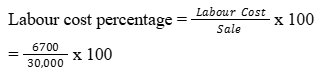
Labour Cost =
| Wages and Salaries | 5600 |
| E.S.I. | 300 |
| Staff meal | 800 |
| Total | 6700 |
= 22.33%
Overhead Cost =
| Gas and Electricity | 800 |
| Repair and renewals | 1,000 |
| Rent and rates | 1,800 |
| Insurance | 400 |
| Postage and telephone | 200 |
| Printing and Stationery | 300 |
| Depreciation | 2,000 |
| Food as Complementary | 500 |
| Total | 7000 |
= 23.33%
Additional Study Materials
- Food Production PYQ 2025 Solved
- Food Production PYQ 2024 Solved
- Food Production PYQ 2023 Solved
- Food Production PYQ 2022 Solved
- Food Production PYQ 2020 Solved