Class 12 Agriculture Sample Paper 2024 Solved
SECTION A: OBJECTIVE TYPE QUESTIONS
1. Answer any 4 out of the given 6 questions on Employability Skills (1 x 4 = 4 marks)
i. What is a sentence?
a. A group of ideas that form a complete paragraph
b. A group of words that communicates a complete thought
c. A set of rules that we must follow to write correctly
d. A set of words that contains basic punctuation marks
ii. Mrs. Sharma’s children fall sick very often. They have cold and cough every month. What should she do?
a. Grow organic food in kitchen garden
b. Use air purifiers with HEPA filters
c. Keep them inside the house all the time
d. Paint her house with non-VOC paint
iii. Rohan has feelings of emptiness, abandonment, and suicide. What type of personality disorder is this?
a. Borderline
b. Dependent
c. Avoidant
d. Obsessive
iv. An entrepreneur who starts a business, nurtures it, and makes it reach a point of self-sustenance is –
a. Technical
b. Industrial
c. Professional
d. Non-technical
v. What does S stands in acronym SMART to set goals?
a. Specific
b. Sustainable
c. Special
d. Safety
vi. A ______ is an arrangement of cells in a horizontal manner.
a. Column
b. Row
c. Cell
d. Worksheet
2. Answer any 5 out of the given 7 questions (1 x 5 = 5 marks)
i. Name any two types of mushrooms.
Ans: Paddy straw mushroom and White button mushroom.
ii. Name any two value-added products of tomato.
Ans: Tomato ketchup and Tomato Puree
iii. Name the two ultra-micro nutrients.
Ans: Mo and Co
iv. Name any two plant species that are used in biopesticide formulation.
Ans: Chrysanthemum, Azadirachta
v. ICMR, New Delhi, recommendation of consumption of fruits per capita every day for balanced diet is.
Ans: 120g
vi. Name any two propagation structures used in nursery.
Ans: Shade house and mist house
vii. Name the three primary nutrients.
Ans: Nitrogen, Phosphorus, and Potassium
3. Answer any 6 out of the given 7 questions (1 x 6 = 6 marks)
i. Type of water which forms very thin film around soil particles and is not available to the plants.
Ans: Hygroscopic water
ii. Name two types of surface irrigation method.
Ans: Basin method and Furrow method
iii. Carrot is a good source of vitamin ____.
Ans: Vitamin A
iv. Name any two nutrients where deficiency symptoms appear on new leaves of the plant.
Ans: Fe and Mn
v. Early vegetative, tasseling and silking stage are critical stage of irrigation of crop.
Ans: Maize
vi. Name two epigeic (surface dwellers) species of earthworms used in Vermicomposting.
Ans: Eisenia fetida and Eiseniella tetraedra
vii. Name any two informal styles of gardens.
Ans: Buddhist garden and Japanese garden
4. Answer any 5 out of the given 6 questions (1 x 5 = 5 marks)
i. Name the largest species of honey bee.
Ans: Apis dorsata (The rock-bee)
ii. National Centre for Organic and Natural Farming is located at.
Ans: Ghaziabad, U.P.
iii. Name any two compulsory legislations for quality control of foods.
Ans: Prevention of Food Adulteration (PFA) Act, 1954, and Essential Commodity Act, 1955
iv. Zero energy cool chamber is based on principle of.
Ans: Direct evaporation cooling
v. Parasites which live inside the body of the host and derive their nutrition from it is known.
Ans: Endoparasite
vi. Treatment done with dematerialized water supplemented with germicides and acidified with citric acid to pH 4.0-5.0 in order to restore the turgor of flowers wilted after harvest, storage or transport is known as ______.
Ans: Conditioning/Hardening
5. Answer any 5 out of the given 6 questions (1 x 5 = 5 marks)
i. Name the chemical preservative which is commonly used products having natural colour such as anthocyanins.
Ans: Sodium Benzoate
ii. A honey bee colony has only one functional female known as ____.
Ans: Queen
iii. A nutrient which is essential component of Adenosine Triphosphate (ATP) which is
directly responsible for energy transfer reactions in plants.
Ans: Phosphorus
iv. Name any two fruit crops that are being organically grown and are exported.
Ans: Pineapple and cashewnut
v. Name any one test that determine the amount of pectin in fruit juices.
Ans: Jelmeter test
vi. Who is known as the Father of Canning.
Ans: M. Nicolas Appert
6. Answer any 5 out of the given 6 questions (1 x 5 = 5 marks)
i. Mention any two non-edible Oil Cakes.
Ans: Castor cake and cotton cake
ii. Name the food safety programme developed for NASA to ensure the safety of food products that were to be used by the astronauts in the space programme.
Ans: Hazard Analysis and Critical Control Point (HACCP)
iii. Name any two pre-cooling methods followed for rapid removal of the field heat from freshly harvested horticultural produce.
Ans: Hydro cooling and Forced air cooling
iv. Irradiation treatment is done for sprout inhibition in vegetable crops (Any two)
Ans: Onion and potatoes
v. Mention the principal form for uptake of potassium by plants is.
Ans: K+
vi. Name any fruit crops that are rich source of proteins.
Ans: Cashewnut and almond
SECTION B: SUBJECTIVE TYPE QUESTIONS
Answer any 3 out of the given 5 questions on Employability Skills (2 x 3 = 6 marks)
Answer each question in 20 – 30 words.
7. Why is listening attentively important? Support your answer with four reasons.
Ans: Four reasons why listening attentively is important-
- 1. to obtain information
- 2. to understand
- 3. to enjoy
- 4. to learn
- 5. to build and maintain relationships
- 6. to resolve conflicts
8. List four characteristics of entrepreneurship.
Ans: Four characteristics of entrepreneurship are-
- 1. An economic activity done to create, develop, and maintain a profit-oriented organisation.
- 2. It begins with identifying an opportunity as a potential to sell and make a profit in the market.
- 3. Deals with optimisation in the utilisation of resources.
- 4. It is the ability of an enterprise and an entrepreneur to take risks.
9. Give four ways to maintain positive attitude.
Ans: Four ways to maintain a positive attitude-
- 1. Start the day with a morning routine.
- 2. Feed the mind with positivity, read motivating books, listen to music with uplifting lyrics, watch inspiring movies, etc.
- 3. Be proactive.
- 4. Focus on constructive and positive things.
- 5. Learn from failures.
- 6. Learn to focus on the present.
- 7. Move towards your goals and dreams.
10. Enumerate four advantages of presentation software.
Ans: Four advantages of presentation software-
- 1. They are interesting as they have features like images, videos, animation, and music.
- 2. Making changes in digital presentations is easy.
- 3. A digital presentation can be shown to a much larger audience by projecting it on a screen.
- 4. The presentation can be printed and distributed to the audience.
11. Write four benefits of green jobs.
Ans: Four benefits of green jobs are-
- Increase the efficiency of energy and raw materials.
- Reduce greenhouse gas emissions.
- Control waste and pollution.
- Protect and restore ecosystems.
- Support adaptation to the effects of climate change.
Answer any 3 out of the given 5 questions in 20 – 30 words each (2 x 3 = 6 marks)
12. What is Organic agriculture?
Ans: Organic agriculture is a unique production management system that promotes and enhances agro-ecosystem health, including biodiversity, biological cycles, and soil biological activity, and this is accomplished by using on-farm agronomic, biological, and mechanical methods in exclusion of all synthetic off-farm inputs.
13. Enlist different methods of composting.
Ans: The Indian Bangalore Method, The Indian Indore Method, Indian Indore heap method, Indian Coimbatore method, NADEP method, ADCO Method.
14. What do you understand by term soil productivity?
Ans: The capability of soil to produce a specified crop yield under well-defined and specified systems of management of inputs and environmental conditions.
15. Enlist various principles of preservation of food.
Ans: There are three main principles:
- Prevention / delay the microbial decomposition of the food.
- Prevention / delay the shelf decomposition of the food.
- Prevention of damage by insects, animals, mechanical causes, etc.
16. What is Mega Food Parks Scheme?
Ans: The Mega Food Parks Scheme (MFPS) is the flagship program of the Ministry of Food Processing Industries (MFPI) during the 11th five-year plan. The scheme aims to accelerate the growth of the food processing industry in the country through facilitating the establishment of a strong food processing infrastructure backed by an efficient supply chain.
Answer any 2 out of the given 3 questions in 30– 50 words each (3 x 2 = 6 marks)
17. Mention the problems of Jelly making.
Ans: Problems of Jelly making
- Jelly failed to set: -Jelly failed to set due to the addition of too much sugar, lack of acid the end-point, cooking below the end-point, cooking beyond the end-point, and prolonged cooking.
- Cloudy or foggy jelly: -Cloudy or foggy jelly due to the use of non-clarified juice or extract, use of immature fruits, over-cooking, the non-removal of scum, faulty pouring, and premature gelation.
- Formation of crystals in jelly: -Formation of crystals in jelly due to the addition of excess sugar and also to over-concentration of jelly.
- Syneresis or weeping of jelly: – Syneresis or weeping of jelly is the phenomenon of spontaneous exudation of fluid from a gel is called syneresis and weeping, and is caused by excess of acid, too low concentration of sugar, insufficient pectin, premature gelation, and fermentation.
18. Differentiate between puffing and flaking.
Ans: Puffing: – Puffed grains are often used as breakfast cereals or as snack food. During puffing, grains are exposed to a very high steam pressure, which causes the grain to burst open. The puffed grains can be further processed by toasting, coating, or mixing with other ingredients.
Flaking: – Flaked cereals are partially cooked and can be used as quick-cooking or ready-to-eat foods. The grains are softened by partially cooking in steam. They are then pressed or rolled into flakes, which are dried. The flakes are eaten crisp and should have a moisture content of below 7%.
19. Write the deficiency symptoms of nitrogen in plants.
Ans:
- Stunted growth may occur because of a reduction in cell division.
- Pale green to light yellow colour (chlorosis) appears first on older leaves, usually starting at the tips.
- Depending on the severity of the deficiency, the chlorosis could result in the death and/or dropping of the older leaves.
- Plants are more susceptible to weather stress and disease.
- N deficiency causes early maturity in some crops, which results in a significant reduction in yield and quality.
Answer any 3 out of the given 5 questions in 50– 80 words each (4 x 3 = 12 marks)
20. Explain the importance of soil organic carbon and discuss in detail the various management practices and their functions that increase soil organic carbon.
Ans: Importance of Soil Organic Carbon: -While the agricultural sector can impact the carbon cycle on a large scale, often through the release of carbon, farmers have a vested interest in retaining and increasing soil organic carbon for individual fields because soil and yield tend to improve when the soil organic carbon level increases. Higher soil organic carbon promotes soil structure or tilth, meaning there is greater physical stability. This improves soil aeration (oxygen in the soil) and water drainage and retention, and reduces the risk of erosion and nutrient leaching. Soil organic carbon is also important to chemical composition and
biological productivity, including fertility and nutrient holding capacity of a field. As carbon stores in the soil increase, carbon is sequestered, and the risk of loss of other nutrients through erosion and leaching is reduced. An increase in soil organic carbon typically results in a more stable carbon cycle and enhanced overall agricultural productivity, while physical disturbances of
the soil can lead to a net loss of carbon into the surrounding environment due to the formation of carbon dioxide (CO2).
Management practices that can increase soil organic carbon
| Management practices | Functions and explanation |
| Conservation tillage practices | Conservation tillage practices, including no-till management, aid in storing soil organic carbon, keeping the physical stability of the soil intact.When reduced-till systems are combined with residue management and manure management, soil organic carbon can increase over time. |
| Crop residue management | Returning crop residue to the soil adds carbon and helps to maintain soil organic matter. |
| Cover crops | Conservation tillage practices, including no-till management, aid in storing soil organic carbon, keeping the physical stability of the soil intact. When reduced-till systems are combined with residue management and manure management, soil organic carbon can increase over time. |
| Manure and compost | Adding organic amendments such as manure or compost can directly increase soil carbon and also result in increased soil aggregate stability. This enhances the biological buffering capacity of the soil, resulting in greater yields and yield stability over time. |
| Crop selection | Perennial crops eliminate the need for yearly planting and increase soil organic carbon by root and litter decomposition post-harvest. Crops with greater root massin general, add to root decomposition and physically bond aggregates together. Using high-residue annual crops can also help reduce net carbon loss from cropping systems. |
21. Discuss about the various schemes of Government of India for promotion of organic farming in India.
Ans: The Government of India is promoting organic farming through various schemes like
- National Project on Organic Farming: – Under the National Project on Organic Farming (NPOF) scheme, assistance up to 25% and 33% of the financial outlay up to a ceiling of Rs. 40 lakhs and Rs. 60 lakhs, respectively, is provided as back ended subsidy through NABARD for production units and agro waste compost production units, respectively. Under NPOF, a total of 56 biofertilizer production units and 17 nos. of fruit/vegetable waste compost units have been established in the country. The government has been advocating integration use of chemical fertilizers and organic manures, including biofertilizers, for increasing the production of major crops.
- National Horticulture Mission: – Besides, under National Horticulture Mission (NHM) and Horticulture Mission for North East & Himalayan States (HMNEH), financial assistance is provided for setting up vermicompost production units @ 50% of the cost subject to a maximum of Rs. 30,000/ per beneficiary, for adoption of organic farming @ Rs. 10,000/ hectare for maximum area of 4 hectare per beneficiary and for organic farming certification @ Rs.5 lakh for a group of farmers covering an area of 50 hectares.
- Rashtriya Krishi Vikas Yojana: – Assistance for promotion of organic farming on different components is also available under Rashtriya Krishi Vikas Yojana (RKVY) with the approval of the State Level Sanctioning Committee.
- National Food Security Mission: – Under National Food Security Mission (NFSM) on Pulses, including Accelerated Pulses Production Programme (A3P), assistance for popularizing Rhizobium culture/Phosphate Solubilizing bacteria is provided to the farmers under cluster demonstrations.
- Promoting the use of Biofertilizer: The Central Government has notified biofertilizers like Rhizobium, Azotobacter, Azospirillum, Acetobacter, PSB, KMB, and Zinc Solubilizing bacteria under the Fertilizer Control Order (FCO). Similarly, under the Initiative for Nutritional Security through Intensive Millets Promotion (INSIMP) Programme, Phosphate Solubilising Bacteria/Azotobacter culture is provided to the farmers as part of the technology demonstration. Further, under the National Project on Management of Soil Health and Fertility (NPMSH&F), financial assistance of Rs 500 per hectare is provided to promote the use of organic manure.
- ICAR Contribution in Promoting Organic Farming: All India Network Project on Soil Biodiversity -Biofertilizers is implemented by the Indian Council of Agricultural Research (ICAR) for R&D on biofertilizers. The ICAR has developed technologies to prepare various types of organic manures such as phosphocompost, vermicompost, municipal solid waste compost, etc. Improved and efficient strains of biofertilizers specific to different crops and soil types are being developed under the Network Project on biofertilizers.
The financial assistance is provided on the basis of project proposals received from States, including Maharashtra. Indian Council of Agricultural Research (ICAR) under Network Project on Organic Farming, with lead center at Project Directorate for Farming Systems Research, Modipuram, is developing a package of practices of different crops and cropping systems under organic farming in different agro-ecological regions of the country.
22. Discuss in detail the various post-harvest factors affecting the post-harvest quality of flowers.
Ans: Post-Harvest Factors
- Water relations: The termination of the life of the harvested flowers depends on water uptake and transport, water loss, and the capacity of the flower tissue to retain its water. A water deficit and wilting develop when the transpiration exceeds the absorption of water. The rate of water uptake of cut flowers depends on transpiration pull, temperature, and composition of solutes. Disruption of water columns in stem vessels by air embolism and resistance to water flow in stems also develops a water deficit. Acidification of water and addition of wetting agent and flower food in the holding solution markedly improve water uptake of cut flowers.
- Respiration: The rate of respiration depends on the quantity of carbohydrates available in the harvested flowers, temperature, and the use of certain chemicals to regulate it. With higher temperatures, there is a faster rate of respiration and burning of the tissue. Consequently, the life of flowers is shortened.
- Relative humidity: It has, bearing on the transpiration rate. The higher the humidity in the air, the lower the transpiration rate, and vice versa.
- Growth regulators: Postharvest life of flowers can be controlled by growth regulators. Water relations changes associated with flower senescence are also influenced by growth regulators. Cytokinins delay the senescence of some cut flowers. Depending upon the concentrations, GA in some cases promotes longevity of flowers, while this is also used in bud-opening solutions. The IAA promotes ethylene production of isolated carnation petals. In contrast, the senescence and abscission of poinsettia flowers are delayed by auxin.
- Preservative solution: Preservatives in the form of tablets or powder are prepared from a mixture of chemicals -sugars, germicides, salts, and growth regulators. Various types of conditioners are sugar and biocide, antiethylene compound, and hydrated compound. The flowers like gladiolus, carnation, chrysanthemum, and freesia benefit most from the pretreatment.
Anti-ethylene compounds in preservative solutions reduce the action of ambient ethylene as well as the autocatalytic production of ethylene by fresh cut flowers. Fresh cut flowers responding to silver thio sulphate are carnation, orchids, gypsophila, gladiolus, gerbera, snapdragon, alstromeria, agapanthus, anemone, and sweet pea.
The greatest improvement in cut flower quality and longevity is obtained when DICA or DDMH is combined with sucrose.
- Pre-cooling and storage: Precooling is essential for removing field heat from flowers. This is done either by forced air cooling or hydrocooling to bring down the temperature from 20 °C-30 °C to 10 °C in a relatively short period.
Other methods are room cooling and vacuum cooling. Flowers can be stored for a longer period at a low temperature. There are two methods of cold storage -wet and dry. The wet method is short-term storage, in which cut stems are dipped in water. Dry storage is a more labour-intensive method and is costly. The controlled atmosphere based on reduction of respiration rates, conservation of respirable substrates during storage, and delay in ethylene-triggered changes causes senescence.
It involves the use of an increased level of CO2 and decreased levels of O2 in the atmosphere, low storage temperature, and prevention of the build-up of endogenous ethylene.
- Packing and transporting: Lower rate of transpiration, respiration, and cell division during transportation are essential for long storage life and keeping quality. Before packing, flowers should be dried. They should be treated with systemic insecticides and miticides. Packing must ensure the protection of flowers against physical damage, water loss, and external conditions detrimental to transported flowers. Boxes made of corrugated fibre boards are good. Flowers sensitive to geotropic bending must be transported in an upright position. The flowers should be transported at an optimal low temperature. The relative humidity of the air during precooling and shipment of cut flowers should be maintained at the level of 95-98%.
Lack of light during prolonged transportation, particularly at high temperatures, causes yellowing of leaves in many flowers. Shipment of flowers is usually done by road, air, and sea. For short distances and time periods shorter than 20 hr, cut flowers may be transported in insulated trucks without refrigeration after precooling and proper packing. Air shipment is quickest, and usually, the temperature is not controlled during the flight. The flowers should be pulsed with STS before air shipment.
23. Describe in detailed manner the various principles of landscape gardening.
Ans: Principles of Landscape Gardening
- A. Balance: -Balance is a psychological sense of equilibrium. As a design principle, balance places the parts of a visual in an aesthetically pleasing arrangement. In visual images, balance is formal when both sides are symmetrical in terms of arrangement. Balance is informal when sides are not exactly symmetrical, but the resulting image is still balanced. Informal balance is more dynamic than formal balance and normally keeps the learner’s attention focused on the visual message. There are three main types of balance: horizontal balance, vertical balance, and radial balance.
- B. Proportion: -Proportion refers to the relative size and scale of the various elements in a design. The issue is the relationship between objects, or parts, of a whole. This means that it is necessary to discuss proportion in terms of the context or standard used to determine proportions.
- C. Perspective: Perspective is created through the arrangement of objects in two-dimensional space to make they appear in real life. Perspective is a learned meaning of the relationship between different objects seen in space. Perspective adds realism to a visual image. The size of a rectangle means little until another object gives it the size of a desk or the size of a building. Perspective can be used to draw the audience into a visual. Perception can be achieved through the use of relative sizes of objects, overlapping objects, and blurring or sharpening objects.
- D. Emphasis: Emphasis is used by artists to create dominance and focus in their work. Artists can emphasize color, value, shapes, or other art elements to achieve dominance. Various kinds of contrast can be used to emphasize a center of interest.
- E. Movement: The way the artist leads the eye in, around, and through a composition. The path the eye follows. Motion or movement in a visual image occurs when objects seem to be moving in a visual image. Movement in a visual image comes from the kinds of shapes, forms, lines, and curves that are used.
- F. Pattern: Pattern uses the art elements in planned or random repetition to enhance surfaces or paintings or sculptures. Patterns often occur in nature, and artists use similar repeated motifs to create patterns in their work. Pattern increases visual excitement by enriching surface interest.
- G. Repetition: Repetition works with pattern to make the artwork seem active. The repetition of elements of design creates unity within the artwork.
- H. Rhythm: Rhythm is the repetition of visual movement of the elements -colors, shapes, lines, values, forms, spaces, and textures. Variety is essential to keep rhythms exciting and active, and to avoid monotony. Movement and rhythm work together to create the visual equivalent of a musical beat.
- I. Variety: -Variety provides contrast to harmony and unity. Variety consists of the differences in objects that add interest to a visual image. Variety can be achieved by using opposites or strong contrasts. Changing the size, point of view, and angle of a single object can add variety and interest to a visual image.
- J. Harmony: -Harmony in visual design means all parts of the visual image relate to and complement each other. Harmony pulls the pieces of a visual image together. Harmony can be achieved through repetition and rhythm. Repetition reemphasizes visual units, connecting parts, and creating an area of attention. Rhythm is the flow depicted in a visual. Rhythm helps direct eye movement. Patterns or shapes can help achieve harmony. By repeating patterns in an interesting arrangement, the overall visual image comes together.
- K. Unity: -Unity means the harmony of the whole composition. The parts of a composition are made to work together as a total visual theme. Unity is the relationship among the elements of a visual that helps all the elements function together. Unity gives a sense of oneness to a visual image. In other words, the words and the images work together to create meaning.
- L. Contrast: -Contrast is in opposition to harmony and should not be overdone. Occasional contrasts are used to create an eye-catching feature in a garden; for example, contrasting foliage texture, colour, or form provides a focal point in the garden.
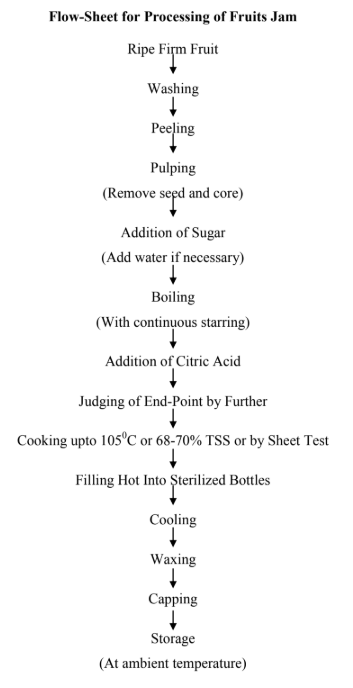
24. Enlist the various components of jam and explain the processing of Jam in detailed manner along with flow sheet for processing of fruits jam.
Ans: Components of Jam
- Fruit Pulp: -45%
- TSS: -68%
- Acidity: -0.5-0.6%
- Water: -33-38%
Processing of Jam
- Selection of fruit: -Fully ripe fruit should be harvested for Jam making. Jam is the best fruit for Jam making. Pineapple, carrot, strawberry, banana, peach, and pear are also used for jam making.
- Washing/Cleaning of fruit: – Fruit should be cleaned with clean water.
- Preparation of Fruit: -Fruit should be peeled and the core material removed for Jam making.
- Blanching: Blanching is the process of heating fruit or vegetables for a short time with steam or water, and it is an essential step before canning, drying, or freezing food. This heating process is not meant to cook the food but to inactivate substances that would otherwise adversely affect the nutrient content, colour, flavour, or texture during subsequent processing and storage.
- Cooking with Sugar: – Fruit pulp starts cooking with 1/3 quantity of sugar. After some time, add the remaining sugar.
- Adding of Citric Acid: – For enhancement of the test, citric acid should be added at 103 °C.
Judging of End-Point: –
- Sheet or Flake test: -A small portion of jam is taken out during boiling, in a spoon or wooden ladle, and cooled slightly; it is then allowed to drop. If the product falls off in the form of a sheet or flakes instead of flowing as a continuous stream or syrup, it means that the end-point has been reached and the product is ready; boiling is continued till the sheet is positive.
- Temperature: -105 °C.
- TSS: – 68-70%
- Weight Test: If the total weight of the jam is 1.5 times the weight of the sugar, the jam is prepared.
- Packing: The jam should be filled into a glass jar.
- Storage: -Jam should be stored in a dry and cool place.
Flow-Sheet for Processing of Fruit Jam
Class 12 Agriculture Sample Paper 2024 PDF
Click here to download CBSE Class 12 Agriculture Sample Paper 2024 and start your exam preparations.