
CBSE Class 12 Biotechnology Sample Paper 2026 Solved
Section – A 1 Mark
1. In which phase of growth is, specific growth rate of microbial culture calculated?
(a) Lag phase
(b) Exponential phase
(c) Stationary phase
(d) Intense metabolic activity phase
2. Name the type of animal cell culture which is prepared by inoculating directly from the parental tissue into nutrient media.
(a) Primary cell culture
(b) Secondary cell culture
(c) Spinner culture
(d) Transformed cell culture
3. Relationship between the number of genes and proteins is not linear because of-
(i) Alternative splicing of genes
(ii) Overlapping genes
(iii) Post-translational modification
(iv) Amplified DNA templates
(a) (i) (ii) and (iii) only
(b) (ii) and (iv) only
(c) (i) and (iv) only
(d) (ii), (iii) and (iv) only
4. Which of the following statement is incorrect about Agar?
(a) It is a polysaccharide.
(b) It is obtained from a red algae.
(c) It is present in both liquid and solid medium
(d) Solidifying agent
5. An example of secondary metabolites produced by microbial cells is:
(a) Vitamins
(b) Alcohol
(c) Amino Acids
(d) Antibiotics
6. YEp contains a gene coding for:
(a) X-Gal
(b) Β-galactosidase
(c) Leucine
(d) GFP
7. Reciprocal translocation between chromosome 9 and chromosome 22 forms-
(a) an extra-short chromosome 9 (der9)
(b) an extra-long Philadelphia chromosome (Ph1)
(c) Philadelphia chromosome (Ph1) with fused abl-bcr gene
(d) der 9 chromosome with fused abl-bcr gene
8. Which of the following statement on differences between homologues and paralogs are correct?
(i) Homologues have the same function whereas paralogs may differ in function.
(ii) Paralogs have the same function whereas homologues may differ in function.
(iii) Homologues are the sequences descended from a common ancestor whereas paralogs are duplicated genes within a genome.
(iv) Paralogs are the sequences descended from a common ancestor whereas homologues are duplicated genes within a genome.
(a) (i) and (iii)
(b) (ii) and (iv)
(c) (i) and (iv)
(d) (ii) and (iii)
9. Severe combined immunodeficiency disease is caused due to the absence of:
(a) Adenosine diphosphate
(b) Adenosine deaminase
(c) Adenosine cyclase
(d) Guanidine nitrate
10. A protein ion with a molecular weight of 10,000 Daltons carried a charge of 5+ and was subjected to mass spectrometric analysis. Calculate its mass to charge ratio.
(a) 2001
(b) 2000
(c) 2501
(d) 5001
11. Single nucleotide polymorphisms usually occur in __________ regions.
(a) Mini-satellite only
(b) Non-coding only
(c) Regulatory only
(d) Both Coding and non-coding
12. Which of the following is not a function of serum?
(a) Cell proliferation
(b) Promote healthy growth of cells
(c) Enhance cell attachment
(d) Provide sterile environment to cell culture
Question No. 13 to 16 consist of two statements – Assertion (A) and Reason (R).
Answer these questions selecting the appropriate option given below:
(a) Both (A) and (R) are true, and Reason (R) is the correct explanation of (A).
(b) Both (A) and (R) are true, but Reason (R) is not the correct explanation of (A).
(c) (A) is true and (R) is false.
(d) (A) is false and (R) is true.
13. Assertion (A) – OKT-3 can prevent graft rejection following kidney transplantation.
Reason (R) – OKT-3 helps immune cells which attack foreign grafts.
Ans: (c) (A) is true and (R) is false.
14. Assertion (A) – If batch culture is continuously fed with fresh medium without removing the growing culture, it is called Continuous culture.
Reason (R) – Continuous culture is widely used for production of biomass or metabolites.
Ans: (d) (A) is false and (R) is true.
15. Assertion (A) – Most of the commonly used cloning vectors contain multiple cloning sites.
Reason (R) – MCS provide flexibility in the choice and use of restriction enzymes.
Ans: (a) Both (A) and (R) are true, and Reason (R) is the correct explanation of (A).
16. ASSERTION (A) – Protoplast can be isolated by using cellulases, hemicellulases and pectinases.
REASON (R) – Protoplasts are plant cells without cell wall.
Ans: (b) Both (A) and (R) are true, but Reason (R) is not the correct explanation of (A).
Section – B 2 Marks
17. A. State the role of selectable marker gene in a cloning vector.
B. Why is small-sized cloning vector a desirable feature?
Ans: A. A gene whose product can identify the host cells containing the vector. This will help in the selection of transformed cells for growth.
B. A small-sized cloning vector is easy to manipulate, to facilitate entry/transfer into host cells.
18. A technician in a tissue culture laboratory accidentally removed the identification tag of a petri dish containing cells from a cancerous biopsy. How can he identify this petri dish among other petri dishes containing normal cells?
Ans: Cancerous cell cultures appear different from normal cells.
- i) They are more rounded in shape.
- ii) They pile on each other, showing no contact inhibition.
19. Attempt either option A or B
A. Why are CO2 incubators used to culture animal cells in lab?
Ans: A. Sterile environment/a constant temperature/an atmosphere with fixed level of CO2 / high relative humidity. (Any two)
OR
B. How are inverted microscopes ideal to visualize growth of cells in animal cell culture?
Ans: B. In animal cell culture, the cells are present at the bottom with the culture medium above. An inverted microscope allows the cells at the bottom to be visualised as the optical system is on top.
20. Name two components of 2D gel electrophoresis. Highlight the basis of separation of each part.
Ans: 2D – Gel electrophoresis has two components: (IEF and SDS –PAGE)
Principle of IEF- Separation of the proteins is based on their pI values.
SDS-PAGE- Separation of the proteins is based on their molecular mass/size
21. Given below is a table of number of genes and chromosomes, and size of genome of two different organisms:
| Organism | No of chromosomes | Genome size (bp) | Predicted genes |
| Arabidopsis | 5 | 157,000,000 | 25,498 |
| Homo sapiens | 46 | 3,000,000,000 | 25,000 |
Draw two inferences from the table above
Ans:
- (i) No simple correlation between the intuitive complexity of an organism and the number of genes in its genome.
- (ii) The relatively small number of genes in a human genome in comparison to Arabidopsis may be due to the unreliability of the computational method.
For Visually Impaired Students:
Why are computational methods of gene counting of genomes inaccurate? Give two reasons.
Ans:
- (i) Errors arise due to overlapping genes and splice variants
- (ii) Algorithm based on known genes is used as a training dataset, which is inaccurate, hence becomes a limitation
- (iii) Gap between genomes
- (iv) Existence of repeated sequences
- (v) Unreliability of in silico (computational) gene prediction
- (vi) No clarity about the method of counting genes (Any 2)
Section – C 3 Marks
22 A. What do you mean by In-situ activation?
B. Write various applications of protein engineering.
Ans: A. Alteration in the structure of Zymogen to make it functional.
B.
- To improve the stability of the protein.
- To design the protein subtilisin for increasing its efficiency in laundry detergents
- To design novel vaccines.
- To improve the nutritional values of cereals and legumes
23 A. Why are fermenters provided with baffles? (1)
B. Write the principle behind using a spectrophotometer for measuring microbial cell growth. (2)
Ans: A. Aeration /to improve oxygen transfer/mixing
B. When light passes through a suspension of bacteria, there is a reduction in light transmitted as a consequence of scattering. With different cell concentrations, absorbance at a particular wavelength will be proportional to the cell concentration, which can be calculated by plotting ga raph with absorbance versus cell concentration.
24 What are artificial seeds? Why and how are they produced? 3
Ans:
- Artificial seeds are artificially encapsulated somatic embryos (Torpedo stage) in a protective coating like calcium alginate.
- They can be utilized for the rapid and mass propagation of elite plant species as well as hybrid varieties in a short period of time.
25 Suggest two ways by which sickle cell anaemia can be diagnosed. Why is it called a molecular disease?
Ans: Microscopic observation of RBC morphology and Peptide mapping/protein fingerprinting of hemoglobin, and compare it with normal hemoglobin. It is due to the substitution of Glutamic acid with Valine at the 6th position of the beta subunit of the hemoglobin.
26 With an example of each, show Blunt and Sticky end cleavage by restriction enzymes. Which one of these is better for recombinant DNA technology, and why?
Ans:
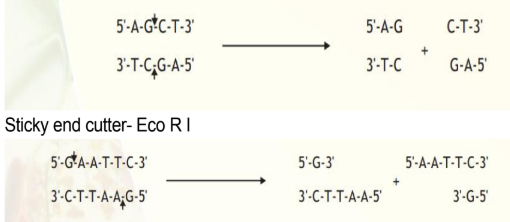
Sticky ends are better because only compatible ends can base pair and join.
27 A. Differentiate between monoclonal and polyclonal antibodies.
B. How has Hybridoma Technology revolutionised the area of diagnostics and therapeutics?
Ans:
A. Monoclonal antibodies are raised against a specific epitope of an antigen, whereas Polyclonal antibodies are a heterologous population of antibodies released by different populations of B–B-lymphocytes.
B. Due to hybridism technology, large-scale production of monoclonal antibodies was achieved, which has helped in the early detection of many infectious diseases/therapeutics and also helps in providing passive immunity in case of many diseases.
28 Attempt either option A or B.
A. How are recombinant cells selected if the vector used is pUC19?
Ans: A. The method is blue-white selection, which is based on the insertional inactivation of the LacZ gene.
This gene expresses the enzyme Beta Galactosidase whose activity can cleave a colorless substrate X-Gal into a blue colored product.
If LacZ gene is inactivated due to presence of the insert, then the enzyme is not expressed. Hence when the host cells are plated on X-Gal Agar and ampicillin containing media white colonies are the ones which contain the rDNA.
OR
B. Give any three advantages that E.coli offers as a host cell.
Ans: B. i) E. coli is a preferred host due to the detailed knowledge of its nucleic acid and can accept a variety of vectors.
i) Genetically defined strains available.
iii) Standard doubling period of 20 minutes
iv) Easy to use
v) Extensively studied for safety (Any three)
Section – D 4 Marks
29 Gene expression of a normal cell and a cancer cell was studied with microarray technique. Cancer cell cDNA was labelled red, and normal cell cDNA was labelled green.
Microarray technique
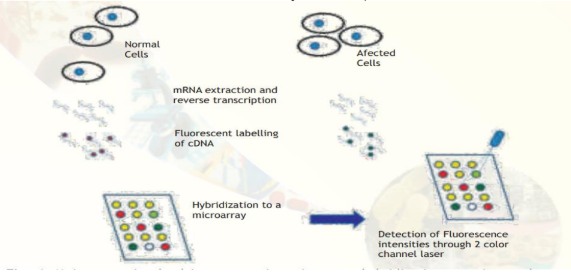
A. Why are some spots depicted above seen as Yellow dots?
B. How are DNA chips useful in functional genomics?
Ans:
A. A yellow spot specifies that a particular gene is being expressed in both normal and cancerous cells at that time.
B. DNA microarrays or gene chips are useful in functional genomics because they enable scientists to study the interaction among thousands of genes simultaneously.
Attempt either option C or D.
C. Comparative hybridisation experiments depicted above compare the amounts of many different mRNAs in two cell populations. Why are such comparative studies important?
Ans: C. By such comparisons, we can understand the altered gene expression patterns in cancerous cells and make attempts to develop cures.
OR
D.Why is cDNA used to check the gene expression of both cell types, though we have isolated mRNA from the cell populations in the first step?
Ans: Since free RNA is quickly degraded, to prevent the experimental samples from being lost, they are reverse transcribed into complementary (cDNA) whose sequences are the complements of the original mRNA sequence.
For Visually Impaired Students:
Gene expression of a normal cell and cancer was studied with microarray technique. The end product of a comparative hybridisation experiment is a scanned array image. Cancer cell cDNA was labelled red, and normal cell cDNA was labelled green.
A. Why are some spots seen as Yellow dots in the scanned array image?
B. How are DNA chips useful in functional genomics?
Ans: A. Solvent extraction/Chromatography /Membrane filtration /Precipitation (Any two)
B. For intracellular metabolite
Attempt either option C or D.
C. Comparative hybridisation experiments described above compare the amounts of many different mRNAs in two cell populations. Why are such comparative studies important?
Ans: C.
i) Separation of cells from fermented broth
ii) Cell disruption
iii) Concentration of broth
iv) Initial purification.
v) Metabolite-specific purification
vi) Polishing of metabolite
OR
D. Why is cDNA used to check the gene expression of both cell types, though we have isolated mRNA from the cell populations?
Ans: Fewer steps to decrease cost, more of the metabolite will be yielded.
30. Downstream processing is an essential aspect of Biotechnology, particularly in the production of Biopharmaceuticals. It includes the purification, isolation and characterisation of the target product from complex biological matrices to ensure the final product is safe, effective and high-quality.
A. Name two methods which can be used to obtain microbial metabolites from clarified fermented liquor. (1)
B. When is cell disruption process used in downstream processing? (1)
Attempt either subpart C or D (2)
C. Write the steps involved in isolation of the desired microbial product for an intracellular product.
Ans:
A. Solvent extraction/Chromatography /Membrane filtration /Precipitation (Any two)
B. For intracellular metabolite
C.
i) Separation of cells from fermented broth
ii) Cell disruption
iii) Concentration of broth
iv) Initial purification.
v) Metabolite-specific purification
vi) Polishing of metabolite
OR
D. Why are lesser number of steps advised in downstream processing?
Ans: Fewer steps to decrease cost, more will be yielded of the metabolite.
Section – E 5 Marks
31 Attempt either option A or B.
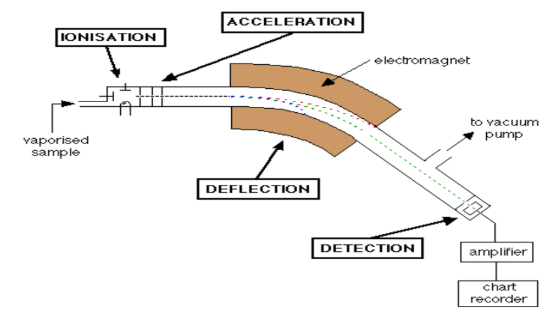
A. Explain how proteins are volatilized as well as analyzed by a mass spectrometer. Draw a well-labelled Diagram of mass spectrometer.
Ans:
A. Principle of Mass spectrometer: It determines the molecular weight of chemical compounds by separating molecular ions according to mass/charge ratio (m/z).
MALDI – Matrix Assisted Laser Desorption Ionization.
The protein sample is dissolved in the matrix, and then a laser beam is applied, which results in the ionization of the proteins, which are then analyzed.
Charged protein accelerated through evacuated tubes and separated by m/z ratio. The signal received upon detection at the detector is transferred to a computer for processing of information.
Detection and recording
OR
B. Classify any five protein-based products. Give one example under each category along with its application.
Ans:
B.
i) Blood products and vaccines, e.g., Factor IX for treating hemophilia
ii) Therapeutic antibodies and enzymes, e.g,. Monoclonal antibodies OKT3 for preventing rejection following organ transplant.
iii) Therapeutic hormones and growth factors, e.g., Insulin to treat diabetes.
iv) Regulatory factors, e.g., Interferons for antiviral properties.
v) Analytical applications, e.g,. Horse radish peroxidase for ELISA.
vi) Industrial enzymes, e.g., Papain for meat tenderization.
vii) Functional non-catalytic proteins, e.g., Kappa casein for milk protein stabilization
viii) Nutraceutical proteins, e.g,. Infant food formulation to provide adequate nutrition for infants. These products are of commercial value to the Biotechnology industry.
32 Attempt either option A or B.
A. Give any two examples of genetically modified crops and the strategy behind developing them.
Ans:
A. Two examples are:
Golden rice – Enriched in provitamin A (beta carotenoids)
Strategy: By introducing three genes involved in the biosynthesis pathway for carotenoid under the control of an endosperm-specific promoter.
Seeds are yellow in colour, contain provitamin A, which gets converted to vitamin A in the body.
Flavr savr tomato:
Strategy: Delayed fruit ripening, ripening is slowed down by blocking or reducing ethylene production, introducing ethylene-forming genes in a way to suppress their own expression.
OR
B. Write any five biosafety concerns regarding transgenic plants.
Ans:
B.
1. Allergenecity
2. Toxicity
3. Effect on beneficial insects and microbes
4. Develop superweeds-pollen escape
5. Create antibiotic-resistant microbes
6. Change evolutionary pattern
7. Effects on biodiversity and environment.
33 Attempt either option A or B.
A. (i) In the diagnosis of tuberculosis, the older methods depended on culturing the causative Bacillus from sputum. Newer methods include PCR-based assays. With the help of a diagram, explain the principle of PCR. How is it more effective than culturing methods?
(ii) If four copies of ds DNA are subjected to polymerase chain reaction, how many copies would be obtained after 20 cycles?
Ans: A. (i) Amplification of DNA sequences specific to Mycobacterium tuberculosis.
PCR can amplify the specific DNA segment into millions of copies. Three steps are:
1. Denaturation – Separates DNA into two single strands
2. Annealing – Primers attach to complementary sequences of DNA
3. Extension – Taq polymerase extends each primer using dNTPs and the DNA strand as template. Technique is more rapid, safer, and sensitive.
(ii) 4 x 220
OR
B. (i) How is ddNTP different from dNTP?
(ii) A DNA strand 3’TACGTACG 5’ is sequenced on a gel. Draw the autoradiogram that would be obtained after sequencing.
(iii) How is single-lane automated sequencing better than Sanger’s method of DNA sequencing?
Ans:
(i) Absence of –OH at the 3’ carbon position of the sugar moiety.
(ii) * indicates nested fragments.
| A | T | G | C |
| * | |||
| * | |||
| * | |||
| * | |||
| * | |||
| * | |||
| * | |||
| * |
Sequence read from the autoradiogram is: 5’ ATGCATGC 3’
(iii) In automated sequencing to avoid using radioisotopes and their consequent danger, dideoxynucleotides are conjugated with fluorescent molecules which, on excitation, give a different colour each. Hence, each band on the gel (read from anode to cathode) indicates the particular base as its terminal dideoxy nucleotide fluoresces with a given colour. This avoids the use of a four-lane gel; a single-lane gel electrophoresis is instead conducted, and the gels are then laser scanned and the data fed into a computer.
Class 12 Biotechnology Sample Paper 2026 PDF
Click here to download the CBSE Class 12 Biotechnology Sample Paper 2026 PDF.
Additional Study Materials
- Class 12 Biotechnology 2025
- Class 12 Biotechnology 2024
- Class 12 Biotechnology 2023
- Class 12 Biotechnology 2022
- Class 12 Biotechnology 2020