
Class 12 Biology Competency-Based Questions Chapter 7
1 Mark Questions
1. A group of students are trying to replicate the famous Miller-Urey experiment using a different set of molecules compared to those employed in the original study.
Their experiment will be deemed supportive and aligning with the Miller-Urey experiment solely on the condition that the molecular weight of –
A. reactants ≥ products
B. reactants < products
C. reactants = products
D. reactants > products
Ans: B. reactants < products
2. Some herbivorous organisms, such as giraffes and brachiosaurus, are known to have evolved long necks, which help them access food that is not available to other shorter herbivores.
Which of the following types of evolution do the statements shown above describe?
A. co-evolution
B. microevolution
C. divergent evolution
D. convergent evolution
Ans: D. convergent evolution
3. Billions of years ago, when Earth had a reducing atmosphere containing methane and ammonia along with high temperatures, the organisms that came into existence would have been –
A. aerobic and chemo-autotrophic
B. anaerobic and chemo-heterotrophic
C. aerobic and chemo-heterotrophic
D. anaerobic and chemoautotrophic
Ans: B. anaerobic and chemo-heterotrophic
4. Ginkgo biloba is also known as a living fossil, as it has changed very little over time. It is resistant to disease and pests, is tolerant of a wide range of environmental conditions and is the last-standing member of its botanical family.
The above is an example of which of the following phenomena?
A. speciation
B. fossilization
C. adaptive radiation
D. survival of the fittest
Ans: D. survival of the fittest
5. Which of the following phenomena significantly contributes to speciation?
P) Natural Selection
Q) Genetic Drift
R) Gene flow
S) Geographic Isolation
T) Stabilising Selection
A. only Q and S
B. only R and T
C. only P, Q and S
D. only Q, R and T
Ans: C. only P, Q and S
6. Two statements are given below – one labelled Assertion (A) and the other labelled Reason (R).
- Assertion (A): Genetic makeup serves as the primary factor in shaping the phenotype of a species and not vice versa.
- Reason (R): Adaptation involves the phenotype’s interaction with the environment, leading to changes in genetic makeup over generations.
Which of the following is correct?
A. Both A and R are true, and R is a correct explanation for A.
B. Both A and R are true, but R is not a correct explanation for A.
C. A is true, but R is false.
D. A is false, but R is true.
Ans: B. Both A and R are true, but R is not a correct explanation for A.
7. A population of grey treefrogs lives on deciduous trees where they blend well in with the bark. Some members of the population have variations in body colour, with different shades of grey as well as yellow on their ventral side.
Due to changes in the environmental conditions, yellow lichen starts growing on the trees. The grey treefrogs can now be easily spotted by predators such as birds and snakes against the yellow background.
Which of the following BEST describes ‘survival of the fittest’ in this scenario?
A. Only the biggest and strongest treefrogs will survive and reproduce.
B. Treefrogs will change their colour to yellow to avoid being eaten by predators.
C. Some treefrogs that might have slightly yellowish skin will survive and reproduce.
D. Treefrogs with slightly yellowish skin will feed on grey treefrogs to eliminate them.
Ans: C. Some treefrogs that might have slightly yellowish skin will survive and
reproduce.
8. In pigeons, one gene controls the appearance of a crest on the head. The allele C (smooth head) is dominant to allele C’ (crested head).
In a population of pigeons, the frequency of the allele responsible for a smooth head is 0.7 and for a crested head, it is 0.4.
Which of the following conditions should be satisfied for the population to be in Hardy-Weinberg equilibrium?
A. The sum total of the frequency of C and C’ is equal to 1.
B. The sum total of the frequency of C and C’ is less than 1.
C. The sum total of the frequency of C and C’ is more than 1.
D. (Cannot be said without knowing the frequency of CC’ individuals.)
Ans: A. The sum total of the frequency of C and C’ is equal to 1.
9. Different species of prokaryotes can withstand and survive in different environmental conditions, ranging from normal to extreme temperature, pH, salinity, and oxygen availability. Over an extended period of time, each species has become well-adapted to its environment, while its fundamental structures remain largely similar.
Which of the following types of evolution do the statements shown above describe?
A. Coevolution
B. Microevolution
C. Divergent evolution
D. Convergent evolution
Ans: C. divergent evolution
10. The Hardy-Weinberg principle is a foundational principle for understanding population genetics with several assumptions.
Which of the following is NOT an assumption of this principle?
A. Random mating
B. Emigration of species
C. Large population size
D. Non-occurrence of mutations
Ans: B. emigration of species
11. Two statements are given below – one labelled Assertion (A) and the other labelled Reason (R).
Assertion (A): Lichens are used as indicators of pollution.
Reason (R): A polluted environment accelerates the growth of lichens by providing them with more nutrition.
Which of the following is correct?
A. Both A and R are true, and R is the correct explanation for A.
B. Both A and R are true, but R is not the correct explanation for A.
C. A is true, but R is false.
D. A is false, but R is true.
Ans: C. A is true, but R is false.
2 Marks Questions
12. A group of students designed and executed an experiment similar to the Miller-Urey experiment, but missed a component. The experimental setup used by them is shown below.
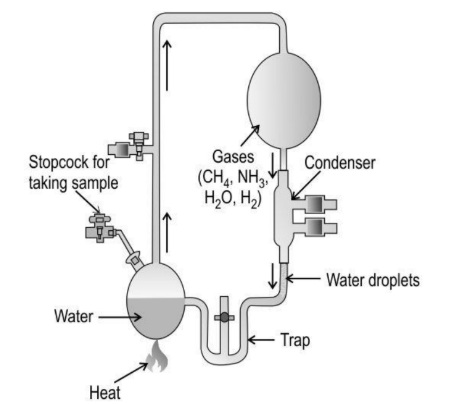
They performed the experiment and analysed the sample after it.
What compounds are they likely to find in the sample? Justify your answer.
Ans:
- CH4, H2O, H2, NH3
- The experimental setup does not have a source of electric sparks/energy that could provide the energy necessary to initiate chemical reactions among the gases and form various organic molecules.
13. A large population of a species of fish in a lake has been relatively genetically unchanged for a long time. A small bird species from an island migrates to the forest around the lake and preys on the smaller-sized fish. Would the population of the fish species adhere to the Hardy-Weinberg law? Justify your answer.
Ans: No. The scenario violates the rule of ‘no gene flow/migration’ from the Hardy-Weinberg law.
14. What is the frequency of the heterozygous genotype (Aa) in a randomly mating population in which the frequency of all dominant phenotypes is 0.36?
Ans:
According to the Hardy-Weinberg equilibrium,
p2 + 2pq + q2 = 1
The dominant phenotype (AA and Aa) can be represented by p2 + 2pq is equal to 0.36.
q2 = 1 – (p2 + 2pq) = 1- 0.36 = 0.64
q = 0.8
p = 1- 0.8 = 0.2
2pq = 2 x 0.2 x 0.8 = 0.32
Therefore, the frequency of the heterozygous genotype is 0.32.
15. Thalassemia is a disease caused by a specific gene mutation, and it affects individuals who inherit two copies of the mutant allele. In a population, the frequency of homozygous recessive individuals is 1 in 100. Calculate the frequencies of the following –
(a) recessive allele (a)
(b) dominant allele (A)
Ans: (a) Since q2 is 1 in 100,
q2 = 1/100 and q = 0.1
(b) p + q = 1
p = 1 – q = 0.9
16. Genetic flow and genetic drift are the same phenomena. Mark the above statement as true or false and justify your answer.
Ans: False. Genetic flow involves the movement of individuals and their genes between populations, actively influencing genetic diversity, whereas genetic drift is a random process that can lead to changes in allele frequencies within populations, often leading to a decline in genetic diversity.
17. Prokaryotic and eukaryotic cells have distinct flagella with differences in structure and mechanism. Prokaryotic flagella are helical and driven by a rotary motor powered by ion flow. Eukaryotic flagella feature a 9+2 microtubule arrangement, propelled by microtubule sliding via dynein motor proteins.
Identify if the above can be classified as homologous or analogous structures. Justify your answer.
Ans: Analogous structures. The prokaryotic and eukaryotic flagella, though they have a similar function, differ in structure and mechanism, due to independent evolution, and hence are analogous structures.
18. From an evolutionary point of view, predict the possible consequential events arising from the following situations:
(a) A population of mammals is split by a geographic barrier, leading to two isolated subpopulations. Over time, the environments on either side of the barrier changed, favouring different traits in each subpopulation.
(b) In a forest ecosystem, a species of herbivores consumes plants that produce deterrent chemicals. A minority of herbivores possessing a genetic mutation can metabolise these compounds.
Ans:
- (a) Isolated by a geographic barrier, two subpopulations adapt to their changing environments through distinct traits, possibly leading to the formation of separate species.
- (b) Over generations, the frequency of the herbivores with the mutation for metabolising the compounds may increase as they can access a broader food source, potentially leading to a more specialised herbivore population.
19. In a population of birds, individuals with intermediate beak sizes can effectively feed on a range of available seeds, while birds with either small or large beak sizes find it difficult to access certain seeds.
(a) Which birds are more likely to be naturally selected?
(b) Based on (a), which type of natural selection does this phenomenon exemplify?
Ans:
- (a) Birds with intermediate beak sizes have a feeding advantage, driving the population towards increased intermediate sizes due to their higher survival and reproductive success, reducing extremes.
- (b) Stabilising selection
20. A group of amphibians arrives on a newly formed archipelago with diverse habitats – from lush forests to arid deserts, with each island presenting unique ecological niches. Currently, the animals are capable of utilising only a few, yet abundant, resources on each island, which have numerous resources that remain inaccessible to them, except for certain mutated individuals that enable them to exploit these previously inaccessible resources.
From an evolutionary point of view, predict the consequential events arising from the above situation in TWO points.
Ans:
- The mutated population of amphibians are likely to exploit unique ecological niches in the archipelago.
- This may eventually lead to the formation of different species.
21. Genetic drift will lead to speciation in very large populations. Explain why this statement is false in TWO points.
Ans:
- Genetic drift is the change in frequency of an existing gene variant in the population due to random chance.
- This effect is negligible when population sizes are very large and speciation may not occur.
22. A group of palaeontologists aim to characterise fossil samples based on their age, amongst other parameters. They collected the samples from different depths in the ground. They have recorded the values of these samples from the ground level and compiled them in the following table:
| Sample Name | Depth from the ground level (m) |
| A | 4000 |
| B | 6000 |
| C | 1500 |
Arrange the sample names with respect to their age (oldest to youngest). Justify your answer.
Ans:
The age of the fossil samples in the order of oldest to youngest is –
Sample B > Sample A > Sample C.
The depth of a fossil sample can indicate its age because new sediment layers settle on top of existing ones, compressing and solidifying them. Older layers and fossils are found at greater depths than younger ones.
3 Marks Questions
23. Lake Tanganyika harbours a wide variety of cichlid fish. These fish have minor modifications in the jaw shape, number of teeth, and intestine length, amongst various other features, and have evolved to feed on algae, plankton, plants, insects, and other fish of various sizes also residing in the lake.
(a) Which of the following evolutionary phenomena does the above scenario describe?
(b) Based on (a), mention any FOUR advantages of this phenomenon.
Ans:
- (a) Adaptive radiation
- (b) This diversification allows the fish in the lake to
- Exploit different food sources.
- Exploit different habitats
- Reduce competition
- Maximising their chances of survival
- Increase beneficial traits and specialisation
- Creates a more stable ecosystem
24. Over the course of human evolution, the size of the brain has consistently grown larger.
(a) Mention any TWO factors that could be responsible for this continual expansion.
(b) Which category of evolution does this pattern align with – stabilising, directional, or disruptive? Justify your answer.
Ans: (a) The human brain evolved to occupy a larger volume and become complex because of the following reasons –
- The development and use of tools by early humans required higher cognitive abilities.
- Need to adapt, innovate, and exploit resources.
- Need for complex interactions, cooperation, and communication within social groups.
- Need for problem-solving capabilities.
- Need for enhanced memory and learning capabilities
- Transmission of knowledge through generations
- (b)
- Directional selection
- The increase in brain size over time suggests a consistent directional shift toward larger brains due to the adaptive advantages conferred by cognitive enhancements.
25. ‘Fitness is a result while natural selection is a process.’ Explain the above statement.
Ans:
- Fitness refers to the outcome of an organism’s adaptation, where its ability to produce offspring with advantageous traits for survival and reproduction is enhanced.
- Natural selection is a mechanism by which heritable traits that confer greater success in a given environment become more prevalent over generations, illustrating the process through which advantageous traits are favoured and passed on.
- In essence, fitness is the consequence/result of successful adaptation, while natural selection is the dynamic process that drives the persistence of adaptive traits in a population over time.
26. Isolation of the Galapagos Islands led to diverse habitats. Tortoises on different islands adapted to specific challenges for survival. A key adaptation was shell shape variation among Galapagos tortoises. Lush, humid islands led to dome-shaped shells, elevating tortoises for plant access. Arid islands favoured saddleback-shaped shells, aiding neck stretching to reach taller vegetation and offering support. Gradual genetic and physical differences among tortoise groups on separate islands over time resulted in distinct species formation in the present time.
(a) Mention any TWO evolutionary phenomena the above is an example of.
(b) If the current complete tortoise population of the islands is plotted for their shell shapes, the category of the graph would accurately depict it – Stabilising, Directional or Disruptive? Justify your answer.
Ans:
- Adaptive radiation and – Speciation
- Disruptive selection plot
- Disruptive selection arises when extreme trait variations are favoured due to differing environmental conditions, leading to a bimodal distribution in the population, as seen in tortoises with dome-shaped shells in lush areas and saddleback-shaped shells in arid regions.
27. Match the examples with the correct evolutionary process.
| Example | Evolutionary process |
| (a) Humans with a mutation in the lactase gene were able to produce lactase even as adults, which was not possible for humans without the mutation | (i) Adaptive Radiation |
| (b) Euphorbia, a genus of flowering plant, and Cactus, an unrelated species, have both developed spines to cope with the low rainfall and arid climate of desert regions. | (ii) Convergent Evolution |
| (c) Broccoli is a species that is derived from wild mustard plants whose flowers and buds have been modified. Cabbage also comes from wild mustard plants, where the internode length has been suppressed. | (iii) Natural Selection |
| (iv) Divergent Evolution |
Ans:
– (a) with (iii)
– (b) with (ii)
– (c) with (iv)
28. A population of peppered moths is in Hardy-Weinberg equilibrium for a gene with two alleles. The ‘A’ allele for dark-coloured wings is dominant over the ‘a’ allele for light-coloured wings.
The frequency of homozygous dominant individuals is 0.36. Based on this information, calculate the frequency of:
(a) allele A in the population
(b) allele a in the population
(c) heterozygous individuals
Ans:
(a) Frequency of homozygous dominant individuals = 0.36 = p2
Frequency of allele a = p = √(0.36) = 0.6
(b) p+q=1
Frequency of allele a = q = 1-p = 1-0.6 = 0.4
(c) Frequency of heterozygous individuals = 2pq = 2×0.6×0.4 = 0.48
5 Marks Questions
29. Bees and flowering plants are known to have co-evolved and incorporated each other as a part of their lifestyle.
(a) How do they mutually benefit from each other?
(b) Describe any TWO adaptations of bees that help them benefit from flowering plants.
(c) Describe any TWO adaptations of flowering plants that help them benefit from bees.
Ans:
- (a) Bees and flowering plants have a mutually beneficial relationship, where bees help in pollinating the flowers and flowering plants provide the bees with nectar and pollen. This relationship helps both kinds of species survive in nature.
- (b)
- Longer tongues to reach the nectaries of the flowers and obtain nectar.
- Improved sensory organs to detect floral colours, patterns and scents to detect the presence and location of flowering plants
- Improved communication and navigation systems for reaching the flowering plants.
- (c)
- Sticky pollen that can stick to the body hair and legs of bees so that it can be transferred to plants at farther locations.
- Flowers have a variety of colours, shapes and patterns to attract the bees towards them.
- Plants produce nectar and protein-rich pollen.
30. Consider a hypothetical situation:
A species of butterflies exhibits a range of wing colours. Butterflies with extremely bright wing colours attract predators easily as compared to those with very dull wing colours. Butterflies with very dull wing colours fail to attract mates as compared to those with bright wing colours. Butterflies with intermediate wing colours have the best chance of both avoiding predators and finding mates.
(a) Which type of natural selection does this phenomenon exemplify? Justify your answer.
(b) A few years later, the rise in industries and pollution causes the habitat to become darker. How would it affect the survival of the different kinds of butterflies belonging to this species? Which type of natural selection does this phenomenon exemplify?
(b) In a specific region where this species is prevalent, a mutation in its population leads to butterflies with a shade of wing colours brighter than the existing shades. How would the long-term survivability of this variant be?
Ans:
- (a)
- Stabilising selection.
- Stabilising selection occurs when the intermediate traits of a population, the intermediate wing colour in this case, are favoured over the extreme traits, such as wings with extremely bright or dull colours.
- (b)
- The darker environment aids camouflage for dull-winged butterflies, reducing predator visibility. Over time, the population could shift towards duller-winged individuals for increased survival and reproduction in the altered habitat.
- Directional selection
- (c) The brighter wing colour variant’s long-term survivability would decrease due to heightened predator attraction.
31. Arrange the following evolutionary phenomena with respect to their contribution to evolution (from most significant to least significant). Justify your answer with respect to each phenomenon.
(A) Vegetative propagation
(B) Natural selection
(C) Hybridisation
(D) Genetic drift
Ans: Natural selection >Hybridisation >Genetic drift >Vegetative propagation
- Natural selection – It acts by favouring the variations and traits that increase an organism’s fitness in its environment and leads to their accumulation over time. Hence, natural selection is considered the most significant factor driving evolution.
- Hybridisation – It involves the interbreeding of different variants, leading to the mixing of genetic material. This can enhance the genetic diversity that might contribute to the creation of new species, making it an important factor in evolution.
- Genetic drift – occurs due to random changes in gene frequencies in small populations due to chance events. It could be less significant than natural selection and hybridisation, as its effects are less predictable and may not always lead to adaptive changes.
- Vegetative propagation is a form of asexual reproduction that produces genetically identical individuals. Thus, it contributes the least to overall genetic diversity and is the least significant factor in terms of evolution.
32. Among 1000 rabbits of a population, 360 have long ears (LL), 150 have medium ears (Ll), and 490 have short ears (ll).
Calculate the following in detail –
(a) frequency of individuals per each genotype
(b) allele frequencies of L and l
(c) Based on (a) and (b), determine if the population is in Hardy-Weinberg equilibrium. Justify your answer.
Ans:
(a)
- Homozygous dominant (LL) individuals: 360 / 1000 = 0.36 (or 36%)
- Heterozygous (Ll) individuals: 150 / 1000 = 0.15 (or 15%)
- Homozygous recessive (ll) individuals: 490 / 1000 = 0.49 (or 49%)
(b)
if p2 = 0.36
p = 0.6
if q2 = 0.49
q = 0.7
(c)
For the population of rabbits to be in the Hardy-Weinberg theorem,
p2 + 2pq +q2 = 1
Substituting the values p = 0.6 and q = 0.7
p2 = 0.36
q2 = 0.49
2pq = 0.84
Since p2 + 2pq +q2 is greater than 1, this population of rabbits is not in Hardy-Weinberg equilibrium.
33. A population of a certain plant species inhabits an area with variable water availability. The plant species carries a gene that influences drought resistance, with two alleles, D and d, where D confers extreme drought resistance and d confers poor drought resistance. Plants with the heterozygous genotype (Dd) were able to survive in different water conditions. In a population of 1000 plants, it was found that 250 plants had the DD genotype.
(a) Calculate the frequency of the DD, Dd and dd genotypes in the population. Show calculation.
(b) Which kind of graph would it represent – Stabilising, Directional or Disruptive? Justify your answer.
(c) Due to climate changes, the frequency of drought periods has increased, and the dd genotype is put under selective pressure. At this stage, which kind of graph would it represent – Stabilising, Directional or Disruptive? Justify your answer.
Ans:
(a) Frequency of DD = p2 = 250/1000 = 0.25
p = 0.5
Therefore, q = 1 – p = 1 – 0.5 = 0.5
Frequency of dd = q2 = 0.25
Frequency of Dd = 2pq = 2 x 0.5 x 0.5 = 0.5
(b)
- Stabilizing evolution
- The DD genotype (extreme drought resistance) and the dd genotype (poor drought resistance) are not favoured due to their disadvantages under varying water availability. The Dd genotype (intermediate drought resistance) has the highest fitness and is favoured, leading to a peak in the middle of the graph.
(c)
- Directional evolution
- Due to the increased drought periods, the selective pressure will favour genotypes with better drought resistance (like DD and possibly Dd), reducing the frequency of the dd genotype, leading to a directional shift towards the D allele.
34. A group of students performed the following experiment: Three plates of nutrient media were taken – A, B and C and studied for the extent of microbial growth in the plate post-incubation of 24 hours.
| Plate | Incubation condition |
| A | The sterile plate was sealed and incubated |
| B | The sterile plate was not sealed and incubated |
| C | A microbial culture was spread on the plate, and it was sealed and incubated. |
(a) What would be the post-incubation results for the three plates?
(b) Which widely believed theory of the origin of life does this experiment disprove? Justify your answer.
(c) Based on (b), how was it originally disproved?
Ans:
- (a)
- A – No microbial growth would be observed since it was sterile and sealed.
- B – Microbial growth could potentially occur due to airborne contaminants reaching the nutrient media.
- C – Microbial growth from the initially spread culture would likely be observed, as the sealed environment would prevent external contaminants from entering.
- (b)
- It disproves the theory of spontaneous generation.
- The lack of growth on the sterile, sealed plate (A) contradicts the idea of life spontaneously forming.
- (c) Louis Pasteur’s swan-necked flask experiment involved sealed and unsealed flasks containing broth to demonstrate that microorganisms do not spontaneously generate but come from external sources, supporting the concept of biogenesis.
35. Among plants, angiosperms, or flowering plants, stand out as the most diverse and numerous group of plants on Earth today, a reflection of their evolutionary triumph.
Mark this statement as TRUE/FALSE and give any FOUR reasons for your answer using the characteristic features of angiosperms.
Ans:
- Angiosperms adapt widely, spanning deserts to rainforests, and high altitudes to aquatic habitats, driving global diversity and distribution.
- Angiosperms’ flower and fruit evolution enables efficient reproduction by luring diverse pollinators, promoting successful pollination and genetic variety.
- Angiosperms use varied strategies — self and cross-pollination — to thrive in diverse conditions, leading to their evolutionary triumph.
- They co-evolve with pollinators, developing traits that attract specific species, and enhancing pollination efficiency. This symbiotic bond boosts both plant and pollinator success.
- Many angiosperms have relatively short life cycles, allowing them to reproduce and spread rapidly. This quick turnaround time increases their evolutionary potential.
Additional Study Materials
- Sexual Reproduction in Flowering Plants- Competency-Based Questions
- Human Reproduction – Competency-Based Questions
- Reproductive Health – Competency-Based Questions
- Principles of Inheritance and Variation – Competency-Based Questions
- Molecular Basis of Inheritance – Competency-Based Questions