
Class 12 Biology Competency-Based Questions Chapter 15
1 Mark Questions
1. Genetic diversity refers to the diversity in the genetic makeup of organisms that are capable of interbreeding.
What component of an ecosystem does genetic diversity DIRECTLY impact?
A. ecosystem diversity
B. species diversity
C. species richness
D. ecological niche
Ans: B. species diversity
2. Dr Kirti has a patient who is diagnosed with an HIV infection. She has to test for HIV infection in the partner of the patient who has no symptoms of the infection. Which of these methods can be used to diagnose the infection in the partner?
P) Urine analysis
Q) Electroporation
R) Polymerase Chain Reaction (PCR)
S) Enzyme Linked Immuno-Sorbent Assay (ELISA)
A. only S
B. both Q and R
C. both R and S
D. all – P, R and S
Ans: C. both R and S
3. Two statements are given below – one labelled Assertion (A) and the other labelled Reason (R).
Assertion (A): Biodiversity does not vary greatly across longitudes.
Reasoning (R): Variations in climate that cause a difference in biodiversity largely depend on the latitudes.
Which of the following is correct?
A. Both A and R are true, but R is not the correct explanation for A.
B. Both A and R are true, and R is the correct explanation for A.
C. A is true, but R is false.
D. A is false, but R is true.
Ans: B. Both A and R are true, and R is the correct explanation for A.
4. Which of the following is/are example/s of biodiversity?
(i) Animals and emigrants in an area.
(ii) Microorganisms present in the intestine of an organism.
(iii) Cell from the same tissue in different organisms.
A. only (i)
B. only (ii)
C. only (ii) and (iii)
D. all – (i), (ii) and (iii)
Ans: D. all – (i), (ii) and (iii)
5. Given below are two statements.
Statement I: Plants are always more prone to extinction than animals.
Statement II: Since plants can cross-pollinate, they can increase their genetic diversity more easily than animals.
Which of the following is TRUE about these statements?
A. Only statement I is true
B. Only statement II is true
C. Both statements are true
D. Both statements are false
Ans: D. Both statements are false
6. The zebra mussel is a species that is native to Eastern Europe and Western Russia. It was unintentionally introduced into the lakes of the United States through the discharge of contaminated cargo from a ship.
Which of the following is this statement an example of?
A. Habitat loss
B. Co-extinction
C. Over-exploitation
D. Alien species invasion
Ans: D. Alien species invasion
7. The slope in a species-area relationship (SAR) predicts the species richness of an area. Consider a mainland with several islands around it.
Which of the following is MOST LIKELY to be true about the slope of regression as we move from islands closer to the mainland to those further away from it?
A. It increases
B. It decreases
C. It remains the same
D. Cannot say without knowing the location of the islands.
Ans: B. It decreases
8. Two statements are given below – one labelled Assertion (A) and the other labelled Reason (R).
Assertion (A): Genetic diversity can be increased only by the occurrence of migration.
Reasoning (R): Genetic diversity is the range of different inheritable traits within a species.
Which of the following is correct?
A. Both A and R are true, and R is the correct explanation for A.
B. Both A and R are true, but R is not the correct explanation for A.
C. A is true, but R is false.
D. A is false, but R is true.
Ans: D. A is false, but R is true.
9. Which of the following statements are CORRECT conclusions that can be derived
from latitudinal gradients in biodiversity?
X) Greater adaptability of organisms leads to better growth
Y) Stability of the ecosystem plays a role in determining species diversity in the region
Z) Presence of favourable conditions in a region enhances diversity
A. Only X and Y
B. Only Y and Z
C. Only X and Z
D. All – X, Y and Z
Ans: B. Only Y and Z
10. Given below is the species distribution across two different regions – X and Y. The area used to count species was the same.
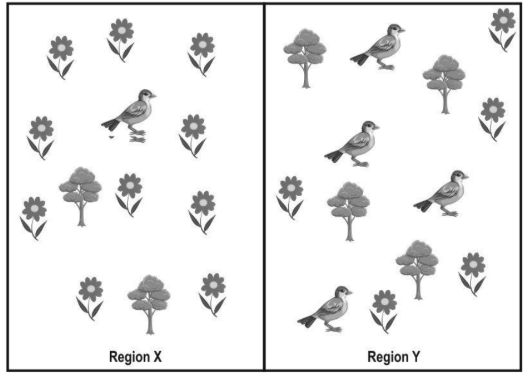
Which of the following is TRUE about the biodiversity in these regions?
A. Region X is more diverse than region Y, even though both regions have the same species richness.
B. Region X is less diverse than region Y, even though both regions have the same species richness.
C. Region X and region Y have the same species richness and so the same diversity.
D. Region X is more diverse as it has greater species richness than region Y.
Ans: B. Region X is less diverse than Region Y, even though both regions have the same
species richness.
11. Which of the following will DEFINITELY contribute to a steeper slope of regression in a species-area relationship graph?
P) increase in the area for analysis
Q) immigration of new species
A. Only P
B. Only Q
C. Both P and Q
D. Neither P nor Q
Ans: A. Only P
2 Marks Questions
12. Species richness and evenness are measures of species diversity in an area. Species richness refers to the number of groups of genetically related species, so the more species in an area greater the richness. Species evenness refers to the abundance of each species in an area. It is said that in two communities having equal species richness, the community with low evenness leads to lower biodiversity. Justify this statement.
Ans:
- Low evenness in a community basically means that a few species are present in greater abundance than the other species in the community.
- Dominance of a few species leads to an unequal distribution of resources, which eventually causes loss of biodiversity over time.
13. Biological invasion is the process by which an organism enters and establishes a sustainable population in a region that is beyond its native geography. High species diversity in a region ensures a decline in the biological invasion of that region. Justify this statement as true.
Ans:
- A high species diversity means that the resources in a region are being utilised by the existing species to survive, leading to lower available resources.
- Lower available resources, which are required by the invading species, may prevent invasion.
14. Producers are considered to be the most important members of the ecosystem. How does the rivet popper hypothesis explain the importance of producers in the stability of the ecosystem?
Ans:
- According to the rivet popper hypothesis, the stability of an ecosystem is affected by the species that becomes extinct/is removed.
- Since producers are the most important members that provide energy to the whole food chain, their loss means danger for the entire ecosystem, similar to the loss of rivets on the wings of an aeroplane.
15. Describe TWO situations in which ex-situ conservation will be preferred over in-situ conservation.
Ans:
- When the survival of an organism is low due to high predation
- When harsh climatic conditions lead to the loss of organisms
- In cases of habitat loss due to a calamity
16. Fish were the first vertebrates to exist and are the most diverse group of vertebrates. Give TWO reasons to justify this statement as TRUE.
Ans:
- They have good adaptability to aquatic conditions in different habitats.
- Since they were the first vertebrates to exist, they have had a lot of time to diversify.
3 Marks Questions
17. Island biogeography studies the factors that affect the species richness and diversification of isolated natural communities, such as islands.
(a) What is likely to happen to the rate of extinction on an island in the following situations?
(i) It is close to the mainland
(ii) The area of the island is small
Give a reason to support your answer
(b) Describe ONE step that the government can take to improve stability in isolated natural communities.
Ans:
- (a) (i)
- The rate of extinction decreases.
- Closeness to the mainland increases accessibility to resources, thereby allowing species on the island to survive and reproduce.
- (a) (ii)
- The rate of extinction increases.
- This is because, in smaller areas, there is greater competition for survival.
- (b)
- Improve disaster management systems so that in case of a disaster, there is less loss of resources and life.
- Improve infrastructure to ensure sustainability.
18. (a) The introduction of genetically modified organisms, such as golden rice, can lead to a significant reduction in the genetic diversity of the region. Justify this statement as true.
(b) How does the impact identified in (a) affect the survival of the species?
Ans:
- (a)
- Genetically modified organisms have a greater advantage due to some desirable characteristics added to them, giving them dominance in competing with related species.
- This may cause these related species to be removed, thereby leading to a reduction in genetic diversity.
- (b) Without genetic diversity, a population may not be able to evolve in response to changing environmental conditions, leading to its eventual extinction
19. State THREE ADVANTAGES of in-situ conservation over ex-situ conservation of organisms.
Ans:
- Conserving the natural habitat allows for the conservation of other organisms along with the endemic species.
- Organisms staying safe and recovering in their natural state is greater than in simulated habitats.
- It does not involve the removal of organisms from their natural habitat, making it a more humane/ethical approach.
20. Cryopreservation is a technique used in the conservation of endemic species.
(a) Explain how this method helps with the conservation of a species.
(b) Which process that is carried out with humans is similar to cryopreservation, and what is it used for?
Ans:
- (a)
- Through cryopreservation, gametes of an endemic species can be preserved.
- The gametes can be fertilised in vitro and propagated using tissue culture and transferred to an animal that can carry the embryo to term, allowing the endemic species count to increase.
- (b) In vitro fertilisation – used in cases of couples who are unable to reproduce normally
5 Marks Question
21. Ecological relationships between organisms play an important role in the biodiversity of the region. In some cases, they benefit the diversity while in others cause a subsequent reduction in it.
(a) A significant reduction in the predator population causes species abundance in the prey species. Is this statement TRUE? Give a reason to support your answer.
(b) Barnacles, sticky crustaceans and the blue whale are in a commensal relationship where barnacles use blue whales for transport. How would the extinction of either species cause a change in biodiversity?
(c) In which type of ecological relationship can the extinction of one species lead to the extinction of the other species?
(d) What is the term used to describe the phenomenon described in (c) called?
Ans:
- (a) TRUE. Reduction of the predator population will allow the prey population to survive, grow and reproduce, thereby increasing their abundance.
- (b)
- If the blue whale becomes extinct, the barnacles may slowly become extinct/population may decline significantly, as they depend on the blue whale for transport in search of food and a stable living place.
- If the barnacles become extinct, it may not impact the diversity of blue whales as they were not dependent on barnacles for survival.
- (c) Mutualism
- (d) Co-extinction