NIOS Biology Question Paper Feb 2021 Set B Solved
1 MARK QUESTIONS
1. Hypervitaminosis is caused due to excessive intake of which of the following:
A) Vit. D
B) Vit. B
C) Folic acid
D) Vit. C
2. For which of the following diseases bioengineered vaccine has not been developed?
A) Rabies
B) Marasmus
C) Herpes
D) Hepatitis B
3. Which of the following is an Arachnid?
A) Scorpion
B) Cockroach
C) Crab
D) Centipede
4. Apomixis is:
A) Development of plants in darkness.
B) Effect of low temperature on flowering.
C) Development of plants without fusion of gametes.
D) Inability to perceive stimulus for flowering.
5. Name the phenomenon which makes it difficult to close a wooden door after monsoon.
A) Osmosis
B) Plasmolysis
C) Diffusion
D) Imbibition
6. Which one of the following is a stop codon?
A) AUG
B) UCA
C) UAA
D) UUU
7. Water chestnut shows two different types of leaves on the same plant. This condition is known as:
A) Heterotropic
B) Biparous
C) Phyllotaxy
D) Heterophylly
8. Approximately how many bacteria may be obtained from one bacterium in an hour under favourable conditions?
A) 64
B) 8
C) 32
D) Infinite number
2 MARK QUESTIONS
9. What is a Food chain? Give a suitable example. What are different steps of a food chain known as?
Ans: Transfer of food from the plants (producers) through a series of organisms with repeated eating and being eaten is called a food chain. Eg., Grasses → Grasshopper → Frogs → Snakes → Hawk/Eagle. Each step in the food chain is called a trophic level.
10. Draw a neat diagram of the male reproductive system of a Cockroach. Label tests and ejaculatory duct in it.
Ans:
11. Distinguish between multiple alleles and Codominance, giving suitable examples.
Ans: The existence of more than one gene controlling the same trait is called a multiple allele. Codominance is the expression of a trait due to the presence of two dominant genes.
12. a) List any three advantages of Bio-diesel.
b) Name a common Petro-Plant.
Ans:
- Advantages of Biodiesel
- It is an agriculture-based fuel substitute.
- It can be made from both vegetable oil and animal fats.
- It can be used without major modifications in engines.
- It does not need a separate infrastructure for storage and delivery.
- Jatropha curcus
13. a) Mention any two functions of Auxin.
b) Which two hormones are essential for vascular tissue differentiation?
Ans:
- Functions of auxin
- Promotes cell elongation.
- Delays the fall of leaves
- Auxin and cytokinin are essential for vascular tissue differentiation.
14. Distinguish between cilia and flagella.
Ans:
| Cilia | Flagella |
| Cilia are shorter | Flagella are longer |
| Several hundred per cell structure | Usually 1-2 |
| Present in Paramecium | Seen in Euglena |
15. Name the two basic strategies for conservation of biodiversity and define them with suitable examples.
Ans:
- In situ (on-site) conservation includes the protection of plants and animals within their natural habitats or in protected areas. Eg. Wildlife Sanctuaries.
- Ex-situ (off-site) conservation is the conservation of plants and animals outside their natural habitats. Eg. Zoo
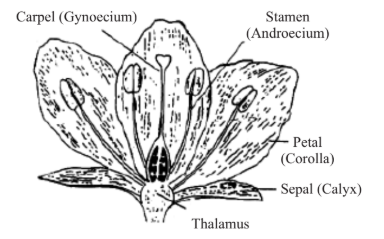
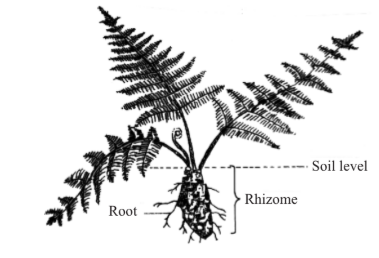
16. Draw a neat and labelled diagram of the Androecium and Gynoecium in an Angiosperm flower.
Ans:
17. Distinguish between B-cells and T-cells.
Ans:
| B-cells | T-cells |
| B-cells mature in bone marrow before they are carried by the blood | T-cells leave the bone marrow before they mature. |
| Initiate antibody-mediated immune response. | Mediate cell-mediated immune response |
| Transform into plasma cells, which secrete antibodies. | Induce B-cells to produce antibodies. |
| Some B-cells become ‘memory cells’ that produce antibodies when an antigen reappears in future. | Regulate immune response. |
18. Explain Kranz anatomy.
Ans: In C4 plants, the vascular bundles have a sheath of large parenchyma cells around them in the form of a wreath, thus the name Kranz anatomy. Kranz means wreath and thus the name. They also have dimorphic chloroplasts.
19. State any two adaptations found in plants to reduce transpiration.
Ans:
- Reducing the size of the leaves reduces the transpiring surface. Some xerophytic plants have needle-like or spine-like leaves (Pinus and Opuntia)
- Thick deposition of cutin (wax-like substance) on the leaf surface.
20. State any four reasons for the degradation of water.
Ans:
- Depletion of the volume of water to meet the needs of an increasing population.
- Use by humans and animals makes water unfit.
- Wastewater from industries flows into water bodies.
- Agricultural waste containing manure, fertilisers and pesticides enters the water
4 MARK QUESTIONS
21. a) What do you understand by a balanced diet?
b) What special diet is recommended for a pregnant woman and why?
Ans:
- A balanced diet contains all essential nutrients in suitable proportions and amounts to provide the necessary energy and keep the body in a healthy state.
- The pregnant women and lactating mothers should take,
- Extra protein for tissue growth
- More calcium and phosphorus are needed to form bones of the baby
- More iron is needed to make sufficient blood for the baby
- More carbohydrates for herself because extra energy is required to carry out all the building processes linked with the embryo.
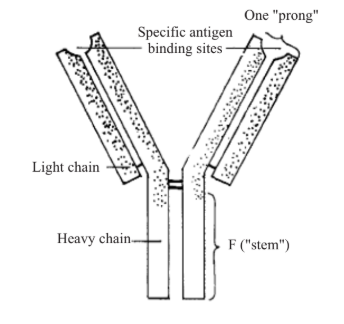
22. a) Draw a diagrammatic representation of an antibody.
b) Define the terms:
i) Immunity
ii) Genetic Engineering
Ans:
- Definition of,
- Immunity: Immunity is the capacity of the body to recognise materials as foreign to itself and to neutralise, eliminate or metabolise them with or without injury to its own tissues.
- Genetic Engineering: The process of obtaining multiple copies of a gene using recombinant DNA technology is called genetic engineering.
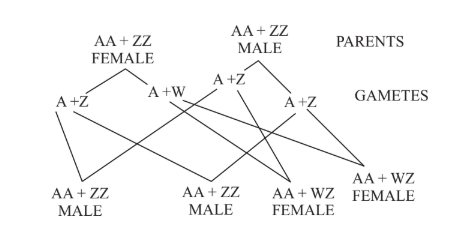
23. With the help of a flow chart, explain sex determination in birds.
Ans: In birds, females are heteromorphic with different sex chromosomes- ZW, while males are ZZ. Females produce A+Z and A+W gametes while males produce only A+Z.
24. a) What do you understand by the following terms:
i) Implantation
ii) Colostrum
iii) Artificial Insemination
b) Name the hormone:
i) Produced by the placenta.
ii) Responsible for uterine contractions for childbirth
Ans:
- Implantation: The fixing of the embryo in the wall of the uterus is called implantation.
- Colostrum: The first secretion that comes out from the mammary glands of the mother, just after childbirth, is called colostrum.
- Artificial Insemination is the introduction of human semen into a woman using a syringe during ovulation.
- Hormone Produced by the Placenta: Progesterone
- Hormone Responsible for uterine contractions for childbirth: Oxytocin
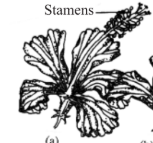
25. Draw neat and labelled diagrams:
a) A Fern Plant
b) Stamens in China rose
Ans:
- Fern Plant
- Stamens in China rose
26. a) How are the heart sounds Lubb and Dubb produced during heartbeat?
b) What is the role of S.A. node (Sinu Atrial Node) in the heart? Where is it situated?
Ans:
- The beating of the heart goes on by itself as long as one is alive. Each heartbeat consists of the steps mentioned below and makes two sounds – Lubb and Dubb during each beat. The heartbeat starts with the contraction or systole of the atria, followed by relaxation or diastole. The lubb sound or 1st heart sound occurs due to the closure of atrioventricular valves, the atrial systole.
- Since the Sinu-atrial Node initiates and regularises the heartbeat, it is also called the pacemaker. It is located in the upper corner of the right atrium.
6 MARK QUESTIONS
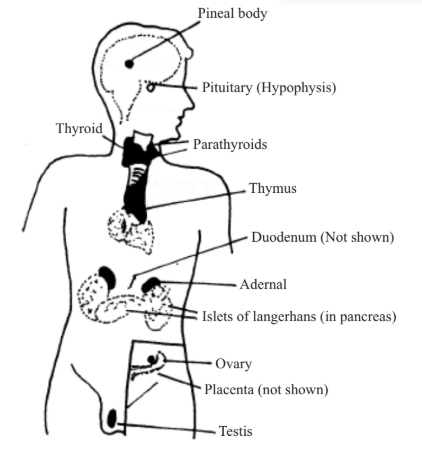
27. Draw a neat diagram to show the location of the eight principal endocrine glands in the human body.
Ans:
28. a) Draw a neat diagram of the double helical structure of DNA.
b) Who proposed this structure?
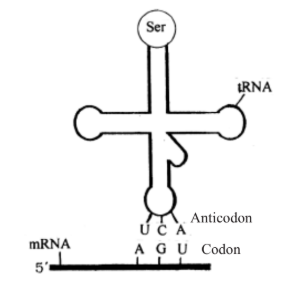
c) Draw a diagrammatic representation of an RNA showing anticodon and codon pairing?
Ans:
- Double helical structure of DNA
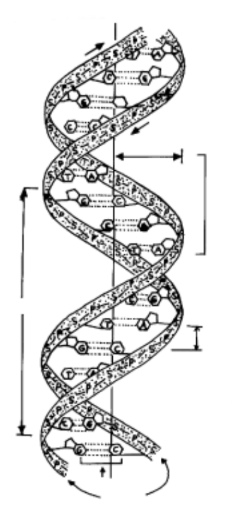
- Franklin and Wilkins proposed this structure.
- RNA
29. a) What is Leghaemoglobin and where is it present? State the role it plays in N2-fixation.
b) Give the overall general chemical equation of photosynthesis?
c) By the help of an appropriate example, briefly explain the ‘Law of limiting factor”.
Ans:
- Leghaemoglobin is a special protein found in the legume nodules. It helps in nitrogen fixation by acting as an oxygen scavenger so that the enzymes, nitrogenases, then convert N2 to NH3 under anaerobic conditions.
- When a process is affected by various factors, the rate of the process depends on the pace of the slowest factor. For example, when light, temperature, and carbon dioxide are available in optimal levels, photosynthesis will be maximum. However, if one of these becomes suboptimal when others are optimal, it will reduce the photosynthetic rate.
30. a) Mention the four Characteristic features of muscle fibres.
b) Name the blood cells present in the plasma and state the main functions of each of them.
c) Where will you locate the following:
i) Stratified epithelium
ii) Intercalated discs
Ans:
- The muscle fibres have the following characteristics:
- Excitability (respond to stimulus)
- Extensibility (stretch)
- Contractility (contract)
- Elasticity (move back to the original position)
- Blood cells
- Red blood cells- transport oxygen and carbon dioxide.
- White blood cells- Defence against bacteria.
- Location
- Striated epithelium: Skin and inner lining of cheeks.
- Intercalated discs: Cardiac muscle tissue
Additional Study Materials
- NIOS Class 12 Biology PYQ Feb 2021 Set A
- NIOS Class 12 Biology PYQ May 2025 Set B
- NIOS Class 12 Biology PYQ Oct 2024 Set B
- NIOS Class 12 Biology PYQ April 2023 Set B
- NIOS Class 12 Biology PYQ Oct 2022 Set B
- NIOS Class 12 Biology PYQ April 2022 Set B