
Class 12 Biology Competency-Based Questions Chapter 10
1 Mark Questions
1. A scientist measured the BOD (biochemical oxygen demand) of water from the following sources.
- Kitchen tap
- Sewer pipe
Choose the correct statement.
A. The BOD of sample P will be lesser than sample
B. The BOD of sample P will be greater than sample
C. The BOD of sample P will be equal to that of sample
D. The BOD of the two samples cannot be compared without additional Data.
Ans: A. The BOD of sample P will be lesser than sample
2. Industrial production of which of these products can be negatively affected by the presence of Saccharomyces cerevisiae?
A. Beer
B. Wine
C. Fruit juice
D. Wheat bread
Ans: C. Fruit juice
3. The pharmaceutical industry aims to develop a chemical that can induce immune system modulation in patients with autoimmune diseases and help in alleviating symptoms.
Which of the following microbes should they consider utilizing?
A. Aspergillus niger
B. Staphylococcus aureus
C. Trichoderma polysporum
D. Saccharomyces cerevisiae
Ans: C. Trichoderma polysporum
4. A pharmaceutical company is working on a drug based on statins and is searching for appropriate candidates for clinical tests so as to evaluate its safety, efficacy, and potential therapeutic benefits in a controlled and monitored setting and obtain potential regulatory approval.
Which of the following would serve as suitable candidates to obtain samples?
A. A professional swimmer.
B. A person who recently recovered from dengue.
C. A gym trainer who consumes protein in higher quantities.
D. A person who consumes saturated fats in higher quantities.
Ans: D. A person who consumes saturated fats in higher quantities.
5. An industry aims to transition from a small-scale experimental bioreactor to a large bioreactor for the production of an enzyme.
Which of the following parameters would be CONSTANT during the scaling-up process?
P) pH profile
Q) Reactor capacity
R) Volume of inoculum
S) Temperature profile
T) Initial nutrient concentration
A. Only P, R, and S
B. Only P, Q, and R
C. Only Q, T, and R
D. Only P, S, and T
Ans: D. Only P, S, and T
6. Certain micro-organisms, such as Pseudomonas, Bacillus, and Burkholderia species, are administered in regions in the oceans where accidental oil spills occur.
Which of the following enzymes could the above micro-organisms be producing for them to be helpful in the scenario?
A. Streptokinases
B. Proteases
C. Amylases
D. Lipases
Ans: D. Lipases
7. Read the following statements:
(A) BOD and polluting potential are inversely related.
(B) BOD and polluting potential are directly related.
(C) More the BOD, the easier it is to treat the water.
(D) More the BOD, more will the harm if released into a water body.
Which of these is true?
A. (A) and (C) are true, and (C) is the reason for (A)
B. (B) and (C) are true, and (C) is not related to (B)
C. (A) and (D) are true, and (D) is not related to (A)
D. (B) and (D) are true, and (D) is the reason for (B)
Ans: D. (B) and (D) are true, and (D) is the reason for (B)
8. ‘Some groups of microbes release secondary metabolites that are harmful to other groups of organisms and not to the groups releasing it.’
For which of the following applications of human welfare is this microbial feature significant?
P) Biopesticides
Q) Fertilizers
R) Fermentation
S) Antibiotics
T) Sewage treatment
A. only P and Q
B. only P and S
C. only P, S, and T
D. only Q, R, S, and T
Ans: B. only P and S
9. A biologist inoculated bacteria A, fungus B, and both bacteria A and fungus B on 3 different sterile petri dishes 1, 2, and 3, respectively. After 24 hours, he observed growth in all 3. These are his observations:
| Plate | Organisms | Observation |
| 1 | Bacteria A | 46 small round colonies |
| 2 | Fungus B | Medium round colonies |
| 3 | Bacteria A + fungus B | Small round colonies + 10 medium round colonies |
What can the biologist conclude from this?
Y) The fungus inhibits the growth of the bacteria.
Z) The bacterium causes the fungus to grow better.
A. only Y
B. only Z
C. both Y and Z
D. neither Y nor Z
Ans: A. only Y
2 Marks Questions
10. Pectinases are used in the textile industry as well as in wastewater treatment. Identify how pectinase can help in each of these industries.
Ans:
- Textiles made from plant sources, such as cotton, will contain plant material such as pectin, which will need to be degraded.
- Waste water will also contain pectinaceous material, where pectinase can act to clarify water, reducing plant wastes.
11. A patient who has been undergoing chemotherapy is suffering from blood coagulation around central venous catheters that have been used to administer the related drugs.
(a) Suggest one possible enzyme that could be considered for administration, with the aim of potentially restoring proper blood flow.
(b) Based on (a), mention the microorganism that it is produced from.
Ans:
- (a) Streptokinase
- (b) Streptococcus spp.
12. Two farmers, A and B, primarily grow rice. Farmer A practices crop rotation with legumes and rice, and farmer B does not rotate crops.
If crops are not rotated, replenishment of nutrients does not occur, which degrades soil fertility. Justify your answer
Ans: Farmer A. Legumes with nitrogen-fixing bacteria called Rhizobia that reside in nodules on
roots and convert atmospheric nitrogen (N2) into a form that plants can utilize, such as ammonia (NH3) and nitrates (NO3–), and aid in better yield when crops are rotated.
OR
No crop rotation does not replenish nutrients in the soil, degrading soil fertility.
13. A wastewater sample containing a higher concentration of calcium chloride, potassium chloride, aluminium, and copper will always have a higher BOD value.
Mark the above statement as true or false and justify your answer.
Ans: False. BOD is influenced by the presence of organic compounds that microbes need
to break down and not by inorganic compounds and metals such as calcium chloride, potassium chloride, aluminium, and copper.
14. Some bacteria, such as Lactobacillus, aid in the conversion of milk to curd. How does the pH of the system change during this conversion? Justify your answer.
Ans: During the process of curd formation, a decrease in the pH occurs in the system.
- The Lactic acid bacteria present in the curd inoculum, when added to milk, convert the lactose of the milk to lactic acid.
- This acid formation lowers the pH of the milk, thereby coagulating the milk proteins and forming curd.
15. Carbon dioxide is produced as a by-product during the fermentation process of various food items and beverages. Explain any two ways by which this can be beneficial.
Ans:
- It increases the shelf life of some products by inhibiting the growth of spoilage organisms, along with preventing the oxidation of certain compounds.
- It enhances the taste and aroma of some products.
- It enhances the texture of some products by making them fluffy.
3 Marks Questions
16. A water treatment plant primarily receives wastewater from an industry that discharges fungicides as a waste byproduct.
Mention any THREE ways the above situation might influence the water treatment procedure.
Ans:
- Fungicides can interfere with the formation and stability of activated sludge flocs and might result in slower settling and reduced solid-liquid separation.
- They can be toxic to other microorganisms, such as bacteria, which are essential for the breakdown of organic matter in wastewater.
- They could form harmful byproducts in combination with other chemicals during treatment.
17. Given below are three chemical equations. Suggest specific microorganisms that can be used as inoculants for synthesizing the desired products.
(a) C6H12O6 → 2 C2H5OH + 2 CO2
(b) N2 + 3H2 → 2 NH3
(c) (C6H10O5)n + H2O → CO2 + H2 + CH4
Ans:
(a) Saccharomyces cerevisiae
(b) Rhizobium spp.
(c) Methanobacterium spp.
18. Correct the wrong information (in bold) in the steps of the sewage treatment plant and then arrange the sentences in chronological order.
1. Agitation in the aeration tank leads to the formation of suspended organic waste matter called flocs.
2. During primary treatment, aerobic bacteria degrade waste matter in the sewage.
3. When the BOD is significantly reduced, the effluent is passed from the aeration tank to the settling tank.
4. The primary sludge is taken for secondary treatment.
5. Anaerobic sludge digesters degrade bacteria and fungi in the sludge and produce oxygen.
Ans:
- 1. Agitation in the aeration tank leads to the formation of mesh-like structures of bacteria associated with fungal filaments called flocs.
- 2. During primary treatment, filtration and sedimentation are used for the physical removal of particles like debris and grit.
- 3. The primary effluent is taken for secondary treatment.
- 4. Anaerobic sludge digesters degrade bacteria and fungi in the sludge and produce methane, hydrogen sulphide, and carbon dioxide.
- Correct order: 2, 4, 1, 3, 5
19. Explain any THREE reasons behind using cow dung for biogas production.
Ans:
- Cow dung contains a significant amount of methane-producing bacteria (methanogens) due to their presence in the cow’s digestive system, and aids in the production of methane, which is a major component of biogas.
- It is rich in organic matter such as cellulose, other carbohydrates, and proteins, which serve as a food source for the microorganisms responsible for anaerobic digestion.
- Easily accessible in rural areas, and is a waste product on farms that needs recycling and proper disposal.
- Biogas derived from cow dung is a renewable energy source, contributing to reducing reliance on non-renewable fossil fuels.
- The leftover material post-production of biogas can be used as an organic nutrient-rich fertilizer that helps in recycling nutrients back into the soil, improving soil fertility and agricultural productivity.
20. Alex, Ross, and Jane are trying to standardise and identify the best way to make curd. They followed different methods as follows:
- Alex took a bowl of lukewarm milk and rested it overnight at room temperature.
- Ross took boiling milk, added some curd to it, and maintained the temperature high overnight.
- Jane took a bowl of lukewarm milk, added some curd to it, and rested it overnight at room temperature.
(a) What are the possible end products that each one of them will obtain?
(b) Based on (a), whose method will yield the best quality curd? Give reasons to support your answer.
Ans:
- (a)
- The milk in Alex’s bowl might not have converted into curd.
- The milk in Ross’s bowl may not turn into curd completely or may spoil.
- The milk in Jane’s bowl would turn into curd.
- (b)
- Jane would have made the best quality curd.
- For proper curd formation, she added the necessary Lactobacilli inoculum into the milk.
- Along with the above, she maintained the milk at the ambient temperature needed for the growth of the Lactobacilli.
21. A scientific group aims to compare the quality of water from various water bodies. They collected samples from 3 water bodies and calculated their BOD amongst other parameters, and tabulated them as follows.
| Sample Name | BOD Value (ppm) |
| A | 100 |
| B | 2 |
| C | 11 |
(a) Arrange the sample names with respect to their level of pollution (highest to lowest).
(b) Explain how BOD can indicate the level of pollution in water and hence the water quality.
Ans:
- (a) The level of pollution in these samples – Sample A > Sample C > Sample B.
- (b) BOD (Biological Oxygen Demand) measures the amount of oxygen consumed by microorganisms for oxidizing the organic matter present in water. Microorganisms need more oxygen to break down organic matter in the polluted water, hence increasing the value of BOD, and indicating the poor quality of the water.
5 Marks Questions
22. To understand the effectiveness of the broad-spectrum antibiotics produced by Acremonium fungi, a group of scientists grows it on nutrient media plates along with various disease-causing microbes. The observations related to their growth patterns are tabulated as follows –
| Micro-organism | Growth pattern with Acremonium fungi |
| Staphylococcus aureus | Both the fungi and bacterial colonies appear. |
| Enterococcus faecalis | Only the fungi grow. |
| Klebsiella pneumoniae | Both the fungi and bacterial colonies appear. |
| Pseudomonas aeruginosa | Only the fungi grow. |
(a) Antibiotics produced by the Acremonium fungi can be used to treat the diseases caused by which of the above microorganisms?
(b) Mention any THREE advantages of using microbes for large-scale antibiotic production compared to chemical synthesis.
Ans:
(a) Enterococcus faecalis and Pseudomonas aeruginosa
(b)
Large-scale antibiotic production by microbes offers the following advantages as compared to chemical synthesis
- It follows pathways that are biologically relevant and efficient.
- Involves less hazardous chemical reactions compared to traditional chemical synthesis and results in a smaller environmental footprint and reduced use of harsh chemicals.
- Renewable and sustainable due to the usage of the previous inoculum.
- Cost-effective.
- Less energy-intensive and faster.
- A vast array of secondary metabolites can also be obtained.
23. While both biological pesticides and chemical pesticides are designed to protect plants and control pests, mention any FIVE advantages that biological pesticides offer over their chemical counterparts.
Ans: Unlike chemical pesticides, biological pesticides
- They are derived from living organisms or natural substances, making them relatively less environmentally harmful
- Degrades faster and leads to lower residual levels in food and water
- Target specific pests or groups of pests. This precision reduces the impact on beneficial insects, pollinators, and other non-target organisms, helping to maintain a more balanced ecosystem.
- Pose fewer risks of acute toxicity or long-term health effects associated with exposure for the farmers and farm animals.
- Play a key role in IPM strategies, which aim to balance pest control and ecosystem health.
- Make less impact on crop and non-crop plants.
- Cause reduced aquatic and soil pollution
24. In a wastewater treatment plant, sampling was done thrice at various stages in the treatment process, indicated by A, B, and C in the following diagram
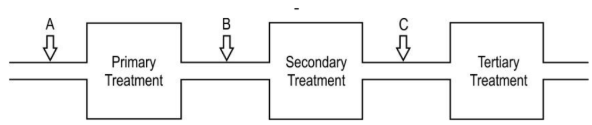
Each time the sample was taken, its BOD was measured, resulting in the
following recorded values: 30 mg/L, 300 mg/L, 250 mg/L
(a) Define BOD and determine which of these BOD values correspond to stages
A, B, and C in the treatment process.
(b) Based on (a), justify your answer for each value.
Ans:
- (a) BOD or Biological Oxygen Demand is a measure of the amount of dissolved oxygen consumed by microorganisms while breaking down organic matter in water, indicating its pollution level.
- A: 300 mg/L
- B: 250 mg/L
- C: 30 mg/L
- (b)
- A – Influent will have the highest organic pollutants and hence the highest BOD. (300 mg/L)
- B – Primary treatment will reduce the organic matter and hence the BOD to some extent with sedimentation and screening. (250 mg/L)
- C – Secondary treatment involves biological processes like activated sludge or trickling filters, which reduce BOD levels to the largest extent. (30 mg/L)
Additional Study Materials
- Sexual Reproduction in Flowering Plants- Competency-Based Questions
- Human Reproduction – Competency-Based Questions
- Reproductive Health – Competency-Based Questions
- Principles of Inheritance and Variation – Competency-Based Questions
- Molecular Basis of Inheritance – Competency-Based Questions
- Evolution – Competency-Based Questions
- Human Health and Disease – Competency-Based Questions
- Strategies for Enhancement in Food Production – Competency-Based Questions








Attractive portion of content. I just stumbled upon your website and in accession capital to claim that I acquire
actually enjoyed account your weblog posts. Any way I’ll be subscribing in your feeds and
even I achievement you get right of entry to constantly fast.
I don’t know whether it’s just me or if everyone else encountering issues with your site.
It appears as if some of the text within your posts are
running off the screen. Can someone else please comment and let me know if this is happening to them as well?
This might be a problem with my internet browser because I’ve had this happen before.
Many thanks
Good article. I absolutely appreciate this site.
Keep writing!
When I initially commented I clicked the “Notify me when new comments are added” checkbox and now each
time a comment is added I get three e-mails with the
same comment. Is there any way you can remove me from that
service? Many thanks!
It’s the best time to make some plans for the future and it is
time to be happy. I’ve learn this put up and if I may just I desire to counsel you few attention-grabbing issues or
advice. Maybe you can write subsequent articles referring to this article.
I wish to read more things approximately it!
Howdy superb website! Does running a blog similar to this require a lot
of work? I have very little knowledge of computer
programming but I had been hoping to start my own blog in the near future.
Anyhow, if you have any suggestions or techniques for new blog owners
please share. I understand this is off topic nevertheless I simply
wanted to ask. Cheers!
I’m not that much of a internet reader to be honest but your blogs really
nice, keep it up! I’ll go ahead and bookmark your site to come back in the future.
Cheers
I was able to find good advice from your articles.
Having read this I believed it was very informative. I appreciate you spending some time and energy to put this information together.
I once again find myself spending way too much time both reading and leaving comments.
But so what, it was still worthwhile!
Heya i’m for the first time here. I came across this
board and I find It really useful & it helped me out a lot.
I hope to give something back and help others like you aided
me.
It’s a pity you don’t have a donate button! I’d definitely donate to this brilliant blog!
I guess for now i’ll settle for bookmarking and adding your
RSS feed to my Google account. I look forward to brand new
updates and will share this website with my Facebook group.
Chat soon!
Hello! I’ve been reading your web site for a long time now and finally got the courage
to go ahead and give you a shout out from Kingwood Texas!
Just wanted to mention keep up the excellent work!
It’s amazing in favor of me to have a site, which is beneficial in support of my experience.
thanks admin
This is a very good tip particularly to those fresh to the blogosphere.
Simple but very accurate information… Appreciate your sharing this one.
A must read article!
Very good info. Lucky me I discovered your blog by chance (stumbleupon).
I’ve book marked it for later!
Hey very interesting blog!
Nice post. I learn something totally new and challenging on blogs I stumbleupon on a daily basis.
It will always be interesting to read through articles from other
writers and use a little something from other sites.